Oil insider trading referral: $580M sold fifteen minutes before the Iran post
Forexia Academy10 min read
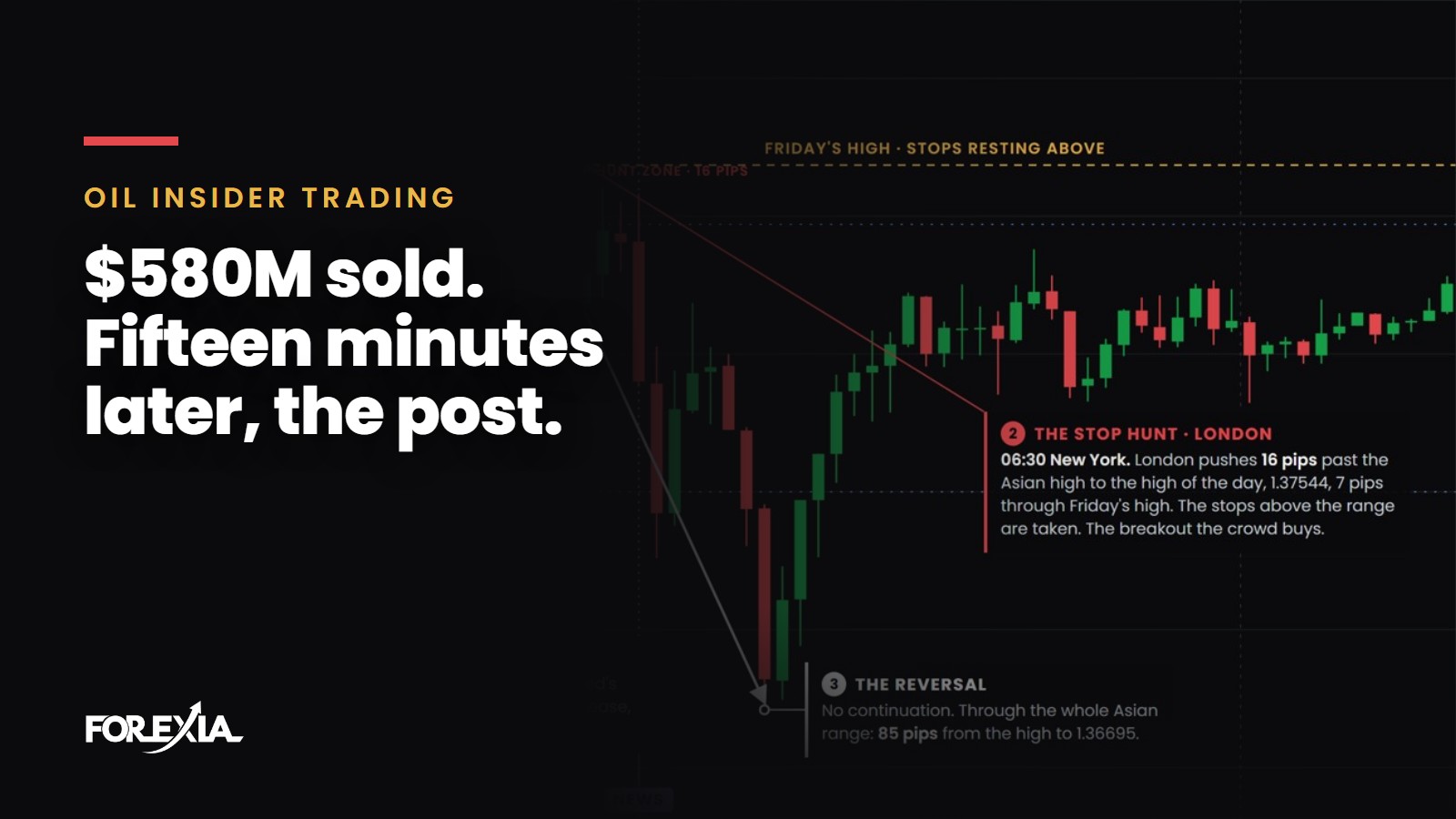
An oil insider trading referral over some $580 million of Brent and WTI futures, traded in one minute on 23 March, was retracted by an adviser to the CFTC's chairman, Bloomberg reported on 13 October. About fifteen minutes after that minute, President Trump posted that he was postponing strikes on Iran's energy infrastructure, and Brent fell by as much as 14%. If you were long oil on the threat that morning, you were standing exactly where the headlines had taught you to stand.
In brief
- What happened: About 6,200 Brent and WTI contracts, worth some $580 million, changed hands between 6:49 and 6:50 a.m. ET on 23 March. Roughly fifteen minutes later came the post, and Brent fell by as much as 14%. CFTC analysts referred the trades for insider trading, and the referral was retracted. Nothing has been proven.
- The trap: A threat to strike Iran's power plants put the crowd long oil. The post turned the threat round, and the crowd long on the headline was the liquidity.
- The tell: Nobody outside sees the post first. What you can see is a crowd on one side of a headline with its stops in the same place, and, on the day's USDCAD chart, a London breakout that did not continue.
- The rule: News is timing, not direction. Ask who was conditioned to stand where before it lands, then wait for the stop hunt and the close back inside.
What happened: the oil futures trades before Trump's Iran post
On 23 March, by the Financial Times' count, about 6,200 Brent and West Texas Intermediate contracts, worth some $580 million, changed hands between 6:49 and 6:50 a.m. ET. IBTimes UK calls it a roughly $580 million wager against oil prices, placed about a quarter of an hour before Trump posted on Truth Social. Bloomberg Television puts billions of dollars in contracts changing hands in the 15 minutes before the announcement.
The post postponed all military strikes on Iranian power plants and energy infrastructure for five days, pointing to progress in talks with Tehran. Brent fell by as much as 14%, US crude dropped by double digits, and American and European equities climbed about 4% from session lows to highs. Later that day Iran's parliament speaker, Mohammad-Bagher Ghalibaf, denied that any negotiations had taken place.
The referral, and its retraction
CFTC analysts flagged the trading and sent an insider-trading referral to the agency's enforcement arm. Then, Bloomberg reported, an adviser to CFTC Chairman Michael Selig stepped in to retract the referral and took over the examination, leaving career staff unsure how, or whether, the matter would move forward. Bloomberg's segment adds that the analysts had identified traders before a senior official asked them to retract.
The inquiry first surfaced on 15 April, when the CFTC was reported to have asked CME Group and Intercontinental Exchange for the data identifying the traders. Later that month the Justice Department was reported to be examining the trades too. Neither agency has commented, IBTimes says.
Not once: 7 April and 6 May
Senators Elizabeth Warren and Sheldon Whitehouse wrote to Selig on 9 April about the 23 March trading and about a bet of roughly $950 million against oil placed hours before the 7 April ceasefire. A second letter, led by Senator Raphael Warnock and sent on 27 May, pointed to more than $700 million in Brent and WTI contracts traded on 6 May, about an hour before a report that Washington and Tehran were nearing a deal.
"An appalling example of insiders rigging the market."
Senator Elizabeth Warren, 15 April, quoted by IBTimes UK
That is an allegation, and it is Warren's. The senators acknowledged that the evidence did not rule out that the 23 March position was placed legitimately, while saying its timing and size raised serious concerns. White House spokesman Kush Desai called the implication of profiteering from inside the administration "baseless and irresponsible".
How the oil trap was built: retail, market maker, observer
Retail's seat: long on the threat
The headline that morning was a threat: strikes on Iran's power plants and energy infrastructure. Every trader who reads headlines knows the chain that follows: supply at risk, oil up. So you bought the threat, or held it, with your stop under the last low, where the course put it and where everyone who read the same story put theirs.
Then you picked up your phone and the position was already closed. You read the post after your stop had been filled. We've been there too: right about the story, wrong about the minute.
A reaction a whole crowd is taught is not an edge. It is a crowd on one side, with its exits in the same place.
The market maker's seat: a crowd to sell to
Now take the other chair, whoever sits in it. A wager of roughly $580 million against oil cannot be placed into an empty room: 6,200 contracts in one minute need someone on the other side. A market leaning long on a threat is full of buyers, and every long stop resting under the lows is a sell order waiting for its reason.
The post gave the reason, and Brent fell by as much as 14%. From this chair the post was the trigger and the crowd long on the headline was the liquidity. That is our reading of the structure, not a finding about who traded: no source names the traders, and the referral that flagged them was retracted.
The observer's seat: a time, not a direction
The observer never gets the post first. Nobody outside the room does, and no chart shows what a president will write. What the observer can see is where the crowd was conditioned to stand before it landed, and where its stops sat.
The trap has three parts every time: consolidation, induction, reversal. The headline does the induction's work, pulling the crowd onto one side, and the news supplies the minute. Three dates in the sources, 23 March, 7 April and 6 May, and each time the size came before the headline.
USDCAD on 23 March 2026: the London stop hunt on the day of the post
We do not chart oil, but we chart the markets that traded through that morning. On USDCAD the London breakout above the Asian range printed its high nineteen minutes before the oil sale, and the reversal ran on through the hours after the post.
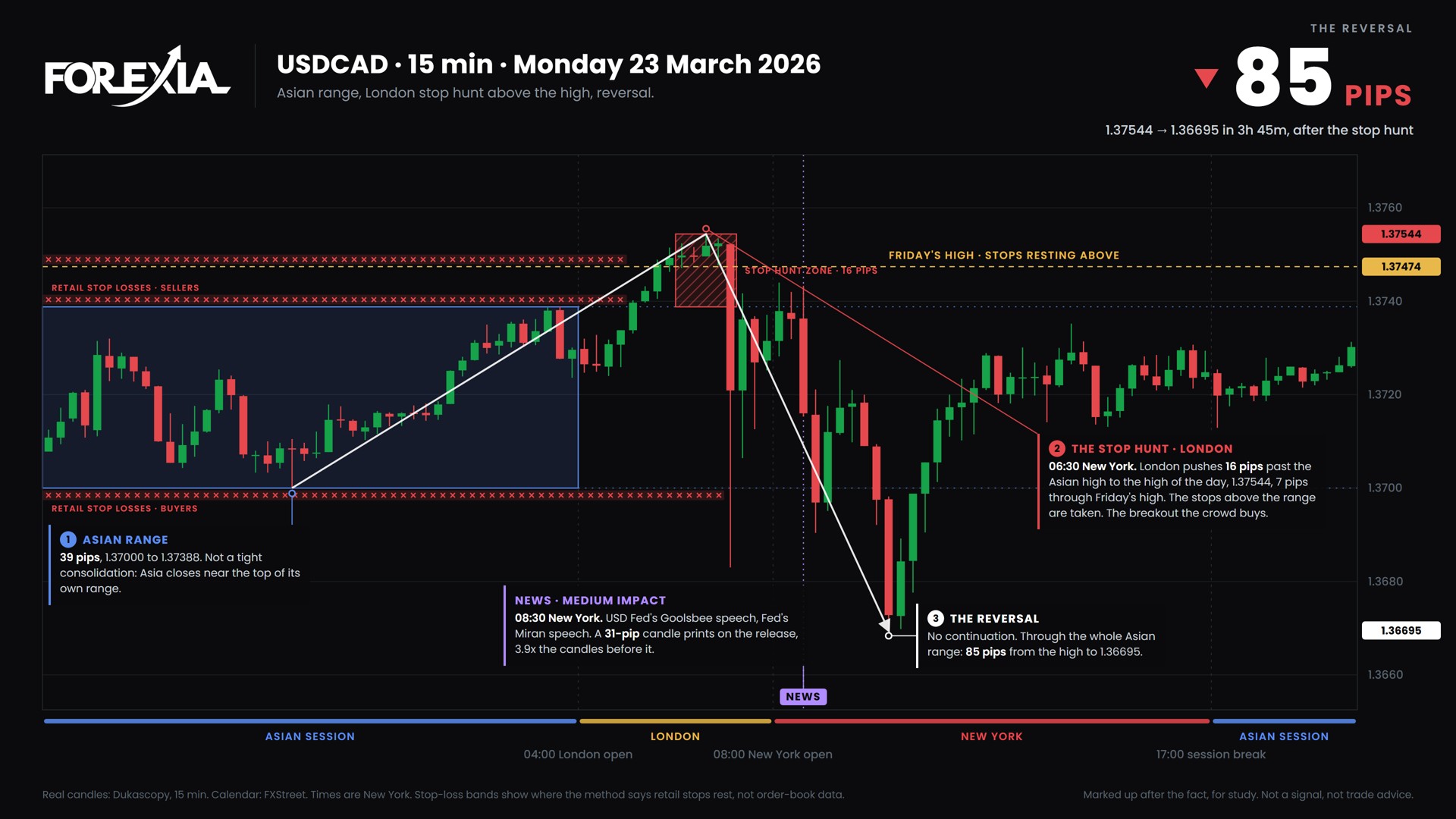
USDCAD, 15 min, Monday 23 March 2026. Asian range 1.37000 to 1.37388, 39 pips. Stop hunt zone 16 pips, to 1.37544 at 06:30 New York, 7 pips through Friday's high (1.37474). The reversal: 85 pips, 1.37544 to 1.36695 in 3h 45m.
- The Asian range. 39 pips between 1.37000 and 1.37388, from the 17:00 session break to the London open. Not a tight one: it drifted and closed near its own top. Sellers' stops rest above its high and above Friday's high, 1.37474; buyers' stops rest below its low.
- The stop hunt. At 06:30 New York, London pushed 16 pips past the Asian high to 1.37544, the high of the day, and 7 pips through Friday's high. The stops above the range are taken; the breakout the crowd buys is the top. No release on the calendar lined up with it: the only one the chart marks is the Fed speeches by Goolsbee and Miran at 08:30, a 31-pip candle, 3.9x the candles before it.
- The reversal. No continuation. The first 15-minute close back under the Asian high came at 07:15 New York, at 1.37209. Price reached 1.36695 by 10:15, 85 pips in 3 hours 45 minutes, through the whole Asian range and the buyers' stops beneath it.
Lay the sources' clock over it, in the same New York time: the high of the day at 06:30, the 6,200 contracts between 6:49 and 6:50, the post roughly a quarter of an hour later, the first close back inside at 07:15. The chart does not mark the post and cannot say who traded. Read it honestly too: 2 of the method's 8 confirmations, and about 1 to 1.5 from the close back inside, under the method's 1 to 3.
Gold in the week of 23 March 2026: where the day sat in the weekly cycle
Of the markets we chart, gold is the one the tool marked as a full weekly cycle that week. Monday, the day of the post, set both edges of the range the rest of the week came back for.
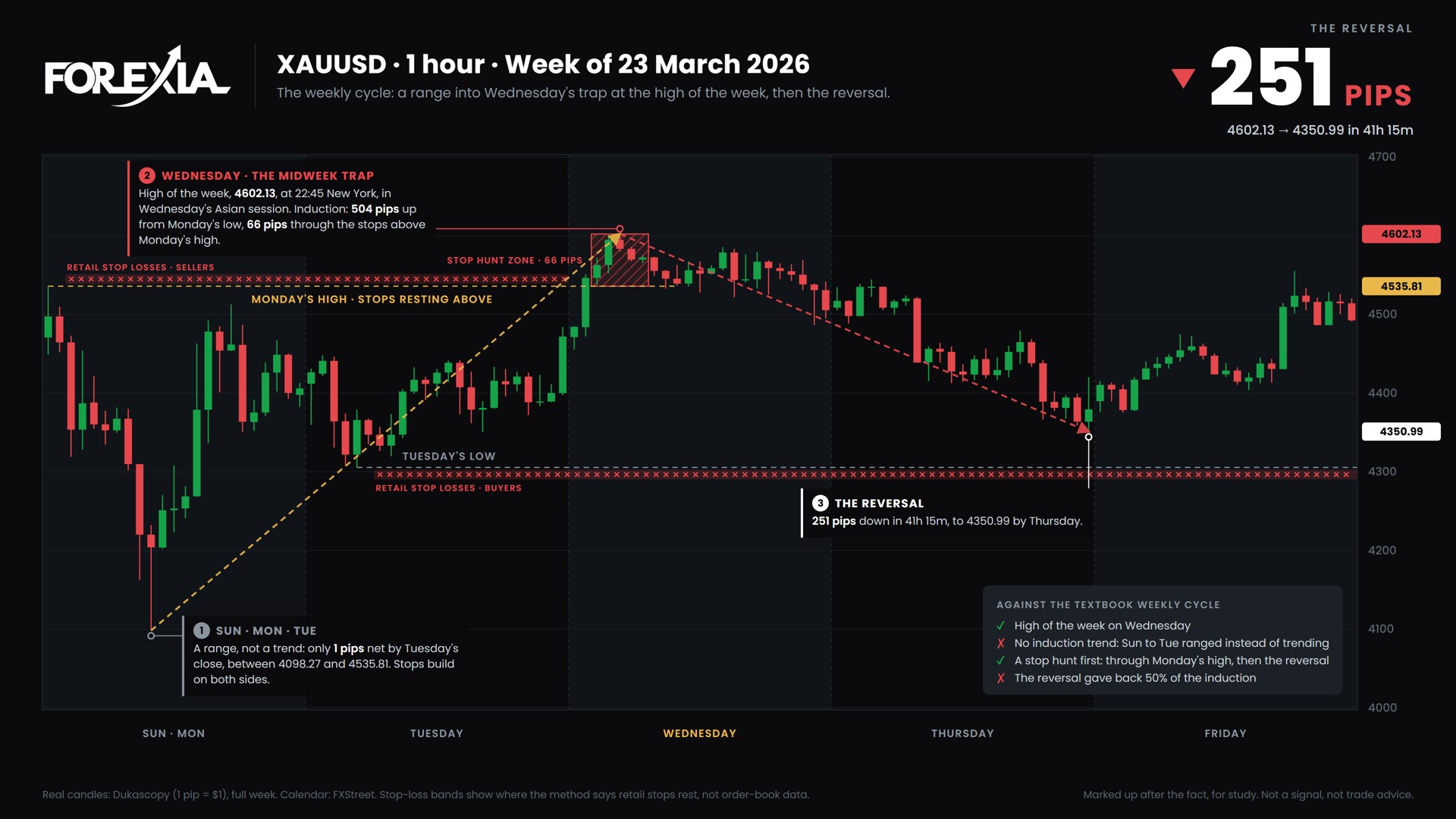
XAUUSD, 1 hour, week of 23 March 2026 (1 pip = $1). Sunday to Tuesday range 4098.27 to 4535.81. Stop hunt zone 66 pips above Monday's high, 4535.81. The reversal: 251 pips, 4602.13 to 4350.99 in 41h 15m.
- Sunday, Monday, Tuesday: a range, not an induction trend. Only 1 pip net by Tuesday's close, between Monday's low of 4098.27 and Monday's high of 4535.81. Stops build on both sides.
- Wednesday: the midweek trap. The high of the week, 4602.13, at 22:45 New York, in Wednesday's Asian session: 504 pips up from Monday's low and 66 pips through the sellers' stops above Monday's high. No release lined up with it.
- The reversal. 251 pips down in 41 hours 15 minutes, to 4350.99 by Thursday. The buyers' stops under Tuesday's low, 4305.56, were not reached.
Two of the four textbook checks held: the high of the week on Wednesday, and a stop hunt before the reversal. The misses: no induction trend from Sunday to Tuesday, and a reversal just short of half the induction.
The rule to keep: how to read a headline on the chart
News is timing. Ask who was conditioned to stand where before it lands, never which way it will push.
- Treat a headline as a time. It tells you when the crowd acts, not where price ends the day.
- Ask where the story put the crowd. A threat, a deal, a number: which side does it put everyone on, and where are their stops?
- Mark the range price built before it. Its high, its low, and the stops behind each edge.
- Wait for the stop hunt and the close back inside. No close back inside, no trade.
None of this tells you what a president will post, and nothing here says where oil goes next. Signing up at https://forexiapro.com is free, and opens the free courses and the first COT report of each month.
Frequently asked questions
Was there insider trading in oil before Trump's Iran post?
Nothing has been proven. CFTC analysts sent an insider-trading referral over the 23 March trades, and an adviser to Chairman Michael Selig retracted it and took over the examination, Bloomberg reported. The White House calls the implication of profiteering "baseless and irresponsible", and the senators who wrote to Selig acknowledged the evidence did not rule out a legitimate position.
Why did oil fall on 23 March 2026?
Trump posted on Truth Social that he was postponing strikes on Iranian power plants and energy infrastructure for five days, pointing to progress in talks with Tehran. Brent fell by as much as 14% and US crude by double digits. Iran's parliament speaker denied later that day that any negotiations had taken place.
Who retracted the CFTC insider trading referral on oil?
An adviser to CFTC Chairman Michael Selig, according to Bloomberg's report as IBTimes UK relays it, and the adviser then took over the examination of the trades. Career staff were left unsure whether the matter would move forward, and Selig faces questions over why his office stepped in.
Sources
- IBTimes UK, 13 October 2026: Bloomberg's report of the retracted referral, the Financial Times' count of the 23 March trades, the market's move, Ghalibaf's denial, the inquiry, the senators' letters and what Warren and Desai said.
- Bloomberg Television on YouTube, 13 October 2026: billions of dollars in contracts in the 15 minutes before the post, and the analysts' identification of traders before the retraction.
- MS NOW on YouTube, 14 October 2026: the same Bloomberg report, discussed by Katy Tur with Jonathan Lemire, Michael Steele and Lisa Rubin.
Learn to read the chart this way. The next time a headline hands you the obvious side, ask who needs you standing there. Signing up is free. Browse the courses.
Written after the fact, for study: not a signal and not trade advice. Candles: Dukascopy. Economic calendar: FXStreet. All times are New York. Stop-loss positions are the method's reading of the structure, not order-book data.