How to Read a Forex Signal: Entry, Stop and Four Targets, and What a Stop After TP1 Means
Dylan Forexia8 min read
How to read a forex signal? Read four things in order: the side, the entry, the stop and the targets. The entry says where the trade starts, the stop says the price at which the idea is wrong and what that costs, and the targets say where it takes profit. This page reads one real signal from our free channel line by line, then says plainly what it means when a signal reaches TP1 and is later stopped.
In brief
- The four parts: side and pair, entry, stop, and four targets, TP1 to TP4.
- The first number to work out: the stop distance, then each target as a multiple of it.
- A stop after TP1: TP1 was reached, the trade then came back and reached the stop. Both facts are on the record.
- Where the losses are: in the same public record as the winners, with counts and no rate.
This page describes what the numbers are. It does not tell you to trade any signal, ours or anyone else's.
How to read a forex signal: what are its four parts?
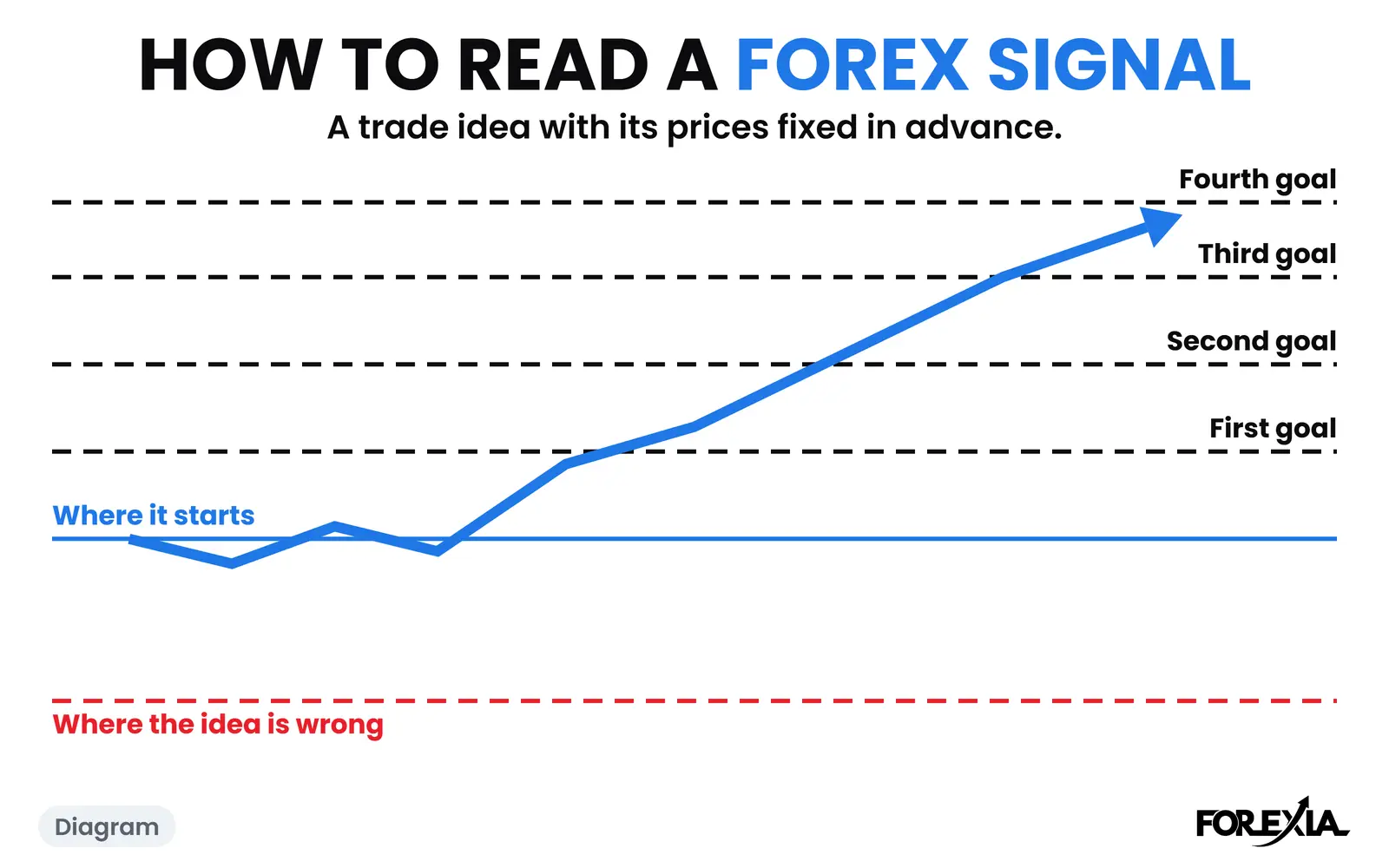
A signal is a trade idea with its prices fixed in advance.
- Side and pair. Buy means the signal expects price to rise from the entry, and sell that it will fall.
- Entry. The price the signal was flagged at.
- Stop. The price at which the trade is closed at a loss. The distance from entry to stop, in pips, is the risk. It also sets your size: the position size calculator turns it into lots.
- Targets. Ours carry four. A target is a price where part of the idea is done, and TP1 is the nearest.
Two numbers are worth working out yourself before any outcome: the stop distance, and the distance to each target as a multiple of it.
One real signal, line by line: GBP/USD buy, 22 October 2026
This is the case file for the GBP/USD buy of 22 October 2026, from the free channel, as the public ledger holds it. Times are New York unless marked UTC. The bot labels it a Signature Trade.
- Sent: Thursday 22 October 2026, 11:00 New York (15:00 UTC).
- Side: buy.
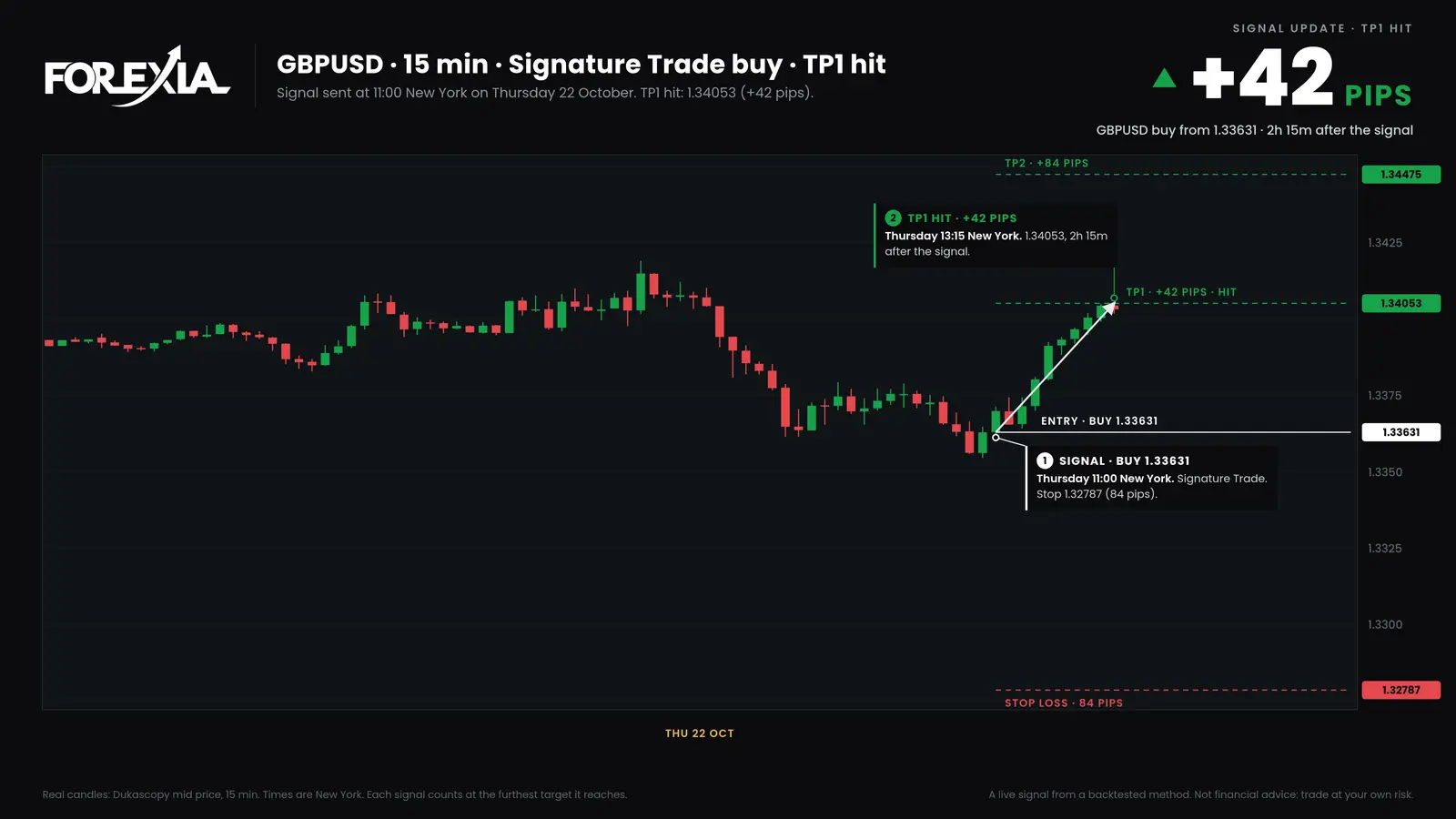
- Entry: 1.33631.
- Stop: 1.32787, 84 pips below.
- TP1: 1.34053, 42 pips above.
- TP2: 1.34475, 84 pips.
- TP3: 1.35319, 169 pips.
- TP4: 1.36163, 253 pips.
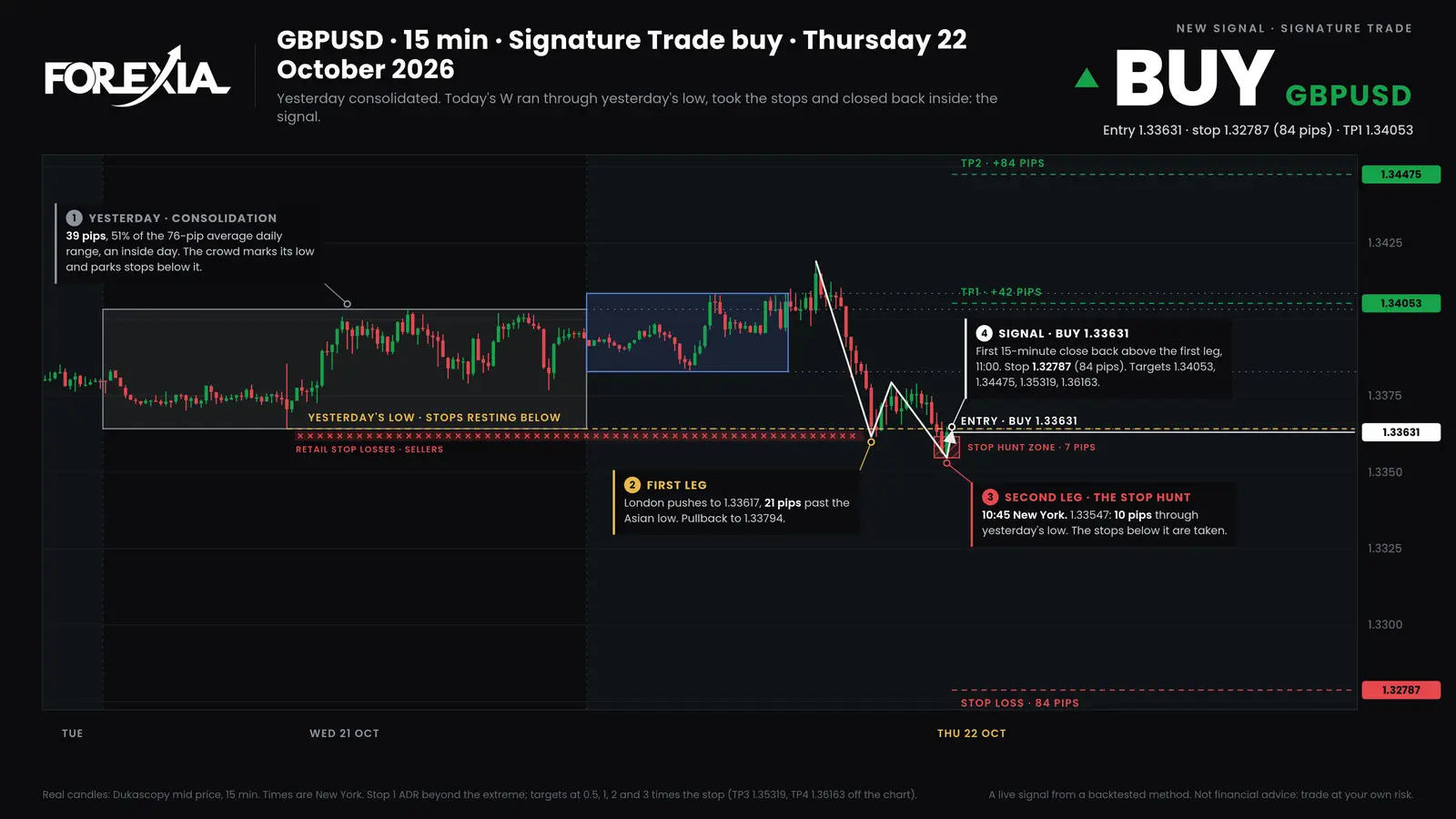
GBPUSD, 15 minutes, 22 October 2026. Entry 1.33631, stop 1.32787 (84 pips), TP1 1.34053, TP2 1.34475. Image: the Forexia signal bot.
- The setup the bot saw. The chart marks the first leg to 1.33617, a pullback to 1.33794, then a second leg 7 pips past it, through yesterday's low of 1.33642. The bot reads yesterday as an inside day, 39 pips against a 76-pip average daily range.
- The entry. It is the first 15-minute close back above the first leg, at 11:00 New York.
- The stop. The chart's footnote says the stop sits one average daily range beyond the extreme, and the targets at 0.5, 1, 2 and 3 times the stop.
Reading the numbers. The stop is 84 pips from the entry. TP1 is half that distance, 42 pips. TP2 equals the stop distance, 84 pips, TP3 is about twice it, 169, and TP4 about three times, 253. So TP1 alone is worth half of what the stop costs. That is the first thing a signal's numbers tell you, before any outcome.
What happened to this signal?
TP1 was hit on Thursday 22 October 2026 at 17:15 UTC, 2 hours 15 minutes after the signal, at 1.34053 (+42 pips at that target).
Price then came back. The trade was closed on 28 October 2026 at 06:50 UTC, which is 02:50 New York on the Wednesday, after price had come back down to the stop. The record's outcome for this signal is "stopped", with 1 target hit.
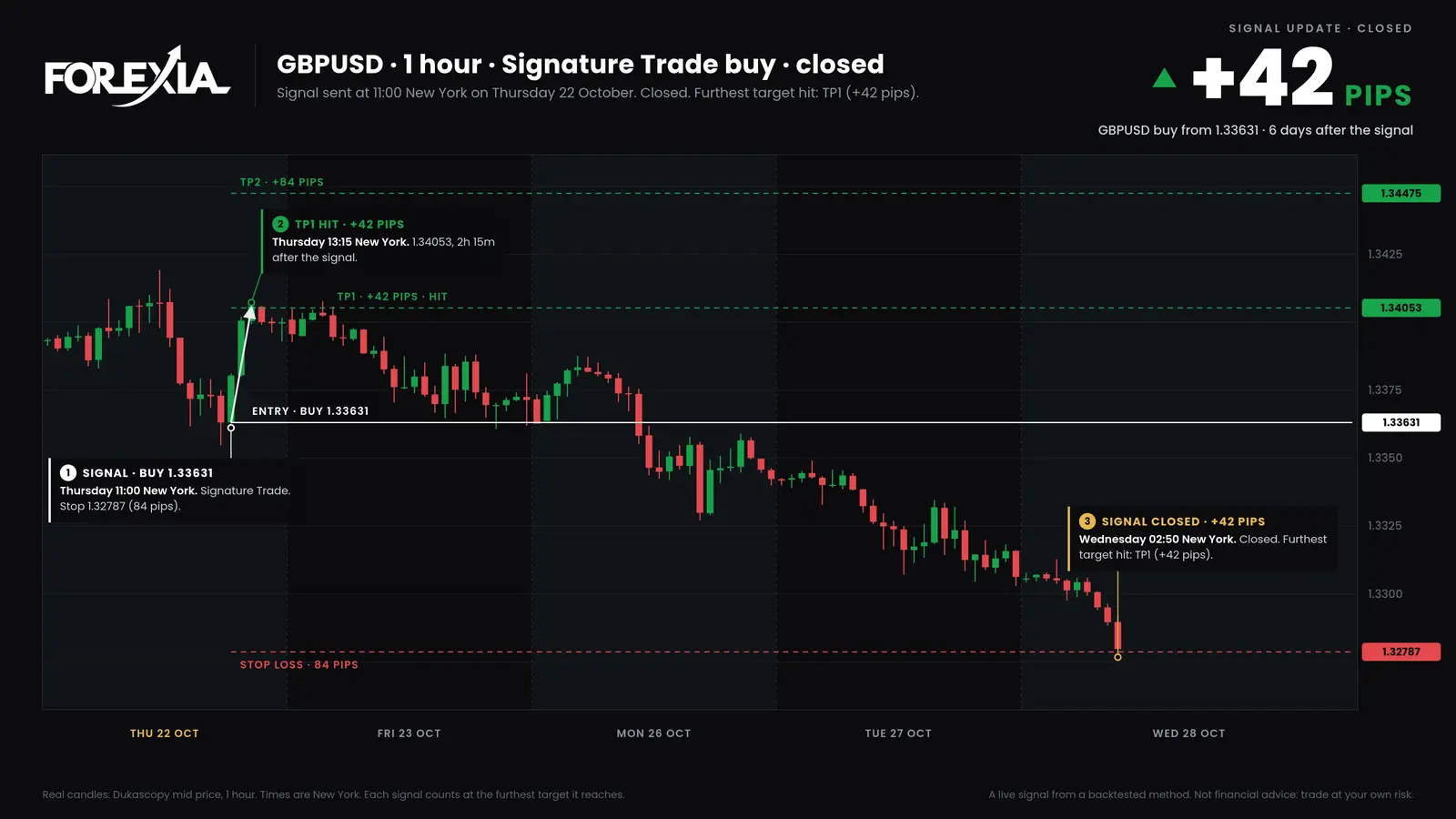
GBPUSD, 1 hour, 22 to 28 October 2026. Entry 1.33631, TP1 1.34053 hit, stop 1.32787 reached 28 October. Image: the Forexia signal bot.
What does a stop after TP1 mean?
Said plainly, a signal that reaches TP1 and is later stopped is not a signal that reached TP4, and it is not one stopped at once.
- The order was TP1, then the stop. Price went to the first target, then came back through the entry and on to the stop. Both are on the record.
- The bot's closing message names the furthest target. For this signal that is TP1, and the card reads "+42 pips". That is the distance to TP1, counted because TP1 was the furthest target the signal reached. It is not what a trader who held the whole position made.
- Holding the whole position to the stop ended at the stop. From the entry, that is the 84 pips of the stop distance, before costs. A position that was partly closed at TP1 ended somewhere between that and a gain, depending on how much was closed. The signal does not say how much to close, so that part is the trader's decision.
- The stop was not moved. The closing chart draws the stop at 1.32787, the same price as at the start.
That is why the ledger counts these separately from a signal that reached all four targets and from one stopped before TP1. It reports what the signal did, not whether it was good.
Where are the losses?
The free channel's signals are copied into a public ledger when they are sent, with a hash of their fixed fields, and each outcome follows. Stopped signals are listed with the others, and none is removed. The ledger at /case-files/ and the Signature Trade trade log show every free-channel signal. We quote counts only.
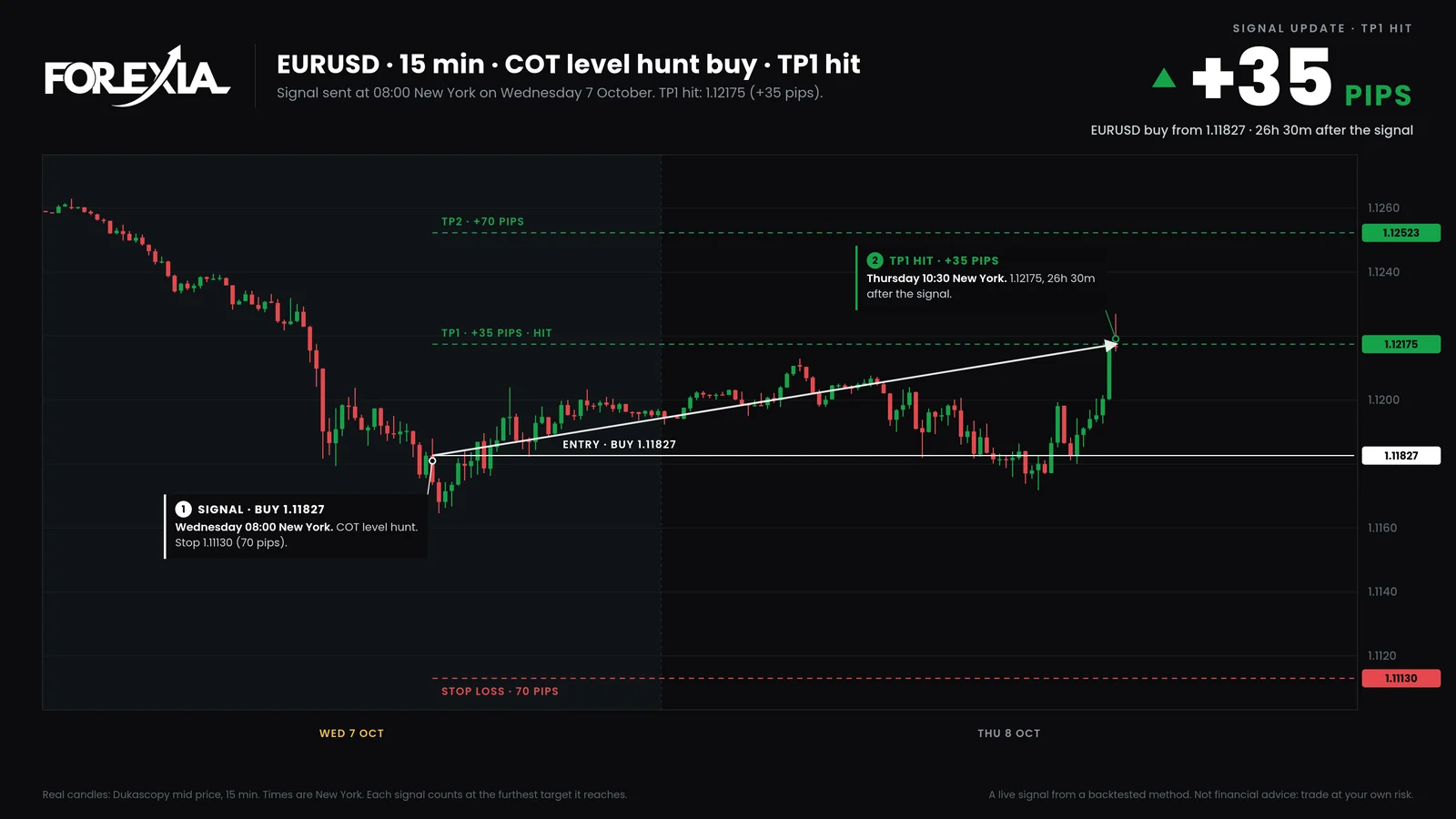
As read on 10 November 2026, the ledger held 8 signals. One reached all four targets. One reached TP3 and closed at its time limit. Two were stopped after TP1, this one and a EUR/USD buy of 7 October. Four were stopped before TP1. A rate from 8 signals would not be evidence, so there is none here.
Two limits on the record:
- It begins on the day the ledger was switched on. Earlier free-channel rows were found afterwards on real prices. Nobody received them, and they are never presented as sent.
- A hash taken after the outcome proves what the figures were then. This signal's row was recorded on 7 November 2026, after the trade had closed, so its hash shows the figures as recorded that day, not that they were fixed before the outcome. Each case file says when its hash was taken.
Signals for paying members are never in it.
What does the bot do, and what does it not do?
The live bot automates the induction and the reversal. It does not read the wedge itself: its test for the first move is that yesterday consolidated, an inside day or a small range, which is the first leg of the chart above. So these trades are the Signature Trade in its mechanical form, not the full course setup with a drawn wedge. The Signature Trade explains the three moves.
What should you check before relying on any signal?
Four questions cost nothing to ask, and a signal provider that cannot answer them is telling you something.
- Can your account carry the stop distance? Work out the size from the stop first.
- Are the targets on the right side? On a buy all four sit above the entry, on a sell below. A target on the wrong side is an error.
- Is there a public record that includes the losses? Ask for counts by outcome, not a rate.
- Does it say what happens after a target? Does the stop move, or does the trade run to the original stop? This one ran to the original stop.
Frequently asked questions
Three questions people type most, answered short.
What do entry, stop and take profit mean in a forex signal?
The entry is the price the trade starts at, the stop is the price where it is closed at a loss, and a take profit is a price where it is closed at a gain. Our signals carry four targets, TP1 to TP4.
What does it mean when a signal is stopped after TP1?
TP1 was reached first, then price came back and reached the stop. The record names TP1 as the furthest target hit and shows the trade was then closed at the stop. What it was worth depends on how much of the position was closed at TP1.
Does the bot trade the whole Signature Trade?
No. It automates the induction and the reversal and not the wedge, so its trades are the mechanical form of the setup.
Sources
Three sources, and what each one gave this page.
- Case file: GBP/USD buy, 22 October 2026: the signal's prices, the TP1 update and the close, as the ledger recorded them.
- The free-channel ledger: the count of signals by outcome, read on 10 November 2026.
- Dukascopy historical candles: the candles on the bot's charts.
Learn to read the chart this way. The courses teach the three moves of the Signature Trade first and the signal last. Browse the courses.
This post is for study. It is not a signal and not trade advice. Charts: the Forexia signal bot, Dukascopy mid-price candles, New York time.
The free channel's full record, losses included, is on the forex signals page.
Frequently asked questions
What do entry, stop and take profit mean in a forex signal?
The entry is the price the trade starts at. The stop is the price where it is closed at a loss, so the distance from entry to stop is the risk. A take profit, or target, is a price where part of the idea is done. Our signals carry four, called TP1 to TP4.
What does it mean when a signal is stopped after TP1?
Price reached TP1 first, then came back and reached the stop. The record names TP1 as the furthest target hit and shows that the trade was then closed at the stop. What that was worth depends on how much of the position was closed at TP1, which the signal does not say.
What is TP1 in forex?
TP1 is the first take-profit target, the one nearest the entry. On the signal in this post it was 42 pips from the entry, half the 84-pip stop distance.
Does the bot trade the whole Signature Trade?
No. The live bot automates the induction and the reversal. It does not read the wedge itself, so its trades are the Signature Trade in its mechanical form, not the full course setup.