Forex Lot Size Calculator: Size a Trade by Risk and Stop
Dylan Forexia7 min read
The 1% is an example, not a recommendation.
Lots
0.50
Units
50,000
Money at risk
$100.00
What it assumes: the account is in US dollars. A standard lot is 100,000 units, and 100 ounces of gold, where $1 of movement counts as one pip, as our charts count it. Lots round down to 0.01, so the risk is never more than you asked for. It leaves out spread, commission and slippage: a stop can fill past its price, and your broker's contract sizes may differ. A sum, not advice.
This forex lot size calculator turns your balance, the share of it you accept losing and the distance to your stop into a position size. Choose the pair, and it answers in lots, units and the money at risk. The sum is the money at risk divided by the stop in pips times what a pip is worth on one lot, rounded down to 0.01.
The 1% in the box is there so the sum has something to show. It is not a recommendation, and this page gives no risk percent. A position size is arithmetic and not advice. The calculator runs in your browser and keeps nothing you type.
How do you use the forex lot size calculator?
Enter four figures and read three. A fifth appears only when a pip on your pair is not in dollars.
- Account balance, in US dollars.
- Risk, as a percent of that balance. Anything above 0 and up to 100 is accepted.
- Stop, the distance in pips from your entry to your stop. On gold, that is dollars of movement.
- Pair: one of the seven majors, gold, or "Another pair (a cross)", which then asks for its second currency.
- Price, if a box for one appears. Its label names the price it wants, and it empties when you change pair, so a price cannot carry over. A price that cannot be that pair's gets a warning.
The answer is Lots, Units (Ounces on gold) and Money at risk, which is what the stop costs at that size. That can be a little under what you asked for, because lots round down.
What is the lot size formula?
The formula has two lines:
Money at risk = balance × risk percent ÷ 100
Lots = money at risk ÷ (stop in pips × pip value per lot)
Take the figures already in the calculator: $10,000, 1%, a 20-pip stop, EUR/USD. The money at risk is $100. A pip on EUR/USD is worth $10 a lot, so 20 pips cost $200 a lot. $100 ÷ $200 is 0.50 lots, which is 50,000 units. Change the stop to 25 pips and the same $100 buys 0.40 lots.
A standard lot of 1.00 is 100,000 units of the first currency. A mini lot is 0.10, or 10,000 units, and a micro lot is 0.01, or 1,000 units. The calculator stops at 0.01, so a nano lot is below what it will answer.
What is a pip worth on each kind of pair?
It depends on the pair's second currency, because a pip is always counted in that currency. The prices below are round numbers chosen for the sum, not quotes. Each line starts from $100 of a $10,000 account.
| Pair | Price you enter | A pip on one lot | Stop | Lots |
|---|---|---|---|---|
| EUR/USD, GBP/USD, AUD/USD, NZD/USD | none | $10.00 | 20 | 0.50 |
| USD/JPY | USD/JPY 150 | $6.67 | 30 | 0.50 |
| USD/CHF | USD/CHF 0.80 | $12.50 | 20 | 0.40 |
| USD/CAD | USD/CAD 1.25 | $8.00 | 20 | 0.62 |
| EUR/GBP, a cross | GBP/USD 1.25 | $12.50 | 20 | 0.40 |
| EUR/JPY, a cross | USD/JPY 150 | $6.67 | 30 | 0.50 |
| AUD/CAD, a cross | USD/CAD 1.25 | $8.00 | 20 | 0.62 |
| Gold | none | $100.00 | 50 | 0.02 |
A yen pair. A pip is the second decimal there, 0.01, and the fourth everywhere else. So a pip on a USD/JPY lot is 0.01 × 100,000 = 1,000 yen, and at 150 that is $6.67. The value moves with the price: at 149.70 it is $6.68. The calculator uses the price you type and fetches none, so the figure is close, not exact, by the time a stop is reached.
A dollars-first pair. The habit of "$10 a pip" is the error here. On USD/CHF at 0.80, a trader who assumes $10 sizes 0.50 lots on a 20-pip stop. The real pip is $12.50, so the stop costs $125, not $100. On USD/JPY at 150 and a 30-pip stop, the same habit sizes too small, at 0.33 lots in place of 0.50.
A pair with no dollar in it. A cross needs its second currency's price against the dollar, never its own. EUR/JPY asks for USD/JPY. Type EUR/JPY's own price by mistake, say 170 with USD/JPY at 150, and on a 30-pip stop the calculator answers 0.56 lots and $98.82 at risk. The real cost is 0.56 × 30 × $6.67, or $112.
Every second currency among the majors is on the list, so any cross of those works. A pair quoted in another currency, such as Mexican pesos, is not on it, and neither are silver, oil or indices.
How much is a pip on gold, and why do sources disagree?
On our charts $1 of movement is one pip, so a pip on gold is worth $100 on a 100-ounce lot. The calculator counts it the same way. A stop $50 from entry goes in as 50, and with $100 at risk the answer is 0.02 lots, or 2 ounces.
Other sources count gold differently, and there is no single standard. Some call $0.10 a pip, others $0.01, and some brokers' lots are 10 ounces or 1 ounce, not 100. So the number of pips means nothing until you know whose count it is. Dollars of movement are the same for everyone.
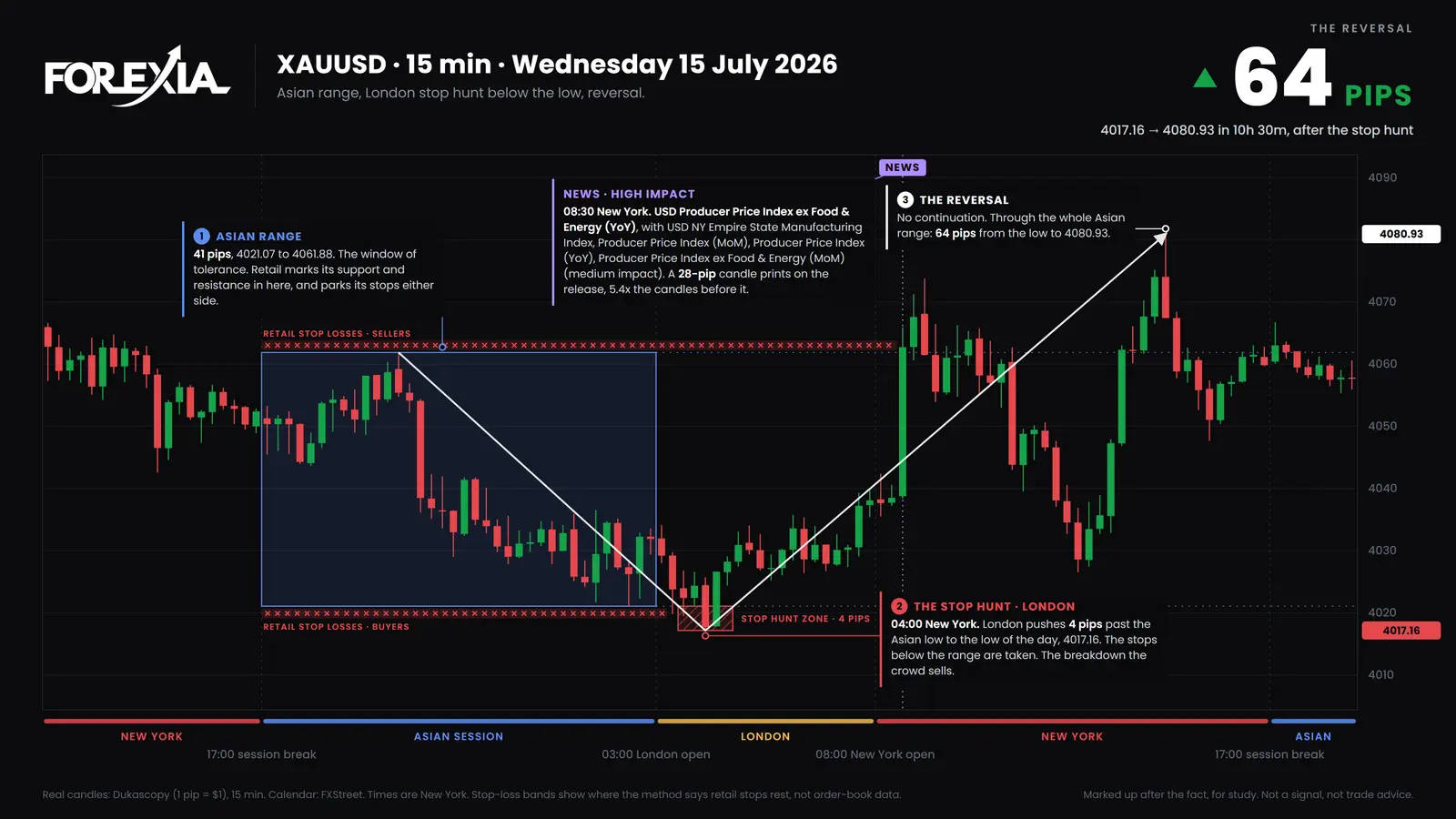
Gold on Wednesday 15 July 2026 ran from 4017.16 to 4080.93, which is $63.77. Our chart calls that 64 pips. A $0.10 count calls it 638, and a $0.01 count calls it 6,377. On 0.02 lots, a move that size is worth $127.54 under all three.
Moving a figure between counts is where the money goes. A 50-pip stop on our count is $50. Type 50 into a calculator that counts $0.10 a pip and it reads $5 of movement, and answers 0.20 lots. At the real $50 stop that size loses $1,000, not $100. The other way round, typing a broker's 500 pips into ours answers 0.00 lots and says the risk does not cover the smallest position. The gold pip value has more to it than this, and the safe habit is short: turn your stop into dollars of movement first.
What does the calculator assume?
It assumes the plain case, and each of these can differ from your own account.
- The account is in US dollars. A €10,000 balance with EUR/USD at 1.10 goes in as $11,000. On a 20-pip EUR/USD stop at 1%, that is 0.55 lots and $110 at risk.
- A lot is 100,000 units, or 100 ounces of gold. Your broker's specification sheet decides this, and on gold it varies.
- Lots round down to 0.01, so the risk is never more than you asked for. $1,000 at 1% on a 33-pip EUR/USD stop gives 0.03 lots and $9.90 at risk, against the $10 asked for.
- Very small figures may fit nothing. $100 at 1% on a 50-pip stop is $1.00, which does not cover even 0.01 lots, and the calculator says so.
- A figure it can read two ways, it asks about. A decimal comma is fine, so 0,5 is a half percent. A price of 1,250 could be 1250 or 1.25, so it gives no answer until you type one of them.
- The stop fills at its price. It often will not. Spread, commission and slippage are left out, and so is the cost of holding overnight. A 0.50-lot trade whose 20-pip stop fills at 25 pips costs $125, not $100. A stop can fill late when price spikes on a release.
- Your margin allows it. It does not check. $10,000 at 1% on a 5-pip EUR/USD stop answers 2.00 lots, which is 200,000 euros of position. Whether your broker lets you open that is a separate question.
What are the other common lot size mistakes?
Most of the rest are about what goes in the stop box.
- Typing points for pips. Many platforms quote a fifth decimal and count points, ten to the pip. A 200-point stop is 20 pips. Typed as 200, it answers 0.05 lots in place of 0.50.
- Keeping one lot size for every trade. The money is what stays the same, so the lots move with the stop: 0.50 on 20 pips, 0.40 on 25, 2.00 on 5.
- Using the size to rescue a stop. The calculator can make a tight stop affordable. It cannot make it survive. A stop just past an obvious high or low sits where we read the crowd's orders as resting, which is what the stop hunt is about, and this tool says nothing about where a stop belongs.
- Taking a correct size for a good trade. Size sets what a loss costs and nothing more. Our own test of the setup as a fixed rule did not make money.
This forex position size calculator sits with our other tools, each with its working shown. The COT index calculator is the same kind of plain sum, on where a crowd stands.
Frequently asked questions
How do I calculate lot size in forex?
Take the money you accept losing, then divide it by the stop in pips times what a pip is worth on one lot. With $100 at risk, a 20-pip stop and a pip worth $10 a lot, that is 100 divided by 200, or 0.50 lots. The calculator on this page does the same sum and rounds down to 0.01.
What risk percent should I enter?
This page does not give one. The 1% in the box is there so the sum has something to show, and it is not a recommendation. A position size is arithmetic: it tells you what a figure you chose comes to on this trade. Choosing the figure is your decision.
Why does the calculator ask for a price on some pairs?
Because a pip on those pairs is not in dollars. On USD/JPY it is in yen, so the USD/JPY price turns it into dollars. On a cross the pip is in the pair's second currency, so that currency's own price against the dollar is the one it needs. EUR/USD, GBP/USD, AUD/USD, NZD/USD and gold need no price.
How much is a pip on gold?
On our charts $1 of movement is one pip, so a pip is worth $100 on a 100-ounce lot. Other sources count differently: some call $0.10 a pip and others $0.01, and some brokers use a different contract size. Convert your stop to dollars of movement before you enter it here.
Does the calculator work for an account that is not in dollars?
Only if you convert first. Everything it works in is US dollars, so turn the balance into dollars at today's price and enter that. A €10,000 balance with EUR/USD at 1.10 goes in as $11,000. The money at risk it shows is then in dollars too.