
The Stop Hunt: What It Means, and How It Relates to a Liquidity Sweep
The Stop Hunt is price driven into clustered stops to fill the other side of an order, and it is commonly called a liquidity sweep. A stop under a low is a sell order waiting for a trigger. Bunch enough of them at one level and a large buyer has the sellers it needs. That is our read of why price so often takes a level and then turns.
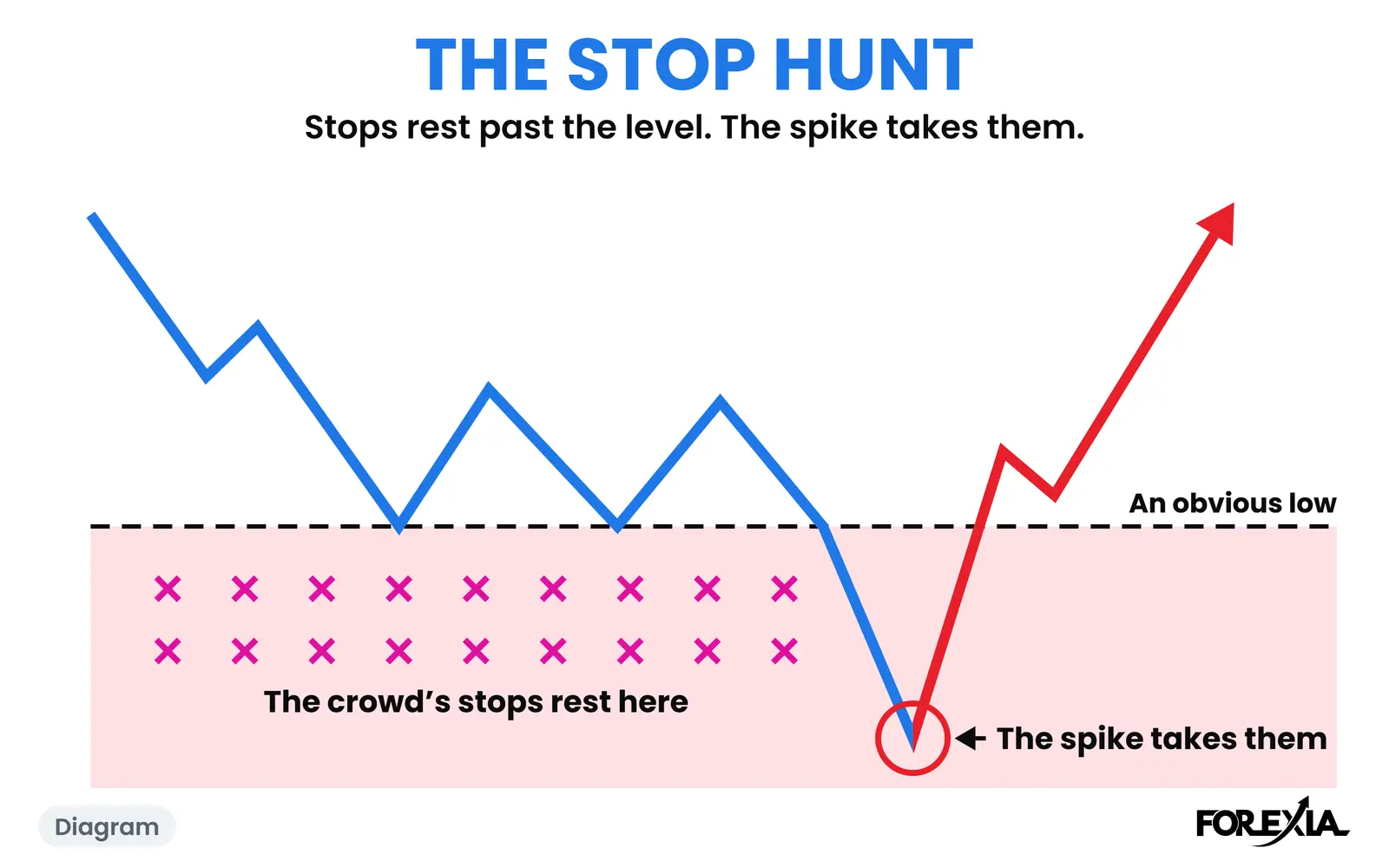
What does the Stop Hunt look like on a chart?
It looks like a break that does not last. On USD/JPY on Tuesday 14 July 2026, London broke the Asian low by 18 pips, to 162.052: the breakdown the crowd sells. Monday's low sat further down, at 161.645. We read the stops under London's low and under Monday's low as pools, the kind Liquidity Mapping marks before the session. Then US inflation came out at 08:30 New York.
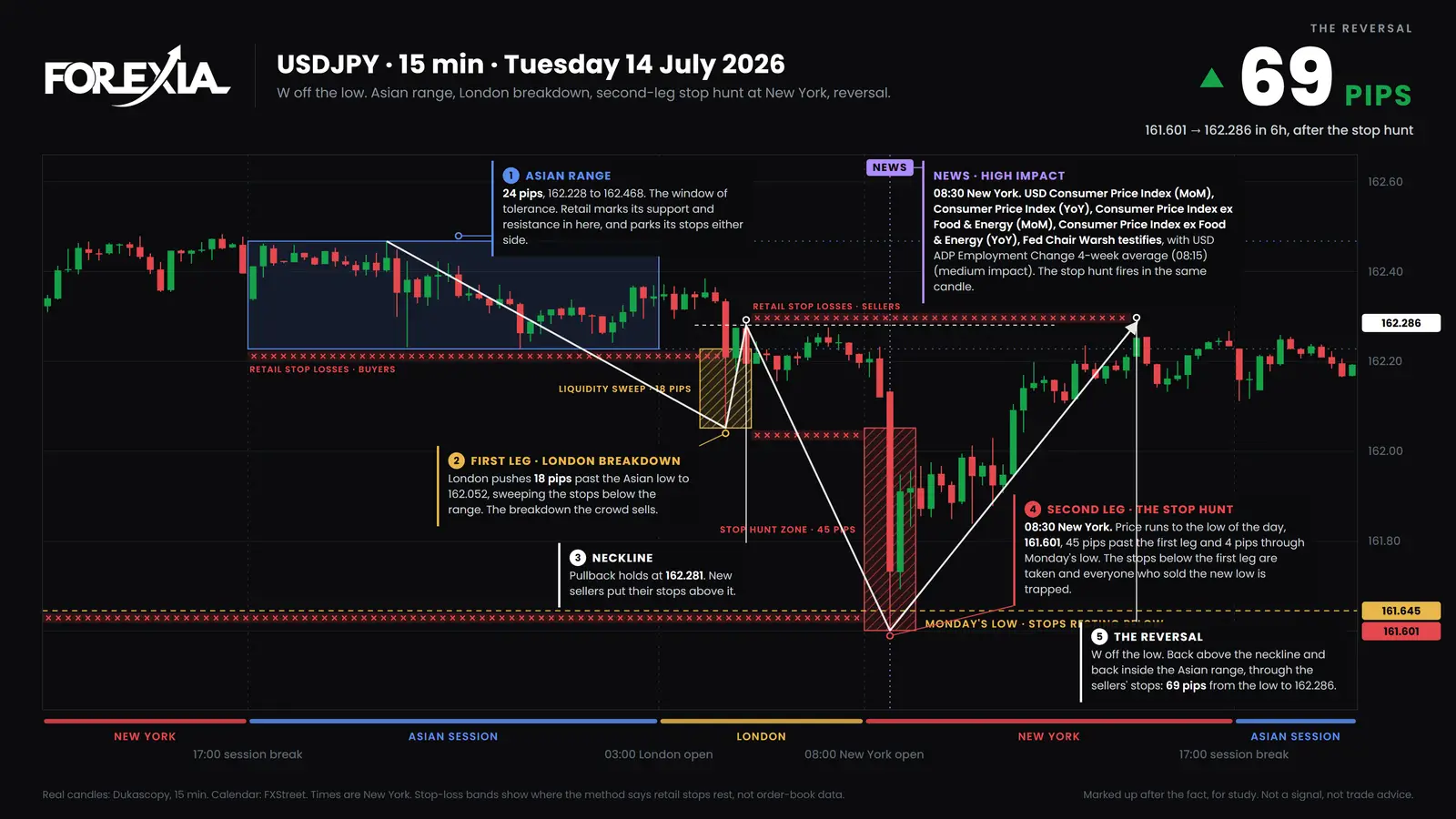
That candle opened at 162.133, ran to 161.601 and closed at 161.732. The low was 45 pips past London's low and 4 through Monday's. The close was 9 pips back above Monday's low: the Close Back. By 14:30 price was at 162.286, 69 pips off the low.
Now take the Three Seats. From the first seat, price went against you. From the market maker's seat, it went to the stops. The observer can state what the candle did and read why: the crowd sold the break, and those stops funded the turn. Nobody outside can see those orders. The bands on the chart are our reading of the structure, not order-book data.
The Stop Hunt and a liquidity sweep: are they the same?
On the chart, yes. Both name price trading through a level where orders rest and then coming back. The difference is what each phrase claims.
"Liquidity sweep" describes what price did. "The Stop Hunt" adds a reading of why: whose orders sat there, and who needed them. The first you can check on any chart. The second is our read, and we say so.
Guides also split the move by shape: a grab for one candle, a sweep for several, a run for one that keeps going. No two agree. The shape does not change the read: how far past the level, and did a candle close back? Stop hunt vs liquidity sweep sets the names side by side, what is a liquidity sweep covers the term itself, and the guide to stop hunting in forex has more real days and a table of how far a hunt runs on each market.
How do you spot a stop hunt?
You read where it can go before it goes. The pattern the crowd sees is the first thing to look at, because each pattern tells its traders where to put their stops: under a double bottom, over a flat top, under the breakout candle. The level beside them matters too, such as the edge of the Asian Box or the previous day's high or low. Together those stops make one pool.
Hunts tend to come at the London open or on a release. You only name one afterwards: until a candle closes back, a hunt and a real break look the same. Where to put your own stop is a separate question, and how to avoid stop hunts takes that up.
What do traders get wrong about stop hunts?
Four readings cost the most.
- Every stop that gets hit was hunted. A stop that goes and price keeps going was a move against you. Stop too tight or stop hunt is a check to run on your last loss.
- The hunt is the move. Selling that inflation candle on 14 July meant selling into the low of the week.
- A hunt means a reversal. It does not, and how often a liquidity sweep reverses is a thing to count, not assume. Our own test of this setup as a mechanical rule did not make money.
- The broker did it. That spike shows on two separate feeds we compared, Dukascopy and OANDA, with lows within a pip, so it was not one broker's quote. Feeds do differ: Monday's low, printed just after the Sunday open, sits 3.5 pips higher on OANDA. Who drove the spike, no chart can show. In 2014 the UK regulator fined five banks over G10 spot forex, saying traders attempted to trigger client stop-loss orders. That shows it has been tried. It says nothing about any one candle.
Which words does the Stop Hunt lead into?
Four sit next to it.
- Liquidity Mapping: marking the pools of stops on the chart before the session.
- The Close Back: the spike that closes back inside the level. The sweep has happened.
- Second Leg Climax: the volatile second leg that hunts the high or low of the day and confirms the M or W.
- The Reversal Candle: one huge candle through the stops, straight after the crowd gets in.
Where is the Stop Hunt taught?
Course 3 of ForexiaPRO, Reverse Price Action, teaches this read step by step in lesson 3.2.1, The Stop Hunt: the Liquidity Sweep Before the Move.
Related words
Frequently asked questions
Why does Forexia say the Stop Hunt and not liquidity sweep?
Because the two say different things about the same move. Liquidity sweep describes what price did: it traded through a level where stops rest and came back. The Stop Hunt adds a reading of why: those stops filled a larger order on the other side. We use both, and we say which part is a reading.
Are stop hunts real, or a conspiracy theory?
Separate what can be shown from what cannot. Price often trades a few pips past obvious levels and closes back, and a triggered stop does become a market order. Regulators have also found deliberate attempts: in November 2014 the UK's Financial Conduct Authority fined five banks over G10 spot forex and said traders attempted to trigger client stop-loss orders. What no chart can show is that a given spike was aimed at your stop. Nobody outside can see the orders, so Forexia's view that market makers build the chart is a reading, not a proof.
How can I check whether a spike was only on my broker's feed?
Look for it on a second feed. If it shows on both, it was a market-wide move and not one broker's quote. On USD/JPY on 14 July 2026 the low was within a pip on Dukascopy and OANDA. A spike on your own broker's feed alone is a question to put to your broker.
What is the difference between the Stop Hunt and the Close Back?
The Stop Hunt is the move through the level. The Close Back is the candle that closes back inside the level afterwards. Until that candle closes, price can go further, so a hunt and a real break look the same. The close tells you what has happened, not what comes next.