News Trading in Forex: What Price Does Around NFP, CPI and FOMC
News trading in forex means trading around a scheduled economic release, such as the US jobs report (NFP), the inflation report (CPI) or the Fed's decision (FOMC). In the minute it lands, price can travel further than in the hours before it, spreads widen and fills worsen. The first move does not reliably tell you where the day ends.
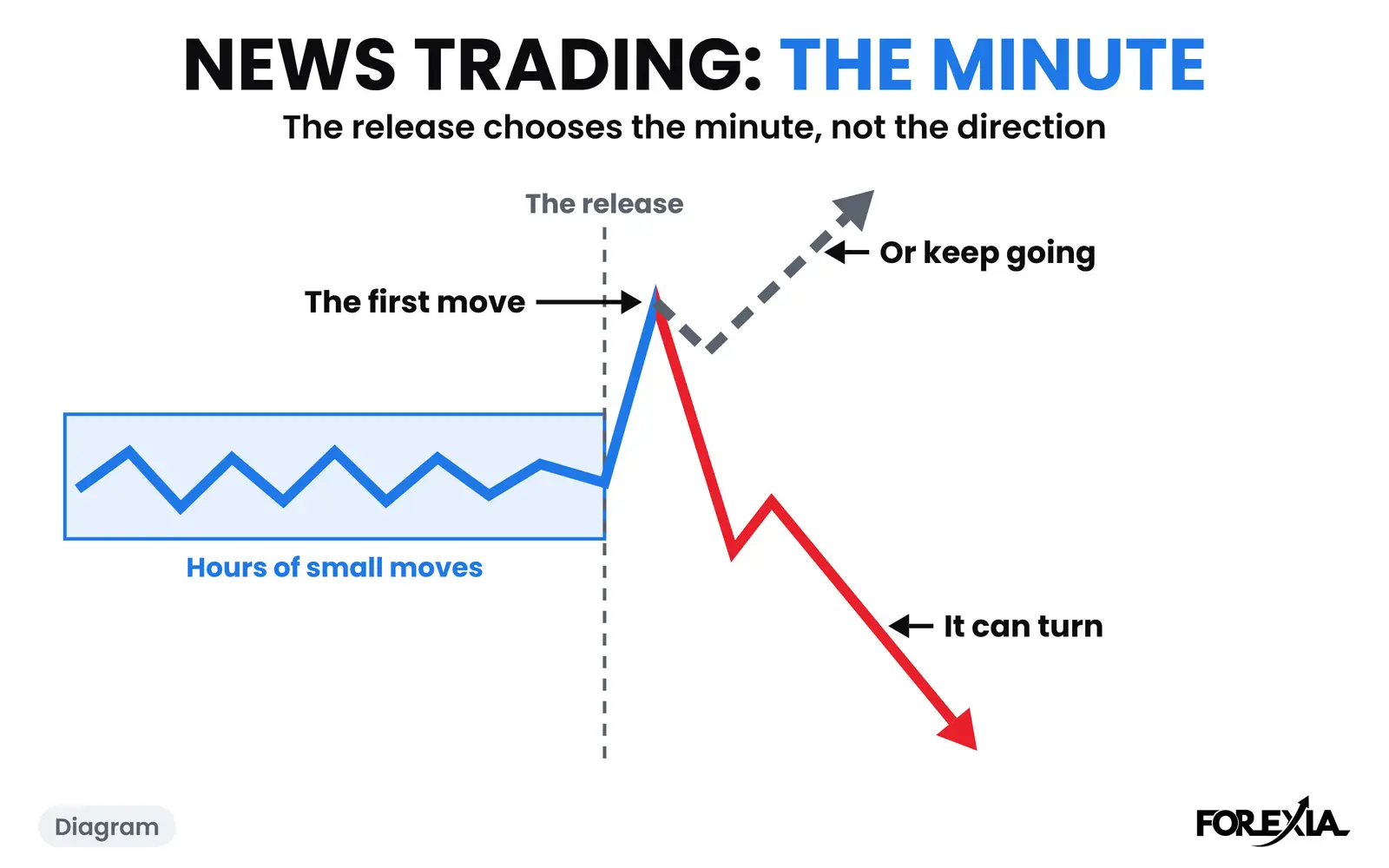
Most guides on this search stop at "wait for the pullback" or "stay out". This page shows what price did on five dated release days on our own charts, minute by minute where it matters, and counts how often the release candle held the high or low of the day across 15 releases on eight markets. We read a release as choosing the minute, not the direction. That is our read, and when we ran the idea as a fixed rule it lost money.
What is news trading in forex? NFP, CPI and FOMC
News trading is any plan built around a release whose time is known in advance. Three US releases matter most, because every dollar pair and gold react to them at once.
| Release | What it is | New York time | Official schedule | On our calendar, 6 April to 1 October 2026 |
|---|---|---|---|---|
| NFP | Nonfarm payrolls: US jobs added outside farming, with unemployment and hourly earnings | 08:30 | Bureau of Labor Statistics | 8 May, 5 June, 2 July, 7 August, 4 September |
| CPI | Consumer Price Index: the change in prices of a basket of consumer goods and services, headline and core | 08:30 | Bureau of Labor Statistics | 10 April, 12 May, 10 June, 14 July, 12 August, 11 September |
| FOMC | The Federal Open Market Committee's rate decision, statement and press conference, eight meetings a year | 14:00, then 14:30 | Federal Reserve | 29 April, 17 June, 29 July, 16 September |
Read the date, do not assume it. The jobs report is called a first-Friday event, but 8 May was the second Friday of its month and 2 July a Thursday. The Fed's minutes are not its decision either: they come three weeks later, with no decision behind them.
The textbook trades the gap between the number and the forecast, since the forecast is already in the price. Better than expected, buy the dollar. Worse, sell it. On the Fed, hawkish means dollar up and dovish means dollar down. What CPI means in forex and what FOMC means in forex explain each release in full.
Other central banks work the same way, with their own markets and minutes. On our calendar since April the ECB decided at 08:15 New York, the Bank of England at 07:00, the Bank of Canada at 09:45 and the RBA at 00:30. The Bank of Japan has no set minute: its last three decisions on our calendar landed at 23:19, 23:11 and 22:54. Unscheduled news, such as a war or a surprise tariff, is a different thing. No one can gather around a minute nobody knows, and nothing below counts it.
News-Induced Liquidity: why the release brings orders in at that minute
News-Induced Liquidity is our name for the extra orders a scheduled release brings in at one known minute. Everyone knows the time, so everyone acts together, and three things stack up.
- Quotes thin out. Our reading, which no public data we hold can show, is that dealers pull or widen their prices around the minute, so fewer orders rest at each level and a smaller order moves price further.
- Stops fire. A stop is an instruction to trade at the market once a price prints. One triggered stop pushes price to the next, on both sides of the market.
- The volume comes whatever the number says. A Federal Reserve study of interdealer trading in euro-dollar and dollar-yen, from 2004, found that even a US data release entirely in line with expectations typically brought a large rise in volume. It is old and covers two pairs, but it fits what we read: the minute draws the orders, not only the surprise.
Spot forex has no public order book, so all of this is a reading. The candles show it from outside. On GBP/USD on Friday 8 May 2026 the jobs report's first minute ran 10 pips under its open and 5 over it. By 08:34 the same candle was 13 pips over its open, at 1.36240, and it closed at 1.36207. Both sides were run inside the first minute, and our data cannot say which came first. Our calendar also has the Bank of England's governor speaking from 08:20 that morning, so not all of it need be the jobs report.
The Three Seats split that minute. Retail sees a number to forecast. The market maker sees a known time when everyone acts at once and stops near price can fill in one candle. The observer looks at where that one candle went, and what it went through. Our read is that market makers build the chart and use this minute. Nobody outside can see the orders, and stops firing into thin quotes could print the same shape with nobody aiming at anything. Forex news manipulation tests that claim with the data, and the trap candle looks at what it does from the wrong side.
NFP by the minute: a real Friday
The jobs report on EUR/USD on Friday 5 June 2026 shows how little the first minute can decide. We use On NFP for this read, which leaves the number alone. All times are New York, and a candle is named by the time it opens.
- The morning. The Asian Box was 14 pips, 1.16090 to 1.16226. London ran over it, reaching 1.16398 at 04:15, pulled back to 1.16345, then went on to 1.16442 at 05:15. We read that as the stop hunt, a liquidity sweep of the stops over the first high. It was the high of the day, more than three hours before the release.
- 08:30, the first minute. Open 1.16346, low 1.16159, close 1.16168. That is 19 pips in one minute, through the morning's pullback and the top of the box.
- To 08:34. It reached 1.16112 and paused. The first five minutes ended at 1.16151, 20 pips under the open.
- 08:36. A second push went through the bottom of the box, and the candle's low came at 08:38, at 1.16053.
- The rest of the day. The 08:30 candle closed at 1.16070, 30 pips top to bottom. The low of the day came at 16:00, at 1.15179, 87 pips under that candle's low.
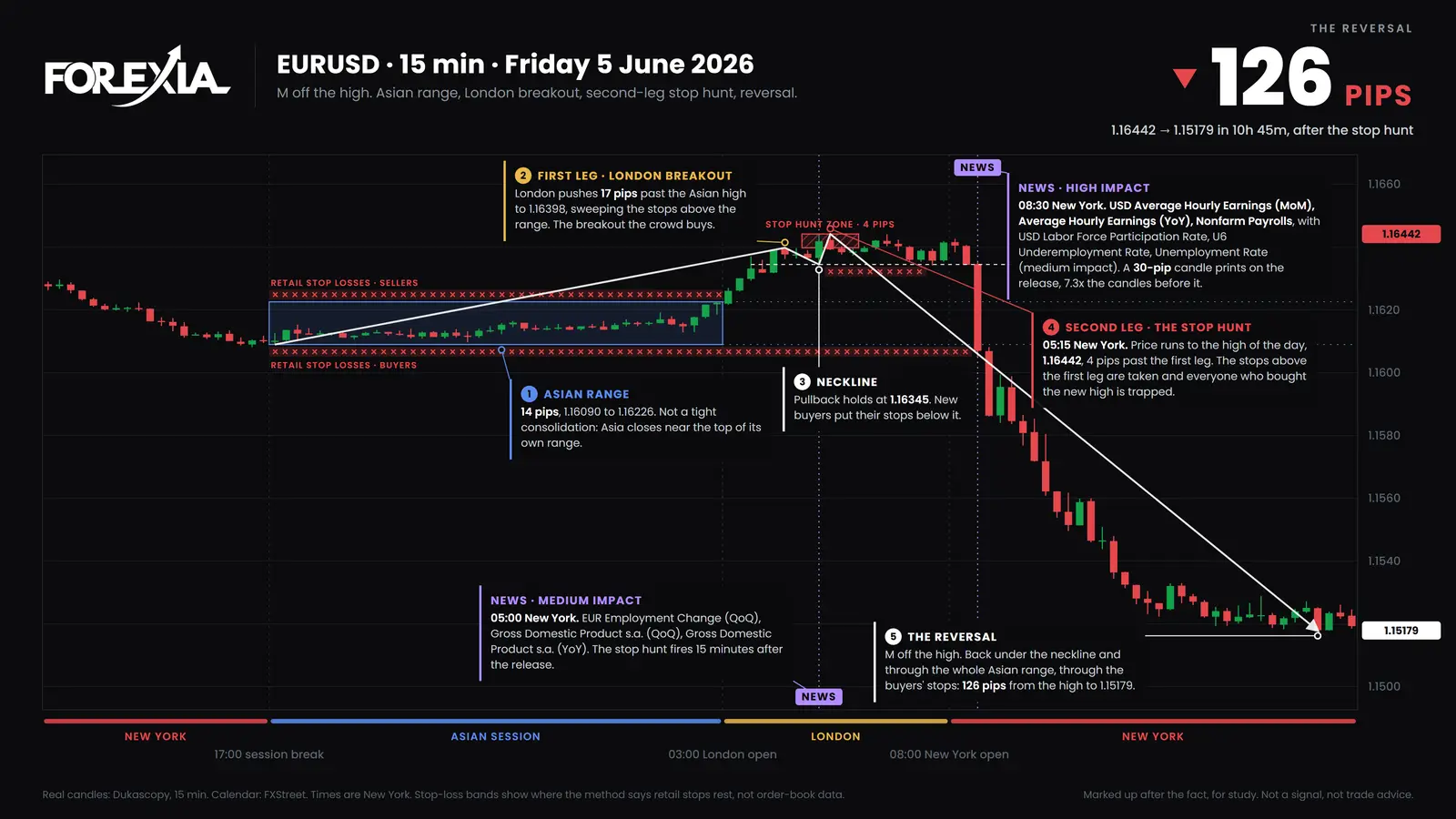
So the release did not make the turn. The turn was three hours old and the release chose the minute the fall ran, which is how we read it. It also held no end of the day: that morning the 08:30 candle held the high or low on one market of eight.
Next steps for this release: how to trade NFP takes the first minutes of more Fridays, the NFP stop hunt goes further into the hunt, and the average NFP move by pair shows how far each market runs. The other markets on this Friday are in the markups of 1 June 2026.
CPI by the minute: EUR/USD and gold on a real print
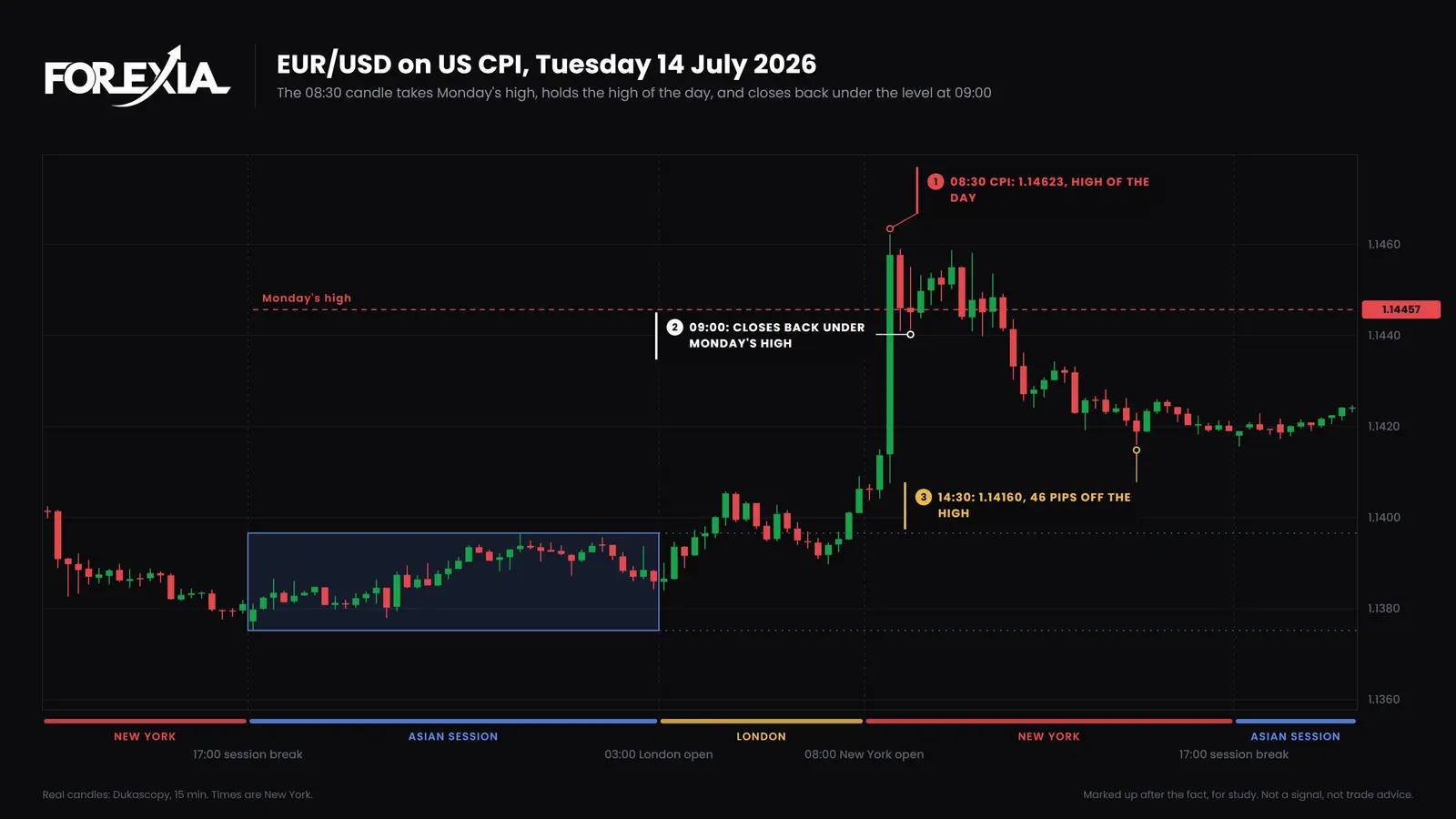
On Tuesday 14 July 2026 one release made the high of the day on both EUR/USD and gold, and both gave most of it back. This is On CPI: we do not quote the print, because the read does not use it. Our calendar also has the Fed chair testifying from 08:30 and the ECB's president speaking at 09:00, so the release was not alone on the page that morning.
EUR/USD, minute by minute:
- Before the release. Monday's high was 1.14457. At 08:29 price stood at 1.14137, already 17 pips over a 21-pip box.
- 08:30, the first minute. Open 1.14139, low 1.14075, high 1.14623, close 1.14590. It ran 6 pips under its open and 48 over it inside one minute. That high was 17 pips past Monday's high and the top of the day.
- 08:36. The first 1-minute candle to close back under Monday's high, at 1.14442. Price traded 1.14378 at 08:37.
- 08:44. Back at 1.14577, which is where the 15-minute candle closed, 12 pips over Monday's high. On a 15-minute chart this still looked like a clean break.
- The 09:00 candle. The first 15-minute candle to close under Monday's high, at 1.14451, under a pip below it: the Close Back on this timeframe. It opened half an hour after the release and closed at 09:15.
- 14:30. Price reached 1.14160, 46 pips off the high and still 19 over the box.
Gold took the same release differently. On gold we count $1 as 1 pip. The candle opened at 4029.61, and the first minute reached 4089.03, 59 pips up. The high came at 08:33, at 4100.78, 71 pips over the open and 2 pips short of Monday's high of 4103.27. So gold cleared the top of its box and took no previous-day level. It traded 4100.61 at 11:00, then fell, and by 14:30 it was at 4042.61, 58 pips off the high.
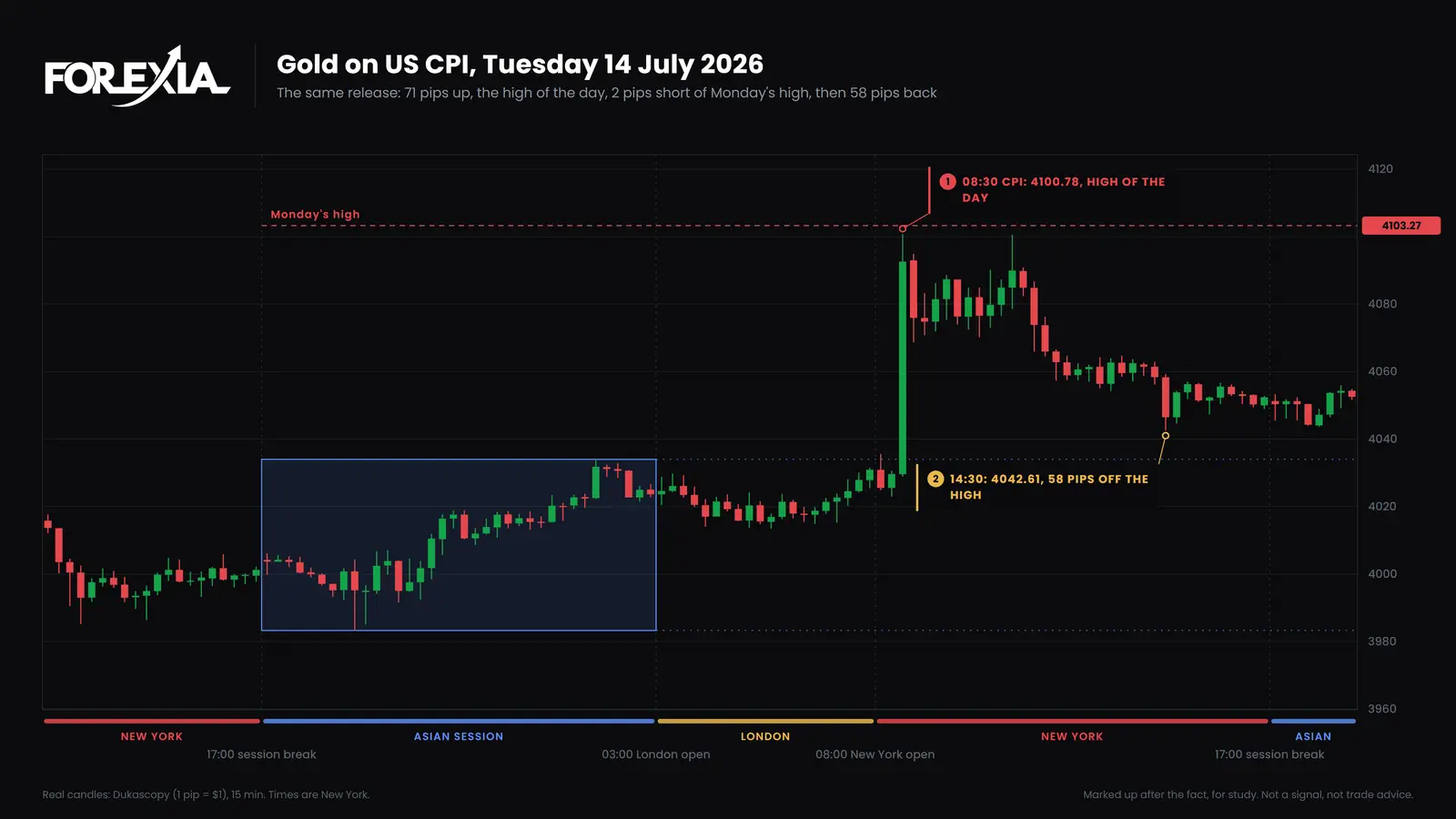
The textbook rule says the number sets the dollar's direction, and for one candle both markets moved as one. By 14:30 EUR/USD had given back 46 of its 48 pips and gold 58 of its 71. A rule about the number would not have told you that. That morning the candle held the day on five of our eight markets, the most of any CPI morning we counted. Two others held on none.
How to trade CPI takes more reactions on these two markets, and the CPI stop hunt goes minute by minute through a morning when the candle held the low. More markups around a CPI morning are in the week of 7 September 2026.
FOMC: what price does before the decision
Price does not have to wait for the decision. On gold on Wednesday 17 June 2026 the high of the day came 27 minutes early, with nothing on our calendar at that minute. This is On FOMC, and it has two known minutes, not one.
- The morning. The box was 32 pips, 4317.41 to 4349.41. The 10:15 candle ran over it and over Tuesday's high of 4354.90, the 10:30 candle reached 4363.88, 14 pips over the box, and price pulled back to 4330.61.
- 13:33. In a single minute gold went from 4363.39 to 4382.13, 18 pips past the 10:30 high and the high of the day. We read that as the Second Leg Climax of an M. A spike before the Fed is no evidence anyone knew anything. A chart cannot say why it printed.
- 14:00, the decision. Open 4379.57, low 4276.90, close 4284.19: 103 pips. The first minute took 43 of them, and by 14:05 price had traded 4300.83.
- 14:30, the press conference. A 57-pip candle: 23 under its open, 34 over it, closing at 4323.07, 39 pips over the decision candle's close.
- 15:30. The low of the day, 4218.81, 163 pips off the high and two hours after it.
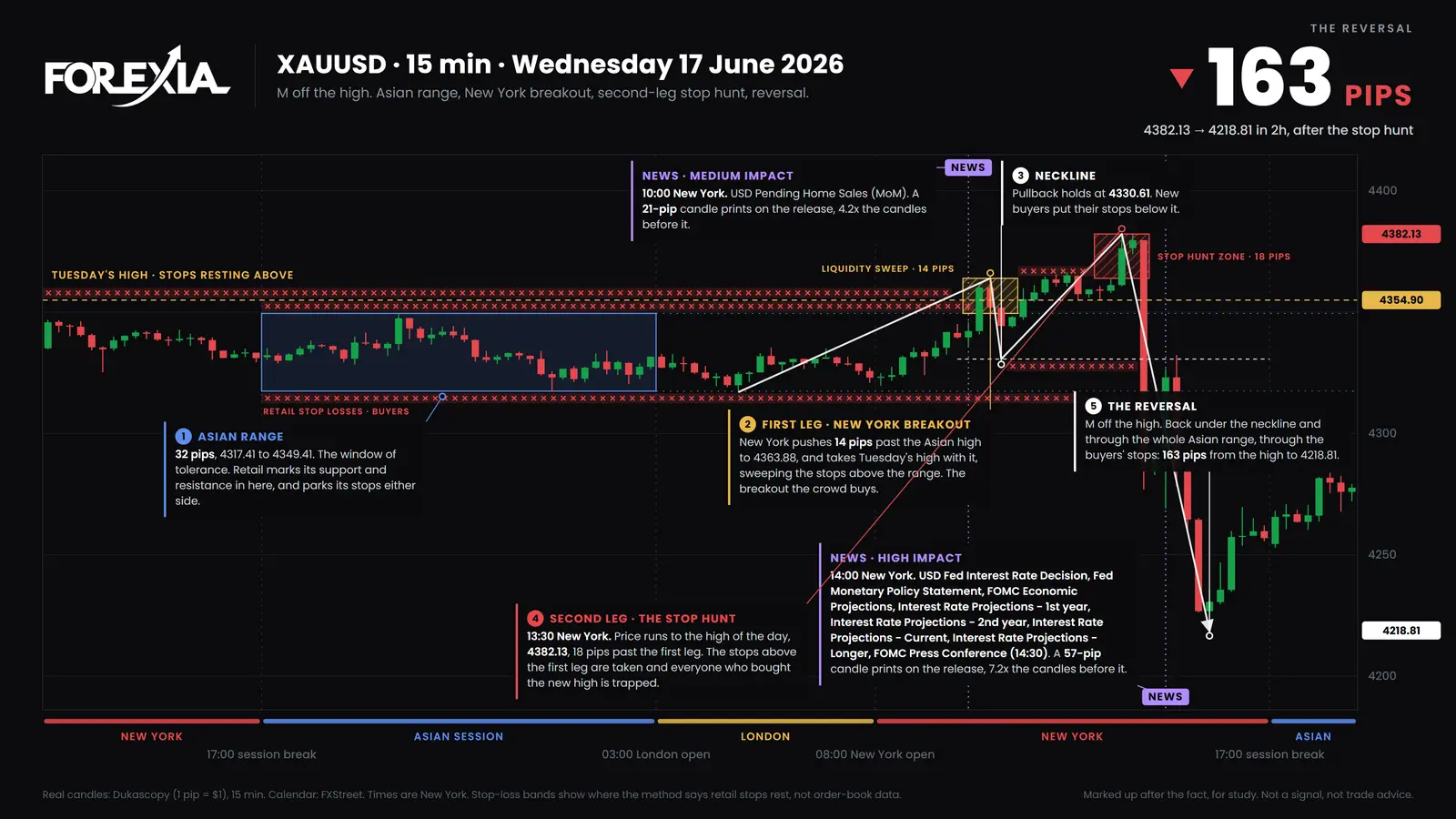
Neither gold's decision candle nor any other market's held an end of the day on 17 June. The decision minute was large and still sat inside the day's range. What price does before the FOMC decision takes the hours before in more depth, why price spikes both ways on FOMC takes the candle, and FOMC news trading in forex goes through a Fed day we read wrong. Gold on FOMC day has a page of its own, and another Fed week is in the markups of 14 September 2026.
Spreads and slippage at the release
Spreads widen around a release and fills get worse, and this is the part of news trading no chart shows. Our candles are drawn from the bid alone, so we cannot measure the spread from them and quote no figure here. Many guides say EUR/USD goes from 1 pip to 5 or 10 on NFP, with no date and no source. Treat a number like that as a rough guess, and ask your own broker for its spread and your fill record.
What each order does in that minute:
| Order | In a fast minute |
|---|---|
| Market order | Fills at the next available quote, which can be far from the last one you saw |
| Stop-loss | Becomes a market order once it triggers, so it can fill well past its price. It is not a promise of that price, unless your broker sells it as one |
| Stop-limit | Can fail to fill at all, which leaves you in the position |
| Limit | Fills at your price or better, or not at all. It fills because price is running through you |
Two more things catch people. Your chart usually draws the bid, while a short position's stop is a buy that fills at the ask, so a stop can fire at a price your chart never showed. And scale matters: gold covered 59 pips in the first minute on 14 July, and a stop inside a minute like that has no tidy fill. Some prop firms also bar trading for a few minutes either side of a high-impact release, so read your rules.
NFP spreads and slippage takes this up on its own.
Why price reverses after news, and when it does not
Our read is that the release candle runs to the nearest stops, and once those orders have filled there is nothing left to push it, so price comes back. That can look like the number being "wrong". Other explanations fit the same candles, such as a thin market overshooting, or traders changing their mind on the details of a report. Nobody outside can separate them.
USD/CAD on Wednesday 10 June 2026 shows a reversal, with two known minutes on one morning: US CPI at 08:30 and the Bank of Canada at 09:45. The CPI candle was only 7 pips, and its low of 1.39230 was 13 pips under the box. Price pulled back to 1.39381 at 09:00, then fell through Tuesday's low on the 09:15 and 09:30 candles. The Bank of Canada's own minute moved under 4 pips. The low came four minutes later, at 09:49: 1.38984, 25 pips past the first low and 20 through Tuesday's low of 1.39185. That was the stop hunt, a liquidity sweep of the stops under both lows, and the crowd sold the break. The 10:15 candle closed back above Tuesday's low at 1.39234, and by 16:00 price was at 1.39499, 51 pips off the low and back inside the box.
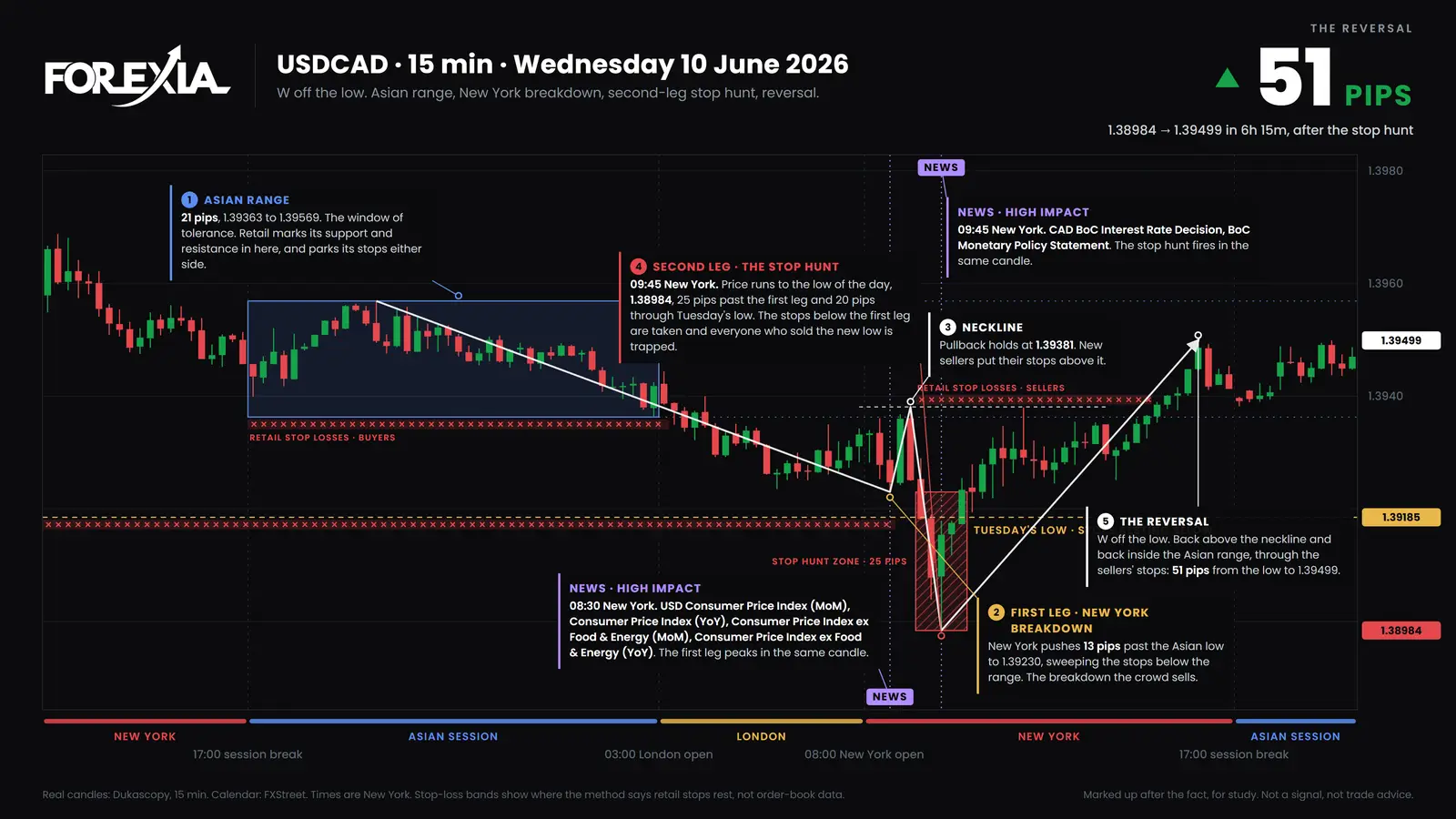
Why price spikes, then reverses, after news looks at more of these days. When the run ends in one huge candle through the stops, we call it The Reversal Candle.
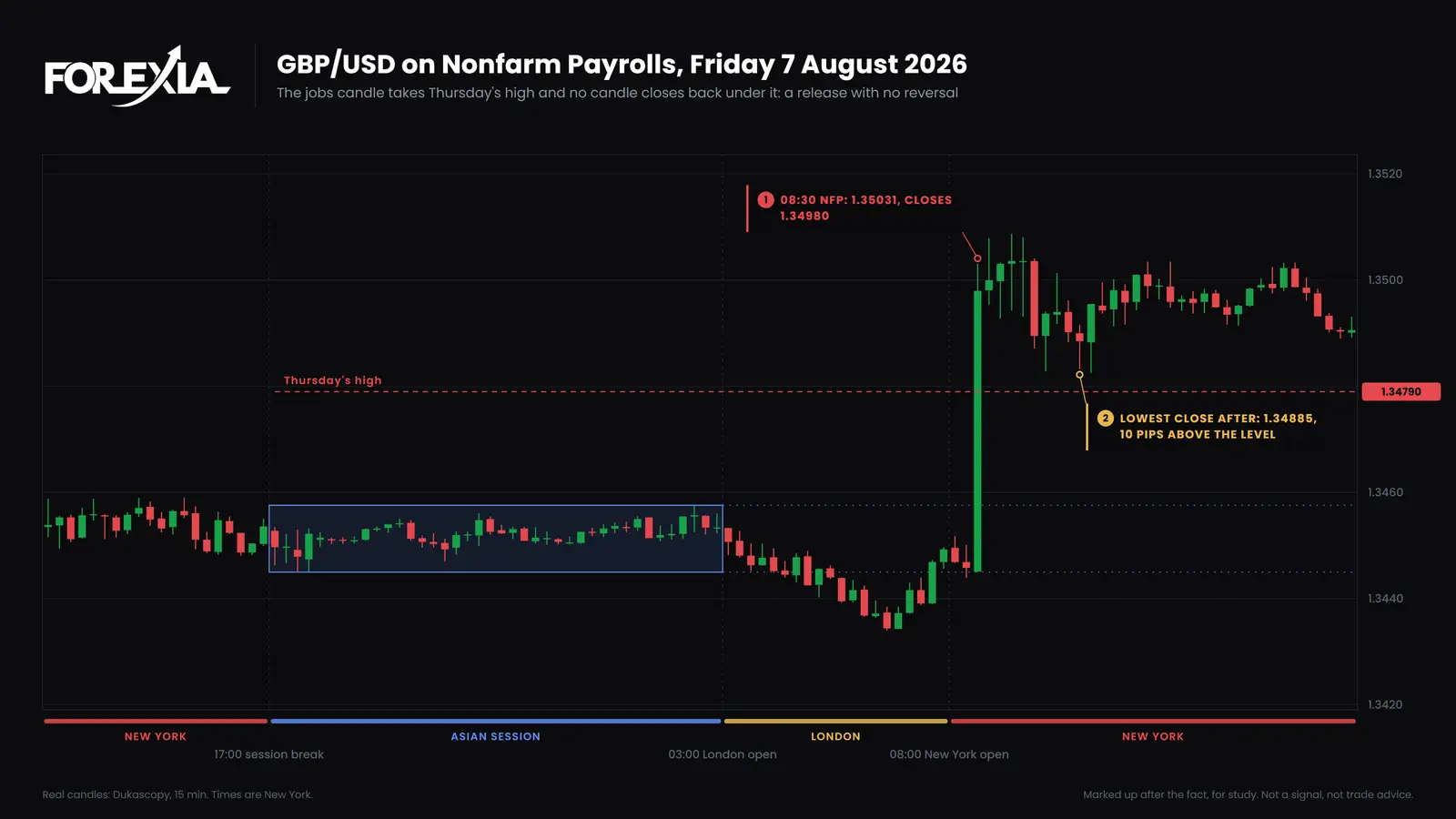
GBP/USD on Friday 7 August 2026 shows the other side. The jobs candle opened at 1.34451, ran to 1.35031 and closed at 1.34980, through Thursday's high of 1.34790 by 24 pips. It looked just like the candles above. No candle closed back under Thursday's high for the rest of the day. The lowest close was 1.34885, 10 pips over it, and the lowest trade was 1.34825. The buyers of that break were right. Our markups exist only for days that reversed, so this chart was drawn for this page from the same candles.
How often does the release candle hold the day? More often than an ordinary candle, and still a minority. We counted seven majors and gold on 15-minute candles, from 6 April to 1 October 2026, on the days our calendar marks these items high impact. A candle holds when its high is the day's high or its low the day's low, session break to session break, leaving out the spread spike on the day's first candle.
| Candle | Releases | Market-days | Held the high or low | At the high | At the low |
|---|---|---|---|---|---|
| 08:30, any high-impact US morning | 30 | 240 | 43 | 18 | 25 |
| 08:30, every other day | none | 790 | 14 | 4 | 10 |
| 08:30, NFP | 5 | 40 | 12 | 4 | 8 |
| 08:30, CPI | 6 | 48 | 12 | 5 | 7 |
| 14:00, Fed decision | 4 | 32 | 5 | 3 | 2 |
| 14:30, Fed press conference | 4 | 32 | 0 | 0 | 0 |
| 14:00, every other day | none | 998 | 20 | 7 | 13 |
Report by report it is lumpy. NFP held on 1, 1, 3, 1 and 6 markets of eight on its five mornings. CPI held on 1, 0, 0, 5, 2 and 4. The Fed's decision held on 0, 0, 0 and 5. Highs and lows both appear on every line that held at all, so a held candle says when to look, never which way.
The limits sit beside the figures. These are 15 NFP, CPI and Fed releases, on one feed, with eight markets that move together on one dollar, so those market-days are not independent. The table counts candles, not trades. It counts the candle holding an end of the day, which is not the same as every first move reversing, and we have no count of that here. A reversal seen afterwards is not a setup.
A longer sample points the same way. On seven majors and gold from 2021 to 2026, 15% to 20% of hunts printed within 15 minutes of a high-impact release for that market's currencies, against 3% to 8% of breaks that stayed. The stop hunt hub gives the definitions and the full table.
Should you trade the news? Common mistakes on release day
We can show very little in favour of it. The plans page one teaches are these:
- Straddle. Pending orders above and below price before the minute. Whichever fills, you pay the widest spread, and a candle that runs both ways can fill one side and stop it.
- Breakout. Trade the first move once it has gone. Our 5 June and 14 July days show why the first minute is a poor guide to the rest of the day.
- Fade. Trade against the spike, on the idea that it overshoots. On 7 August a fade would have sold a break that held.
- Wait. Let the spread settle and trade what follows, or stand aside altogether. That is the only plan with no release-minute spread to pay.
NFP breakout, pullback or stay out compares them. This page has no test of a straddle or breakout.
What we did test was close to the fade, and it lost. A program flagged each hunt as it happened on seven dollar majors and gold, on 5-minute Dukascopy candles with real bid and ask, from February 2021 to December 2024. Costs were the real spread plus 0.7 to 0.8 pips a round trip for commission and slippage ($0.15 on gold). R is the amount risked on one trade.
- Fading hunts printed on a high-impact release: -0.12R a trade, against -0.16R on all hunts and -0.17R on hunts with no release within six hours.
- Limit orders resting only in the minutes after a release: lost 0.29 to 0.34R a trade.
A hunt on a release held its extreme more often than one away from it, and lost less. It still lost, because by the time the candle closes back the stop is far away. Fills in those minutes had the real spread and no extra slippage, so real fills would be worse. It is one rule on one data source, and it says nothing either way about a person reading the chart. The method and full results are in our mechanical backtest, and the stop hunt hub carries the wider test. Whether any of this suits you is a question of its own, taken in should you trade the news.
What the days above show about the usual mistakes:
- The number did not settle it. On 14 July EUR/USD went 6 pips under its open and 48 over it in one minute, and most of it was gone by the afternoon.
- One candle did not settle it either. The 08:30 candle held no end of the day on 197 of the 240 release market-days we counted.
- The same morning read differently by timeframe. On 14 July the first 1-minute close back under Monday's high was the 08:36 candle, and the first 15-minute one was the 09:00 candle.
- The calendar moves. The jobs report came on 8 May and 2 July, gold's 17 June had two Fed candles of 103 and 57 pips, and USD/CAD had CPI and a rate decision on one morning. Check both currencies.
- Normal size is not normal risk in that minute. A stop can fill well past its price, so the money at risk is larger than the distance suggests.
More dated days, including the releases, are in our forex chart markups, every week. These days were picked afterwards, for study, so they flatter the read. None is a signal or trade advice.
Course 2 of ForexiaPRO, The Chaos Pattern, teaches this read step by step in Module 3, The News Minute.
How it works
- Trap Candle Forex: The One Huge Candle That Takes Your Stop
Trap candle forex: what it looks like from the wrong side, on AUD/USD jobs reports and gold on CPI in 2026, with the average that said the opposite.
Real days
- NFP Stop Hunt: What the Jobs Report Did to Gold and the Pound on 4 September 2026
An NFP stop hunt on one real Friday: gold's came hours before the jobs report, the pound's on its first minute. Both, minute by minute, on our own candles.
- FOMC News Trading Forex: The Fed Day We Read Gold Wrong (29 July 2026)
FOMC news trading forex on a day we got wrong: gold, 29 July 2026, closed back and the hunt went on. Every 2026 Fed date, and how long a close back lasts.
- CPI Stop Hunt: What EUR/USD Did at 8:30 on 11 September 2026
A CPI stop hunt on EUR/USD, 11 September 2026, by the minute: London's low, the 8:30 candle through it, the close back, and a morning that took nothing.
Questions
- Why Does Price Spike Both Ways on FOMC? One Minute, Two Pairs, Two Candles
Why price spikes both ways on FOMC: inside one candle, across two Fed minutes and across pairs. AUD/USD, USD/JPY and USD/CHF, read to the minute.
- Why Does Price Spike, Then Reverse, After a News Release?
Why price spikes then reverses after news: the release sets the minute, not the direction. USD/CAD, GBP/USD and a spike that stayed, on real candles.
Research
- Forex News Manipulation? We Counted the 8:30 Candle on 30 Release Mornings
Forex news manipulation: we counted the 8:30 candle on 30 release mornings and 8 markets, set it beside the regulators' findings and show its limits.
The words
- News-Induced Liquidity: Why Price Spikes Both Ways on a Release
News-Induced Liquidity is the orders a release brings in at one known minute. GBP/USD on US CPI, 12 August 2026, and a count of 30 release mornings.
- On CPI: Reading the Inflation Release Minute by Minute on EUR/USD
On CPI is the News-Induced Liquidity read on the inflation number. EUR/USD on 11 September 2026, minute by minute, and a count of six CPI mornings.
- On FOMC: What Price Does Around the Fed's Decision and Press Conference
On FOMC is the News-Induced Liquidity read on the Fed's decision: two minutes, not one. AUD/USD on 16 September 2026 and a count of four Fed days.
- On NFP: Reading the Jobs Report Candle, Not the Number
On NFP is the News-Induced Liquidity read on the jobs report. Gold on 4 September 2026, candle by candle, and how often the NFP candle held the day.
Frequently asked questions
What is news trading in forex?
News trading is taking positions around a scheduled economic release, such as the US jobs report, inflation report or the Fed's decision. Price can move further in that minute than in the hours before it, and spreads widen. Some traders position before the release, some trade the first move, and some wait for what follows.
What is NFP in forex?
NFP is nonfarm payrolls, the number of jobs added in the US outside farming in the past month. It is the headline of the Bureau of Labor Statistics' Employment Situation report. It moves forex because every dollar pair and gold react to it at one known minute, 08:30 New York.
What time is NFP released, and is it always the first Friday?
It comes out at 08:30 New York, usually on a Friday early in the month, but not always the first. Of the five reports on our calendar from May to September 2026, 8 May was the second Friday of its month and 2 July was a Thursday. Take the date from the official schedule.
How do you trade NFP?
Guides offer three plans: position before the report, trade the break of the first move, or wait for a pullback. None removes the problem that spreads are widest and fills worst in that minute. We show what the first minutes did on real days, and our own fixed-rule test around releases lost money after costs.
How does CPI affect forex and gold?
The textbook rule is that hotter inflation than forecast lifts the dollar and pushes EUR/USD and gold down, and cooler does the reverse. On 14 July 2026, both rose on the CPI candle, EUR/USD 48 pips and gold 71. By 14:30 they had given back 46 and 58 of those pips, so the first candle did not settle the day.
What time is the FOMC decision, and why are there two candles?
On the Fed days on our calendar the decision came at 14:00 New York and the press conference at 14:30. Each can move price: on 17 June 2026 gold's 14:00 candle ran 103 pips and its 14:30 candle ran 57, with both ends of it either side of its open. The minutes are a separate release, three weeks later.
Why does price spike both ways on news?
We read it as orders on both sides arriving in one known minute: quotes thin out, stops rest above and below price, and a triggered stop becomes a market order. On GBP/USD on 8 May 2026 the jobs candle ran 10 pips under its open and 13 over it. No chart can show whose orders those were.
Why does price reverse after news?
Our read is that the candle runs to the nearest stops, and once they have filled nothing is left to push it. Often it does not reverse. On our count the release candle held the day's high or low on 29 of 120 market-days across 15 NFP, CPI and Fed releases, and on 7 August 2026 GBP/USD simply stayed above the level it took.
What happens to spreads during NFP?
They widen, and fills get worse. A stop becomes a market order once it triggers, so it can fill past its price, and a position's stop can fire on a quote your chart never drew, because most charts show only the bid. Our candles are bid-only and cannot measure how wide it gets, so we quote no figure here.
Should you trade during news releases?
That depends on what you can show, and we can show very little in favour. Our own fixed rule on hunts printed on a high-impact release came to -0.12R a trade after costs, from February 2021 to December 2024. It is one rule and says nothing about a trader reading the chart, but a release alone is no edge.
Is it better to trade before or after a news release?
Before, you are guessing the number and holding through the widest spread. After, the spread has narrowed but the first move is gone, and it may not have been the real one. We have no test that settles it. What our days show is that the first minute's direction often did not last the day.
What is the best news trading strategy?
We cannot name one. Straddles, breakouts, fades and waiting are all widely taught, and pages recommending them show no dated results. The two plans we did run as fixed rules, fading a hunt on a release and resting limit orders in the minutes after it, both lost money after costs. That is two rules, not all of them.