
On CPI: Reading the Inflation Release Minute by Minute on EUR/USD
On CPI is the News-Induced Liquidity read applied to the inflation number, on a real release day from our chart markups. CPI is the Consumer Price Index, out at 08:30 New York around the middle of the month. News-Induced Liquidity says the release chooses the minute. On CPI reads which stops that minute ran and whether a candle closed back, and leaves the number alone.
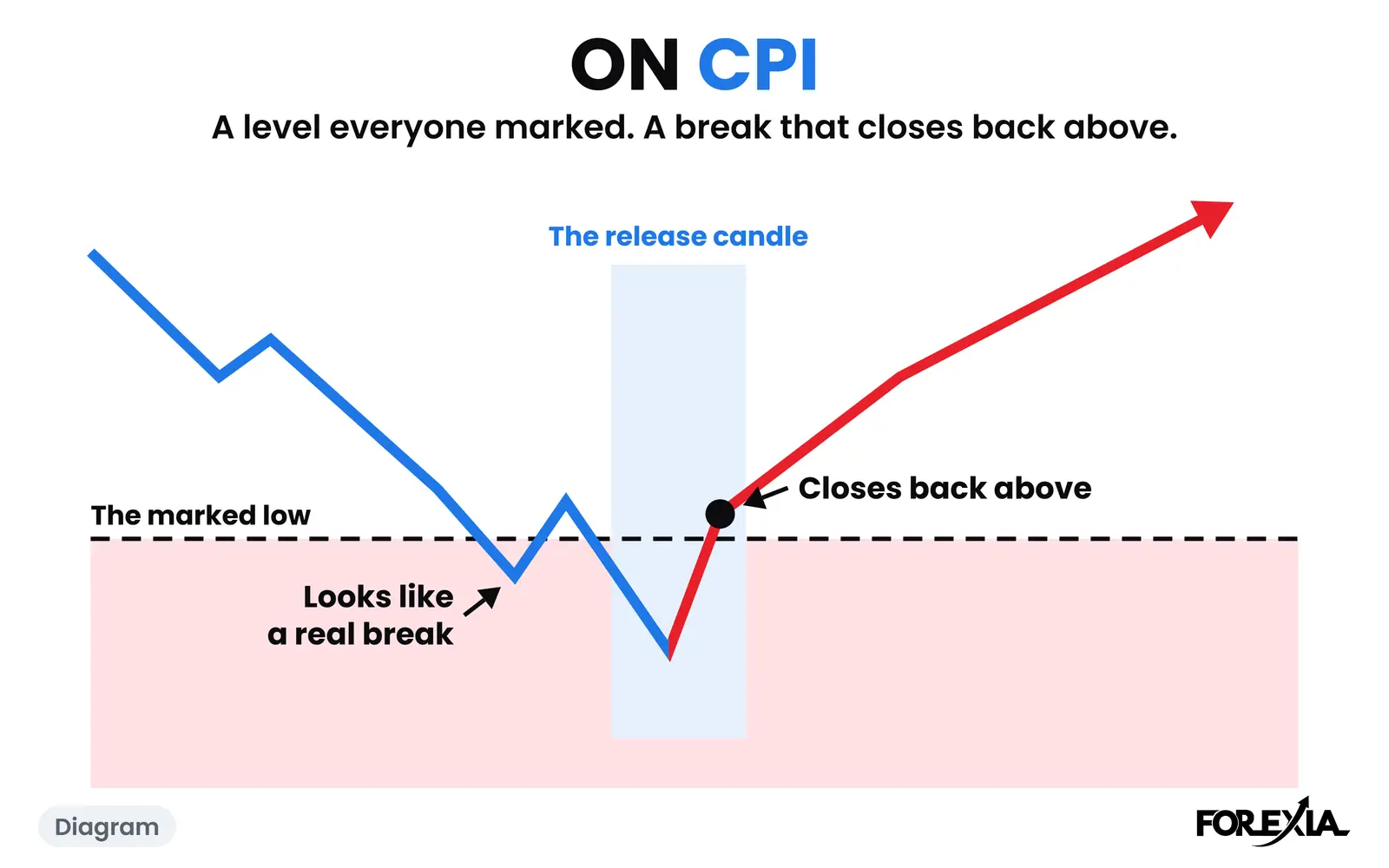
What does On CPI look like on a chart?
It looks like a break through a level everybody had marked, then a close back above it within 15 minutes. EUR/USD on Friday 11 September 2026 had CPI on the calendar for 08:30.
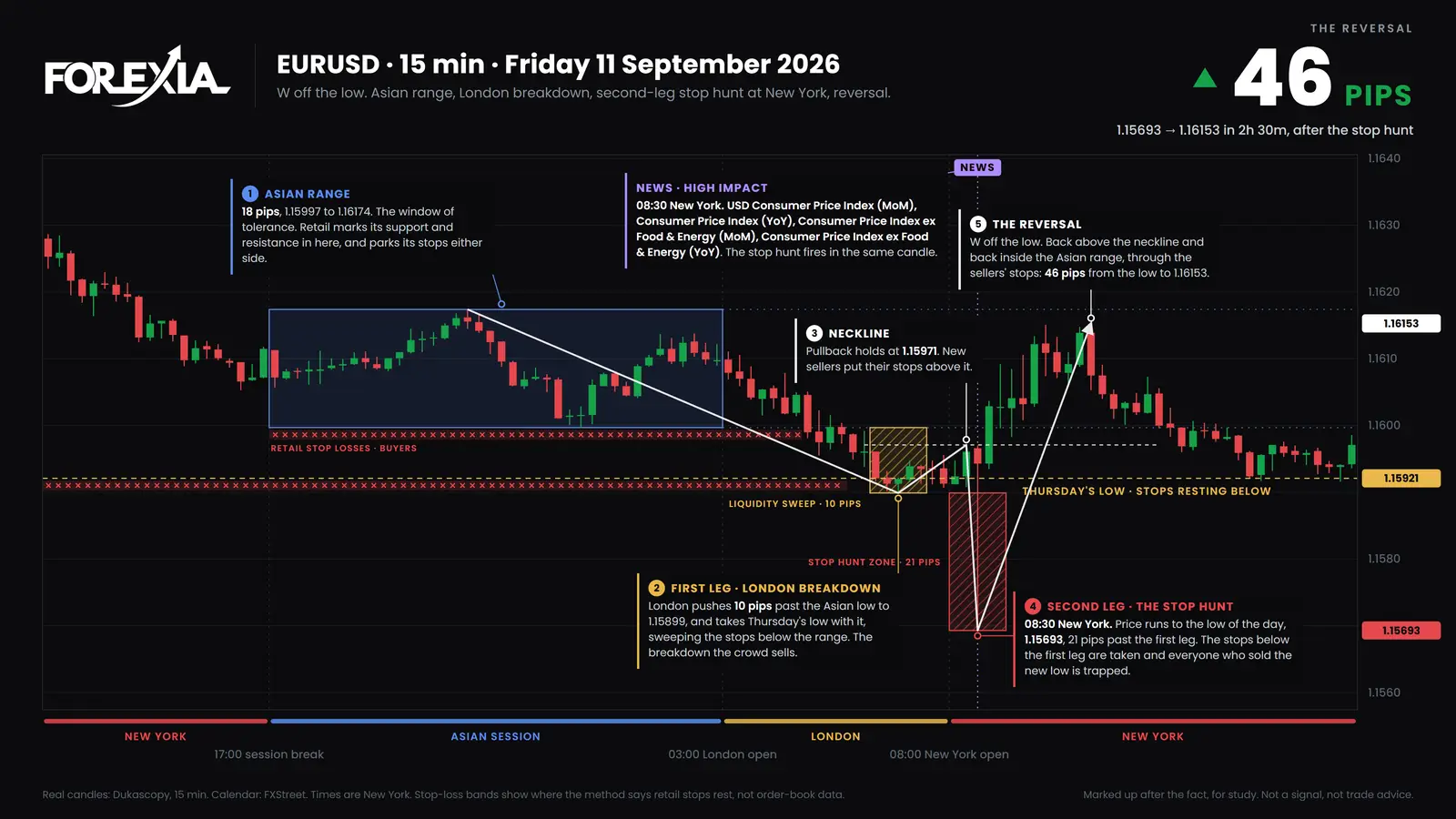
- The map. Thursday's low was 1.15921. The Asian Box was 18 pips, 1.15997 to 1.16174.
- London's move. Price sold off through the box and Thursday's low to 1.15899 at 06:45, 10 pips under the box. That is the breakdown the crowd sells. We read the pool as sitting under that low.
- The first minute. At 08:30 price opened at 1.15966 and fell through London's low to 1.15723.
- The second minute. The low of the day, 1.15693, 21 pips past London's low. We read this as the Second Leg Climax of a W.
- Ten minutes under. Every minute from 08:30 to 08:39 closed under London's low. The first trade back above it came at 08:40.
- The 15-minute close. The candle closed at 1.15943, 4 pips back above London's low and 2 above Thursday's: the Close Back, on the release candle itself.
- After. The next candle closed back inside the box, at 1.16029. By 11:00 price had reached 1.16153, 46 pips off the low. It did not keep it: by 14:45 price was back at Thursday's low. The low of the day held.
The Three Seats split that morning. The first seat waits for the number. The market maker's seat has sell orders and stops stacked under London's low with one known minute to fill them. The observer marked the low before London ended and watches for the close, because for ten minutes this looked like a real break.
On CPI and CPI news trading in forex: how do they differ?
CPI news trading asks what the number will do. The guides' rule: hotter than forecast, the dollar rises and EUR/USD falls; cooler, the reverse. They add core against headline and the gap against consensus. That is the first seat, and it is about the number.
On CPI is about the candle. We do not quote the print here, because the read does not use it, and we have not tested the textbook rule. It makes no forecast and says nothing about entries.
The how-to has its own page: how to trade CPI takes real reactions on EUR/USD and gold. What CPI means in forex explains the number, the CPI stop hunt goes further into the hunt, and the guide to CPI trading sets it beside the other releases. The same week on other markets is in the markups of 7 September 2026.
How often does the CPI candle hold the high or low of the day?
On a quarter of market-days, and very unevenly. We took the six CPI reports on our calendar from 10 April to 11 September 2026, on seven majors and gold, 48 market-days of 15-minute candles. A candle holds when its high is the day's high or its low the day's low, session break to session break, leaving out the spread spike on the day's first candle. It held on 12 of the 48: 5 highs and 7 lows.
By report: 1 on 10 April, none on 12 May, none on 10 June, 5 on 14 July, 2 on 12 August and 4 on 11 September. Two of the six mornings held on no market at all.
Six reports is a small sample, on one feed, with eight markets moving on one dollar. It counts candles, not trades. The morning above is a read, not a trade: a reversal seen afterwards is not a setup, and our own test of the setup as a mechanical rule did not make money.
How do you spot the read on CPI?
On 11 September the levels were on the chart before the minute: Thursday's low at 1.15921, the box, and London's low at 1.15899. Against those, read the 08:30 candle by where it ended, 4 pips above London's low and 2 above Thursday's, and leave the headline alone.
What do traders get wrong on CPI?
Three things cost the crowd most that day.
- Selling the first minute. It went through London's low to 1.15723 and looked like the direction. The second minute made the low of the day, and the candle closed above London's low.
- Calling the low at 08:31. The low did print then, and nothing on the chart said so: the next eight minutes all closed under London's low. Until a candle closes back, a hunt and a real break look the same.
- Taking the bounce for the answer. The 46 pips were real, and by 14:45 price was back at Thursday's low.
Which words does On CPI lead into?
Three sit next to it.
- News-Induced Liquidity: the extra orders a scheduled release brings in at one known minute.
- Second Leg Climax: the volatile second leg that hunts the high or low of the day and confirms the M or W.
- The Close Back: the spike that closes back inside the level. The sweep has happened.
Where is On CPI taught?
Course 2 of ForexiaPRO, The Chaos Pattern, teaches this read step by step in lesson 2.3.5, CPI Day, Minute by Minute.
Related words
Frequently asked questions
What does On CPI mean?
On CPI is Forexia's name for the News-Induced Liquidity read applied to the US inflation number. It leaves the number alone and asks which stops the candle at the release ran and whether a candle closed back. It is a read, not a way of trading the report.
What time does US CPI come out?
At 08:30 New York, around the middle of the month. The six reports we counted in 2026 came on 10 April, 12 May, 10 June, 14 July, 12 August and 11 September, on different weekdays, so take the date from the calendar each month.
Does a higher CPI number always push the dollar up?
That is the textbook rule, and it is about the number. This page is about the candle, and we have not counted the rule. On EUR/USD on 11 September 2026 the release candle fell 21 pips past London's low and closed 4 pips back above it inside 15 minutes, so a rule about the number would not have told you where that candle ended.
How often does the CPI candle hold the high or low of the day?
On six reports from 10 April to 11 September 2026, on seven majors and gold, the 08:30 candle held the day's high or low on 12 of 48 market-days. Two of the six mornings held on no market at all. It is a small count of candles, not a strategy, and Forexia's own test of the setup as a mechanical rule did not make money.