
Forex Sessions: Market Hours, Session Times and What Each Session Does
What are the forex market hours? The short answer
Forex market hours run from 17:00 New York on Sunday to 17:00 New York on Friday, around the clock. Inside that week the usual forex session times, each in its own city's time, are Sydney 07:00 to 16:00, Tokyo 09:00 to 18:00, London 08:00 to 17:00 and New York 08:00 to 17:00.
Forex has no exchange and no opening bell, so these hours are a convention. That is why broker tables disagree by an hour. Ours match our forex market hours clock, which shows them in your own time and handles daylight saving for you.
This page gives the hours with every clock change worked out, then shows what each session did on real dated days and counts what it did on eight markets. It also says why our courses count from the session break and not from the clock.
| Session | In its own city | UTC, northern summer | UTC, northern winter | New York, northern summer | New York, northern winter |
|---|---|---|---|---|---|
| Sydney | 07:00 to 16:00 | 21:00 to 06:00 | 20:00 to 05:00 | 17:00 to 02:00 | 15:00 to 00:00 |
| Tokyo | 09:00 to 18:00 | 00:00 to 09:00 | 00:00 to 09:00 | 20:00 to 05:00 | 19:00 to 04:00 |
| London | 08:00 to 17:00 | 07:00 to 16:00 | 08:00 to 17:00 | 03:00 to 12:00 | 03:00 to 12:00 |
| New York | 08:00 to 17:00 | 12:00 to 21:00 | 13:00 to 22:00 | 08:00 to 17:00 | 08:00 to 17:00 |
Northern summer here means April to early October, and northern winter means early November to mid-March. The weeks in between are in the next section. The sessions overlap like this:
- London and New York: 08:00 to 12:00 New York, which is 12:00 to 16:00 UTC in summer and 13:00 to 17:00 UTC in winter.
- Tokyo and London: two hours in summer (07:00 to 09:00 UTC) and one in winter (08:00 to 09:00 UTC).
- Sydney and Tokyo: 00:00 to 06:00 UTC in summer and 00:00 to 05:00 UTC in winter.
Many places keep one clock all year, so their session times change only when London's and New York's do:
| Your city | London opens, summer | London opens, winter | New York opens, summer | New York opens, winter |
|---|---|---|---|---|
| Mexico City | 01:00 | 02:00 | 06:00 | 07:00 |
| São Paulo | 04:00 | 05:00 | 09:00 | 10:00 |
| Lagos | 08:00 | 09:00 | 13:00 | 14:00 |
| Johannesburg | 09:00 | 10:00 | 14:00 | 15:00 |
| Nairobi | 10:00 | 11:00 | 15:00 | 16:00 |
| Dubai | 11:00 | 12:00 | 16:00 | 17:00 |
| Karachi | 12:00 | 13:00 | 17:00 | 18:00 |
| Mumbai | 12:30 | 13:30 | 17:30 | 18:30 |
| Singapore | 15:00 | 16:00 | 20:00 | 21:00 |
How does daylight saving move the forex session times?
Each city keeps its own local hours, so the sessions slide against each other and against UTC when the clocks change. Tokyo never moves, because Japan does not change its clocks. The other three change on different dates: the US from the second Sunday in March to the first Sunday in November, the UK from the last Sunday in March to the last Sunday in October, and Sydney the other way round, from the first Sunday in October to the first Sunday in April.
| Year | New York goes forward | London goes forward | Sydney goes back | Sydney goes forward | London goes back | New York goes back |
|---|---|---|---|---|---|---|
| 2026 | 8 March | 29 March | 5 April | 4 October | 25 October | 1 November |
| 2027 | 14 March | 28 March | 4 April | 3 October | 31 October | 7 November |
| 2028 | 12 March | 26 March | 2 April | 1 October | 29 October | 5 November |
These dates follow today's rules, and a government can change its rules. Sydney's changes move only Sydney's own hours. The weeks that catch people out are the ones between New York's change and London's: two or three weeks in March and one in the autumn. New York always moves first in spring and last in autumn, so the two cities are four hours apart in those weeks instead of five. Three things follow:
- London opens at 04:00 New York, not 03:00. Any table written in New York time is an hour out.
- The overlap is five hours, not four. New York's 08:00 is noon in London, and London still runs to 17:00.
- Releases move too. Each comes out on its own country's clock. In our calendar files, UK jobs figures land at 02:00 New York from April to October, and landed at 03:00 on 19 March 2026. The Bank of England's decision moved from 07:00 to 08:00 New York that day, and the ECB's from 08:15 to 09:15. US figures stayed at 08:30 New York, which is 12:30 in London instead of 13:30.
EUR/USD on Thursday 19 March 2026 shows all of it. On this page a candle is named by the New York time it opens, on Dukascopy's 15-minute candles. That morning the UK's jobs figures hit the 03:00 candle, which ran from 1.14730 to 1.14527. London's own first candle came an hour later, at 04:00 New York. It reached 1.14437 and closed at 1.14476, the first close under a 41-pip night (1.14504 to 1.14912). A trader reading a New York table would have called the 03:00 candle the London open.
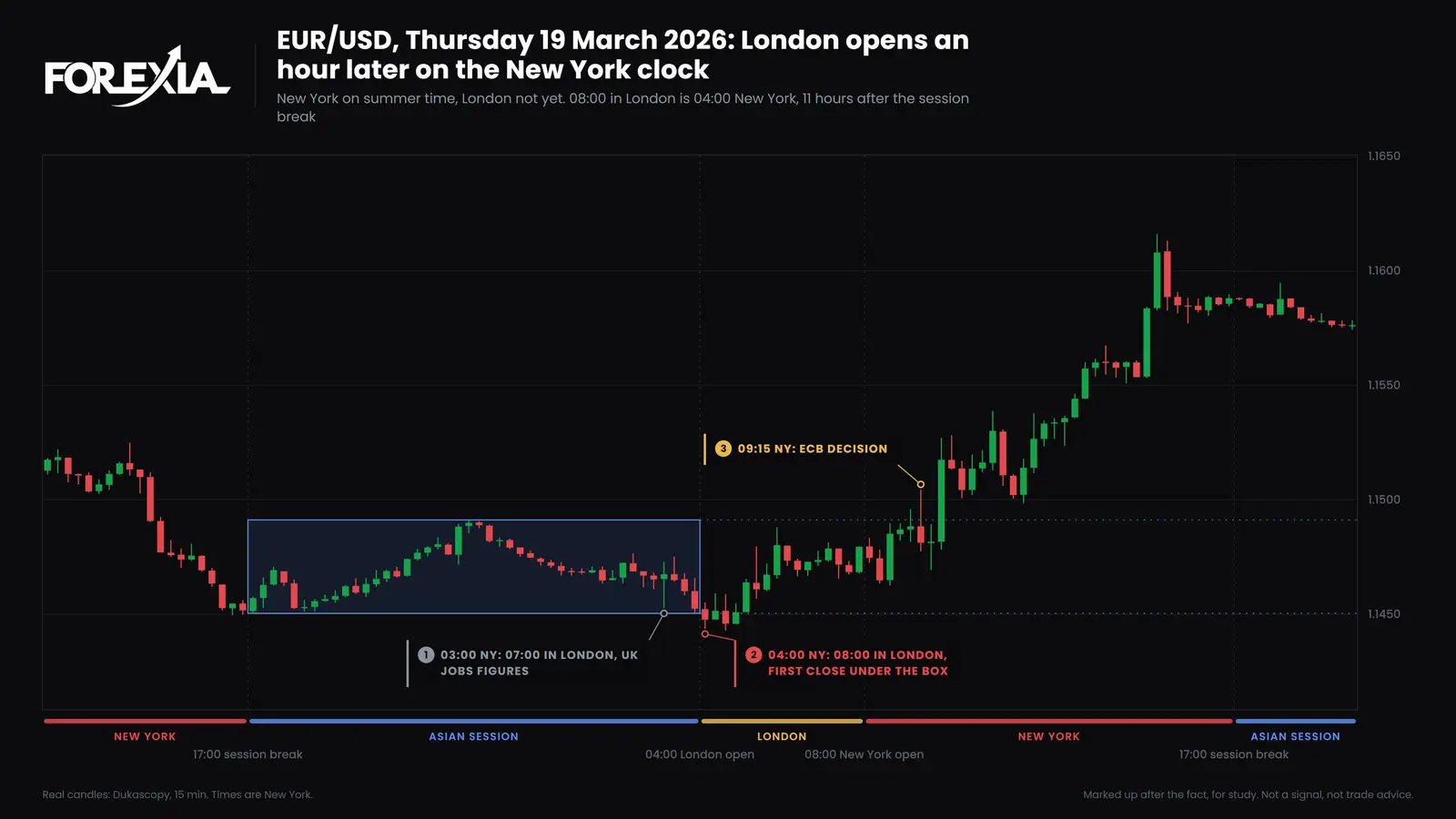
The low of the day was 1.14429 on the 04:30 candle, when the Swiss National Bank's decision landed. With the Bank of England and the ECB also deciding that morning, price then ran 173 pips to 1.16161 by 15:00. We put that size down to the news and not the clock. The clock only moved when it came.
Why do our courses read the session break and not the clock?
Because the session break is one line on the chart, and it is the same line for everyone. It sits at the 17:00 New York rollover, where each trading day starts. London's usual open at 03:00 New York is ten hours after it, and New York's 08:00 is fifteen. Traders in Lagos and in Manila see the same line, and New York's own daylight saving moves it for them.
So Course 2 reads the day from that line. Clock phrases like "forex session times" live on this page and on the clock tool, because this is where people search for them.
There is one honest exception, and it is the weeks above. New York is still fifteen hours after the break, but 08:00 in London is then eleven. Our own charts follow London's 08:00, so our box runs an hour longer in those weeks. Which does the market follow? We counted the size of each 15-minute candle as a share of the market's average day, on eight markets, for the three weeks from 9 to 27 March 2026 (120 market-days), against the 1,030 market-days from 6 April to 1 October 2026.
| Candle opening at, New York | 02:45 | 03:00 | 03:45 | 04:00 | 04:15 |
|---|---|---|---|---|---|
| Clocks in step, 6 April to 1 October | 8.0% | 10.3% | 8.6% | 10.0% | 8.6% |
| Clocks out of step, 9 to 27 March | 7.7% | 10.1% | 8.5% | 10.7% | 11.7% |
Neither clock wins. The step up at ten hours was still there when London's clock read 07:00. The candles rose again at eleven hours, when it read 08:00, and stayed up. So the morning seems to start on the break's count and build to London's own open. Three weeks of one March is a small sample, so compare a candle with its neighbours and not with the other row.
The Asian session: why does a quiet range matter?
It matters because it leaves the two levels the rest of the day is read against. We draw the night's high and low as the Asian Box, from the session break to the London open, which covers Sydney and most of Tokyo. Its median size was 23 pips on EUR/USD, 30 on GBP/USD, 41 on USD/JPY and 54 on gold, where we count $1 as 1 pip. That is 40% to 52% of each market's average day, on 1,030 market-days to 1 October 2026.
Part of the quiet is simple: less of the market is at its desk. Sales desks in the UK and the US handled about 38% and 19% of world forex turnover in April 2025, against 11.8% in Singapore and 7.0% in Hong Kong. The rest is our reading: those calm hours are the Window of Tolerance, where the crowd places its orders, trusts the edges and wears down. Nobody outside a broker's book can see those orders.
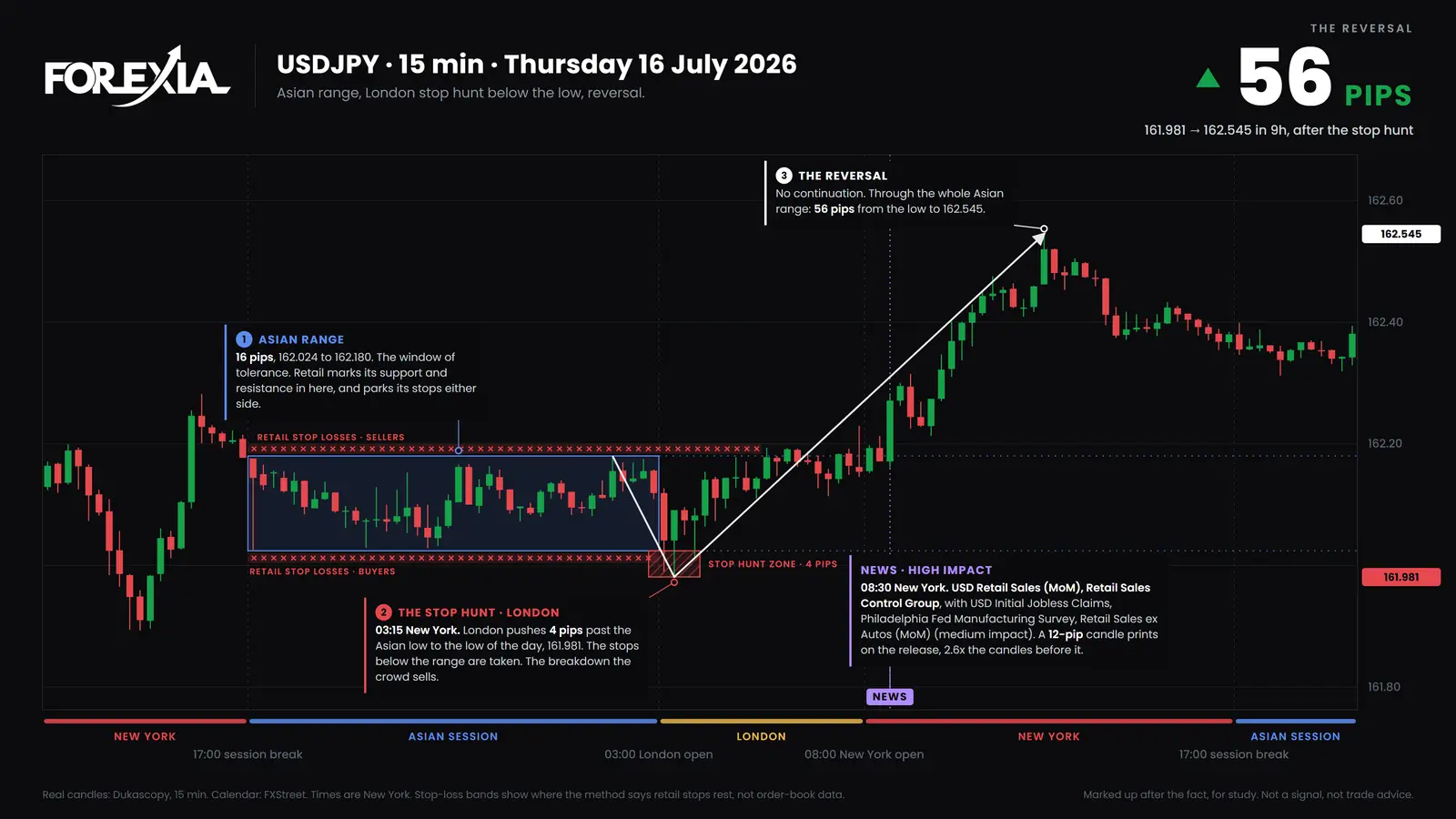
USD/JPY on Thursday 16 July 2026 fit that whole night inside 16 pips, 162.024 to 162.180, on a market whose median night is 41. Its candles averaged under 5 pips. London's first two candles ran under the bottom edge, to 161.981 at 03:15, and neither closed under it. The first close out of the box was on the other side, at 162.191 on the 06:00 candle. By 12:15 price was at 162.545, 56 pips off the low.
Our guide to the Asian session strategy covers how the night is traded and which pairs suit it, the Asian range has its own page, and so does why the first break often fails.
The London open: breakout, fakeout or the turn?
It can be any of the three, and only the closes tell you which. London opens at 08:00 in London, usually 03:00 New York. On 285 of 1,030 market-days no London candle closed outside the box at all. On the other 745 it did, and that first close is what the textbook calls a breakout and we call the London Breakout: the move retail enters for the continuation. On 287 of those 745 days London had undone it by New York's open, which is the turn coming early.
A London open fakeout is the short version of that. Gold on Wednesday 15 July 2026 sat in a 41-pip box from 4021.07 to 4061.88. An hour into London, the 04:00 candle ran 4 pips under the box to 4017.16 and closed at 4017.70: the breakdown the crowd sells. The next candle closed at 4026.61, back inside. That run was the stop hunt, what most traders call a liquidity sweep. US producer prices came out at 08:30, and that candle closed over the whole box at 4062.72. The high was 4080.93 at 14:30, 64 pips off the low.
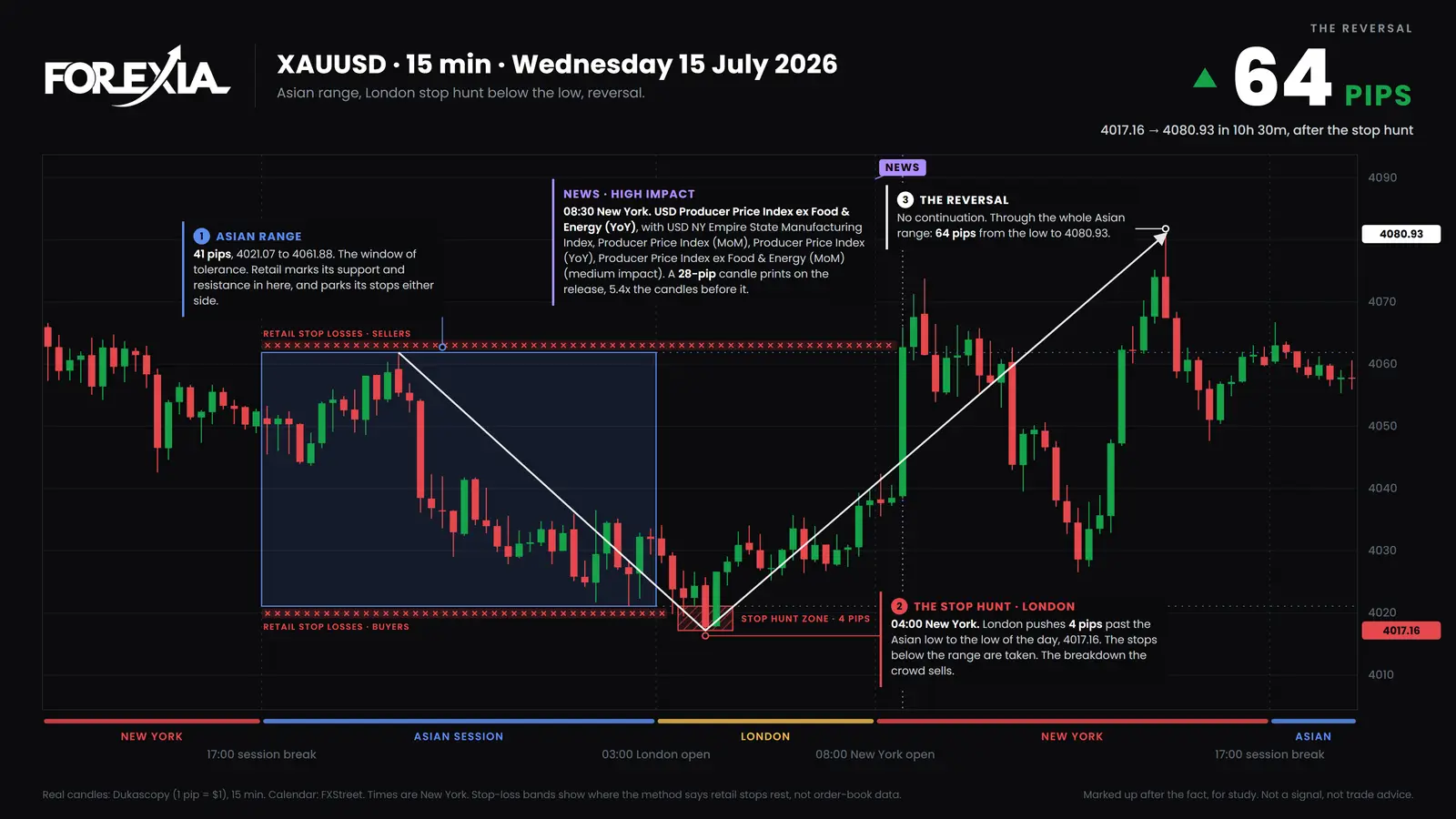
Marked up afterwards, that looks obvious. A reversal seen afterwards is not a setup, and our own test of the setup as a fixed rule did not make money. Plenty of London breaks do carry.
The guides go further: why the London breakout fails, whether the strategy works at all, the London open stop hunt, when London does the turn itself and the best pairs for the London session.
The New York session: does it reverse London's move?
Sometimes, and less often than the phrase suggests. The New York session runs 08:00 to 17:00 New York. We use the New York Reversal narrowly: London's break still stands at New York's open, New York runs past London's extreme, and a candle closes back inside the box. Of the 458 market-days when London's break stood at New York's open:
- 91 (20%): New York pushed past London's extreme, then closed back inside the box
- 173 (38%): New York closed back inside with no such push
- 194 (42%): no New York candle closed back inside
USD/CAD on Wednesday 15 July 2026 is the first line. The box ran from 1.40390 to 1.40645, 26 pips. London's 06:15 candle closed over it at 1.40659, and London's high was 1.40715. New York's first candle reached 1.40768, 5 pips past that (the chart's 7 pips are from the first leg's 1.40697), the second top of an M. The 08:30 candle, on US producer prices, closed back inside at 1.40525. The Bank of Canada decided at 09:45, and that candle and the next closed just over the box again, at 1.40657 and 1.40651, before price fell back inside. The 13:30 candle closed under the whole box at 1.40310, and by 14:30 price was at 1.40242, 53 pips off the high.
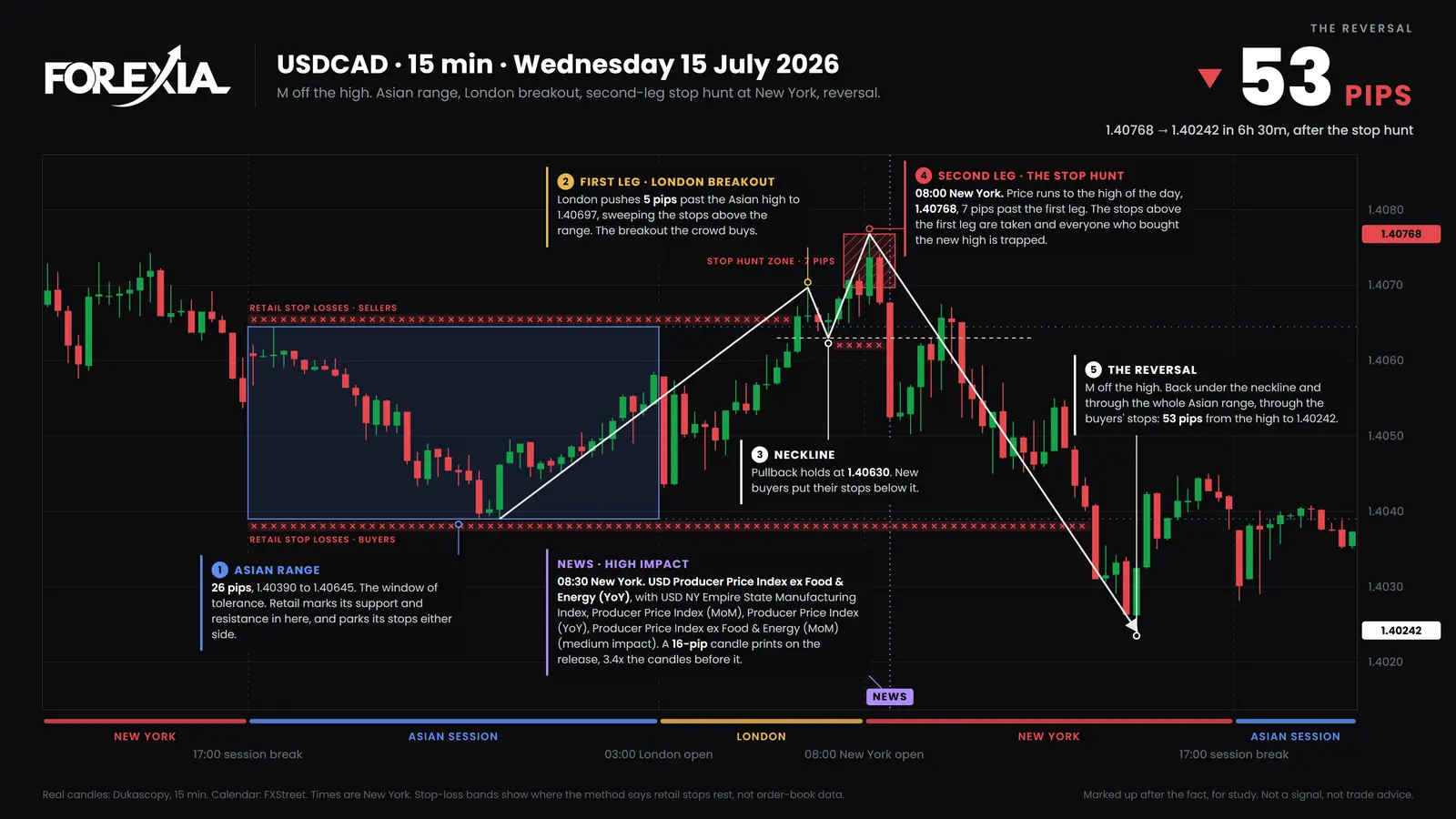
The last line matters as much. On 194 days the crowd that joined London's break was right all day, and New York does not owe anyone a turn. Our guide to the NY session reversal goes through both kinds of day.
London vs New York session comes down to what you are asking. London alone moves less per hour than the overlap, and more than New York does after London's close, on all eight markets in the table below. New York carries the scheduled US figures, at 08:30 and 10:00 on its own clock. And in our longer count, 2021 to 2026, the 08:00 New York hour was the busiest for stop hunts on all eight, as the stop hunt page shows.
The Chaos Pattern: what does one whole day look like?
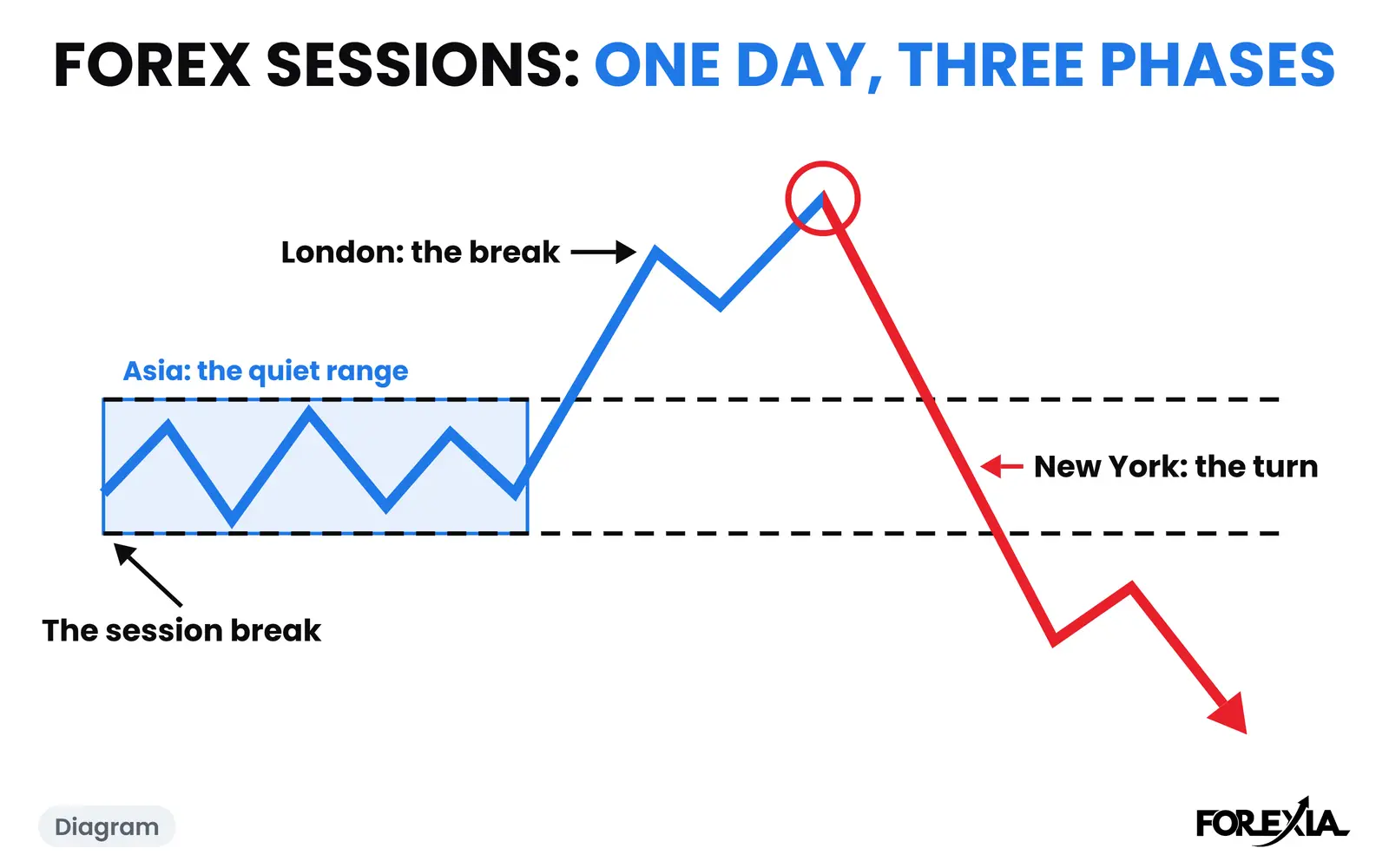
The Chaos Pattern is the daily cycle: Asia sets the scene, London breaks it and New York reverses it. Consolidation, then breakout, then reversal. It is our way of asking which phase today's chart is in, and most days do not run all of it. Of 1,030 market-days on seven majors and gold, from 6 April to 1 October 2026, counted on closes with the rollover wick left out of the box:
- 285 (28%): London never closed outside the box
- 287 (28%): London closed outside it, and by New York's open was back inside or across it
- 264 (26%): London's break stood at New York's open, and a New York candle closed back inside
- 194 (19%): London's break stood, and no New York candle closed back inside
GBP/USD on Friday 18 September 2026 ran the third line, off the low. Asia left 26 pips, 1.33491 to 1.33755. London's 07:30 candle, half an hour before New York, closed under the box at 1.33454, and London's low was 1.33424. New York's 08:15 candle reached 1.33353, 7 pips past that, 14 under the box and 1 through Thursday's low. The 10:00 candle closed back inside at 1.33492, by a tenth of a pip. The 12:00 candle closed over the whole box at 1.33759, and the high was 1.33978 at 16:15, 62 pips off the low.
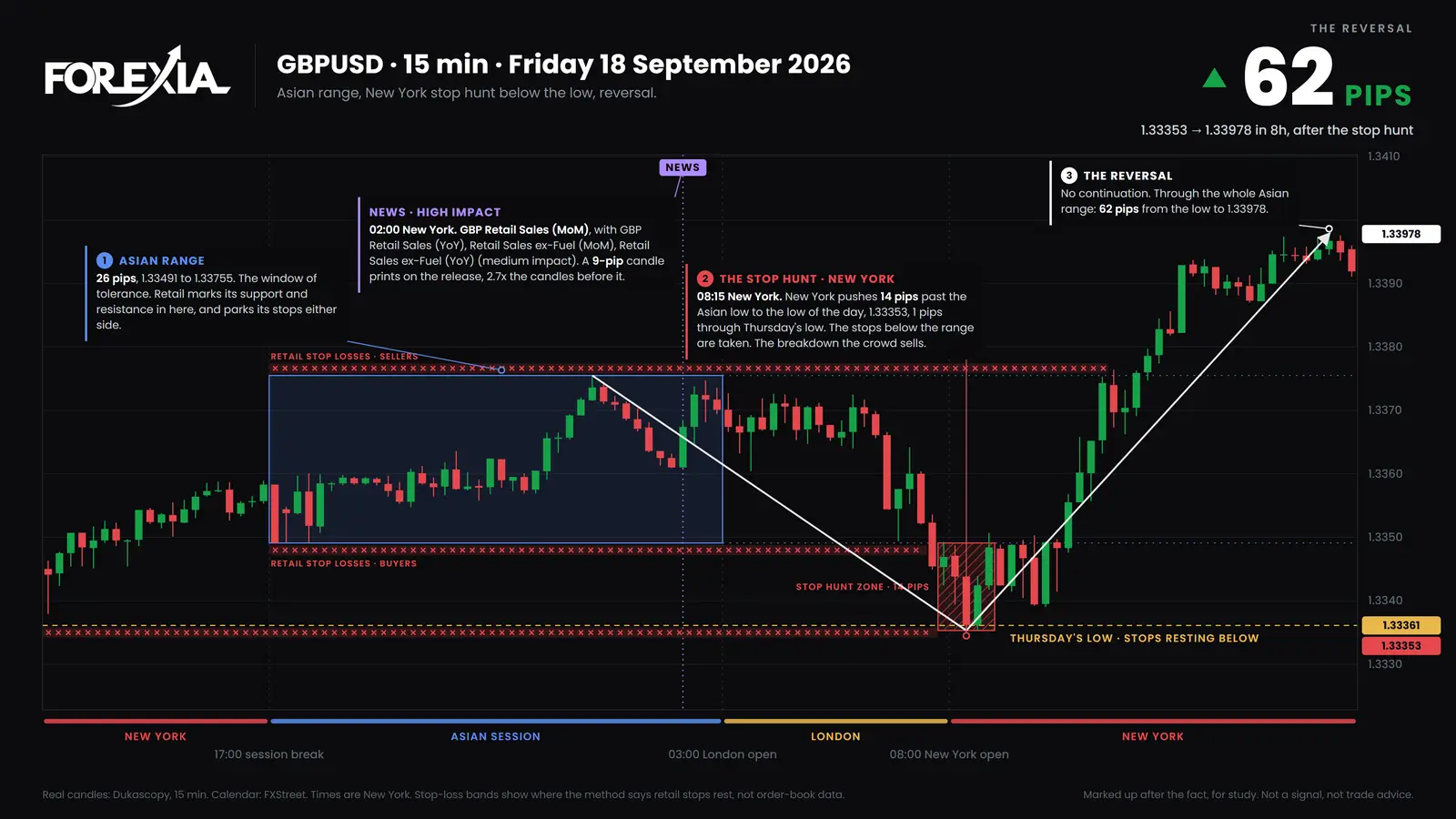
The Three Seats read that day differently. Retail sees a dull night, a breakdown to join and a reversal from nowhere. We read the market maker's seat as one plan: orders built around a range, a break that brings the crowd in, then a fill against them. The observer calls no direction and asks only which phase has been reached. Nobody can see who sold or who bought. We can see what closed where.
Best time to trade forex: by pair and by goal
The best time to trade forex depends on your goal, but if the goal is movement, the answer is the same on every market we counted: the London and New York overlap. This table gives the median range of each window in pips, with pips an hour in brackets, on seven majors and gold from 6 April to 1 October 2026. All of it is in one setting of the clocks, New York and London both on summer time.
| Market | Asia, 10 hours | London alone, 5 hours | Overlap, 4 hours | New York after London, 5 hours |
|---|---|---|---|---|
| EUR/USD | 23 (2.3) | 24 (4.7) | 29 (7.3) | 19 (3.7) |
| GBP/USD | 30 (3.0) | 32 (6.4) | 40 (9.9) | 24 (4.8) |
| USD/JPY | 41 (4.1) | 31 (6.3) | 35 (8.7) | 25 (5.1) |
| USD/CHF | 24 (2.4) | 21 (4.3) | 27 (6.6) | 17 (3.3) |
| AUD/USD | 25 (2.5) | 20 (4.1) | 24 (6.0) | 15 (2.9) |
| USD/CAD | 23 (2.3) | 22 (4.5) | 31 (7.7) | 20 (4.1) |
| NZD/USD | 26 (2.6) | 18 (3.6) | 22 (5.5) | 14 (2.7) |
| Gold | 54 (5.4) | 33 (6.6) | 50 (12.5) | 31 (6.1) |
The overlap moved most per hour on all eight, and Asia least. The hourly figure is simple division, and a range does not grow evenly with time, so read it as a ranking and not a rate. By goal:
- The most movement: the overlap, 08:00 to 12:00 New York.
- Reading a level before the crowd reaches it: the night. Asia's range was about 60% of the day's on NZD/USD, USD/JPY and AUD/USD, and about 45% on EUR/USD, GBP/USD and USD/CAD, so the Pacific pairs and the yen do more of their moving there.
- The day's extremes: of the 2,060 highs and lows of those days, 39% printed in Asia, 13% in London alone, 25% in the overlap and 22% in New York after London. By its share of the clock (42%, 21%, 17% and 21%), the overlap prints more than its share and London alone far less.
- The quietest hours: Asia per hour, then New York after London's close.
Our pair guides take this hour by hour: the best time to trade EUR/USD, GBP/USD and USD/JPY, and gold has its own trading hours page.
Three limits. Range is not profit: our fixed test lost money in London and in New York alike, as the stop hunt page sets out. Spreads are usually said to be tightest in the overlap, and we have not counted that here, because this feed is bid prices only. And you will read that more than half of all forex volume trades in the overlap. We could not find a primary source for it. The BIS survey counts turnover by where the desk sits, not by the hour.
Sunday open and the weekend gap: when does forex start?
Forex opens at 17:00 New York on Sunday, which is 21:00 UTC while New York is on summer time and 22:00 UTC while it is not. Gold starts an hour later on our feed, at 18:00. In Sydney that moment is 07:00 on Monday in July, 08:00 in the weeks either side and 09:00 in January. So a table saying the market opens with Sydney at 07:00 is wrong for much of the northern winter: that hour arrives before the market does.
The weekend gap is usually small. Over the 26 Sundays from 5 April to 27 September 2026, the median gap between Friday's last close and Sunday's first open ran from 8 to 12 pips on the seven majors, and 15 on gold. On 147 of those 207 market-weekends price traded back to Friday's close by the London open on Monday. These are bid prices, and the spread is wide at that open, so a small gap can be only the spread.
Now and then it is not small. The biggest gap of the sample on five of the eight markets came on one Sunday, 12 April 2026: gold from 4746.94 to 4635.00, 112 pips, and EUR/USD from 1.17216 to 1.16739, 48 pips. Our guide to the forex Sunday open takes it from there.
Common mistakes with session times
Five cost the most, and they are all about which clock you are looking at.
- Using one table all year. A table in UTC or New York time is an hour out for part of the year. Keep the table in each city's own time, or use the clock.
- Trusting your platform's clock. Many brokers set their server so that 17:00 New York reads as midnight, which puts it two hours ahead of UTC in the US winter and three in the US summer. A 10:00 candle on that chart is not 10:00 in London. Compare it with a clock you trust.
- Taking a session for a bell. Nothing happens at 08:00 because a table says so. Tables differ: London ends at 16:00 in some and 17:00 in others, and some add Frankfurt, an hour ahead of London, or Wellington, Singapore and Hong Kong. Read what closed, not what time it is.
- Reading the rollover as a real price. At 17:00 New York spreads widen and our bid-price feed can print a wick that is only the spread. Check a low made there on a second chart. Many brokers pause briefly at that minute too.
- Forgetting that gold's day starts late. On our feed gold has no candles in the first hour after the break, so its night on a 15-minute chart is shorter than EUR/USD's on the same day, though it ends at the same time.
Course 2 of ForexiaPRO, The Chaos Pattern, teaches this read step by step, from lesson 2.1.1, Asia Sets It, London Breaks It, New York Turns It, to lesson 2.4.1, The New York Reversal.
How it works
- Asian Range Forex: Why Ten Quiet Hours Are Where the Orders Sit
What the Asian range in forex is for: ten quiet hours build orders on both sides. GBP/USD on three real days and how often each pair's day was set in Asia.
- Best Forex Pairs to Trade During the London Session: What We Counted, and Three Real Mornings
The best forex pairs to trade during London session, by what we counted: range, spread and hunts on eight markets, then three real mornings with limits.
- Asian Session Strategy: How Asia Sets the Day, London Breaks It and New York Turns It
An Asian session strategy starts with what the night leaves. Three real days, USD/CHF and EUR/USD, and how often Asia, London and New York ran in order.
Real days
- London Open Stop Hunt: What the Break of Yesterday's Extreme Looked Like
A London open stop hunt past yesterday's extreme on EUR/USD and gold, a day the break stayed, and a count of how often that level closed back the same day.
- NY Session Reversal: When New York Undoes the London Move, and Why
A NY session reversal on three real days, NZD/USD, EUR/USD and GBP/USD in 2026: when it comes, what the crowd's averages said, and one that stopped short.
- London Session Reversal: Three Days When London Did the Hunt and the Turn
A London session reversal on three real days, EUR/USD and GBP/USD: the stops run and the turn come before New York opens. How often it happens.
Questions
- Why Does the London Breakout Fail? Watch It From the Crowd's Seat
Why does the London breakout fail? The crowd enters together and its stops queue behind it. Real days on USD/CAD and EUR/USD, and how often the break held.
- Does the London Breakout Strategy Work? Two Days That Did Not Turn, and What a Count Cannot Show
Does the London breakout strategy work? Real days on GBP/USD and AUD/USD, a count of 745 breaks, and exactly what that count cannot tell you about a trade.
The words
- The Asian Box: How to Draw the Asian Range, and What Its Breakout Really Is
The Asian Box is the Asian range drawn on the chart. How to draw it, how big it runs on eight markets, and its breakout on gold, 25 September 2026.
- The Chaos Pattern: The Daily Cycle Behind Every Asian Session Strategy
The Chaos Pattern is the daily cycle: Asia, London, New York. One gold day, 20 August 2026, and what 1,030 market-days did with the three phases.
- The London Breakout: What the Strategy Says, and Why the Crowd Buys the Top
The London Breakout is the move out of the Asian range at the London open. The strategy's rules, USD/CAD on 30 July 2026, and 745 breaks counted.
- The New York Reversal: Why New York Undoes London, and How Often It Does
The New York Reversal is the dealer moving against London's breakout. NZD/USD on 13 July 2026, a day it did not come, and a count of 458 days.
- The Window of Tolerance: What the Quiet Asian Range in Forex Is For
The Window of Tolerance is the calm Asian range where most traders place their orders. What it does to them, on GBP/USD, 27 August 2026, candle by candle.
Frequently asked questions
What are the forex market hours?
Forex trades around the clock from 17:00 New York on Sunday to 17:00 New York on Friday. That is 21:00 or 22:00 UTC, depending on whether New York is on summer time. There is no exchange and no bell, so a broker's own hours can differ by a few minutes, and many pause briefly at the daily 17:00 New York rollover.
What are the forex session times?
By the usual convention, each in its own city's time, Monday to Friday: Sydney 07:00 to 16:00, Tokyo 09:00 to 18:00, London 08:00 to 17:00 and New York 08:00 to 17:00. In northern summer that is 21:00, 00:00, 07:00 and 12:00 UTC for the opens. In northern winter it is 20:00, 00:00, 08:00 and 13:00 UTC.
What time does the London session open?
08:00 in London all year. That is 07:00 UTC while the UK is on summer time and 08:00 UTC while it is not. In New York time it is 03:00, except for three or four weeks a year when the two countries' clocks are out of step, when it is 04:00.
What time is the New York session in forex?
08:00 to 17:00 New York time all year. That is 12:00 to 21:00 UTC while New York is on summer time and 13:00 to 22:00 UTC while it is not. It overlaps London from 08:00 to 12:00 New York, and to 13:00 New York in the weeks the clocks are out of step.
What is the best time to trade forex?
It depends on what you want from the market. If you want movement, the London and New York overlap moved most per hour on all eight markets we counted, and Asia moved least. More movement is not more profit, though. Our own test of the setup as a fixed rule lost money in London and in New York alike.
Do session times change with daylight saving?
In a city's own time they do not. In UTC they do, because New York, London and Sydney change their clocks on different dates and Tokyo never changes. New York moves first in March and last in the autumn, so for three or four weeks a year London opens at 04:00 New York instead of 03:00, and the overlap with New York is five hours instead of four.
When does the forex market open on Sunday?
At 17:00 New York, which is 21:00 or 22:00 UTC. In Sydney that is 07:00 on Monday in July and 09:00 on Monday in January, so 'the market opens with Sydney at 07:00' is only true for part of the year. Gold starts an hour later on our feed, at 18:00 New York.
What is the London and New York overlap?
The hours when both sessions are open: 08:00 to 12:00 New York, or 13:00 to 17:00 London. In UTC it is 12:00 to 16:00 in northern summer and 13:00 to 17:00 in northern winter. In the weeks the clocks are out of step it runs 12:00 to 17:00 UTC, five hours instead of four.
Does the New York session reverse London?
Sometimes, and less often than the phrase suggests. Of 458 market-days when London's break of the Asian range still stood at New York's open, New York ran past London's extreme and then closed back inside the range on 91. It closed back with no new extreme on 173, and did not close back on 194.
Why does the London open fake out the Asian range?
We read it this way: a quiet night leaves two obvious edges with the crowd's stops just past them, and the first move out brings breakout traders in. Nobody can see those orders, so that is a reading. It does not happen every day. London undid its own break by New York's open on 287 of the 745 days it closed outside the range.
Is the forex market open on bank holidays?
Usually, but thinly. A holiday closes the banks in one centre while the others keep trading, so that centre's session is quiet and spreads can widen. Around Christmas and New Year many brokers shorten their hours, and they publish them in advance. A session table and our clock do not know about holidays, so check your broker's notice.
The latest chart markups
- Reverse Price Action: How to Read a Forex Chart Markup
Reverse price action reads a chart from the side of the crowd: where retail orders and stop losses sit, and how price collects them. A visual guide.
- EURUSD Stop Hunt: Forex Chart Markups, 28 September 2026
An EURUSD stop hunt through Tuesday's high on US PCE data completed an M formation and fell 165 pips. Chart markups, 28 September 2026.
- USDCHF Stop Hunt: Forex Chart Markups, 21 September 2026
A USDCHF stop hunt fired in the candle of the SNB rate decision and reversed 68 pips. Real chart markups, week of 21 September 2026.