
The Window of Tolerance: What the Quiet Asian Range in Forex Is For
The Window of Tolerance is the calm Asian range in which most traders place their orders. It is the Asian range in forex seen from inside: about ten quiet hours from the 17:00 New York session break to the London open. We read the quiet as the point. The Asian Box is the two lines drawn around it, and this word is about what those hours do.
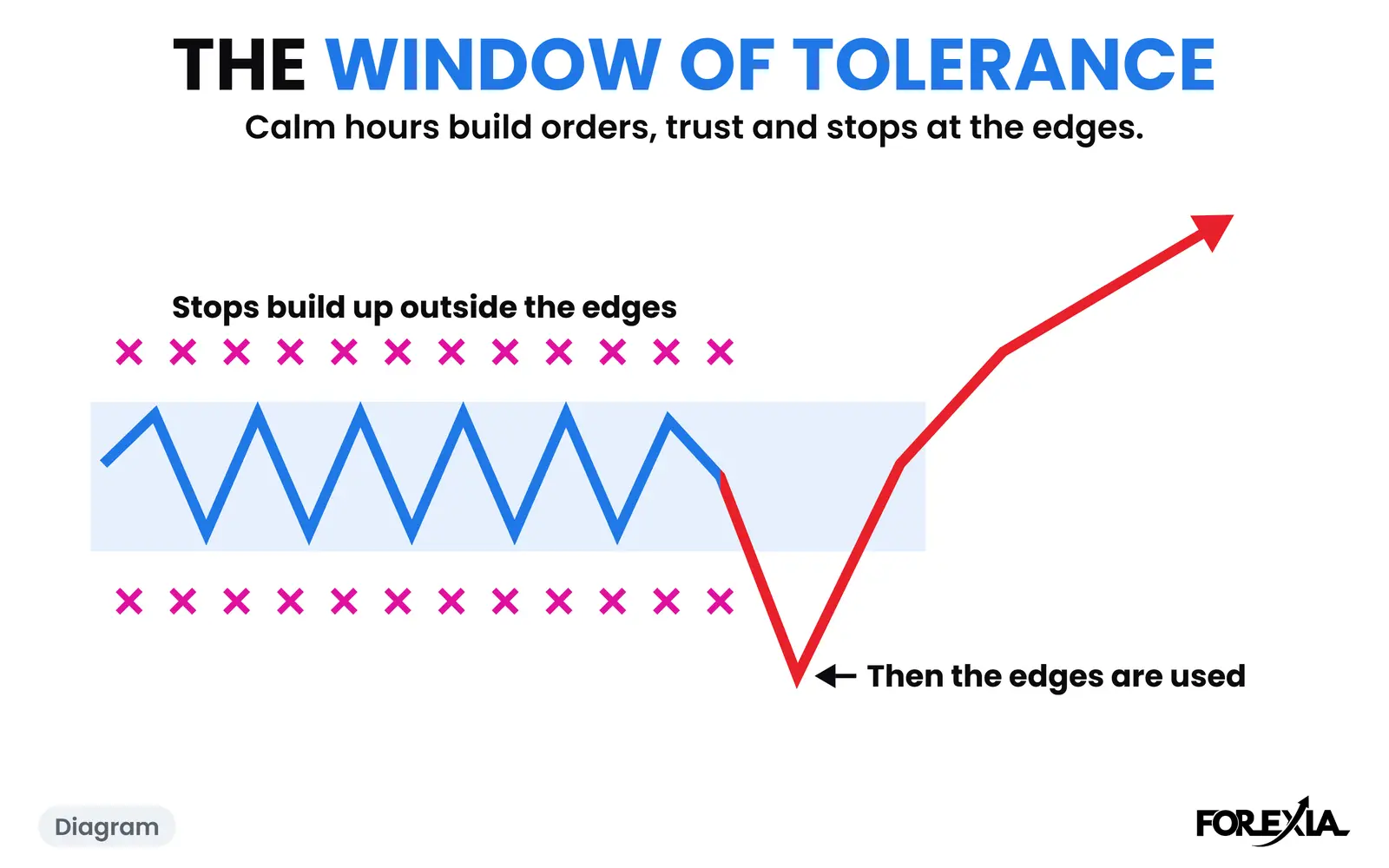
What does the Window of Tolerance look like on a chart?
It looks like nothing happening. On GBP/USD on Thursday 27 August 2026 the whole night fit inside 13 pips, 1.35850 to 1.35977, against a median of 30 pips for the pair over the 25 weeks and four days we counted. Its 40 candles averaged about 3.5 pips each, and every close sat between 1.35870 and 1.35971.
The edges did the rest. The nine candles from 18:00 to 20:00 New York all came within 2 pips of the top. Eight of the last ten before London came within 2 pips of the bottom, and none closed under it. To anyone watching, that is support, tested and held.
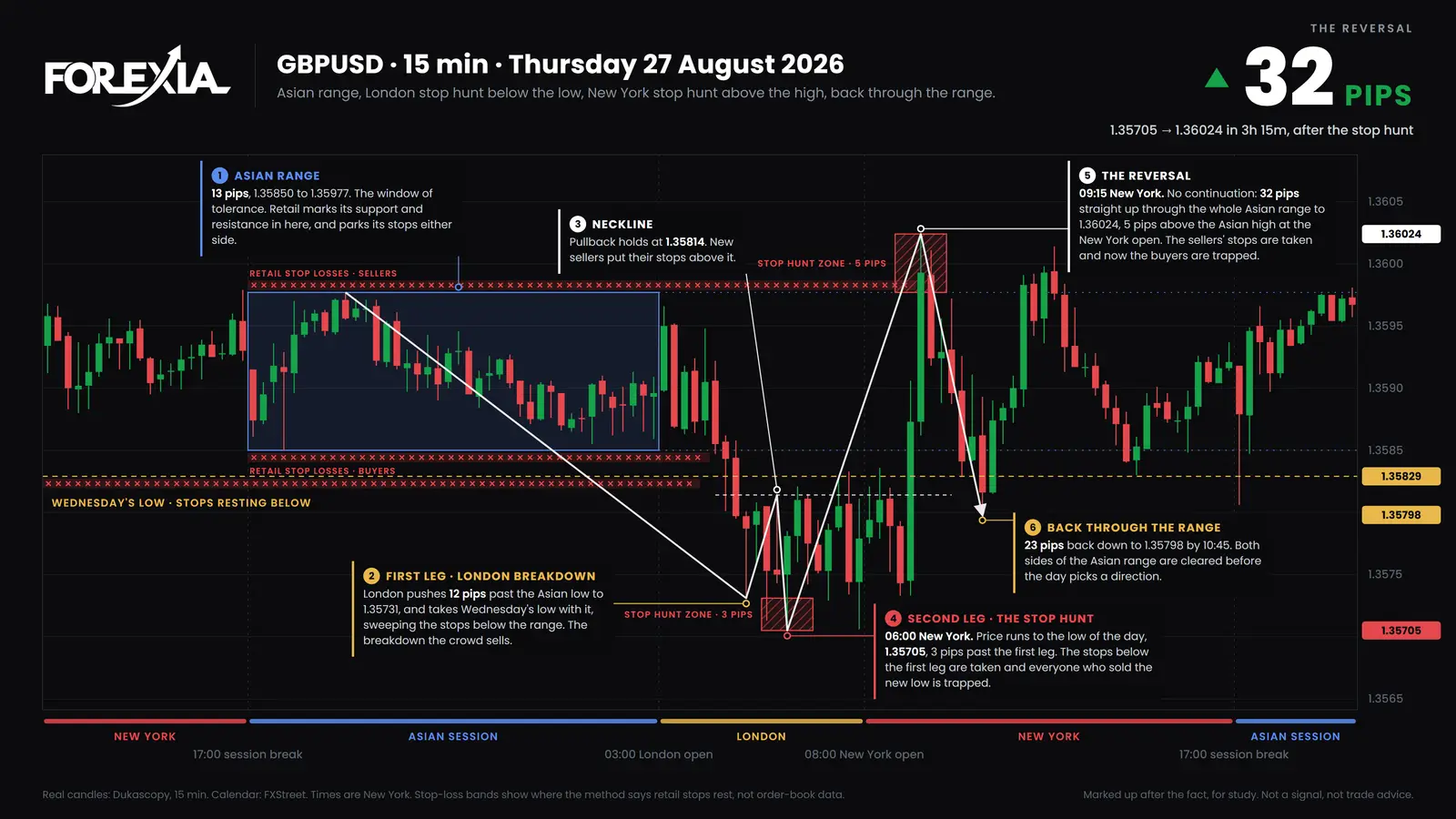
Then it was used. The 04:30 candle, which opened an hour and a half into London, closed under the box at 1.35843. By 06:00 price had reached 1.35705, about 15 pips under it and past Wednesday's low of 1.35829. The 09:00 candle closed back inside at 1.35873, and at 09:15 price reached 1.36024, 32 pips off the low and 5 over the top of the box. The bottom edge held all night, and within seven hours of the London open both edges had been traded through.
What does the Window of Tolerance do to traders?
We read it as doing three things, all of them to the crowd.
- It builds orders. Every few pips someone buys near the bottom or sells near the top, and each of those trades leaves a stop just outside the range.
- It builds trust in the edges. The more often price turns at a line, the more it looks like real support or resistance, and the more stops sit just past it.
- It wears people down. Ten hours of a few pips makes a trader impatient. When the first move out comes, it looks like the one they waited for.
That is the retail seat in the Three Seats. The next phase of the Chaos Pattern is built on it, and how the three forex sessions fit together is on the hub.
The Window of Tolerance and the Asian range in forex: how do they differ?
The Asian range is a measurement. The Window of Tolerance is a reading of it. Search for the range and you get a high, a low and a clock, and the clocks disagree: 19:00 to midnight New York, 20:00 to midnight, 00:00 to 07:00 GMT. Then the guide asks how to trade it.
Our word asks a different question: what were those hours for? The answer does not depend on the exact window, because it is about the behaviour inside the night, though we do draw our box from the session break to the London open. How to mark the range and what it does next is in our Asian range forex guide, and the typical size of the box on each market is on its own page. In the same 25 weeks and four days, a median box ran from 40% of the pair's average day on EUR/USD and GBP/USD to 52% on NZD/USD.
Why so quiet? Less of the market is at its desk. Sales desks in Singapore and Hong Kong handled 11.8% and 7.0% of world forex turnover in April 2025, against about 38% in the UK and 19% in the US.
What can the Window of Tolerance not tell you?
It cannot show you the orders. Nobody outside a broker's book sees them, and the stop bands on our charts are a reading of the structure, not order-book data. It does not tell you which way the day will go, or whether the next session will move at all. Our own test of the setup as a mechanical rule did not make money.
How do you spot the Window of Tolerance?
Look for a night that is going nowhere. The candles are small against the pair's normal night, the closes bunch together, price keeps turning at the same two edges, and Asia ends near where it began. A night with a move in it is something else: a box around a fall has edges too, but they mark where the move started and stopped. Seeing where the crowd's orders rest is the habit we call Liquidity Visualization.
What do traders get wrong about the Window of Tolerance?
Three readings cost the most.
- The edges are real support and resistance. That bottom edge held all night. London closed under it within two hours.
- Quiet means nothing is happening. With candles of 3.5 pips there is little to trade, but this is when the stops pile up.
- The first move out is the move. That morning the first close out of the box was down. By 09:15 price was over the top.
Which words does the Window of Tolerance lead into?
Two sit next to it.
- The Asian Box: the same night drawn as two lines on the chart.
- Liquidity Visualization: using market structure to see on the chart where the crowd's orders rest.
Where is the Window of Tolerance taught?
Course 2 of ForexiaPRO, The Chaos Pattern, teaches this read step by step in lesson 2.1.2, The Window of Tolerance: Ten Hours of Quiet.
Related words
Frequently asked questions
What is the Window of Tolerance in forex?
It is Forexia's name for the calm Asian range in which most traders place their orders: about ten quiet hours from the 17:00 New York session break to the London open. We read the quiet as the point, because the orders for the next session build there.
Is the Window of Tolerance the same as the Asian range?
They cover the same hours and ask different questions. The Asian range is a measurement: the high and low of the night. The Window of Tolerance is what those hours do to the traders in them: orders placed, edges trusted, patience worn down.
Why is the Asian session so quiet?
Less of the market is at its desk. Sales desks in Singapore and Hong Kong handled 11.8% and 7.0% of world forex turnover in April 2025, against about 38% in the UK and 19% in the US. That the quiet is also where orders gather is our reading, and it cannot be seen in public data.
Are the edges of the Asian range real support and resistance?
They look it, because price turned there all night. We read those turns as what builds the crowd's stops just past each edge. On GBP/USD on 27 August 2026 the bottom held through eight close approaches, and then London closed under it and reached about 15 pips below.