
The Chaos Pattern: The Daily Cycle Behind Every Asian Session Strategy
The Chaos Pattern is the daily cycle: Asia sets the scene, London breaks it and New York reverses it. Consolidation, then breakout, then reversal. An Asian session strategy trades one part of that day. This word reads all three, and asks which phase the chart is in. It is a map of the day and not a forecast, and most days do not run all of it.
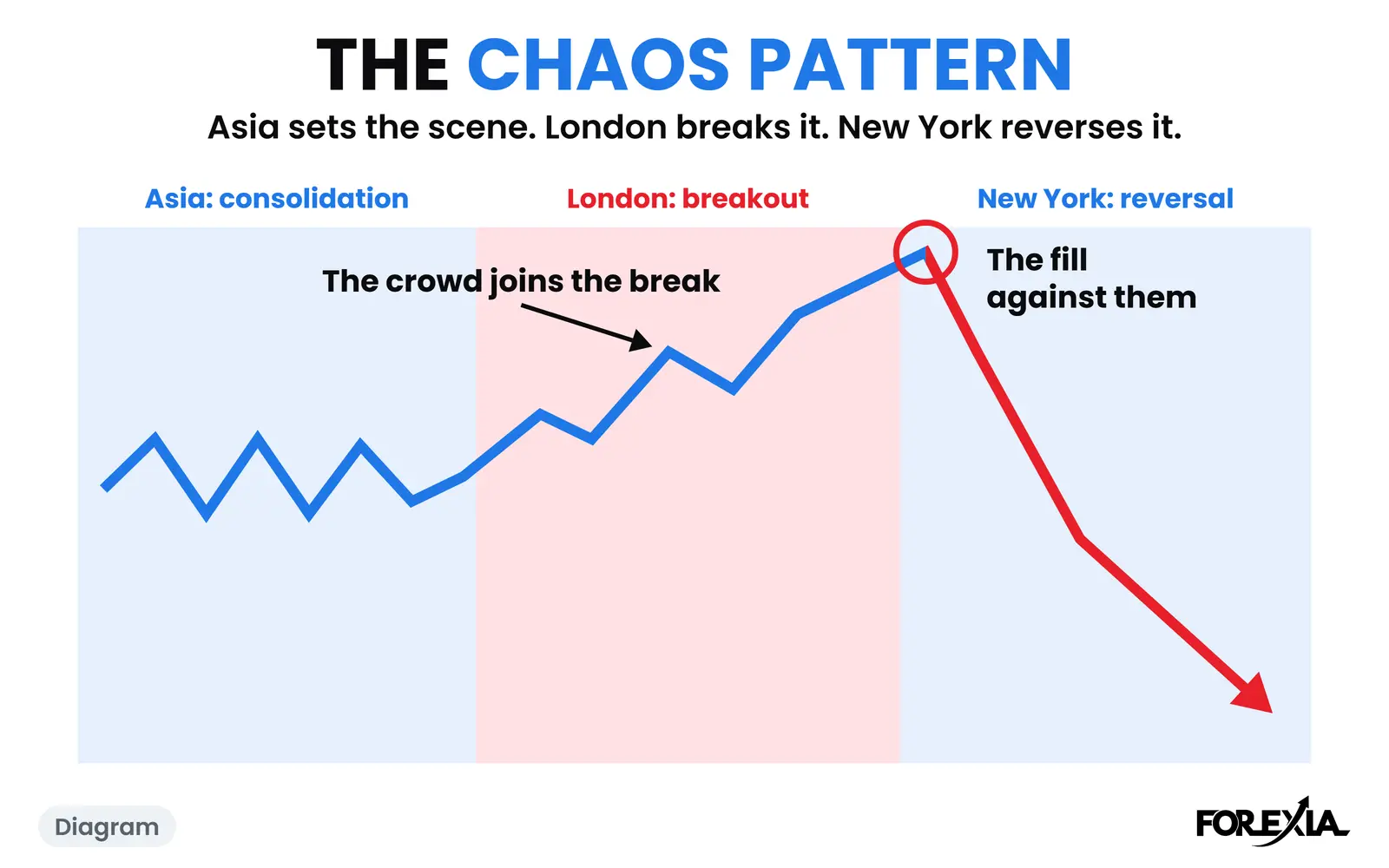
What does the Chaos Pattern look like on a chart?
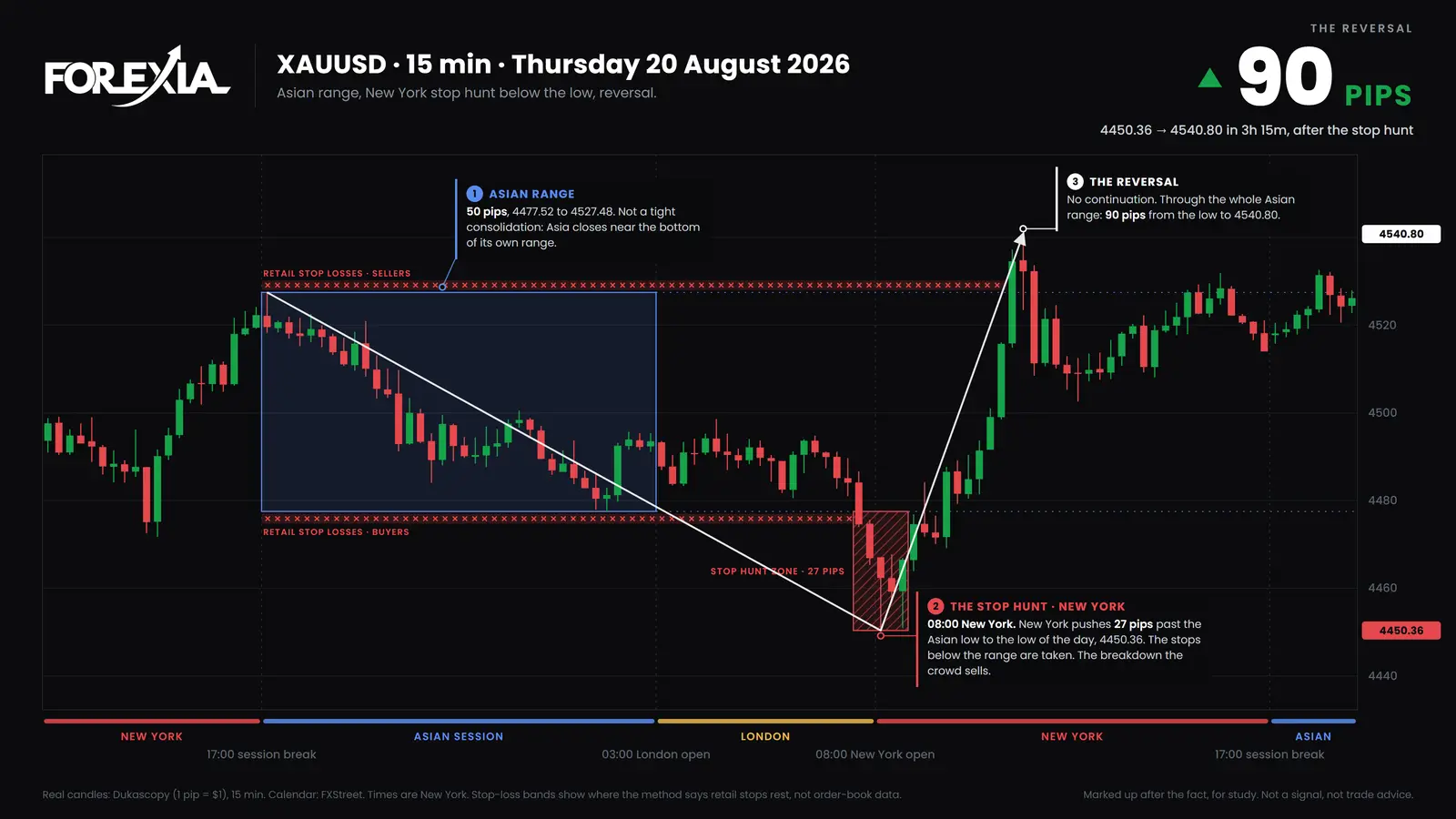
It looks like three different markets on one chart. On gold on Thursday 20 August 2026, where we count $1 as 1 pip, the phases came in order, and the low came half an hour before the morning's US releases at 08:30, all medium impact.
- Asia, the consolidation. The Asian Box ran from 4477.52 to 4527.48, 50 pips. It was a slide more than a tidy range, with the high at the first candle and the close near the bottom.
- London, the breakout. For four and a half hours nothing left the box. Then the 07:30 candle closed under it at 4474.57, and by the end of London price had reached 4465.30, 12 pips under. That is the London Breakout, late and downward.
- New York, the reversal. The first New York candle ran to 4450.36, 15 pips past London's low and 27 under the box: the Stop Hunt, what most traders call a liquidity sweep. The 09:30 candle closed back inside at 4486.56, and the 11:00 candle closed over the whole box at 4534.56. By 11:15 price was at 4540.80, 90 pips off the low. This is the New York Reversal.
The Three Seats see that day differently. The crowd sees three separate events: a dull night, a breakdown to join and a reversal from nowhere. We read the market maker's seat as one plan: orders building around a range, a break that brings the crowd in on one side, then a fill against them. The observer does not call a direction. The observer asks which phase has been reached.
The Chaos Pattern and an Asian session strategy: what is the difference?
An Asian session strategy is a way to trade the night. Guides offer two: sell the top and buy the bottom of the range, or wait and trade its break at the London open. Both treat Asia as the event.
The Chaos Pattern treats Asia as the first of three phases. The night matters for what it leaves behind, and it has no entry in it. So the two answer different questions. One asks how to make money between the session break and the London open. The other asks what the night is setting up. Our guide to the Asian session strategy takes the how-to and the pairs, and what each forex session does is on the hub.
The night is quiet for a plain reason: most of the money sits elsewhere. Sales desks in the UK and the US handled about 38% and 19% of world forex turnover in April 2025, against 11.8% in Singapore and 7.0% in Hong Kong. That the night's quiet is orders waiting for them is our reading, not something those figures show.
How often does a day run the whole Chaos Pattern?
About one day in four. We counted seven majors and gold on 15-minute candles from 6 April to 1 October 2026, without the rollover wick in the box. Of 1,030 market-days:
- 285 (28%): London never closed outside the box
- 287 (28%): London closed outside it, and by New York's open was back inside or across it
- 264 (26%): London's break still stood at New York's open, and a New York candle closed back inside the box
- 194 (19%): London's break stood, and no New York candle closed back inside
So the third line is the full pattern, and the second is the turn coming early. On 91 of those 264 days New York first went past London's extreme, the shape the gold chart shows. This counts candles, not trades: no entry, stop, cost or filter. Our own test of the setup as a mechanical rule did not make money.
How do you spot the Chaos Pattern?
Go back to that gold day and look at three places. The night slid from its first candle to 4477.52, wide for a range, but its edges are plain. Nothing closed outside them until 07:30, half an hour before New York. Then 09:30, when a close came back over the bottom edge. At each point the chart had shown only what had already closed. At 08:00 nobody could yet call that low the low.
What do traders get wrong about the Chaos Pattern?
Three readings cost the most.
- Calling London's break the trend. It is the second phase of three, though on 194 days in our count it did carry.
- Expecting all three every day. On more than a quarter of days London never closed outside the box, so there was no break for New York to reverse.
- Reading it backwards. A clean day like the gold one looks obvious once it is finished. At 08:00 that morning the crowd's sell was working, and a reversal seen afterwards is not a setup.
Which words does the Chaos Pattern lead into?
Five sit next to it.
- The Asian Box: the Asian range drawn on the chart.
- The London Breakout: the move out of it, where retail enters for the continuation.
- The New York Reversal: the dealer moving against that breakout.
- News-Induced Liquidity: the extra orders a scheduled release brings in at one known minute.
- The Weekly Script: the same idea a scale up, the week as a plan in advance.
Where is the Chaos Pattern taught?
Course 2 of ForexiaPRO, The Chaos Pattern, teaches this read step by step in lesson 2.1.1, Asia Sets It, London Breaks It, New York Turns It.
Related words
- The Asian Box: How to Draw the Asian Range, and What Its Breakout Really Is
- The London Breakout: What the Strategy Says, and Why the Crowd Buys the Top
- The New York Reversal: Why New York Undoes London, and How Often It Does
- News-Induced Liquidity: Why Price Spikes Both Ways on a Release
- The Weekly Script: Forex Weekly Analysis as a Plan in Three Parts
Frequently asked questions
What is the Chaos Pattern in forex?
It is Forexia's name for the daily cycle: Asia sets the scene, London breaks it and New York reverses it. Consolidation, then breakout, then reversal. It is a way of asking which phase today's chart is in, not a forecast of what comes next.
Does the Chaos Pattern happen every day?
Not all of it. Of 1,030 market-days on seven majors and gold, from 6 April to 1 October 2026, New York closed a standing London break back inside the Asian Box on 264. London never closed outside the box on 285, undid its own break on 287, and on 194 the break stood and New York did not close back inside.
Is the Chaos Pattern an Asian session strategy?
No. An Asian session strategy trades the night, either its edges or its breakout. The Chaos Pattern reads the night as the first of three phases and has no entry in it. A reversal seen afterwards is not a setup, and Forexia's own test of the setup as a mechanical rule did not make money.
Why does the pattern run Asia, then London, then New York?
Because that is the order the sessions open in, and most of the turnover sits in the last two. Sales desks in the UK and the US handled about 38% and 19% of world forex turnover in April 2025. We read the quiet night as orders building for the two sessions that follow. That last part is our reading, not something the data can show.