
The Three Seats: Retail Trader vs Market Maker, and the Observer Who Reads Both
The Three Seats are the retail trader, the market maker and the observer. They are three ways to read one chart, and they answer a question the usual retail trader vs market maker comparison leaves open: where do you stand? "Most traders spend their whole career in the first seat."
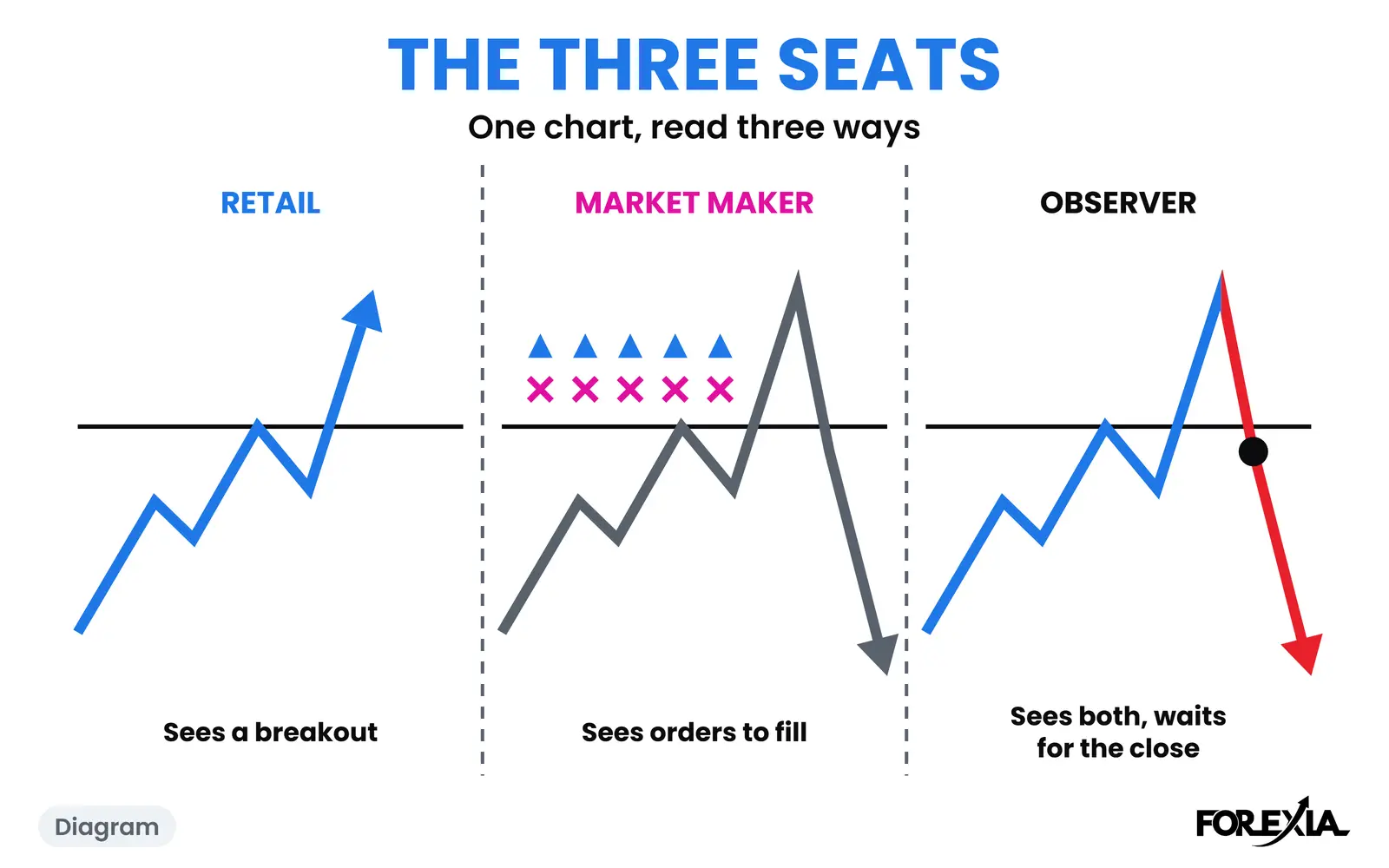
What do the Three Seats look like on a chart?
They look like one candle read three ways. On GBP/USD on Thursday 24 September 2026, the Asian Box ran from 1.32227 to 1.32505, 28 pips. At 03:45 New York a candle pushed 5 pips over the top, to 1.32557, and closed at 1.32458, 5 pips back under it. No high-impact release lined up with it. Two medium-impact speeches followed at once, from the Bank of England at 04:00 and the Fed at 04:10, and the chart's news note says so: the hunt fired 15 minutes before the 04:00 release.
| Seat | What it sees | What it wants | That 03:45 candle |
|---|---|---|---|
| Retail | A pattern: a breakout | A trade, and it fears missing the move | Buys the break, or has a sell stopped out |
| The market maker | Orders, not patterns | Its size filled where the orders rest | Needs buyers to sell to: the stops over the box and the breakout orders |
| The observer | The crowd's plan and the market maker's need | To see the trap spring, and it fears only acting too early | Waits for the close, which came back inside the box |
By 14:00 the pound was at 1.32041, 52 pips under the top of that candle and through the whole box.
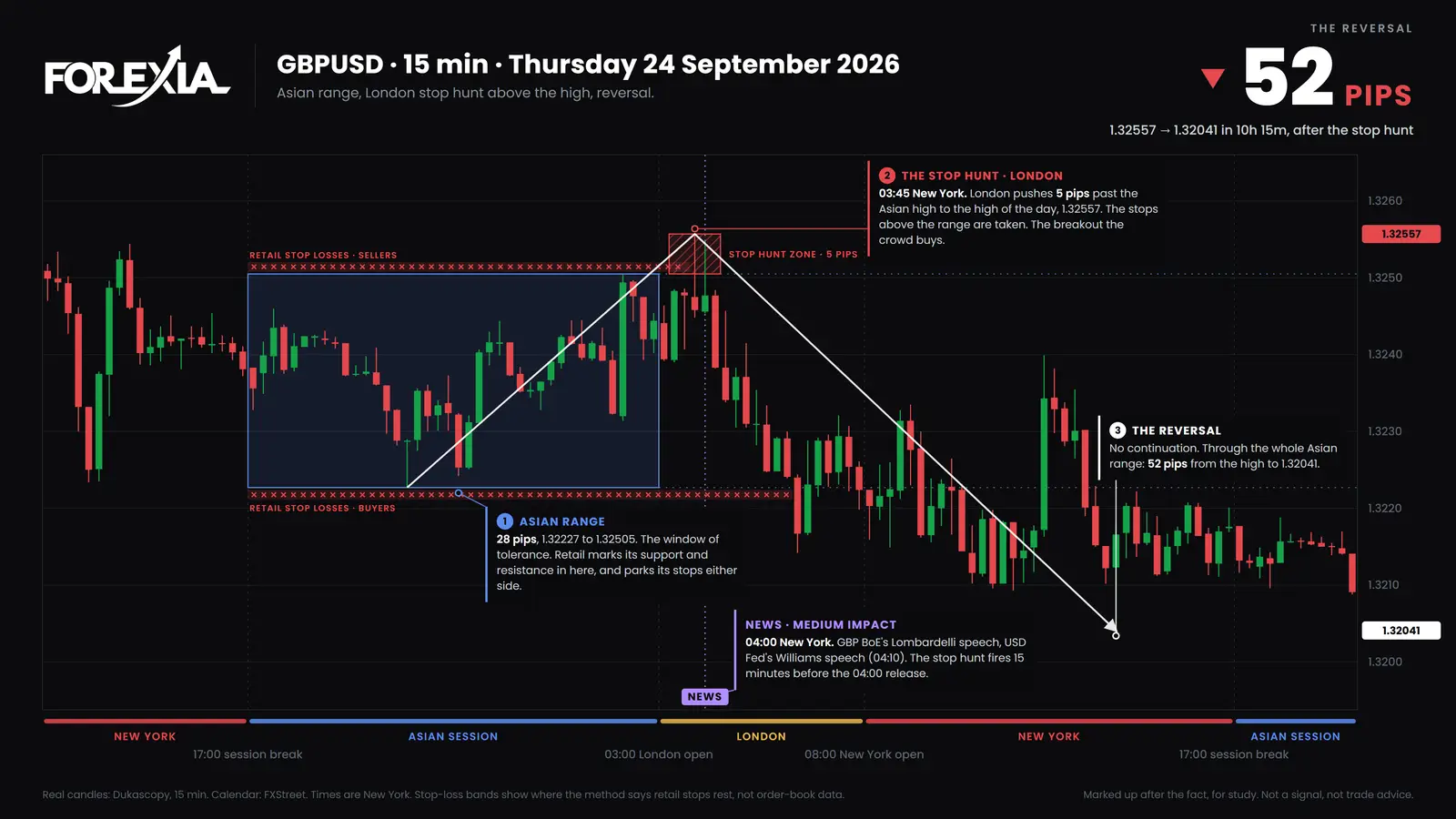
Read the middle row as what it is. Nobody outside can see those orders, and the stop bands on the chart are our reading of the structure, not order-book data. Read the last row carefully too. The observer reads what happened, and a turn seen afterwards is not a setup. Our own test of this setup as a mechanical rule did not make money.
The Three Seats and retail trader vs market maker: what is the difference?
The usual comparison has two sides. A retail trader is paid only if the direction is right. A market maker fills orders and is paid by the flow, so it wants activity more than it wants a direction. That part is sound, and what do market makers do in forex goes through it.
Two things get lost.
First, "market maker" is used for two different things: a broker quoting its own prices to you, and the banks and dealers providing liquidity between themselves. Our second seat means the second. The first is a question about your broker, and market maker vs ECN broker answers it.
Second, a two-way comparison gives you nowhere to stand. You cannot sit in the second seat: you do not have its orders or its flow. You can stay in the first and resent it, or take the third. The observer is not a participant with special access. It is a trader who reads what the other two are doing and waits for a close before saying which one happened. Retail traders vs institutional traders takes up the wider comparison.
Reading from all three on purpose has a name of its own: Perceptual Positioning.
How did that morning read from each seat?
From the retail seat it was simple. Asia had drawn a ceiling, London went through it, and a break over a ceiling is a reason to buy. Anyone short from inside the box had just paid for being there.
From the market maker's seat, which we can only reason about, the same push was useful. Those stopped shorts and those new buyers were all sending buy orders into one small space, 5 pips over the box, and anyone with size to sell had found the other side of the trade. Liquidity Mapping is how we mark where such a space could be.
The observer had neither job. When that candle ended back under the top of the box, all it had shown was that this push had not held. The fall to 1.32041 took until 14:00, and at 04:00 nobody in any seat knew about it. On a low the picture turns over: the buy becomes a sell, and the stops sit under the line.
What do traders get wrong about the Three Seats?
Three readings cost the most.
- Treating the market maker as a person to hate. It is a process: it fills orders where the orders are. You can read a process. You cannot read anger.
- Thinking the observer predicts. At 03:45 nobody knew the box would break the other way. The candle's close said only that this push had not held.
- Calling every stop-out a hunt. A stop that goes and price keeps going was a move against you. The Stop Hunt is a word for a specific move, and it can only be named afterwards.
Which words do the Three Seats lead into?
Four sit next to them.
- Perceptual Positioning: the act of reading one chart from all three.
- Dumb Money: the predictable retail herd the chart is built to trap.
- Reverse Price Action: reading a pattern backwards, from where its stops sit to how the bigger players use that pool.
- Liquidity Visualization: using market structure to reverse engineer the retail mindset and see liquidity on the chart.
Where are the Three Seats taught?
Course 1 of ForexiaPRO, Reading the Map, teaches this read step by step in lesson 1.1.2, Retail, Market Maker, Observer.
Related words
- Perceptual Positioning: The Trading Psychology of Reading One Chart From Three Seats
- Dumb Money: What It Means, and Where Dumb Money vs Smart Money Goes Wrong
- Reverse Price Action: Reading a Pattern Backwards, and What a Fake Breakout Really Is
- Liquidity Visualization: Seeing Where the Crowd's Orders Rest Before a Sweep
Frequently asked questions
What are the Three Seats in trading?
They are three places to read one chart from. The retail trader sees a pattern and wants a trade. The market maker sees orders and needs price to reach them. The observer sees both, waits for the candle to close, and reads what happened.
What is the difference between a retail trader and a market maker?
A retail trader is paid only if the direction is right. A market maker fills orders and is paid by the flow. In forex the phrase can mean two things: a broker that quotes its own prices, or the banks and dealers that provide liquidity between themselves. Forexia's second seat means the second.
Can a retail trader sit in the market maker's seat?
Not literally. You do not have its orders, its flow or its view of them. You can only reason about what it needs from the structure of the chart, and that is a reading, not a fact. Nobody outside can see those orders.
Is the market maker the enemy?
No. It is a process: it fills orders where the orders are. Anger at it does not help you read the chart, and no chart can show that a given candle was aimed at you.