
Dumb Money: What It Means, and Where Dumb Money vs Smart Money Goes Wrong
Dumb Money is Forexia's name for the predictable retail herd the chart is built to trap. In the usual dumb money vs smart money contrast the phrase is an insult. Ours is a description: dumb does not mean stupid, and plenty of clever people trade this way. It means predictable. You know where it buys, and where it sells when it is wrong.
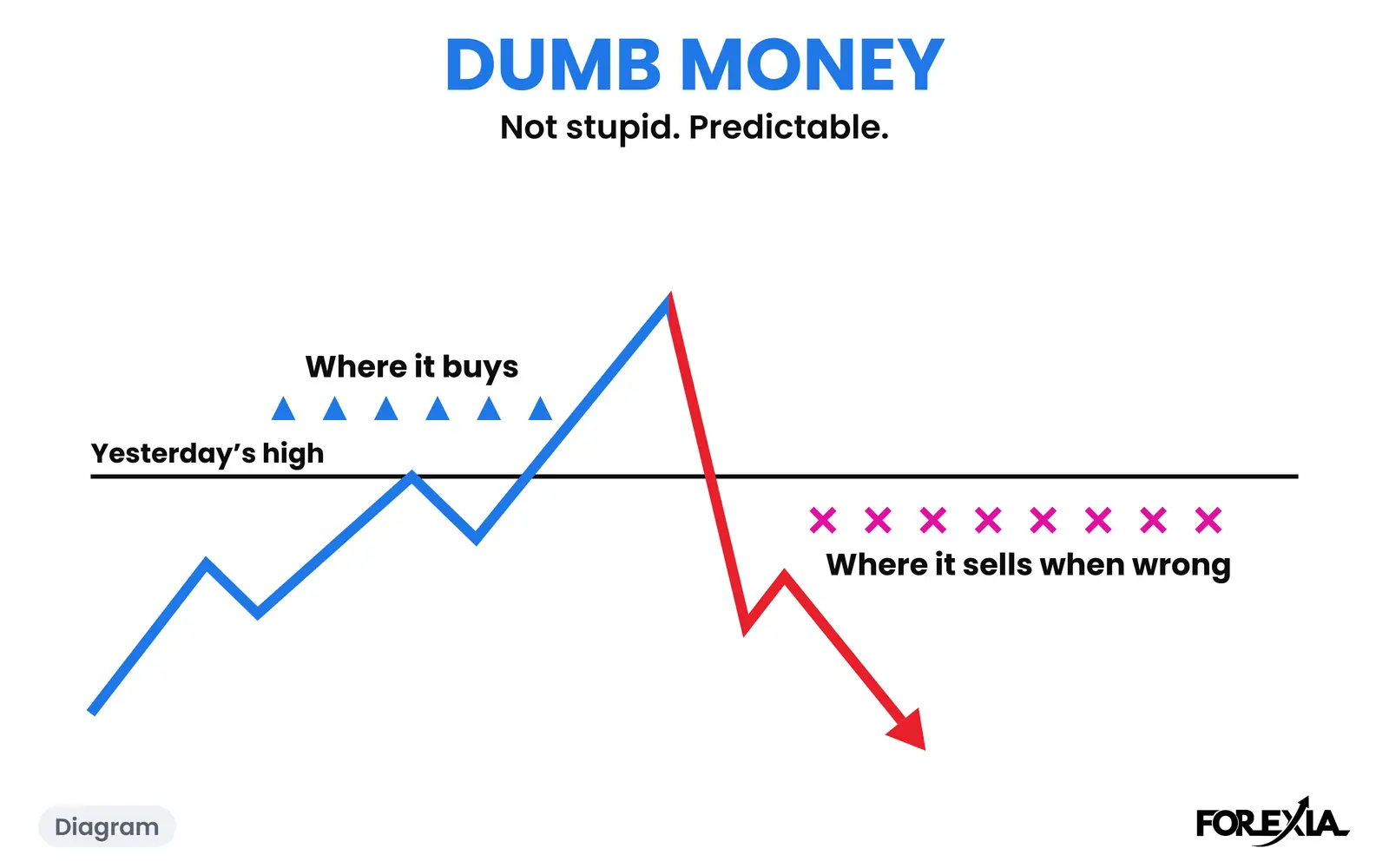
What does Dumb Money look like on a chart?
It looks like a good reason to buy. On EUR/USD on Wednesday 30 September 2026, Tuesday's high sat at 1.13740, above the Asian Box (1.13288 to 1.13572). London pushed over the box, reached 1.13639 at 06:00 New York, and pulled back.
At 08:30, on US core PCE inflation and final GDP, one candle opened at 1.13610, ran to 1.13803 and closed at 1.13744, over Tuesday's high. A break of yesterday's high, on the news, with a big candle behind it. That is the moment the book says it is safest to buy, and the stop goes just under the broken level.
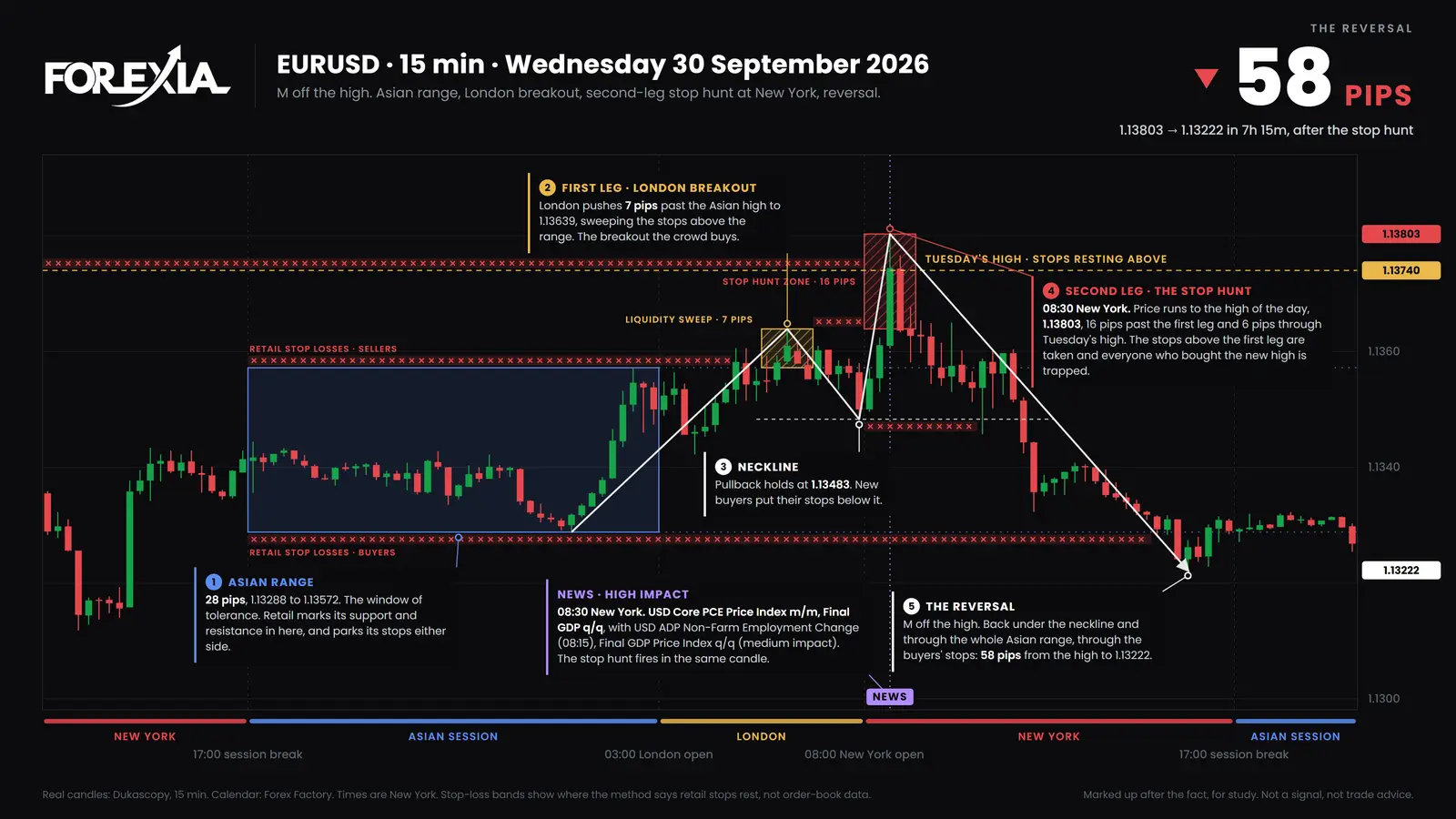
The next candle fell to 1.13633, 11 pips under Tuesday's high. A stop placed under the broken level was gone inside fifteen minutes. By 15:45 price was at 1.13222, 58 pips below the top of the breakout candle.
We read it this way: the crowd bought the break, and those orders were what a large seller needed. The confirmation was real, but what it confirmed was where the crowd would buy. Nobody outside can see those orders, so that is a reading. The candles are the fact.
Dumb Money and dumb money vs smart money: what is the difference?
The usual contrast is simple. Smart money means banks, funds and other large players. Dumb money means retail: late, emotional, under-informed. The phrase has a research history too. A 2005 NBER paper by Frazzini and Lamont says "fund flows are dumb money", about individual investors moving money between mutual funds and losing wealth over the long term.
Our word differs in two ways.
It is about predictability, not information. The trader on that candle may know the data better than most. What makes them Dumb Money is that the same candle, the same stop and the same reason are in every textbook.
And it does not come with an instruction to "follow the smart money." From outside, you cannot see it. You can see where the crowd was told to act, and reason from there, which is what the Three Seats are for. Dumb money vs smart money sets the two side by side and asks what each label can really tell you.
How do you spot Dumb Money?
You look for where the book tells everyone to act. Break of a level the whole market has drawn, a big candle on a release, a stop a few pips past the line. The previous day's high and low and the edges of the box are the usual places, and the London Breakout is the usual session.
The feeling is part of the signature. The more certain the entry feels, the more people are feeling it with you. How one trader ends up there is the subject of the NPC.
What do traders get wrong about Dumb Money?
Three mistakes matter.
- Stopping at the insult. It is a description of behaviour. Predictable is something you can change.
- Thinking the crowd is always wrong about direction. It often is not. What it gets wrong, again and again, is where it stands while the move starts.
- Calling every break a trap. Some run, and doing the opposite of every pattern is just another fixed instruction.
That last one can be counted. We counted seven majors and gold on 15-minute candles from 6 April to 1 October 2026. A level is an edge of the Asian Box, or the previous day's high or low if Asia had not traded past it. Taken means through it after the London open, by at least 3% of the average daily range, leaving out the wick of the first candle after the session break. Of 1,601 levels taken, 291 had not closed back by the end of the day, and those ran a median of 65% of the average day past the level.
That counts candles, not trades. Our own test of this setup as a mechanical rule did not make money, so a reversal seen afterwards is not a setup.
Which words does Dumb Money lead into?
Four sit next to it.
- The NPC: what trading education turns you into, a predictable bot who follows the trend.
- The Induction Trend: Sunday, Monday, Tuesday, the trend Dumb Money follows.
- The London Breakout: retail enters for the continuation, and the turn can come in London too.
- The Stop Hunt: price driven into clustered stops to fill the other side, commonly called a liquidity sweep.
Where is Dumb Money taught?
Course 1 of ForexiaPRO, Reading the Map, teaches this read step by step in lesson 1.1.3, Dumb Money and the NPC.
Related words
- The NPC: What Trading Education Turns You Into, and One Reason Most Traders Lose
- The Induction Trend: Why I Lose Money Trading the Trend the Week Starts With
- The London Breakout: What the Strategy Says, and Why the Crowd Buys the Top
- The Stop Hunt: What It Means, and How It Relates to a Liquidity Sweep
Frequently asked questions
What does dumb money mean in trading?
It usually means retail traders, set against the banks and funds called smart money. Forexia uses it for something narrower: the predictable retail herd the chart is built to trap. The word is about being predictable, not about being clever or not.
Are all retail traders dumb money?
No. The label describes what a trader does, not who they are. A retail trader who buys the same break as everyone else, with the stop where everyone else's is, is acting as dumb money that day. Plenty of clever people trade that way, because that is what they were taught.
Where does the phrase dumb money come from?
It is older than trading social media. A 2005 National Bureau of Economic Research paper by Andrea Frazzini and Owen Lamont says fund flows are dumb money, meaning that individual investors lose wealth over the long term by moving money between mutual funds. That is about stocks and fund flows. The same phrase on a forex chart is a looser use of it.
Can you make money by trading against dumb money?
Do not assume so. Some breakouts run, and being on the other side of them is a loss. Forexia's own test of its setup as a mechanical rule did not make money. Knowing where the crowd stands is a reading, not a result.