
The NPC: What Trading Education Turns You Into, and One Reason Most Traders Lose
The NPC is what trading education turns you into: a predictable bot who follows the trend and asks no questions. The label describes behaviour, not intelligence. It is one part of our answer to why most traders lose: the same patterns, the same confirmations and the same stops, run by thousands of traders on the same candle.
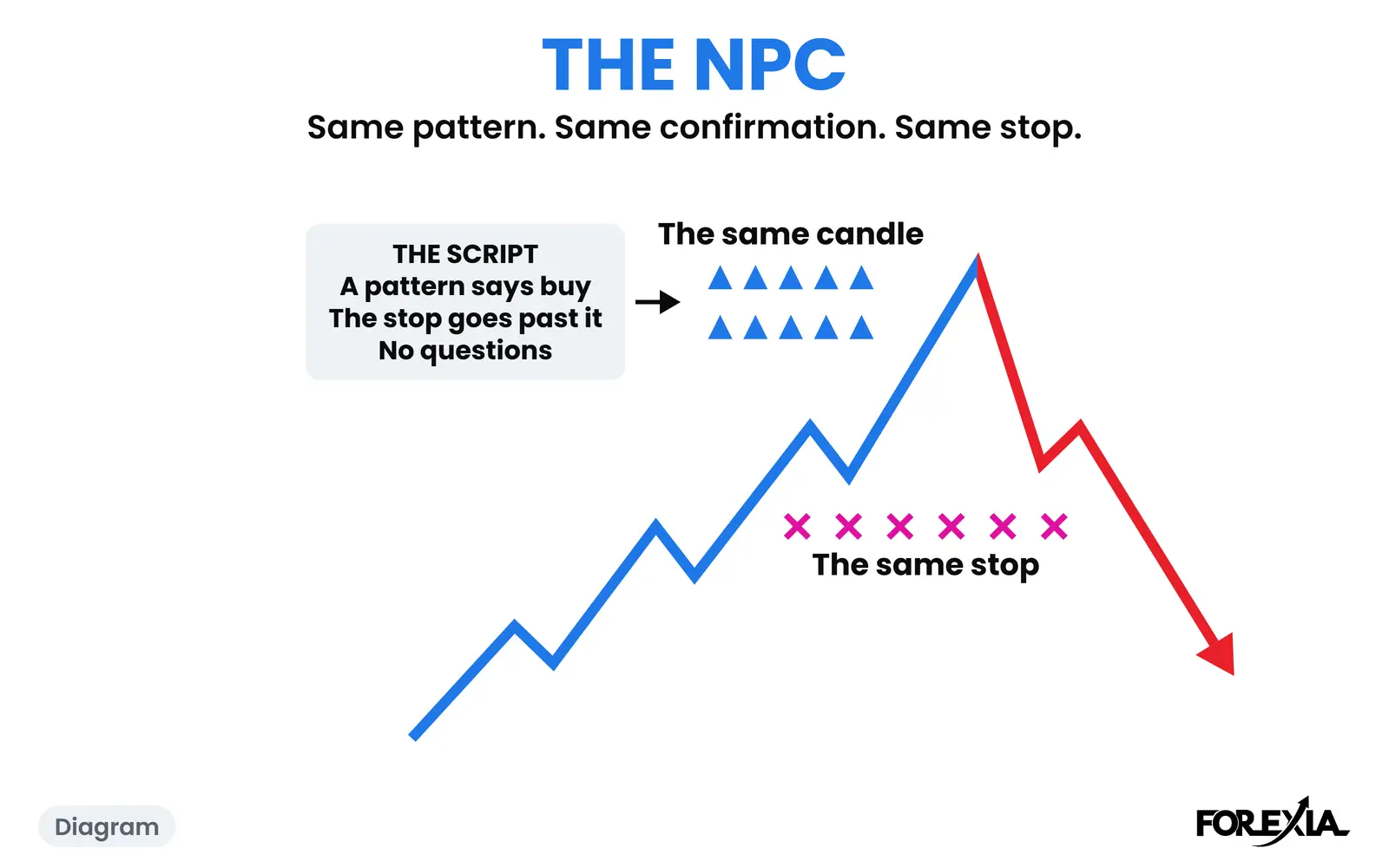
What does the NPC look like on a chart?
It looks like a sensible trade with nothing wrong with it. On USD/CAD on Thursday 1 October 2026 nothing high-impact was on the calendar, and the medium-impact US data came at 08:30 and 10:00 New York, not at the candles that matter here. London pushed over the top of the Asian Box (1.42498), reached 1.42582 at 06:00, then pulled back to 1.42316 by 09:45.
The dollar climbed again, and at 11:30 a candle broke London's high by 4 pips, to 1.42623. It was a new high of the day in a rising market. The pair had climbed more than 130 pips from the week's open.
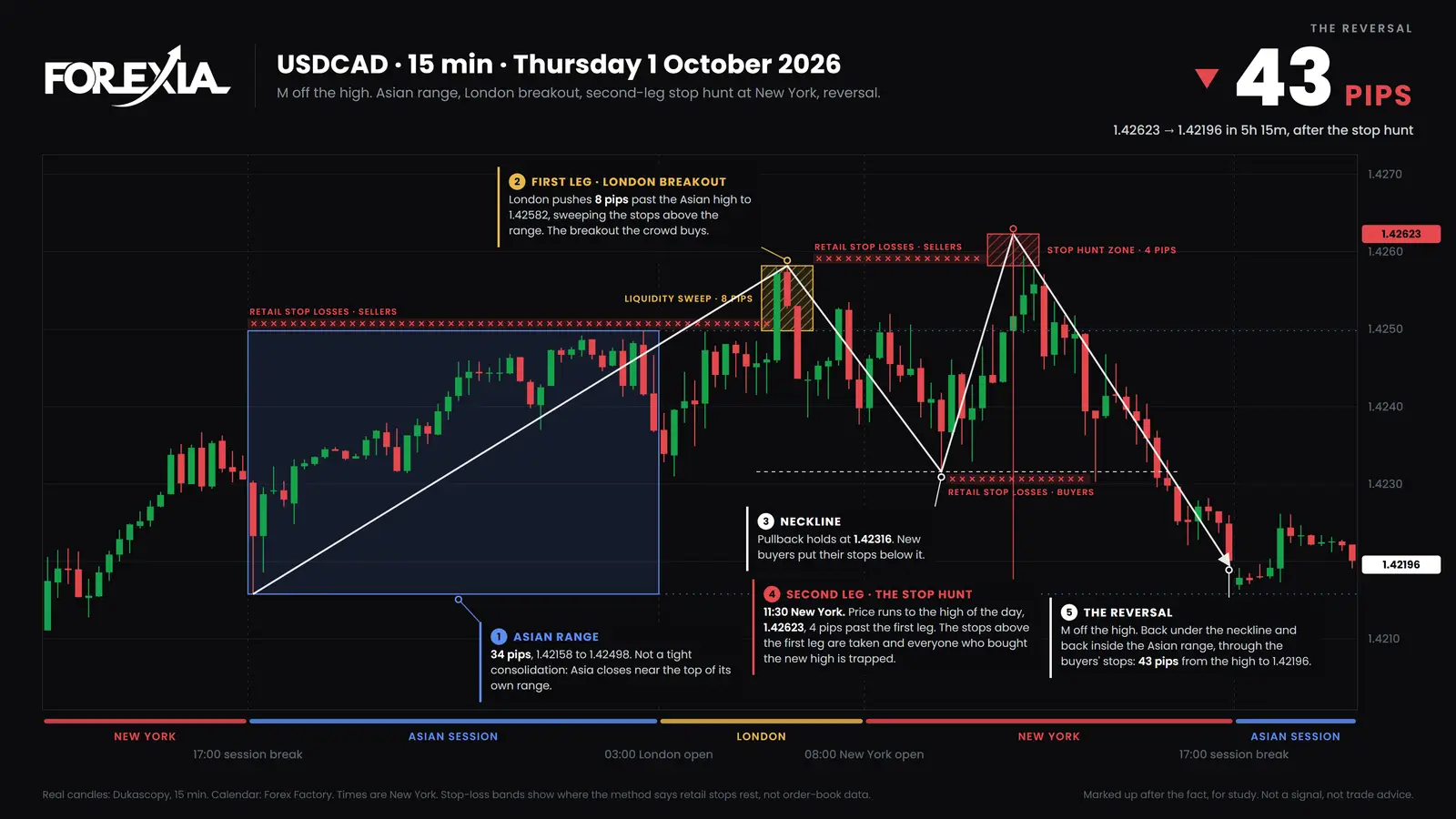
That candle closed at 1.42517, back under London's high. By 16:45 price was at 1.42196, 43 pips lower and under the last pullback low, where a buyer's stop sits. That 1.42623 turned out to be the high of the week.
No release lined up with that candle. We read it as a crowd running the same instructions at the same price. Nobody outside can see those orders, so that is a reading, and this one day proves nothing about how often it happens. Our own test of this setup as a mechanical rule did not make money, so a turn seen afterwards is not a setup.
The NPC and why most traders lose: how do they connect?
The usual answers to why most traders lose are about one trader's errors: too much leverage, no plan, cutting winners and holding losers. Those are real, and why most traders lose goes through them.
The NPC adds what the crowd does together. Trading education teaches the same shapes from the same pages, so a large number of people see the same pattern on the same candle and place the same order. A stop is an order. Thousands of them in one place are a pool of orders waiting to be filled, and Dumb Money is that pool seen from outside. Being predictable is a cost that shows up even in a trader with a plan and good discipline.
So the two answers do different jobs. Discipline is about whether you follow your rules. The NPC asks who else has the same rules. It is our reading, not a measurement, since nobody can count who was in that candle. The figure most often quoted for how the crowd fares, the 90-90-90 Rule, is a saying and not a statistic.
The name comes from video games, where a non-player character runs a fixed script and has no idea it is doing so. On social media it is an insult. Here it is a diagnosis, and you can change a diagnosis.
How did the NPC behave on that day?
We read the 11:30 buyer on 1 October as well supplied with reasons, all of them borrowed. The pair had risen all week, London's high had just gone, and a fresh high is what the book calls strength. So the order goes in on the break, with the exit under 1.42316, the pullback everyone could see. Nothing on that chart asks who else is doing the same. Price went under that pullback at 13:30.
The wider idea is that a trade can look sound on every count and still be the same trade as thousands of others, which is a cost whether or not it wins that day.
What do traders get wrong about the NPC?
Three mistakes come up most.
- Stopping at the insult. It is a description, not a verdict. Predictable can change.
- Swapping one script for another. Another tool on that chart would have left the same buyer at the same high, and the Trap shows what a late signal can do.
- Reversing everything. A seller at every new high is on a script too. That 11:30 candle turned, and plenty of new highs do not.
Which words does the NPC lead into?
Four sit next to it.
- Dumb Money: the predictable retail herd the chart is built to trap.
- The Trap: the averages cross late, pull the crowd in, then cross back onto their stops.
- The 90-90-90 Rule: the industry's saying about how the crowd fares.
- The Induction Trend: Sunday, Monday, Tuesday, the trend Dumb Money follows.
Where is the NPC taught?
Course 1 of ForexiaPRO, Reading the Map, teaches this read step by step in lesson 1.1.3, Dumb Money and the NPC.
Related words
- Dumb Money: What It Means, and Where Dumb Money vs Smart Money Goes Wrong
- The Trap: Why the Crowd's Averages Cross Late, and the Best Indicator for Scalping
- The 90-90-90 Rule: The Saying About Why Most Traders Lose Money, and What Is Actually Known
- The Induction Trend: Why I Lose Money Trading the Trend the Week Starts With
Frequently asked questions
What is an NPC trader?
It is a trader running the instructions they were taught: the same patterns, the same confirmations and the same stop placement as thousands of others, on the same candle. The name comes from video games, where a non-player character follows a fixed script. The label describes behaviour, not intelligence.
Am I an NPC if I trade patterns?
Not because of the patterns. Patterns are worth knowing, because they show where orders are sitting. The label is for taking a pattern on trust, with the same order and the same exit as everyone else reading it.
Do NPC trades always lose?
No. Some breakouts run, and the textbook direction often comes. The cost is being predictable: the entry and the stop sit where the market can reach them first.
Does the NPC explain every loss?
No. Leverage, no plan and holding losers cost plenty of traders on their own. The NPC is one more reason, about what a crowd does together, and it is our reading rather than a measurement.