
The 90-90-90 Rule: The Saying About Why Most Traders Lose Money, and What Is Actually Known
The 90-90-90 Rule is the saying that ninety percent of traders lose ninety percent of their money within ninety days. The industry has that saying, and Forexia repeats it as one: it is not our statistic, and we found no study behind it. What it points at has support: regulators report that most retail accounts lose money on CFDs, and a chart can show a trader losing while right about direction.
What does the 90-90-90 Rule look like on a chart?
A saying has no chart. What a chart can show is one way of losing with the direction right, and that is the part we find useful.
On AUD/USD on Wednesday 2 September 2026, the Asian Box ran from 0.71306 to 0.71526, 22 pips. A textbook calls the low of the night support, says buy there, and puts the stop a few pips under it. At 04:45 New York a candle dropped through, to 0.71259, 5 pips under the low. At 06:00 price reached 0.71210, about 10 pips under it.
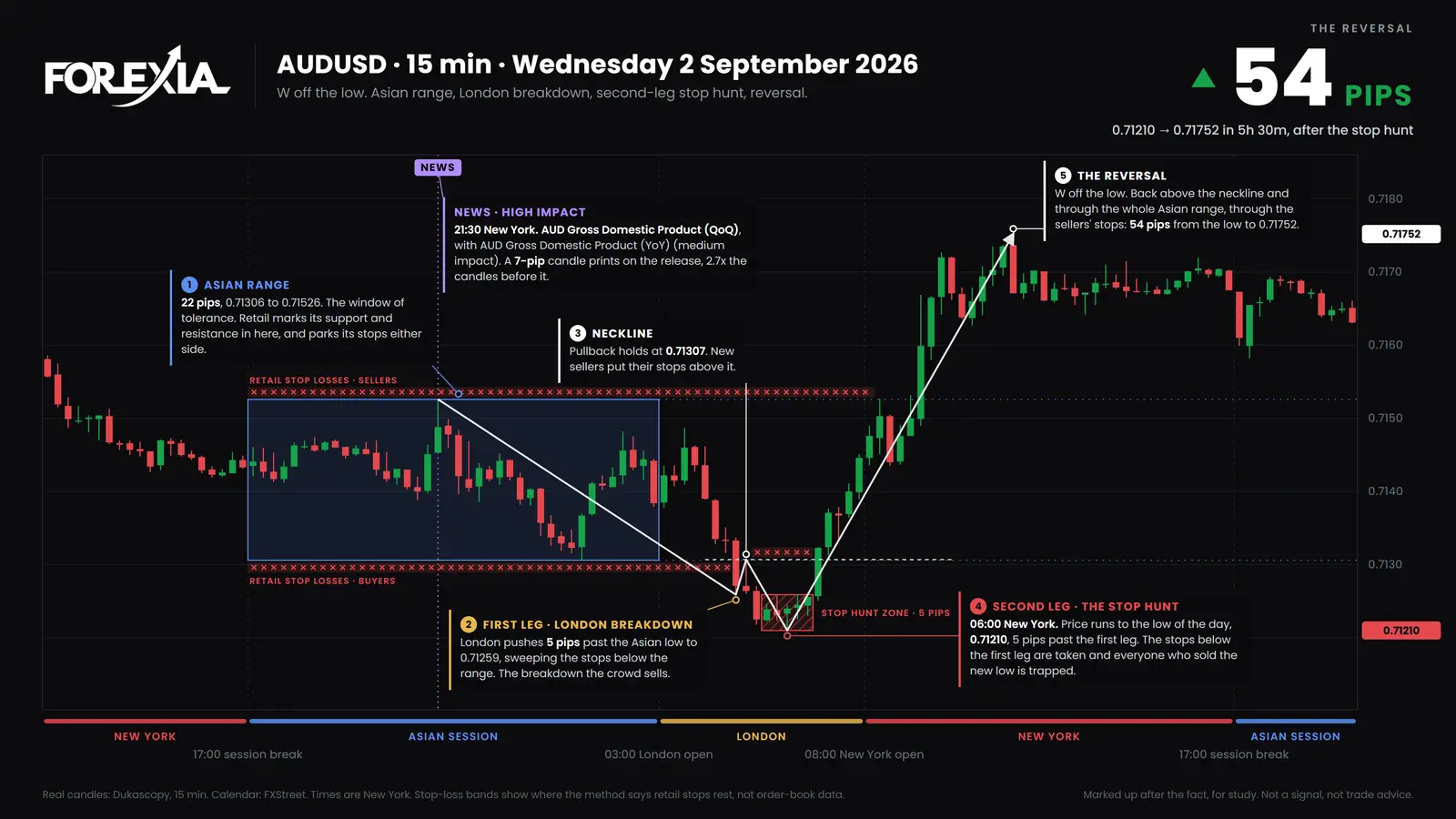
Then price turned, and by 11:30 it was at 0.71752, 54 pips off the low. A buyer at that support was right about where the pair was going. A stop a few pips under the line was gone before the move began.
One day says nothing about ninety percent of anybody. It shows the mechanism we think the saying gestures at. And it is not a recipe: a turn seen afterwards is not a setup, and our own test of this setup as a mechanical rule did not make money.
The 90-90-90 Rule and why most traders lose money: what is actually known?
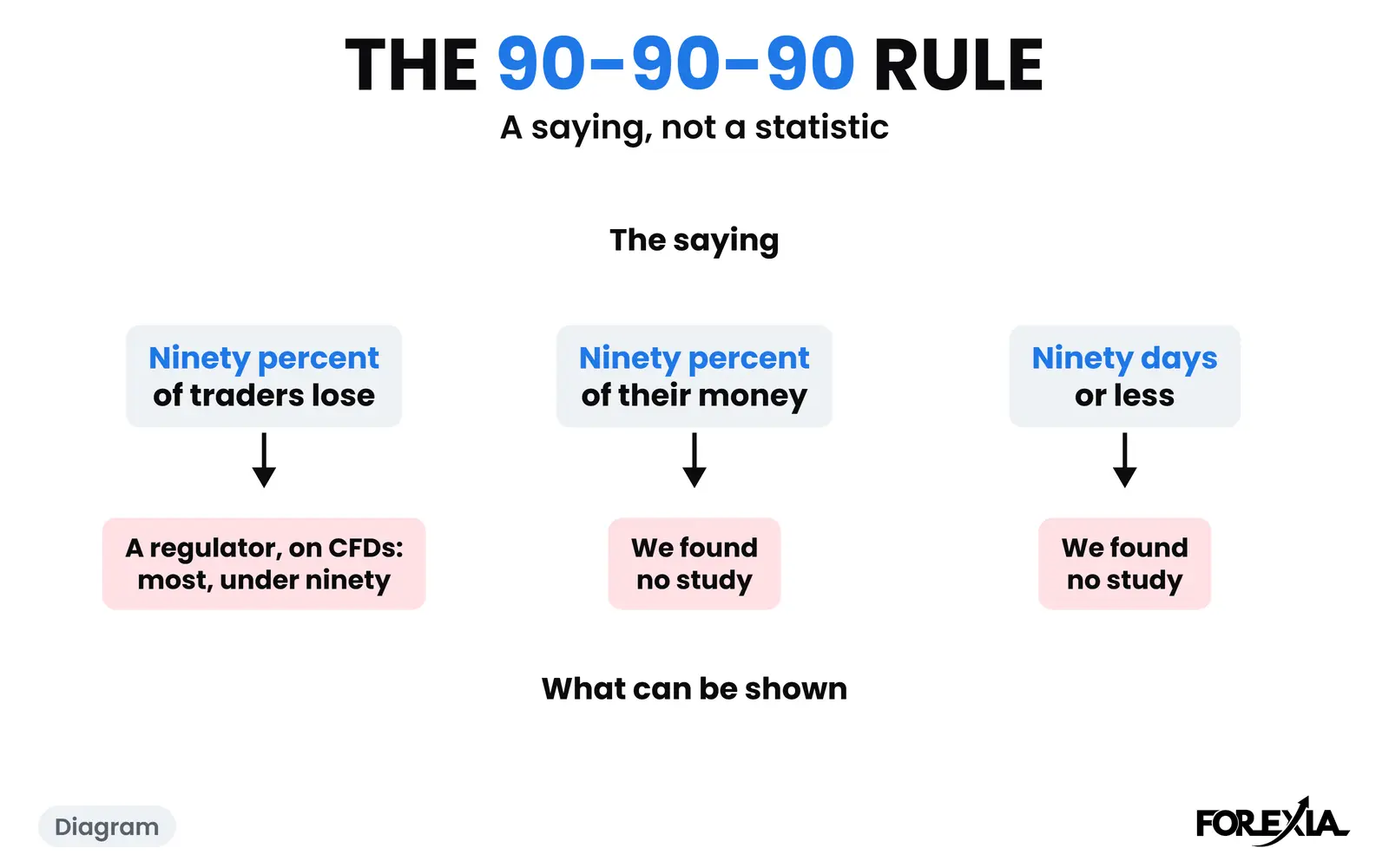
The direction of the saying has support, and its numbers do not. Taken one at a time:
| The saying | What can be shown |
|---|---|
| Ninety percent lose | The closest hard figure is a regulator's. In March 2018 ESMA reported that 74-89% of retail accounts typically lose money on CFDs. That is high, and all of it is under ninety. It covers one product and counts accounts, not traders. |
| Ninety percent of their money | We found no study. ESMA gave losses in euros, an average of €1,600 to €29,000 per client, and not as a share of the account. |
| Within ninety days | We found no study. The pages that repeat it name none. |
So when someone asks why most traders lose money, the saying is no evidence. It is a picture. The usual reasons are leverage, no plan and holding losers, and why most traders lose goes through them. Our own addition is the NPC: a crowd running the same instructions, with the same stops, on the same candle. We read the saying as a description of that crowd, not as a measure of it.
How do you spot the 90-90-90 Rule being misused?
Look at what it is doing in the sentence.
It is fine as a warning: this is hard, and most people lose. It is being misused in three ways.
- As a statistic. "Studies show" with no study named.
- As a pitch. The rule is the setup, and the next line offers to put you in the ten percent. That is a sales pattern, and we will not make that offer.
- As an explanation. A number, even a true one, does not tell you why anyone lost.
What do traders get wrong about the 90-90-90 Rule?
Three readings come up most.
- Taking it as our finding, or anyone's. It is a saying, and the course says so when it quotes it.
- Assuming the other ten percent profit. The saying does not say that. Losing less than ninety percent is still losing.
- Taking it as fate. Being predictable is a cost, and a cost can be removed once you can see it. Removing it does not promise a profit, and it can still leave you with a Reversal Candle going through your stop.
Which words does the 90-90-90 Rule lead into?
Three sit next to it.
- The NPC: what trading education turns you into, a predictable bot who follows the trend.
- Dumb Money: the predictable retail herd the chart is built to trap.
- The Reversal Candle: one huge candle through the stops, straight after the crowd gets in.
Where is the 90-90-90 Rule taught?
Course 1 of ForexiaPRO, Reading the Map, quotes it as the saying it is in lesson 1.1.3, Dumb Money and the NPC.
Related words
Frequently asked questions
What is the 90-90-90 rule in trading?
It is a saying in the trading industry: ninety percent of traders lose ninety percent of their money within ninety days. It is a rule of thumb. Forexia quotes it as a saying and does not offer it as a finding.
Is the 90-90-90 rule true?
Nobody has shown it. We found no study behind the three numbers, and the pages that repeat it name none. The direction it points in has support: in March 2018 the EU's markets regulator, ESMA, reported that 74-89% of retail accounts typically lose money on CFDs. That is one product, and it says nothing about ninety days.
Where does the 90-90-90 rule come from?
We could not trace it. It circulates on trading forums, broker blogs and course pages, usually introduced with words like 'statistics show' and no source.
Does that mean the other ten percent make money?
No. The saying does not say that, and it would not follow if the saying were true. Losing less than ninety percent of an account is still losing. Be careful of any pitch that offers to put you in the ten percent.