
The Asian Box: How to Draw the Asian Range, and What Its Breakout Really Is
The Asian Box is the Asian range drawn on the chart: the high and low from the day's session break to the London open. The first move out of it is what breakout traders call an Asian range breakout. We read that move the other way: the box is a map of where the crowd's orders sit, not a trade.
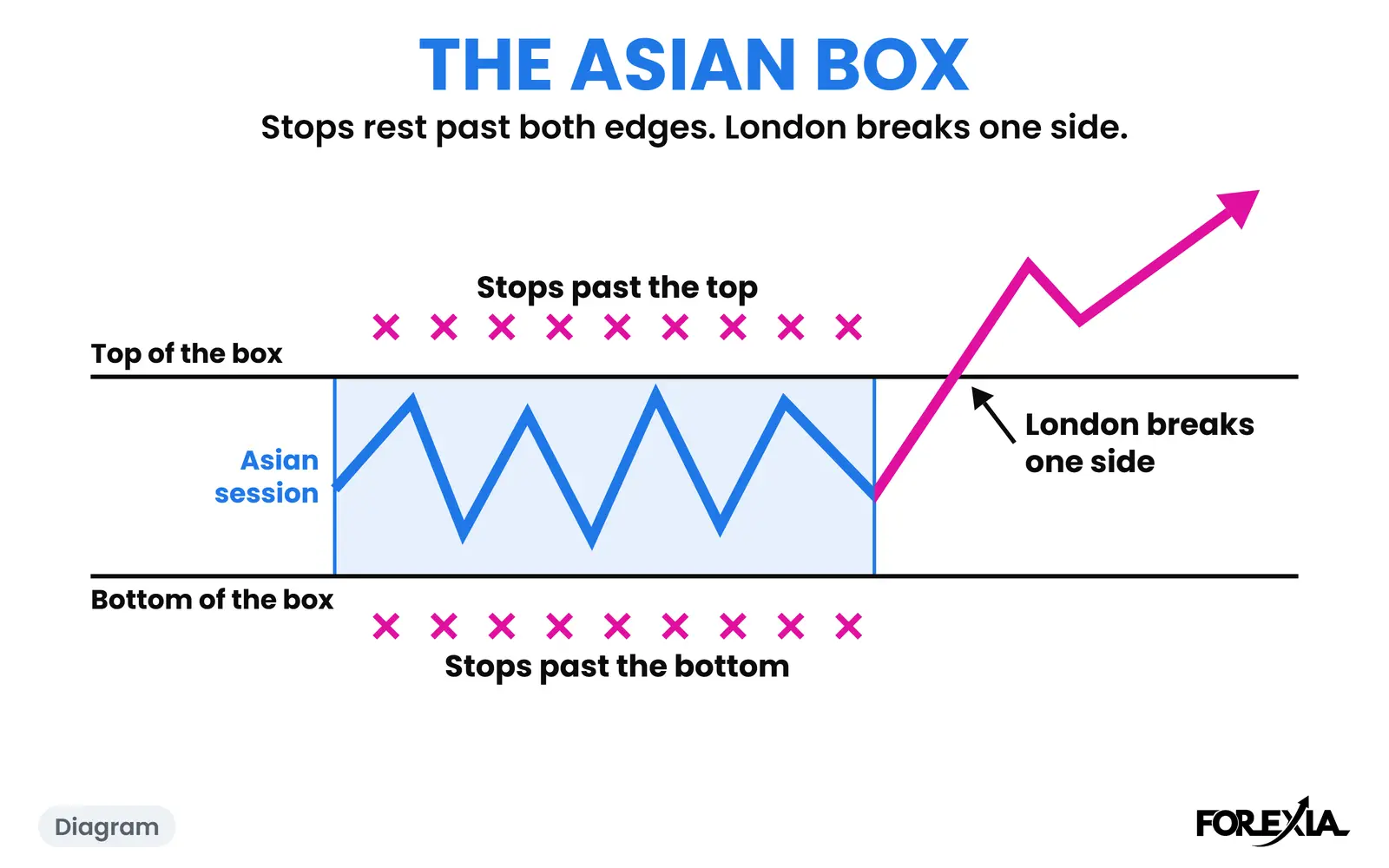
How do you draw the Asian Box?
Mark the highest and lowest wick from the 17:00 New York session break to the London open, 08:00 in London. That is about ten hours, on a 15-minute chart. Use wicks and not bodies, because the stops sit past the wick.
Every guide gives a different window: 00:00 to 06:00 UTC, 00:00 to 08:00 GMT, Tokyo's open to London's. The same night makes a different box in each. Ours follows the two events, so it stays right when the US and the UK change their clocks on different dates.
On a bid-price feed, ours included, the first candle after the break can print a wick that is only the spread widening at the rollover. Compare a low made there with a second chart. The Asian range liquidity sweep shows what the window and the wicks do to real levels.
What does the Asian Box look like on a chart?
It looks like a dull night. On gold on Friday 25 September 2026 the box ran from 4255.93 to 4295.44: 40 pips, where we count $1 as 1 pip, against an average day of 92. The high came at 21:30 New York and the low at 01:00. We read the quiet as orders waiting for London: the UK alone handled about 38% of world forex turnover in April 2025, Singapore 11.8% and Hong Kong 7.0%.
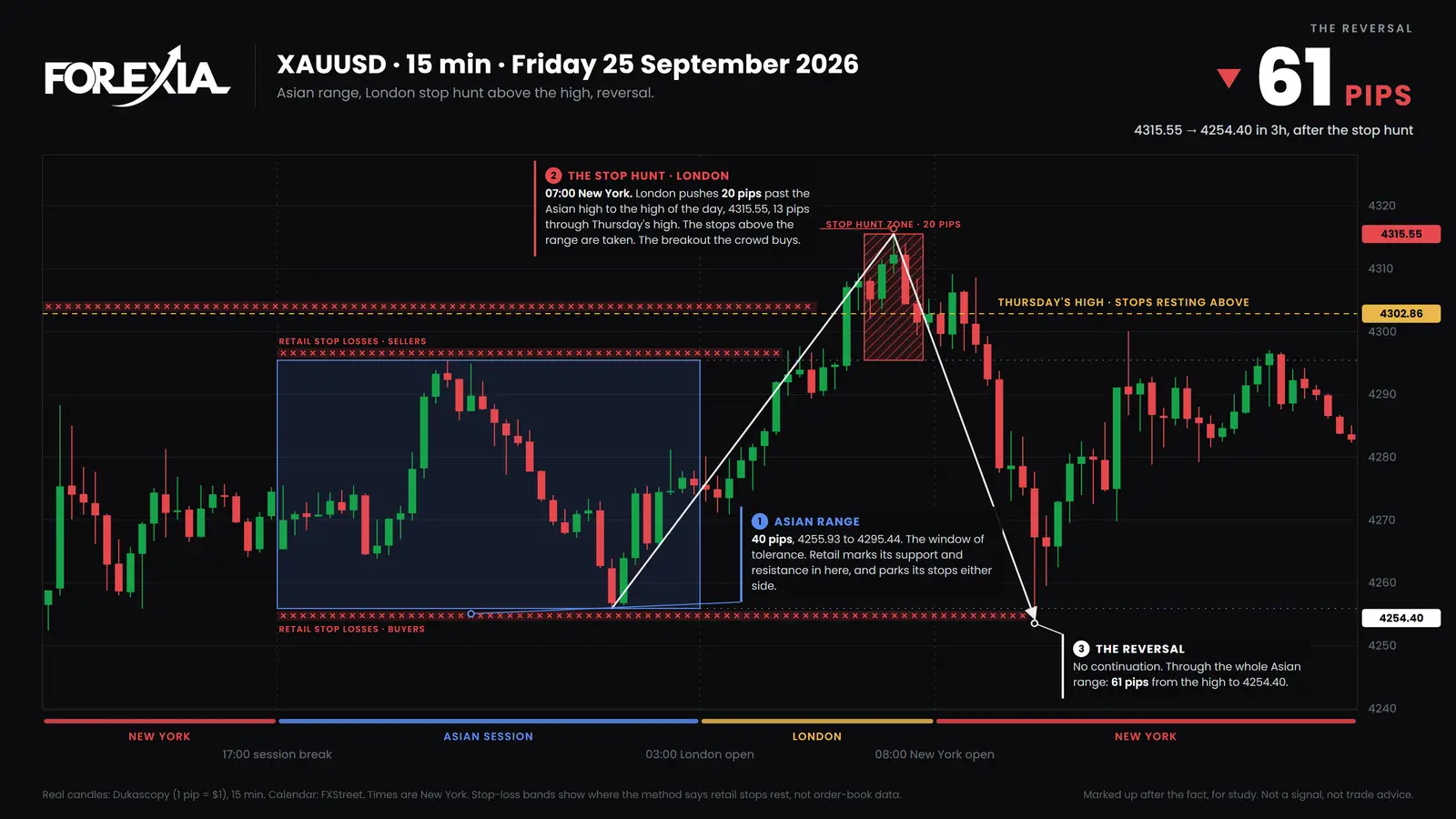
That night is the first phase of the Chaos Pattern. The first candle over the box came at 04:45, and the first close over it at 06:00, at 4307.10: the breakout the crowd buys. At 07:00 price reached 4315.55, 20 pips over the box and 13 over Thursday's high (4302.86). The 09:00 candle closed back inside at 4292.40, and by 10:00 price was at 4254.40, 61 pips off that high.
Read it from the Three Seats. The crowd sees a dull night and an edge that held. The market maker sees orders piling up on both sides, held there by time, the part of the night we call the Window of Tolerance. The observer sees what the night led to: the first move out ran 20 pips over the box, and then price fell 61.
The Asian Box and the Asian range breakout: what is the difference?
An Asian range breakout is a trade: buy or sell the first move out of the range and expect it to carry on. The Asian Box is a map: the same two lines, read for whose stops sit past them. One asks which way price will go. The other asks who has just been invited in.
The count is why a break of the box proves little on its own. Of 1,179 box edges traded through after the London open, by at least 3% of the average daily range, on seven majors and gold from 6 April to 1 October 2026, without the rollover wick, 969 (82%) closed back inside the box the same day. That does not make fading the break a plan: after 620 of those close backs (64%), price went past that wick again the same day.
Why the first break often fails takes the breakout apart, and the London open fakeout has its own guide.
How big is a normal Asian Box?
It depends on the market. The median box over those 25 weeks and four days, with the middle half of days in brackets:
- EUR/USD: 23 pips (18 to 29)
- GBP/USD: 30 pips (24 to 39)
- USD/JPY: 41 pips (28 to 65)
- USD/CHF: 24 pips (19 to 30)
- USD/CAD: 23 pips (19 to 30)
- AUD/USD: 25 pips (20 to 34)
- NZD/USD: 26 pips (20 to 36)
- Gold: 54 pips, or $54 (41 to 65)
Against the pair's own average day, that runs from 40% on EUR/USD and GBP/USD to 52% on NZD/USD. These leave out the rollover wick, which would add a pip or two on USD/CHF, USD/CAD and NZD/USD. Sizes move with the market, so measure your own.
What does a box that is not clear look like?
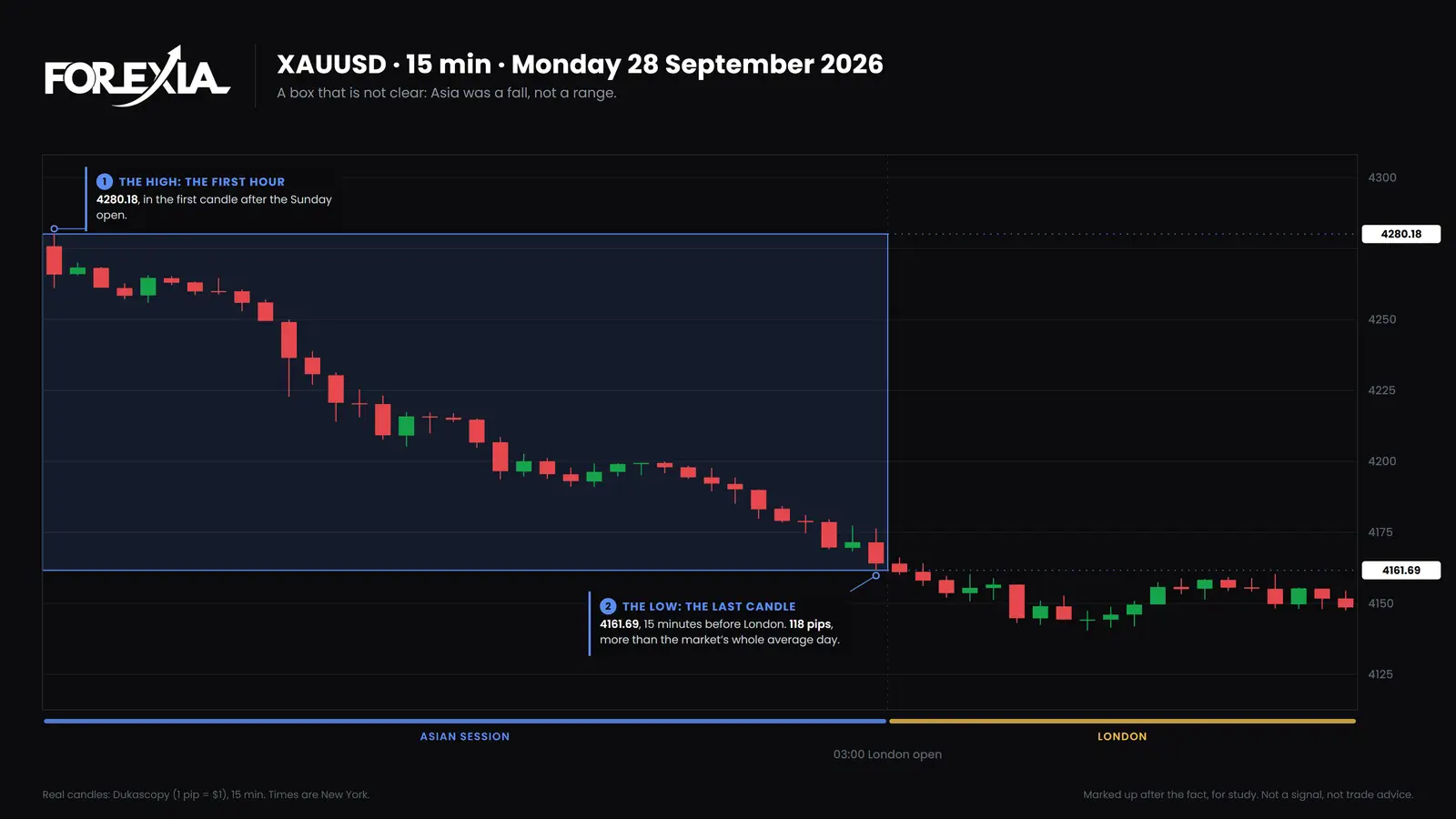
It looks like a move with a rectangle around it. On gold on Monday 28 September 2026, one trading day after the box above, the high came in the first candle after the Sunday open and the low in the last candle before London: 118 pips, from 4280.18 to 4161.69. That night was a fall, not a range. Its edges were where a move started and where it stopped, not where a crowd's stops bunched.
What do traders get wrong about the Asian Box?
Two readings cost the most.
- The bodies will do. A box on the bodies puts every stop you map from it in the wrong place.
- A pip count travels between pairs. A normal night is 23 pips on EUR/USD and 54 on gold, so a box only means something against its own pair's average day.
Which words does the Asian Box lead into?
Four sit next to it.
- The Window of Tolerance: the calm Asian range, where most traders place their orders.
- The London Breakout: retail enters for the "continuation". The turn can come in London too.
- Liquidity Mapping: marking the pools of stops on the chart before the session.
- M & W Reversals: M off the highs, W off the lows, from a clear Asian range, London or New York only.
Where is the Asian Box taught?
Course 2 of ForexiaPRO, The Chaos Pattern, teaches this read step by step in lesson 2.1.2, The Window of Tolerance: Ten Hours of Quiet.
Related words
Frequently asked questions
What is the Asian Box?
It is the Asian range drawn on the chart: two lines at the high and low of the night, from the session break to the London open. Breakout traders see two levels to trade. Forexia reads the same two lines as a map of where the crowd's orders sit.
Does the Asian range breakout work?
Not as a rule on its own. In our count of 1,179 box edges taken after the London open, on seven majors and gold from 6 April to 1 October 2026, 969 (82%) closed back inside the box the same day. After 620 of those close backs (64%), price went past that wick again the same day. Neither the break nor the fade is a plan by itself.
How many pips should the Asian range be?
It depends on the market. Over the same 25 weeks and four days the median box was 23 pips on EUR/USD, 30 on GBP/USD, 41 on USD/JPY and 54 on gold, where we count $1 as 1 pip. That is 40% to 52% of each market's average day, so compare a box with its own pair and not with another's.
Is the Asian Box the same as the Window of Tolerance?
No. The Window of Tolerance is the calm stretch of the night, the hours when most traders place their orders. The Asian Box is the two lines drawn around it. One is about time, the other about where those orders sit.