How to Start Forex Trading Step by Step: Six Steps in Order
Dylan Forexia8 min read
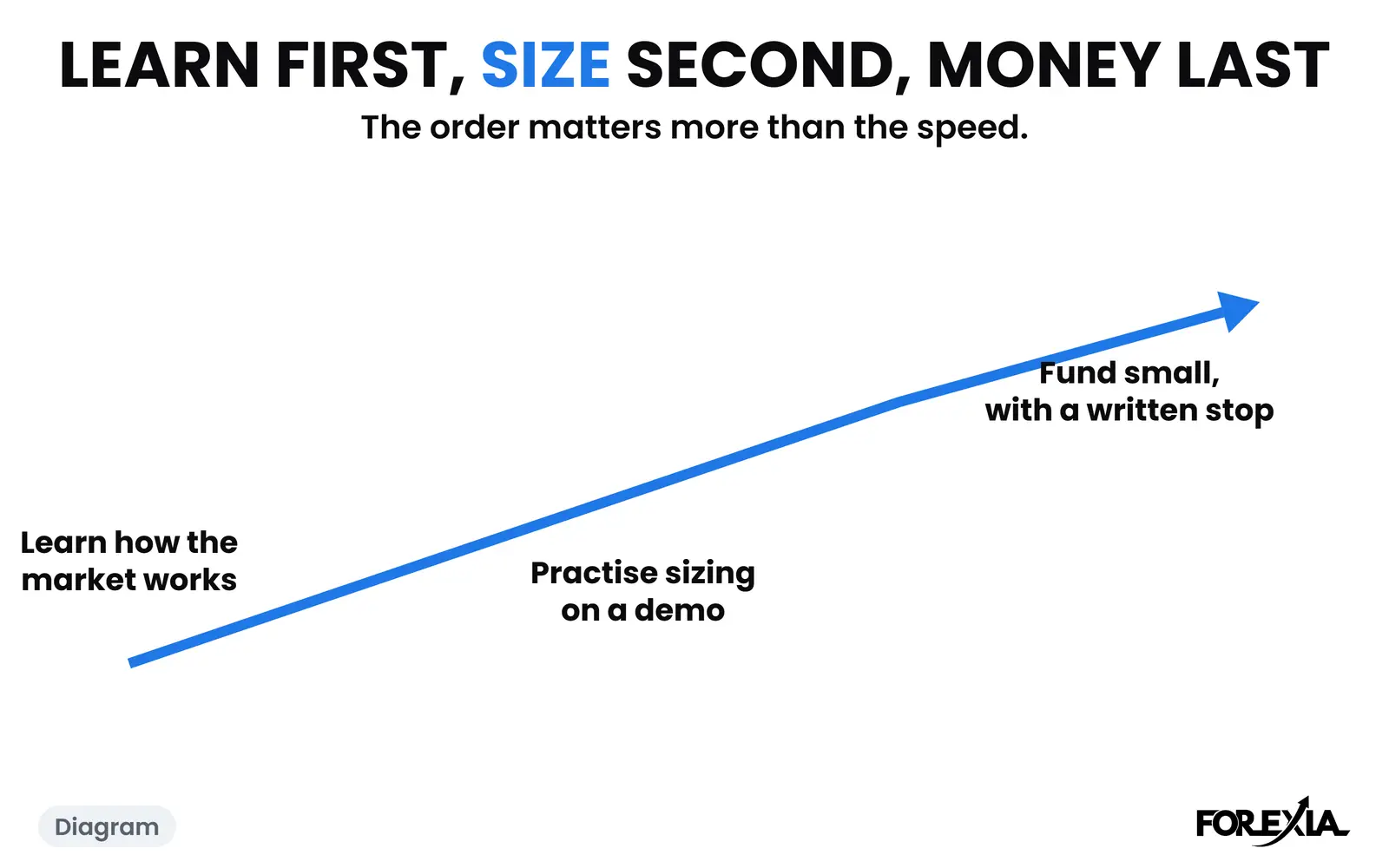
How to start forex trading step by step comes down to an order: learn the terms, learn to read a chart, practise the size of a trade on a demo account, write your rules down, and only then put in a small amount of real money. Most beginners reverse it, opening an account first and learning the rest from the losses. This guide gives the six steps in order, with one real EUR/USD day to show why the third and fifth steps matter most.
In brief
- The order: vocabulary, a chart, a demo, written rules, a small real account, a journal.
- The step that decides the account: working out the size of a trade from its stop, before you place it.
- The one thing to skip: a real deposit before you can state your stop, your size and your daily loss limit.
- The limit: forex and CFD trading carries a high risk of loss. No order of steps removes it.
This guide is for study. It is not trade advice, and it says nothing about what any account will earn.
How do you start forex trading step by step?
Six steps, each with the reason it comes where it does. The wider path for beginners is on the learn forex page; this is the shortest honest version of it.
Step 1: Learn the six words you will use every day
You need these before any chart makes sense.
- Pair: two currencies priced against each other, such as EUR/USD.
- Pip: the usual small unit of a price move. On most pairs it is the fourth decimal place; on yen pairs, the second.
- Lot: the size of a trade. A standard lot is 100,000 units of the first currency, and a 0.01 lot is one hundredth of that.
- Spread: the gap between the buying price and the selling price. It is a cost you pay on entry.
- Leverage: the multiple by which a broker lets a position exceed your balance. It raises the size you can open, not the odds of the trade.
- Stop: the price at which you accept the idea was wrong and the trade closes.
Step 2: Learn to read a chart before you trade one
A chart is a record of where buyers and sellers acted. Learn candles, sessions and the highs and lows that other traders can see. This is the part a free course does well, and the five free courses are laid out in order on the courses pages. Reading comes before a broker because it costs nothing and shows you how fast a market can move.
Step 3: Practise the size of a trade on a demo account
A demo account lets you place orders with no money at risk. Use it for the mechanics: entering, setting a stop, working out the lot size. The sum is always the same. Decide the amount you accept losing, measure the stop distance in pips, and divide. The lot size calculator does it for you once you know the idea.
A demo does not test how you behave when the money is yours. It is practice for the mechanics only. Do it until placing an order, setting the stop and working out the lot size are routine, and until you have felt a stop being hit a few times without wanting to move it. That second part is the one a demo can only half teach, so keep the demo trades as seriously sized as you intend the real ones to be.
What does a real day teach about the stop?
Take one day. On Wednesday 14 October 2026 EUR/USD opened the New York session after a quiet night. The chart below is real Dukascopy candles, in New York time.
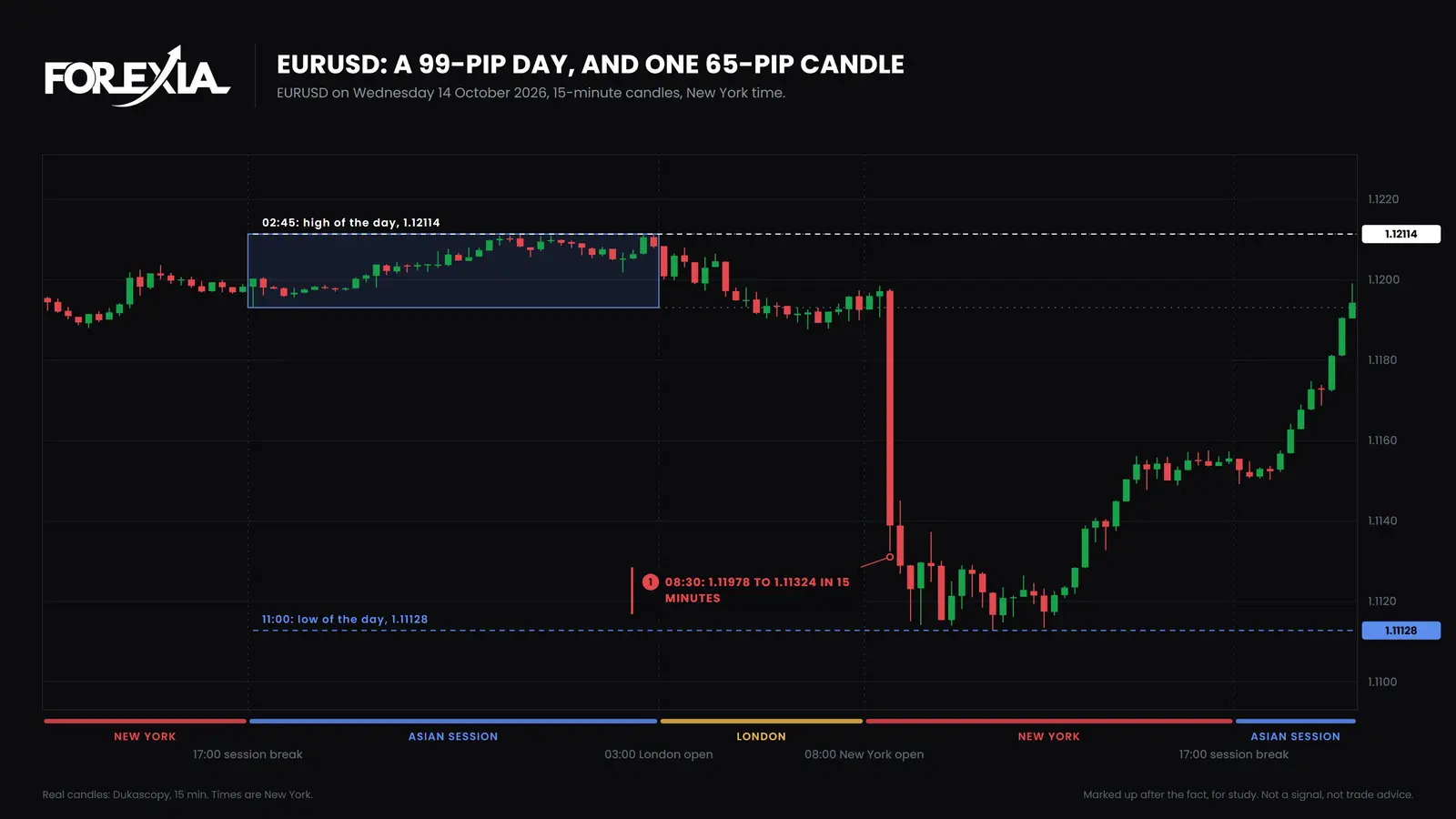
EURUSD, 15 minutes, 14 October 2026, New York time. High of the day 1.12114, low 1.11128, 99 pips. The 08:30 candle ran from 1.11978 to 1.11324. Chart data: Dukascopy.
- The night was quiet. The Asian range, from the 17:00 break to the London open at 03:00, was 18 pips.
- The high of the day came at 02:45, at 1.12114, before London opened.
- One candle did most of the work. The 08:30 candle high was 1.11978 and its low 1.11324, 65 pips in fifteen minutes.
- The low came at 11:00, at 1.11128, 99 pips under the high.
Now the lesson. A buy at that candle's open of 1.11973 with a stop 20 pips away would have had its stop at 1.11773. The candle's low went through it inside the same fifteen minutes. We make no claim about how a broker would have filled it, and we do not say anyone should have traded it. The point is arithmetic: a 20-pip stop that looked tight at 08:29 was nowhere near wide enough for what the next candle did.
That is why the next two steps come before the money.
Step 4: Choose a broker, and check what you can check
Pick a broker regulated where you live, and read who regulates it on its own account page. Check its spread and its smallest lot, because the smallest lot sets the smallest loss you can take. Each broker sets its own minimum deposit, and it is not the number your risk plan needs. The how much money guide works that out on a real day.
Leverage is capped for retail clients in some places. In 2018 the European regulator ESMA set 30 to 1 on major currency pairs (ESMA's decision). A cap does not make a trade safe; it limits one way of making it larger.
Step 5: Write your rules down before the first order
Three lines, on paper, before you fund anything.
- The loss you accept on one trade, in dollars. Many traders use 1% of the account or less. That is a convention, not a rule from any regulator. See forex risk per trade.
- The most you lose in a day. When it is reached, you stop.
- Your stop comes from the chart, not from the balance. If the stop the chart needs makes the lot size smaller than your broker's smallest, you skip the trade or accept a larger loss than planned. Do not move a stop in to fit a balance.
On the real day above, one 65-pip candle made up most of a 99-pip day. A stop set a few pips too close to the entry is an easy way to lose a trade to noise.
Step 6: Fund small, trade small, and keep a journal
Fund the account with money you can afford to lose. If losing the deposit would change your life, do not deposit it. Trade the smallest size your rules allow. After each trade write what you planned, what happened and whether you kept your rules; the forex trading journal page shows what to write. Read the journal weekly, and look for the same mistake twice: moving a stop, trading after your daily limit, sizing by feel. A repeated mistake is a rule you have not yet written. The journal is the only record of how you really behave, which a demo cannot give you.
What should you do after the six steps?
Keep learning the chart. Beginners who stop at the mechanics usually find the market moves faster than their rules expected. The common beginner mistakes page lists what costs most in the first months.
Our own method is taught in five free courses, starting with how price takes the stops that other traders leave on obvious levels. Course 1, Reading the Map, is where to begin, and its paid version is part of ForexiaPRO. Start with the first free course on the courses page and see whether the way of reading a chart makes sense to you before you spend anything.
Frequently asked questions
Four short answers, in the words people type into a search box.
How do I start forex trading with no experience?
Start with the vocabulary, then a chart, then a demo account, and only then a small real account. Learn what a pip, a lot, a spread and a stop are before you place any order. Practise working out the size of a trade on a demo until the sum is routine, and keep the first real account small enough that you can afford to lose all of it.
How long does it take to learn forex before you start?
There is no honest fixed number. Some people place their first real trade after a few weeks of study and practice, and some wait much longer. A better test than the calendar is whether you can write down your stop, your size and your daily loss limit before every trade, and keep to them on a demo account.
Do I need a demo account first?
It is the cheapest way to learn the mechanics: placing orders, setting stops and working out lot size. It does not test how you behave with your own money at stake, so treat it as practice for the mechanics only.
What is the biggest mistake when starting forex trading?
Trading a size set by the balance or by hope instead of by the stop. A trade whose loss, if the stop is hit, is larger than you planned is the commonest way for a first account to end quickly. The guide above puts the stop first for that reason.
Sources
Where each fact on this page comes from.
- Dukascopy 15-minute candles for EUR/USD, 14 October 2026: the day's high, low, Asian range and the 08:30 candle, as drawn on the chart above.
- ESMA, "ESMA agrees to prohibit binary options and restrict CFDs": the 2018 leverage limits for retail clients.
- The how much money guide: the worked sums for five account sizes.
Learn to read the chart this way. The free courses teach the method from the first chart, on real days. Browse the courses.
This guide is for study. It is not a signal and not trade advice. Trading forex and CFDs carries a high risk of loss, and you can lose all the money you deposit. Chart data: Dukascopy, 15-minute candles, New York time.
Frequently asked questions
How do I start forex trading with no experience?
Start with the vocabulary, then a chart, then a demo account, and only then a small real account. Learn what a pip, a lot, a spread and a stop are before you place any order. Practise working out the size of a trade on a demo until the sum is routine, and keep the first real account small enough that you can afford to lose all of it.
How long does it take to learn forex before you start?
There is no honest fixed number. Some people place their first real trade after a few weeks of study and practice, and some wait much longer. A better test than the calendar is whether you can write down your stop, your size and your daily loss limit before every trade, and keep to them on a demo account.
Do I need a demo account first?
It is the cheapest way to learn the mechanics: placing orders, setting stops and working out lot size. It does not test how you behave with your own money at stake, so treat it as practice for the mechanics only.
What is the biggest mistake when starting forex trading?
Trading a size set by the balance or by hope instead of by the stop. A trade whose loss, if the stop is hit, is larger than you planned is the commonest way for a first account to end quickly. The guide below puts the stop first for that reason.