Forex Trading Journal: What to Write After Every Trade
Forexia Academy7 min read
A forex trading journal is a record of each trade, written down when it closes: what you saw, what you did and what it cost, in the same columns every time. The free template below is a plain CSV file with the columns we use, a header row and one made-up example row. Download it, delete the example, and fill in one line per trade. It opens in Excel and Google Sheets.
Download the free trading journal template (CSV)
The file holds no personal data, and nothing you type is sent anywhere. It lives on your own computer. A Google Sheets copy is planned, and this page will link it when it is ready.
How do you use the trading journal template?
Three habits make a journal worth the trouble.
Write the row when the trade closes. Memory edits itself within hours. A trade you lost feels like bad luck by dinner, and a trade you won feels like skill.
Fill every column, every time. A blank cell is a decision you did not record. If a column does not apply, write "none" so you can tell it from forgetting.
Read the journal once a week, at a fixed time. Sort by session, then by grade, then by setup. Look for the column where the losses gather. Do not read it in the middle of a trade.
To start, open the file, delete the example row and keep the header. In Google Sheets, choose File, Import, Upload, and pick "Replace spreadsheet". The columns will line up.
What does each column record, and why?
Every column exists because it answers a question you will ask yourself later.
| Column | What to write | Why it earns its place |
|---|---|---|
| Date | The day the trade was opened, as year-month-day. | Lets you sort, and lets you look up the news of that day. |
| Pair | The market, for example EURUSD or XAUUSD. | You will find that some markets suit you and some do not. |
| Session | Asian, London or New York, by the clock where you trade. | Behaviour changes by session. Your own results by session are the most useful cut a journal gives. |
| Setup | The name of the pattern you were trading, in your own words. | Without a name you cannot compare like with like. |
| Grade | Textbook or Partial, written after the day ends. | Separates "the setup was clean and I lost" from "the setup was messy and I took it anyway". |
| Level hunted | The level price ran through: the Asian low, the previous day's high, a round number. | Records what you thought was being targeted, so you can check later whether you were right. |
| Close back | Yes or No: did a candle close back on the other side of that level? | The difference between a hunt and a real break. |
| Size (lots) | The position size. | Lets you see whether you traded bigger after a loss. |
| Entry | The price you were filled at. | Needed for the sums, and to check slippage. |
| Stop | The price of your stop. | Writing it before the result protects you from moving it afterwards. |
| Exit | The price you were out at. | Shows whether you left on your plan or on your nerves. |
| R | The result in R: exit distance divided by stop distance, negative if stopped out. | Puts every trade in one unit, whatever the size or the market. |
| Notes | One line: what you did differently from your plan, and what you felt. | The cheapest early warning there is. |
R is worked out the same way as on our risk reward calculator: the distance from entry to exit, divided by the distance from entry to stop. A trade stopped at the stop is minus 1R. Spread and commission are not in the sum unless you add them.
Why record the level hunted and the close back?
Most journal templates stop at entry, exit and profit or loss. That tells you how the trade ended and nothing about how it began.
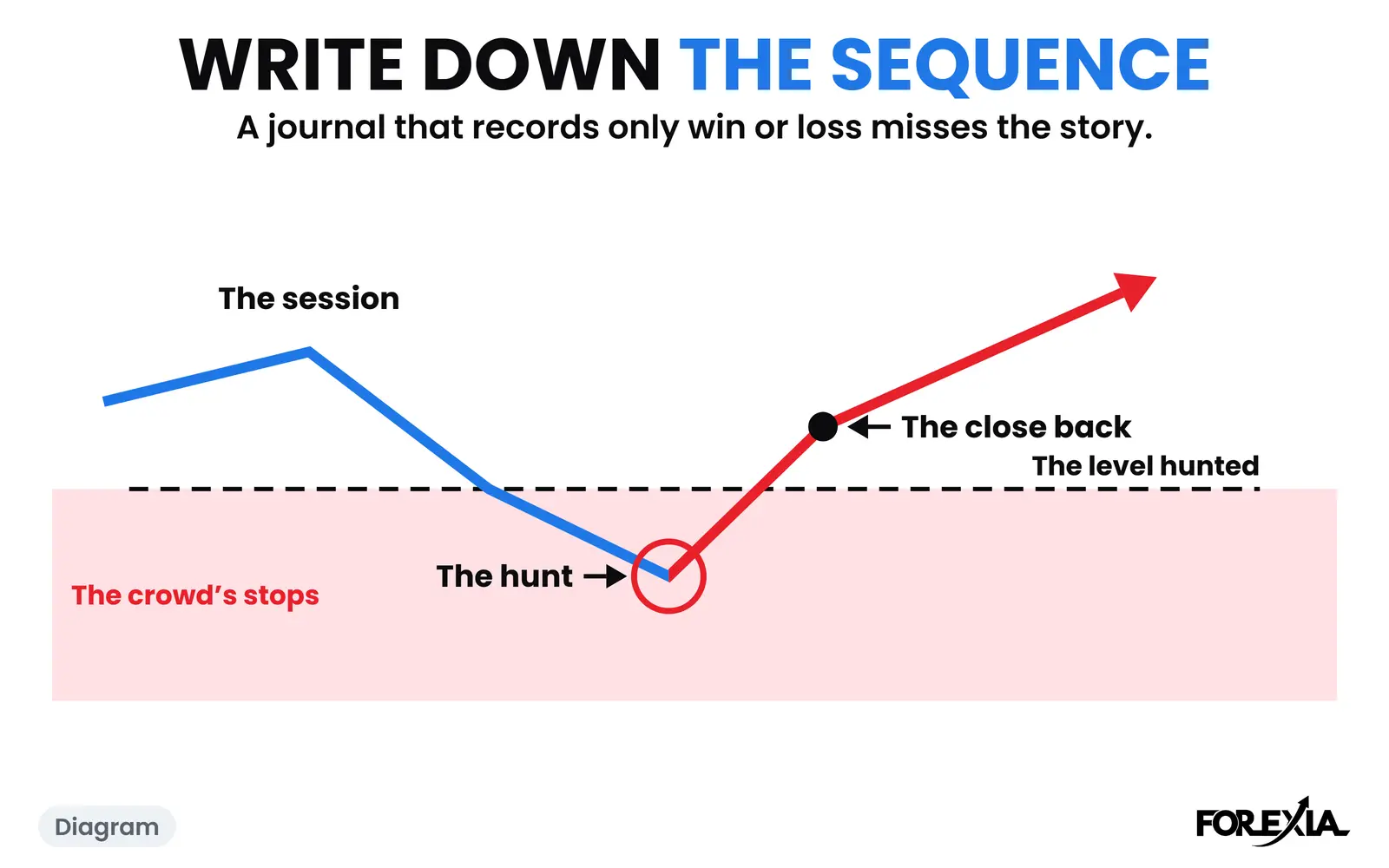
Our reading is that the crowd's stops rest past the obvious levels, and that price often runs through one of those levels before it turns. We call that the stop hunt. What matters for a journal is what price did next. The close back, a candle finishing on the near side of the level again, is the first sign the run was a hunt and not a break.
If you write the level and the close back on every trade, the journal can answer questions a profit column never can. Did you enter before or after the close back? Did the trades where price never closed back go worse than the others? You do not need to share our reading to use the columns. They are facts about the chart, and facts are what a journal is for.
We say "our reading" on purpose. Nobody outside the market can prove who ran a level or why, and no journal changes that. It records what you saw and what you did.
Why grade each trade Textbook or Partial?
Win or loss is a poor grade for a decision. A sound trade can lose and a careless one can win. If the journal records only the result, you will teach yourself that luck was skill.
So grade the setup, not the outcome. Textbook or Partial is how cleanly the day played the sequence: Textbook if every part was there in order, Partial if something was missing or late. Fill it in after the day closes, and fill it in whatever the result was.
Over time the Grade and R columns sit side by side. If your Partial trades behave differently from your Textbook ones, that is worth knowing, and you did not need a headline result to find it. If nothing differs, you have also learned something. Either way, a small sample is a question and not an answer: a few weeks of entries can show a habit, and they cannot show an edge.
What does a filled-in row look like?
The row below is made up to show the shape. It is not a real trade and not a result of ours, and the numbers were chosen only so the arithmetic is easy to follow.
| Date | Pair | Session | Setup | Grade | Level hunted | Close back | Size (lots) | Entry | Stop | Exit | R | Notes |
|---|---|---|---|---|---|---|---|---|---|---|---|---|
| 2026-01-01 | EXAMPLE | London | EXAMPLE ROW | Partial | Asian low | Yes | 0.10 | 1.00000 | 0.99800 | 1.00400 | 2.0 | Illustrative numbers only. Not a real trade. |
Read it from left to right. The stop is 0.00200 from the entry, so the risk is 1R. The exit is 0.00400 from the entry in the trade's favour, so the result is 4 divided by 2, which is 2.0R. The grade is Partial because, in this made-up case, the close back arrived late. The notes cell is one plain line.
That is all a row is. If it takes more than two minutes to write, you are writing a diary, and a diary is a different tool.
What should you look for in the weekly read?
Pick one question a week and answer it from the columns. Some good ones:
- Session: is there a session where most of your minus 1R trades sit?
- Grade: do you take Partial setups when your own rules say to wait?
- Stop: how many losing rows have an exit that is not at the stop? That is a moved stop.
- Size: does the size column grow after a loss?
- Notes: which word keeps coming back? "Late", "bored" and "revenge" are in a lot of journals.
Write the answer as one sentence at the bottom of the week, and change one thing. Changing five things at once means you will not know which one mattered.
What a journal cannot do
A journal does not make a method work. It shows you what you actually did, which is often not what you planned. It cannot tell you whether a setup has an edge, because a few dozen rows are far too few for that, and it cannot protect you from risk you did not size properly.
Our own test of the setup, run as a mechanical rule, did not make money. That is why we say plainly that a journal is for seeing your own habits, and that a reversal you notice afterwards is not a trade you could have taken. Use it to find the leak, and keep your size small while you learn.
Trading leveraged products carries a high risk of loss. Nothing on this page is advice or a signal.
How does the journal fit the rest of your plan?
A journal needs something to measure against, and that is a plan written before the trade. Start with how much you can afford to risk: our guide to how much money you need to start forex covers that. If you trade around releases, our note on trading the FOMC shows the kind of day that fills a Notes column quickly. If you are weighing what to pay for your education, read paid forex course vs free YouTube first.
The Learn Forex hub collects the rest. ForexiaPRO teaches the method behind these columns step by step: see ForexiaPRO.
Frequently asked questions
What should I write in a forex trading journal?
Write the facts of the trade the moment it closes: the date, the pair, the session, the setup, the level that was hunted, whether price closed back, the size, the entry, the stop, the exit and the result in R. Add one line of notes on what you did and why. Facts first, opinions last.
Is there a free forex trading journal template?
Yes. The template on this page is a plain CSV file with a header row and one example row. It opens in Excel, Google Sheets and any spreadsheet app. It holds no data about anyone, and you delete the example row before you start.
How often should I review my trading journal?
Write each entry when the trade closes, and read the whole journal once a week at a fixed time. A weekly read is where patterns show: the session you keep losing in, the setups you graded as partial, the stops you moved. Reading after every trade mostly feeds mood.
What is R in a trading journal?
R is the result counted in units of the risk. If the stop was 1R away, a trade that reached a target twice as far scores 2R and a trade stopped out scores minus 1R. Writing R lets trades of different sizes and markets sit in one column.
How many trades do I need before the journal tells me anything?
More than you expect. A few trades only show what happened, not what usually happens, and a handful of results can be luck in either direction. Use the first weeks to check that every row is complete, and treat any pattern as a question to test, not a finding.
Should I journal a trade I did not take?
Yes, in the notes: a setup you saw and skipped, and why. It shows whether your rules are doing their job. Keep the row short and leave the entry, stop and R empty, because no order was placed.