
Textbook or Partial: How We Grade a Forex Setup Day
Textbook or Partial is how cleanly a day played the signature trade forex setup. Our weekly chart markups file each day they mark up in one of two folders, Textbook or Partial, once the day is over. It grades a finished day, not a trade, which is where it differs from the checklists most guides give for grading a forex trade setup.
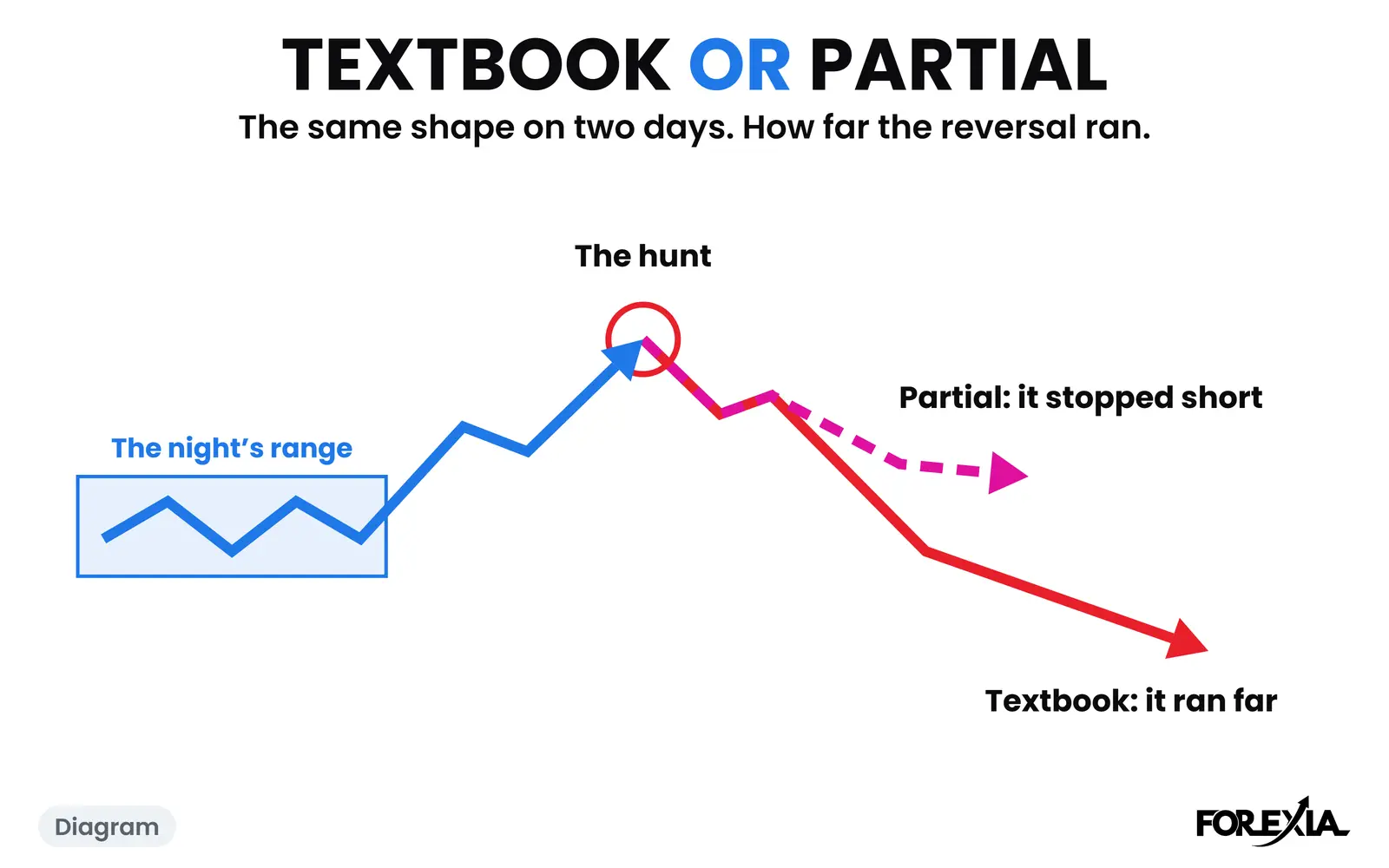
What do a textbook day and a partial day look like on a chart?
They look alike until the end. Take EUR/USD on Tuesday 9 June and Wednesday 10 June 2026, back to back, the same M reversal off the high.
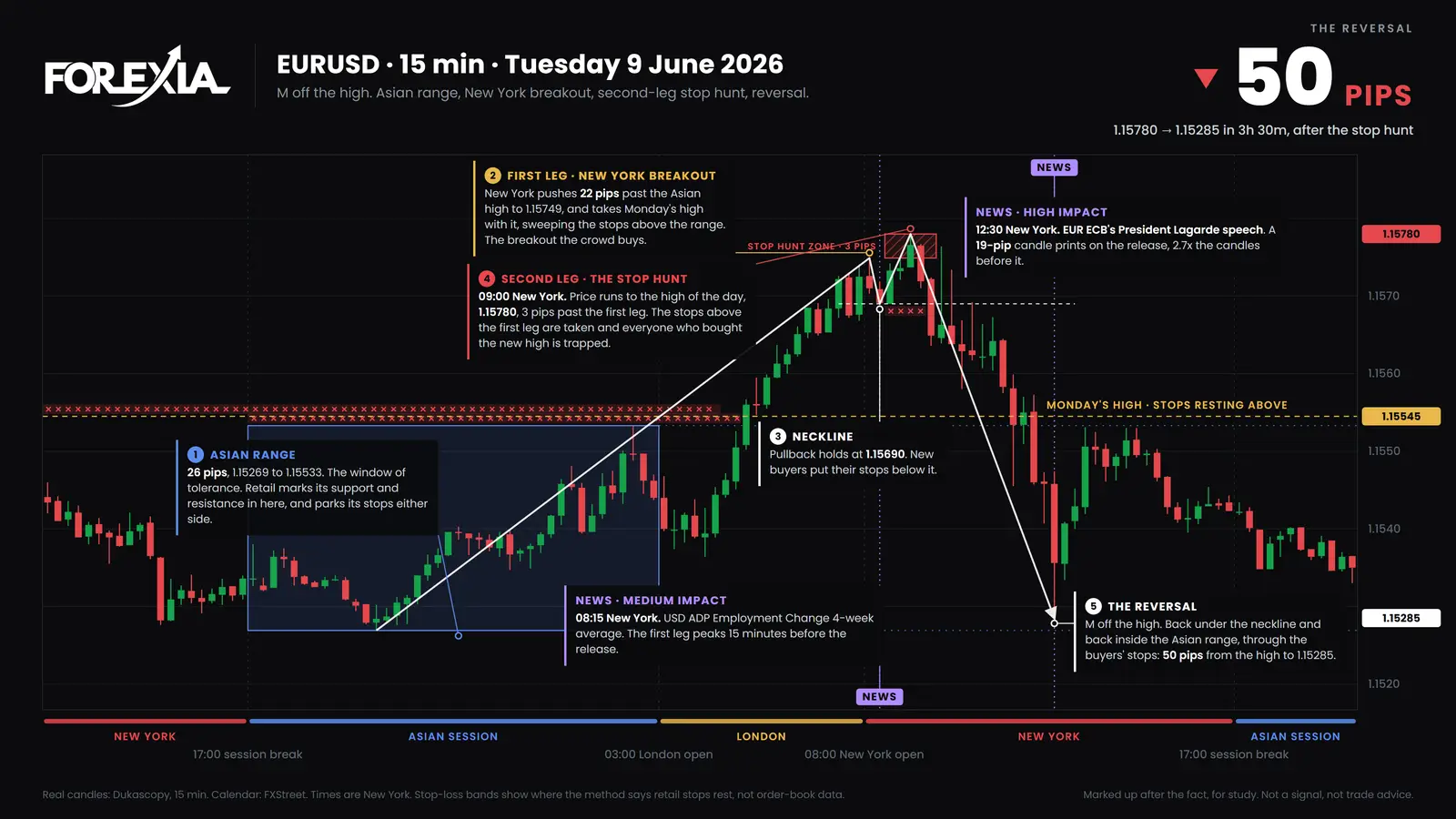
On Tuesday the Asian range ran from 1.15269 to 1.15533, 26 pips. Price pushed above it, first leg to 1.15749 at 08:00 New York, then pulled back to a neckline at 1.15690. A second leg reached 1.15780 in the 09:00 candle, 3 pips past the first: the stop hunt, taking the buyers' stops. The low of the reversal, 1.15285, came in the 12:30 candle, 50 pips down and back inside the range. The 12:30 candle was also the release of the ECB President's speech, a high-impact item on our calendar. The 08:15 ADP release, medium impact, came before the first leg peaked.
Wednesday had the same structure. The Asian range ran from 1.15330 to 1.15581, 25 pips. The first leg reached 1.15646 in the 08:45 candle, the neckline held at 1.15472, and the second leg topped at 1.15731 in the 09:45 candle, 9 pips past it. Tuesday's high, 1.15780, was not reached. The reversal ran 39 pips to 1.15343 in the 11:45 candle and stopped there, 1 pip above the range's low. The US CPI came at 08:30, high impact, 75 minutes before the hunt's candle opened.
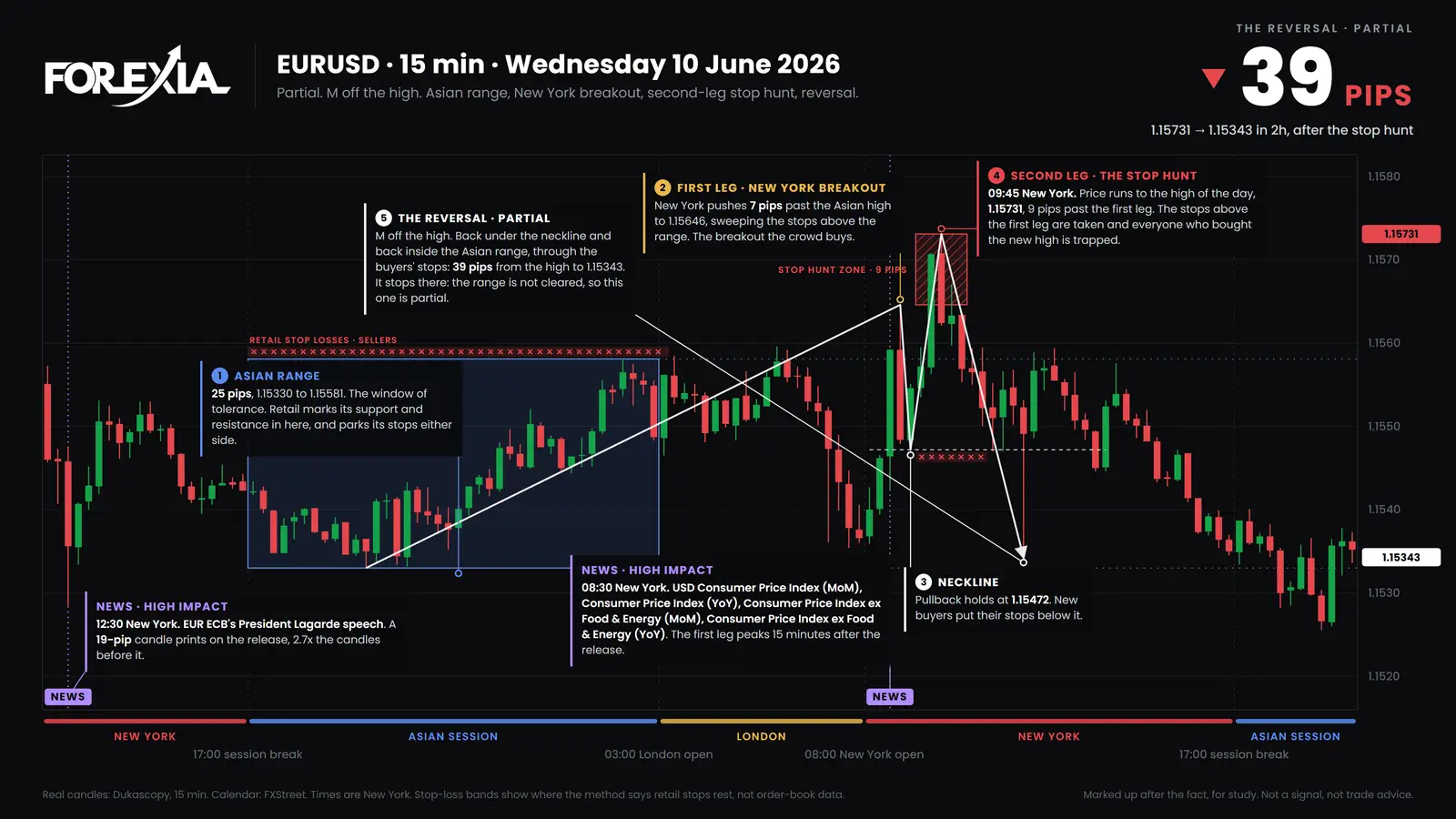
The write-ups give their reasons in the day's own numbers. Tuesday's reversal ran 50 pips against the pair's 55-pip average daily range. Wednesday's ran 39 against 54, and stopped inside the Asian range. We do not set a cutoff here, because the owner has not written one for this page. Look at what each day did after the hunt, and how it compares with a normal day for that pair.
Textbook or Partial and how to grade a forex trade setup: how do they differ?
A guide on grading a setup works before the trade. It writes a checklist, counts the passes, gives a letter, and sizes the position to it. Those pages also tell you to grade the setup apart from the outcome. Textbook or Partial works the other way round. It is given after the day, with all of it in view, which nobody has when the first leg is printing.
That makes the two answer different questions. A checklist asks whether a setup is worth taking. The filing asks how cleanly the day played it. Confirmation Stacking owns the first, the count of what lined up. A Textbook day can have few confirmations and a Partial day many, and the grade of the day is a separate fact.
How many days are Textbook and how many Partial?
Of the 332 day charts marked up between 6 April and 1 October 2026, 209 were filed Textbook and 123 Partial. Of the 152 of those that were M or W formations, 78 were Textbook and 74 Partial. That counts where a chart was filed, nothing more.
Course 5 teaches that most days are partial, and that grading them is part of the work. Our folders hold only days we marked up, and we mark only days that reversed. A folder of reversals is not a sample of ordinary days, so the two statements do not test each other.
What do traders get wrong about a textbook day?
Three readings cost the most.
- Reading Textbook as a trade that works. The grade comes from the whole reversal, known after the close. Our own test of the setup as a mechanical rule did not make money. A count of how days were filed is not a result.
- Reading Partial as a failed setup. Wednesday printed the same structure as Tuesday and the same hunt. It ended sooner. The two are filed apart so a Partial day is not averaged into the Textbook ones.
- Taking the news as the reason. Tuesday's low came in the candle of a speech and Wednesday's hunt came after CPI. The charts do not show why either turned. We read the hunt as the crowd's stops being used, and say so as our reading.
Which words does Textbook or Partial lead into?
Four sit next to it.
- Confirmation Stacking: the count of what lined up on a day, kept apart from its grade.
- The #SignatureTrade: the setup the course builds, graded this way.
- The Chaos Pattern: the daily cycle both days belong to.
- Reverse Price Action: reading the chart from where the stops were, which is how a day gets graded.
Where is Textbook or Partial taught?
Course 5, in production, of ForexiaPRO, The #SignatureTrade, teaches this step by step in lesson 5.4.1, Grading a Day.
Related words
- Confirmation Stacking: How Many Confirmations Does a Forex Setup Need?
- The #SignatureTrade: a Wedge, a Clear Asian Range and the Break Everyone Believes
- The Chaos Pattern: The Daily Cycle Behind Every Asian Session Strategy
- Reverse Price Action: Reading a Pattern Backwards, and What a Fake Breakout Really Is
Frequently asked questions
What does Textbook or Partial mean?
It is how cleanly a real day played the setup. Our weekly chart markups file every day they mark up in one of two folders, Textbook or Partial, once the day is over. The grade describes the day that happened. It does not predict the next one.
How do you grade a forex trade setup?
Most guides grade before the trade, with a checklist and a letter. We grade after the day, by how far the reversal ran once the stop hunt was done. On EUR/USD on 9 June 2026 it ran 50 pips against a 55-pip average day, and on 10 June 39 pips against 54. The first was filed Textbook and the second Partial.
Is a Partial day a failed setup?
No. A Partial day printed the same shape and the same hunt. The reversal stopped short of where a Textbook day's went. It is a different ending to the same structure, filed so the two are not mixed.
Does a Textbook grade make the setup a good trade?
No. A grade is given with the whole day in view, which nobody has while trading. Our own test of the setup as a mechanical rule did not make money, so Textbook describes a day and promises nothing.
How many days are Textbook and how many Partial?
Of the 332 day charts we marked up between 6 April and 1 October 2026, 209 were filed Textbook and 123 Partial. Every one of those days had already reversed, because the markups only cover days that turned, so the split says nothing about ordinary days.