
Confirmation Stacking: How Many Confirmations Does a Forex Setup Need?
Confirmation Stacking is adding reasons until a setup feels certain: the Asian range, an M or W, the London hunt, a second leg, a wedge, the induction trend, ADR met and the high or low of the week. A stack grades a day of the signature trade forex setup. It does not promise its result, so there is no number of confirmations to quote as enough.
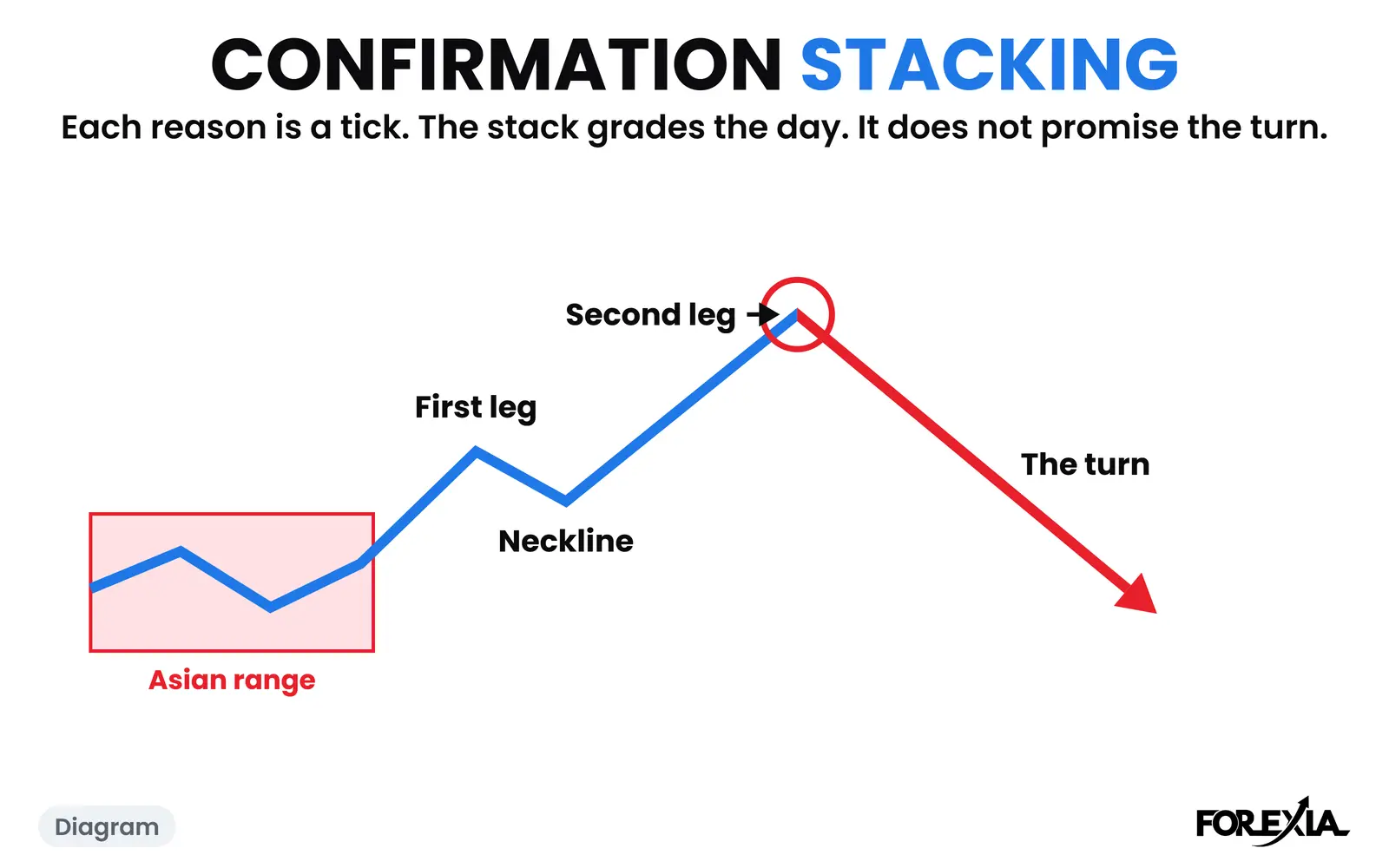
What does a stack look like on a real day?
It looks like a day that kept ticking boxes. On Friday 17 April 2026 EUR/USD spent Asia in a 15-pip range, 1.17720 to 1.17871. London took the high by 12 pips, to 1.17991, and pulled back to a neckline at 1.17908. At 09:00 New York a second leg ran to 1.18491, 25 pips through Thursday's high, 1.18238. From there price fell 89 pips to 1.17601 by 16:45.
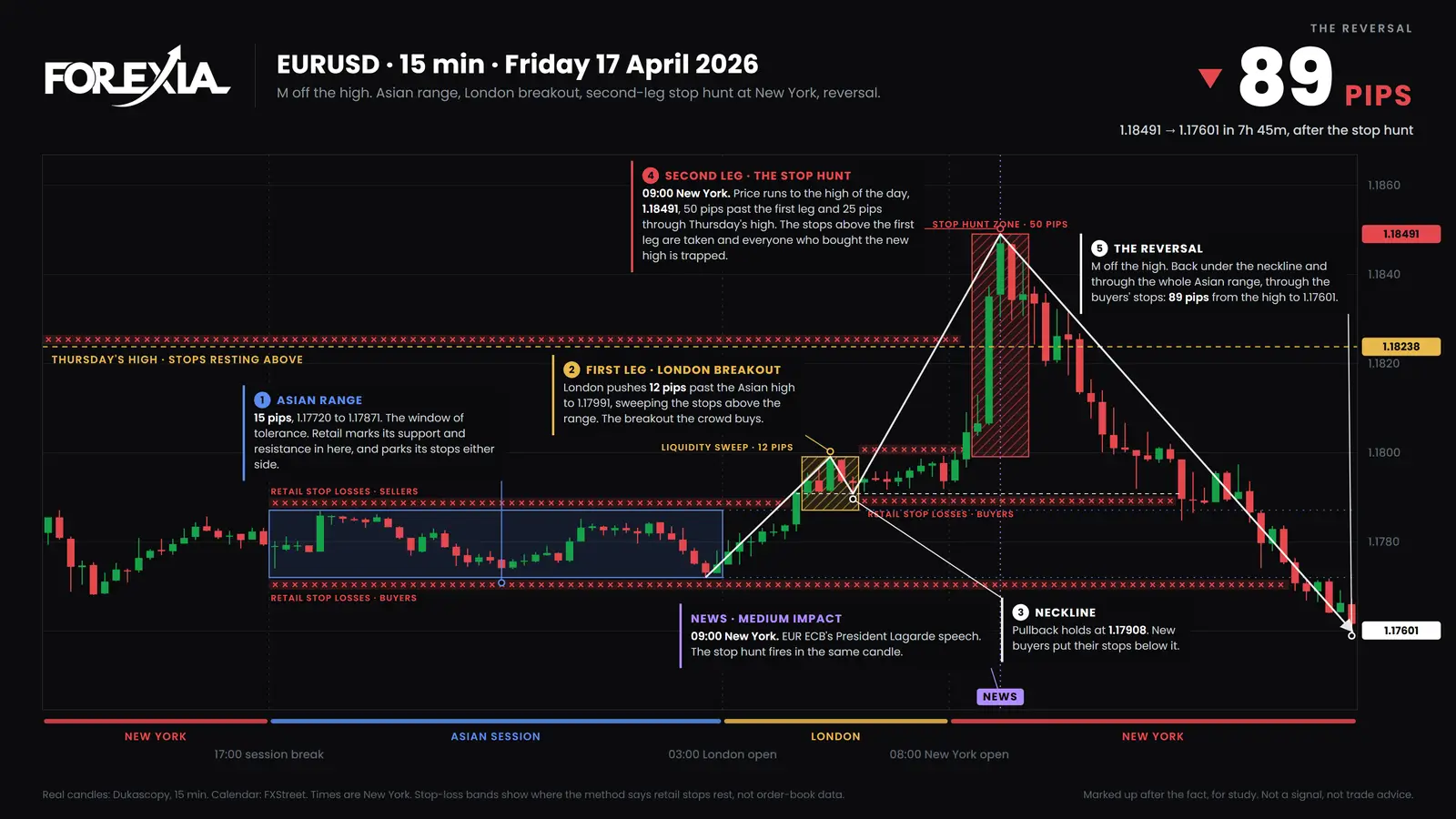
Our markup tool scores each marked day out of eight. It scored this one 6 of 8. The list is the tool's own and is close to the course's but not the same. It held a clear Asian range, a second leg, a hunt at a session open, Thursday's high taken, the week's high and a push into it from the week's open. It missed on two. The calendar's only release in that candle was the Lagarde speech, a medium-impact one, and the tool counts high-impact news only. It was also a Friday, not a Tuesday or Wednesday.
Does a thin stack mean the day will not turn?
No. Two days earlier, on Wednesday 15 April 2026, USD/CAD scored 1 of 8 on the same list. Its Asian range was 24 pips, 1.37580 to 1.37816, and it drifted up and closed near its own top, so it was not tight. There was no second leg. At 07:30 New York price pushed 6 pips past the high, to 1.37879, and then fell 62 pips to 1.37263 by 14:15, through the whole range.
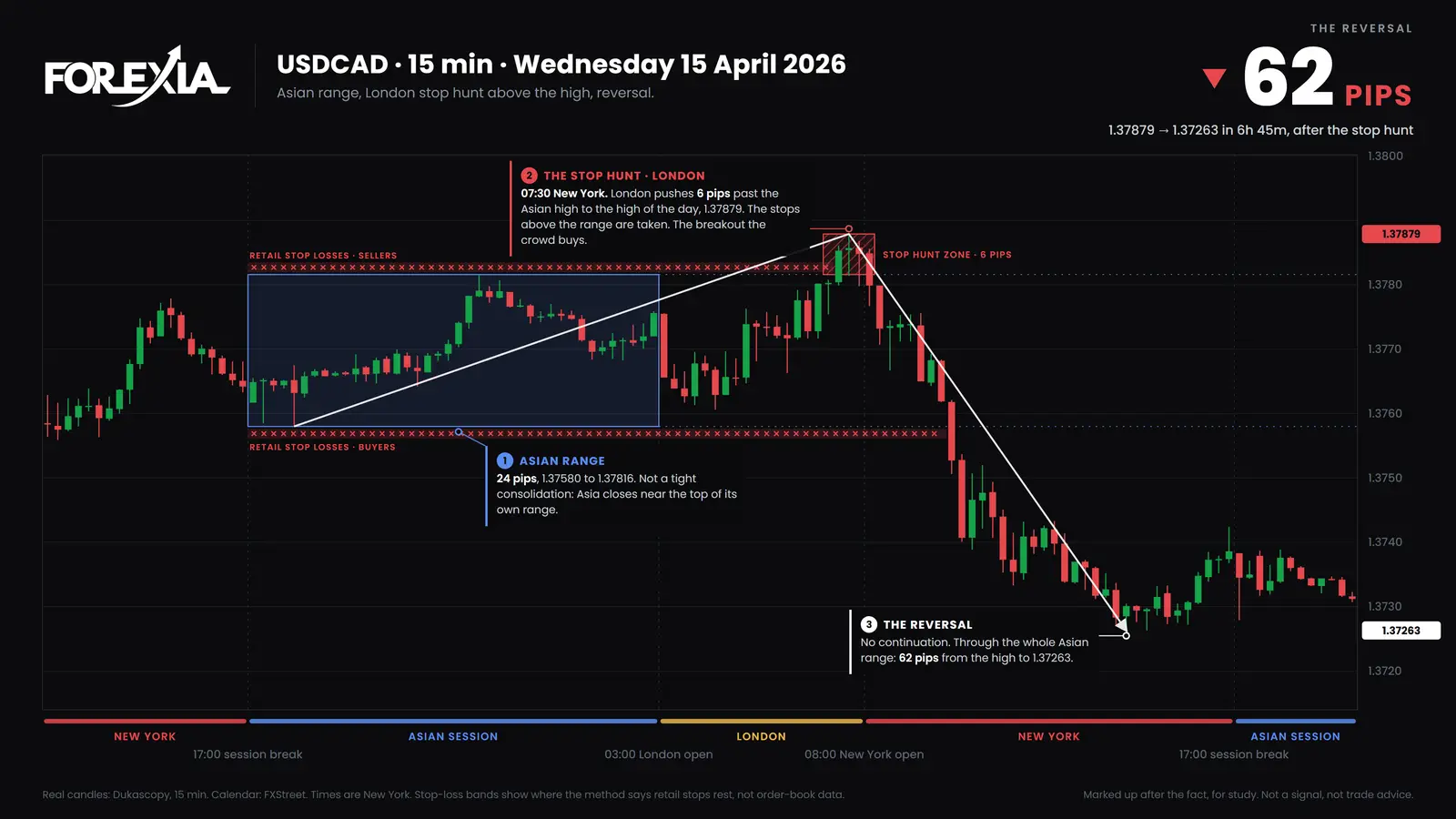
No CAD release was in the calendar that day. Medium-impact US releases came at 08:30, an hour after the high: the Empire State Manufacturing Index and a Fed speech. Both days were graded Textbook, because the fall cleared the whole Asian range. The 1 of 8 day fell 62 pips and the 6 of 8 day fell 89, and nothing on either chart told you that in advance.
Confirmation Stacking and how many confirmations a forex setup needs
Searches for "how many confirmations" are asking for a number. Most guides give one, three to five, and say the factors should be independent: RSI, stochastic and MACD agreeing is one momentum reading, not three. We agree about independence, and we give no number. Our word answers a different question. It asks how cleanly a day played the setup, after the fact, and files the day as Textbook or Partial.
Some of our own entries lean on each other. An M or a W has a second leg by its own definition. The week's high or low is known only when the week is over, which our markup tool says beside its own score. A count that includes it can only grade a day in hindsight. That is why we say a stack grades, and do not say it predicts.
How do you spot a stack?
Look at the day and ask which of the list's parts are on it. The EUR/USD day shows an Asian range with stops either side, an M whose second leg took Thursday's high, and a Stop Hunt at the high of the day. Whether the week's high was in is visible only later.
The USD/CAD day shows a range that never settled and one push through its high. It has no neckline, no second leg and no previous-day level taken. A parts list that short describes a day. It does not forecast the next hour.
Does a higher score sort the days?
On our counts it did not. From 6 April to 1 October 2026 the markup tool marked 332 daily setups, and each of those days had already reversed, since the tool marks only days that turned. Of 118 scoring one or two, 76 were Textbook. Of 147 scoring three or four, 90 were. Of 64 scoring five or more, 42 were.
The share is close to the same in each band. This counts setups on days that had already turned, so it cannot say whether a high score makes a turn more likely, and it is not a count of trades. Our own test of the setup as a mechanical rule did not make money. A stack of reasons is a way to describe a day we have already seen.
What do traders get wrong about stacking?
Four readings cost the most.
- Counting the same reason twice. Two ticks that describe one event add nothing.
- Reading a high count as a promise. The stack grades the day. It does not forecast the next candle.
- Reading a low count as a veto. The 1 of 8 day above fell 62 pips.
- Treating the count as the crowd's view. The retail seat stacks reasons to feel sure. The market maker's seat looks at where the stops sit. The observer counts afterwards. That is our reading, not something a chart can prove.
Which words does Confirmation Stacking lead into?
Seven sit next to it.
- The #SignatureTrade: the setup whose list this is.
- M & W Reversals: the second-leg shape inside it.
- ADR Met Tuesday: the daily range used up.
- The Week's High and Low: the entry known only in hindsight.
- The Induction Trend: the trend that draws the crowd in.
- The Asian Box: the range the list starts from.
- Textbook or Partial: how a day is graded afterwards.
Where is Confirmation Stacking taught?
Course 5, in production, of ForexiaPRO, The #SignatureTrade, teaches this step by step in lesson 5.2.1, The More Confirmations, the Better.
Related words
Frequently asked questions
What is Confirmation Stacking, and how many confirmations are enough?
Confirmation Stacking is adding reasons until a setup feels certain. There is no agreed number of them. Broker guides say three to five independent factors, and none shows evidence for it. We do not give a number either. A stack of confirmations grades how cleanly a day played the setup, and it does not promise what price does next.
What is the difference between confirmation stacking and confluence?
Confluence is the word most traders use for several reasons meeting at one price. Confirmation Stacking is our word for counting them on the setup's own list: the Asian range, an M or W, the London hunt, a second leg, a wedge, the induction trend, ADR met and the high or low of the week.
Does a higher score mean a better trade?
On our counts it did not sort the days. Of 332 daily setups the markup tool scored, the share graded Textbook was close to the same among those scoring one or two, three or four, and five or more. Those are days that had already turned, so this is not a test of trades.
Do more confirmations make a setup safer?
Not by themselves. Some confirmations lean on each other, and one of them, the high or low of the week, is known only after the week ends. Our own test of the setup as a mechanical rule did not make money.