What Is Forex? A Plain Answer, Before Any Trading
Forexia Academy5 min read
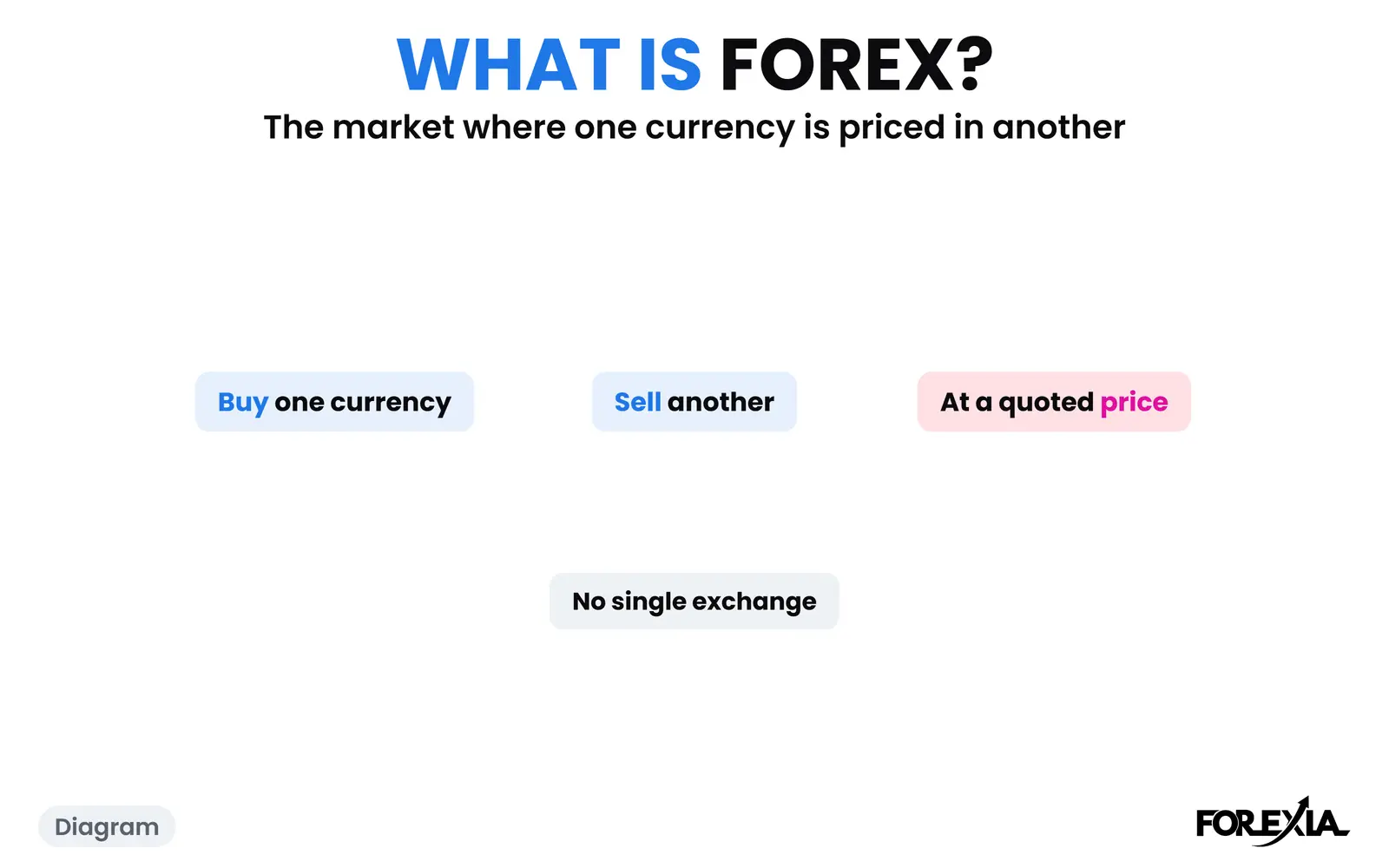
What is forex? Forex, short for foreign exchange, is the market where one currency is priced in another. A euro is worth so many US dollars, and that price moves all day. To trade forex is to buy one currency and sell another at the quoted price, then close the position later. The gap between the two prices is your gain or your loss, and either can happen.
What does forex mean?
The word is a short form of foreign exchange. People use it for the market and, loosely, for trading in it. Every price in the market is a pair: how much of the second currency one unit of the first costs. In EUR/USD at 1.11973, one euro costs 1.11973 US dollars.
A company paying a foreign supplier uses the forex market. So does a bank settling a client's payment, a fund moving money between countries and a central bank. A retail trader, trading through a broker on the price alone, is one more kind of user.
Read the page in order and you have the whole idea. First the word, then the size of the market, then what a trader does in it, then what it is not. Nothing here asks you to open an account. If you want one fact to hold on to before the detail, it is that forex is a market in which you are always dealing in two currencies at once, and you are always exposed to the price of one against the other.
Who is in the forex market, and how big is it?
The Bank for International Settlements counts it every three years. In April 2025 it found foreign exchange traded at $9.6 trillion a day, up 28% from $7.5 trillion in 2022. Those are the BIS's first-release figures, published on 30 September 2025, and it said they were subject to revision.
Two things in that survey change what the word "forex" means to a beginner. First, spot trading is under a third of the turnover. FX swaps were 42% of it and spot trades, the swap at today's price, were 31%. Second, the US dollar was on one side of 89.2% of all trades, the euro on 28.9%, the yen on 16.8% and the pound on 10.2%.
The BIS page we read gives no figure for retail traders, so we give none. What it does show is how much of the market is something other than spot trading. There is no single exchange. Dealers quote prices to each other and to their clients, and a broker passes a version of those quotes to you, so two brokers can show slightly different prices at the same moment.
In brief
- What it is: the over-the-counter market where currencies are swapped. It has no single exchange.
- What a trader does: buys or sells a pair such as EUR/USD, then closes the position at a different price.
- What it costs: a spread on every trade, and a loss when the price goes the other way.
- The risk: leverage lets a position be larger than your money, so a loss can be larger than you planned.
What does a forex trader actually do?
A trader opens a position by buying a pair they expect to rise, or selling one they expect to fall. They close it later. The result is the difference between the two prices, less the spread, which is the gap between the buying price and the selling price and is paid on every trade. How that works step by step is the page on trading on the forex, and the quoting and the market hours are in how forex works.
A price move in forex is measured in pips, the fourth decimal place on most pairs. Here is what that looks like on a real day. On Wednesday 14 October 2026 EUR/USD reached its high of 1.12114 at 02:45 New York time and its low of 1.11128 at 11:00, about 99 pips lower. One 15-minute candle at 08:30 fell from 1.11973 to 1.11324, 65 pips.
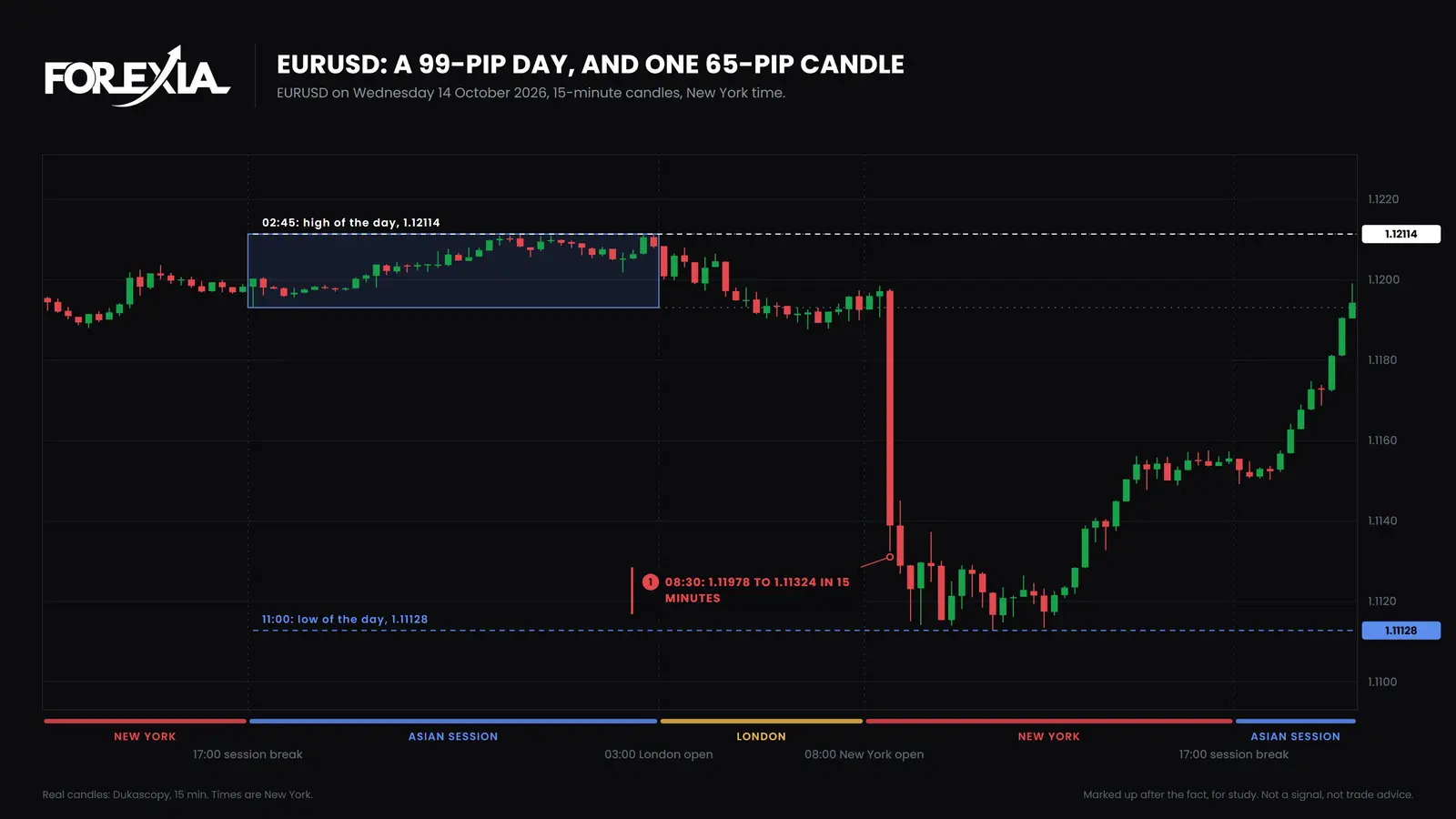
Someone who had bought at that candle's open would have lost on it, and someone who had sold would have gained. The chart shows what a move is. It does not say anyone should have traded it.
What is forex trading not?
It is not owning part of a company, as shares are. It is not a savings product. Your money is not protected the way a bank deposit is, and the CFTC's advisory tells customers to check whether a deposit is protected if a dealer fails. It is not a way to a result anyone can promise.
The CFTC's customer advisory says that two out of three forex customers lose money, and that leverage amplifies both gains and losses, so you could lose all of your margin and more. The page shows no date, so read it as the regulator's own warning and not as a measured figure for today. Our page on why most traders lose sets out what has been measured and what has not.
Who is forex trading not for?
It is not for money you cannot afford to lose, such as rent, a loan repayment or an emergency fund. It is not for anyone looking for income by a date. And it is not for a person who has not yet worked out how much one trade may cost them, which comes before any choice of pair. A beginner who still wants to learn it can start with the learn forex page, which sets out the order: the words, a chart, the size of a loss, a demo account, and only then money.
Where to go next
If the idea of a trade is still vague, read trading on the forex, which follows one real signal from open to close, including how it ended. If you want to know which pair people start with and why, read what to trade in forex. ForexiaPRO's courses teach the whole method on real dated charts.
Sources
- Bank for International Settlements, OTC foreign exchange turnover in April 2025, dated 30 September 2025: turnover, instrument split and currency shares. First-release figures, subject to revision.
- US Commodity Futures Trading Commission, Eight Things You Should Know Before Trading Forex: the warning on losses, leverage and deposits. The page shows no date.
- Candles: Dukascopy, 15-minute. All times are New York.
This page is for study. It is not a signal and not trade advice. Trading forex can lose you money.
Frequently asked questions
What does forex stand for?
Forex is short for foreign exchange, the swapping of one currency for another. You will also see it written FX. It names the market and, in everyday use, the act of trading in it.
What is the forex market?
It is the global over-the-counter market where currencies are bought and sold. There is no single exchange: banks and other dealers quote prices to each other and to their clients, and a retail broker passes a version of those prices on to traders.
Is forex the same as the stock market?
No. Shares are bought on exchanges and you own part of a company. In forex you trade one currency against another, usually through a broker, and you hold a position on the price, not a share of anything.
Is forex trading safe?
No trading is safe. The US Commodity Futures Trading Commission says in its customer advisory that two out of three forex customers lose money, and that leverage magnifies losses as well as gains. Learn the risk before you put money in.
Can a beginner make money in forex?
Nobody can say what a beginner will make, and we do not. Some traders gain and many lose. A first aim that can be met is to understand the risk and keep each loss small while you learn.