What to Trade in Forex: How a Beginner Chooses a Pair
Forexia Academy6 min read
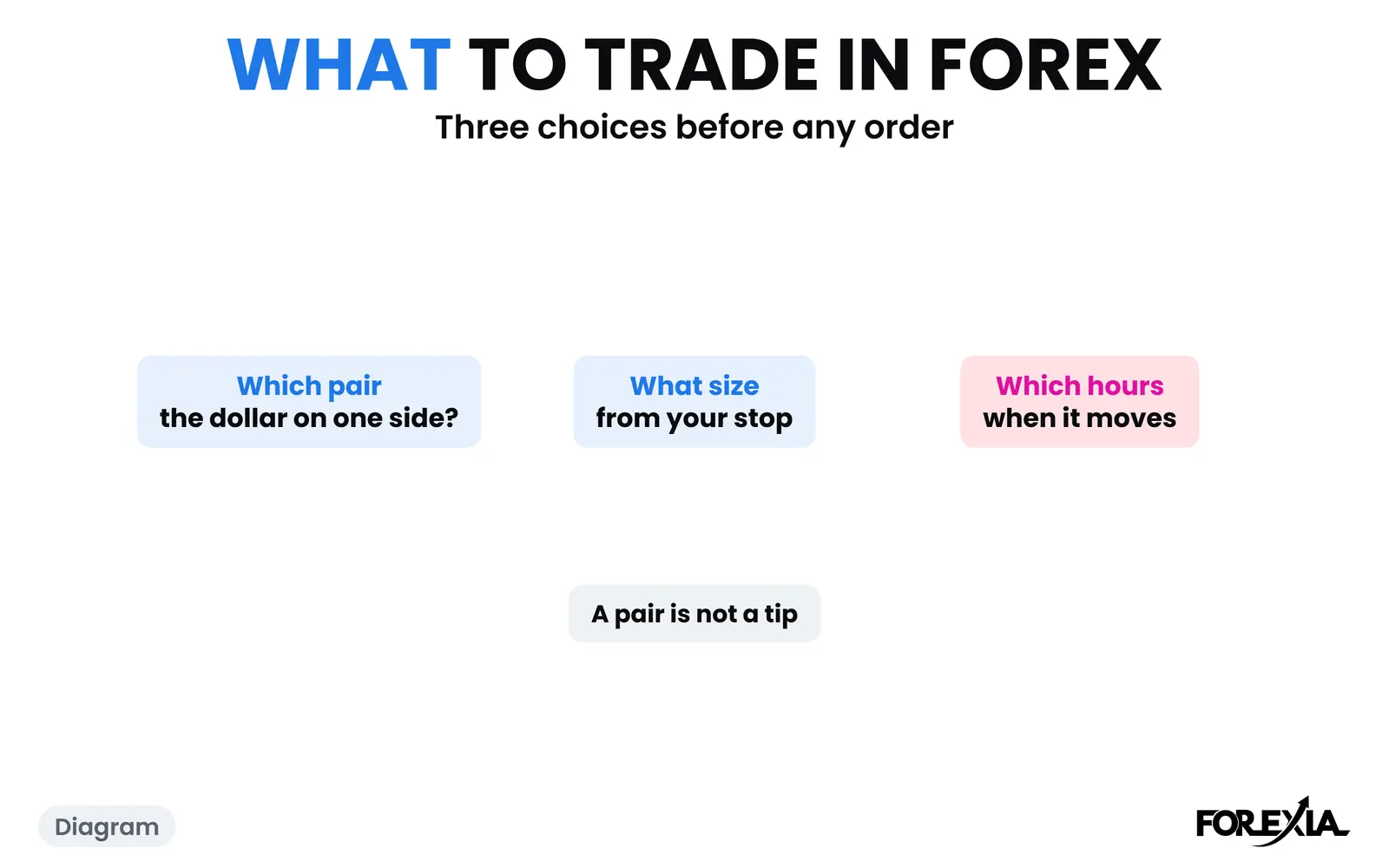
What to trade in forex? In forex you trade currency pairs, such as EUR/USD or GBP/USD, and the choice of pair comes down to three practical questions, not a tip: how far it tends to move compared with your stop, what hours you can watch, and what it costs you. We do not name a pair to buy. This page shows how a beginner can choose, with five pairs measured on one real day.
What can you trade in forex?
The market is large and the list of pairs a broker offers is longer than a beginner needs. A beginner does not need most of them, and the reason is not that the rest are bad. It is that every pair you add is one more pip value to work out, one more spread to check, one more set of hours to keep in your day and one more chart to read before an order. The sensible first question is therefore how few you can manage properly, not how many you can find, and that is a question about your time and your stops, not about the market.
Currency pairs. Each is one currency priced in another, and the market is grouped by convention. Beginners often ask this as if the answer were a list of names. It is not, because the same pair can suit one person's stop, hours and account and not another's. What can be said in general is what the pairs are, how they are grouped and what the measured facts about them are, and the rest is a set of questions you answer for yourself. The groups below are habits of speech, not official classes, and different sources draw the lines slightly differently. They are useful because they tell you what sort of pair you are looking at before you look at its chart. The first thing a group tells you is whether the US dollar is involved, and the dollar's place in the market is large, as the figures after the list show.
- Major pairs have the US dollar on one side and another large currency on the other, such as EUR/USD, USD/JPY and GBP/USD.
- Minor pairs, or crosses, are made from two large currencies that are not the dollar, such as EUR/GBP.
- Exotic pairs match one large currency with the currency of a smaller economy.
The dollar's place is the one fact that is measured. The Bank for International Settlements found the US dollar on one side of 89.2% of all foreign exchange trades in its April 2025 survey, against 28.9% for the euro, 16.8% for the yen and 10.2% for the pound, and said the ten most traded pairs all involve the dollar. Those are the BIS's first-release figures, published on 30 September 2025 and subject to revision. They describe the whole market, not what retail traders pick, and the page we read gave a share for only three pairs, none of them a major, so we quote no share for any one.
Brokers that offer forex often list gold and stock indices beside it. They are not currency pairs. Gold has its own hub, and we do not treat it as one more pair.
How do five pairs differ on one real day?
A pair that moves more in pips needs a wider stop to survive a normal day, and a wider stop means a smaller position for the same loss. That is the practical meaning of "which pair". Here is one real Wednesday, 14 October 2026, measured in New York time from 15-minute Dukascopy candles.
| Pair | High | Low | Range in pips |
|---|---|---|---|
| EUR/USD | 1.12114 | 1.11128 | 98.6 |
| GBP/USD | 1.32753 | 1.31366 | 138.7 |
| USD/JPY | 158.948 | 158.046 | 90.2 |
| AUD/USD | 0.70129 | 0.69503 | 62.6 |
| USD/CAD | 1.42995 | 1.41963 | 103.2 |
The calendar day of Wednesday 14 October 2026, high to low, New York time. A pip is 0.0001, except on USD/JPY where it is 0.01. Candles: Dukascopy.
This is one day. It is not a ranking, and the order would change on another day. It does show that on the same Wednesday the widest of these ranges was more than twice the narrowest, so a stop that is sensible on one pair may be far too tight on another. That is why the position size calculator sizes a trade from your stop, and why the pip's money value, which also varies by pair, is on the pip calculator.
In brief
- What you trade: pairs of currencies. Gold and indices are different products, even if a broker lists them beside forex.
- How a pair is grouped: majors have the US dollar on one side, minors do not, exotics pair a major with a smaller economy's currency.
- What chooses one: its movement against your stop, its hours, its cost.
- What does not: a ranking of best pairs, including ours.
Which hours can you watch?
Pairs tend to move at different times of the day, and a session's hours are one way to choose. A trader in Europe who can watch only the morning is choosing among pairs when they choose a time. The sessions are laid out on the forex sessions page, and one session's pairs are looked at in the best pairs for the London session. Check the open and close of each session against your own day before you pick, because a pair you cannot watch is a pair you cannot manage.
What does it cost you to trade a pair?
Every trade pays a spread, the gap between the buying price and the selling price. It differs by broker, pair and hour, and we name none because we have not checked any broker's. Read the spread on the account page of the broker you are considering, at the hours you intend to trade, and compare it with your stop. A cost that is small beside a wide stop can be large beside a narrow one.
Who is choosing a pair not for?
It is not for anyone who wants a name to buy. We do not give one. It is also not a reason to fund an account: a pair is the last of the choices, after the loss you accept and the stop that fits the chart. The order in learn forex puts the size of a loss before money. If you are still at the first step, what is forex and trading on the forex come before this page.
Sources
- Bank for International Settlements, OTC foreign exchange turnover in April 2025, dated 30 September 2025: the currency shares and the dollar's place in the top ten pairs. First-release figures, subject to revision.
- Candles: Dukascopy, 15-minute, read with the site's own chart tool. All times are New York.
This page is for study. It is not a signal and not trade advice. Trading forex can lose you money.
Keep reading
Frequently asked questions
What can you trade in forex?
Currency pairs: one currency against another, such as EUR/USD. Brokers that offer forex often offer other things too, such as gold or indices as contracts for difference, but those are not currency pairs.
What are the major forex pairs?
By the usual convention they are the pairs that have the US dollar on one side and another large currency on the other, such as EUR/USD, USD/JPY and GBP/USD. The BIS found the dollar on one side of 89.2% of all trades in April 2025.
Should a beginner trade one pair or many?
We give no instruction on that. One pair is simpler to learn, because you see the same pair's pip value, spread and hours again and again, and several pairs can move together. Whichever you pick, size each trade from its own stop.
Is gold part of forex?
Gold is quoted against the US dollar the way a pair is, but it is a metal, not a currency, and it behaves differently. We keep gold on its own hub page.
What is the best forex pair to trade?
There is no pair that is best for everyone and we name none. What fits is a pair whose stop you can size, whose hours you can watch and whose cost you understand.