Leverage Calculator: Margin and the Leverage You Really Use
Forexia Academy6 min read
Enter the EURUSD price to value the position in dollars.
What it assumes: the account is in US dollars; a standard lot is 100,000 units, or 100 ounces of gold. Required margin is the position's value divided by your account leverage; effective leverage is the position's value divided by your balance, whatever leverage the account allows. Your broker's margin rules, and what it does at a margin call, may differ. A sum, not advice.
The leverage calculator on this page turns a position into the margin your broker holds back and the leverage you are really using. One lot of EUR/USD at 1.10 is a $110,000 position. At 1:100 the margin is $1,100, and on a $10,000 balance you are using 11 to 1. Enter a market, a balance, a size and your account's leverage, and it gives all three figures. It covers the seven majors and gold.
Leverage changes how much margin a position needs. It does not change what a price move costs you, and this page gives no leverage to use. Every figure is arithmetic, not advice.
How do you use the leverage and margin calculator?
Enter four figures and read three. A fifth appears only when the position's value needs a price.
- Market: one of the seven majors or gold (XAU/USD).
- Account balance, in US dollars.
- Position size, in lots.
- Account leverage, the 100 of 1:100. Common values are in the box's list, and any figure of 1 or more is accepted.
- Price, if a box for one appears. Pairs that start with the dollar, such as USD/JPY, need none, because a lot of them is $100,000 whatever the price.
The answers are Position value, Required margin and Effective leverage. The position's value is the lots times the contract (100,000 units, or 100 ounces of gold) times the price. Nothing you type is kept.
How are margin and effective leverage worked out?
There are two divisions.
Required margin = position value ÷ account leverage
Effective leverage = position value ÷ account balance
Take one lot of EUR/USD at 1.10. The position is worth $110,000. Here is what the margin comes to at three account leverages, and the leverage used on a $10,000 balance:
| Account leverage | Margin on 1.00 lot | Margin on 0.10 lots | Effective leverage, $10,000 balance |
|---|---|---|---|
| 1:30 | $3,666.67 | $366.67 | 11.0 to 1 (1.00 lot) |
| 1:100 | $1,100.00 | $110.00 | 11.0 to 1 (1.00 lot) |
| 1:500 | $220.00 | $22.00 | 11.0 to 1 (1.00 lot) |
The last column does not change down the table. Effective leverage has nothing in it for the account's leverage, because it is the position against the balance. It reads 1.1 to 1 for the 0.10-lot position at all three. A USD/JPY lot is $100,000 at any price, so on a $2,000 balance it is 50 to 1.
What does leverage do to a stop?
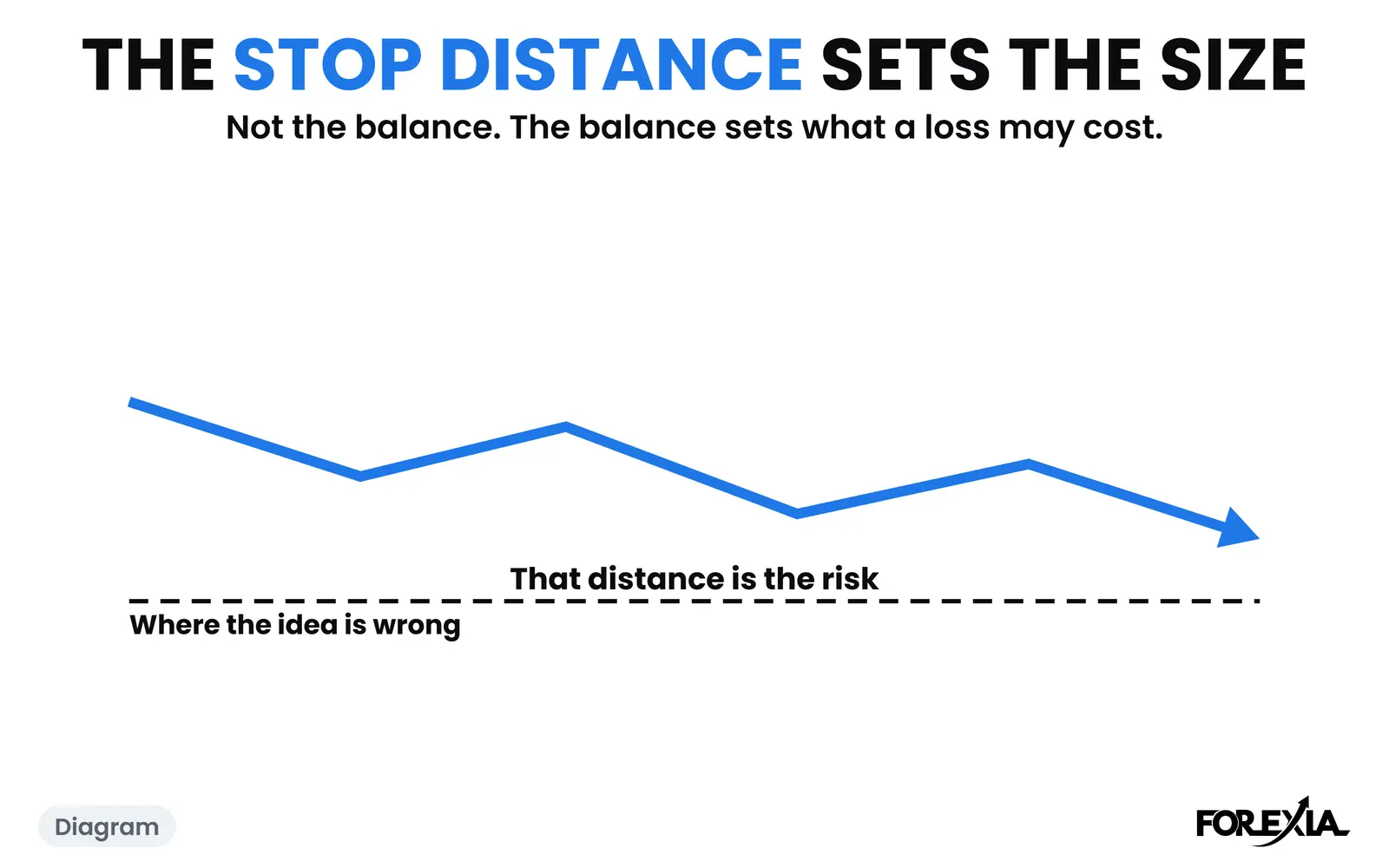
It does not change the cost of the stop. It changes whether the position can be opened at all, and how much of the balance is left to hold it. Here is a real day.
On Friday 11 September 2026, the 08:30 New York candle in gold, US CPI, opened at 4340.86. It ran down to 4291.95, up to 4362.23, and closed at 4353.61. The low is $48.91 under the open, and on our charts that is 48.91 pips. A buyer at the open needed a stop below 4291.95 to be sitting there afterwards.
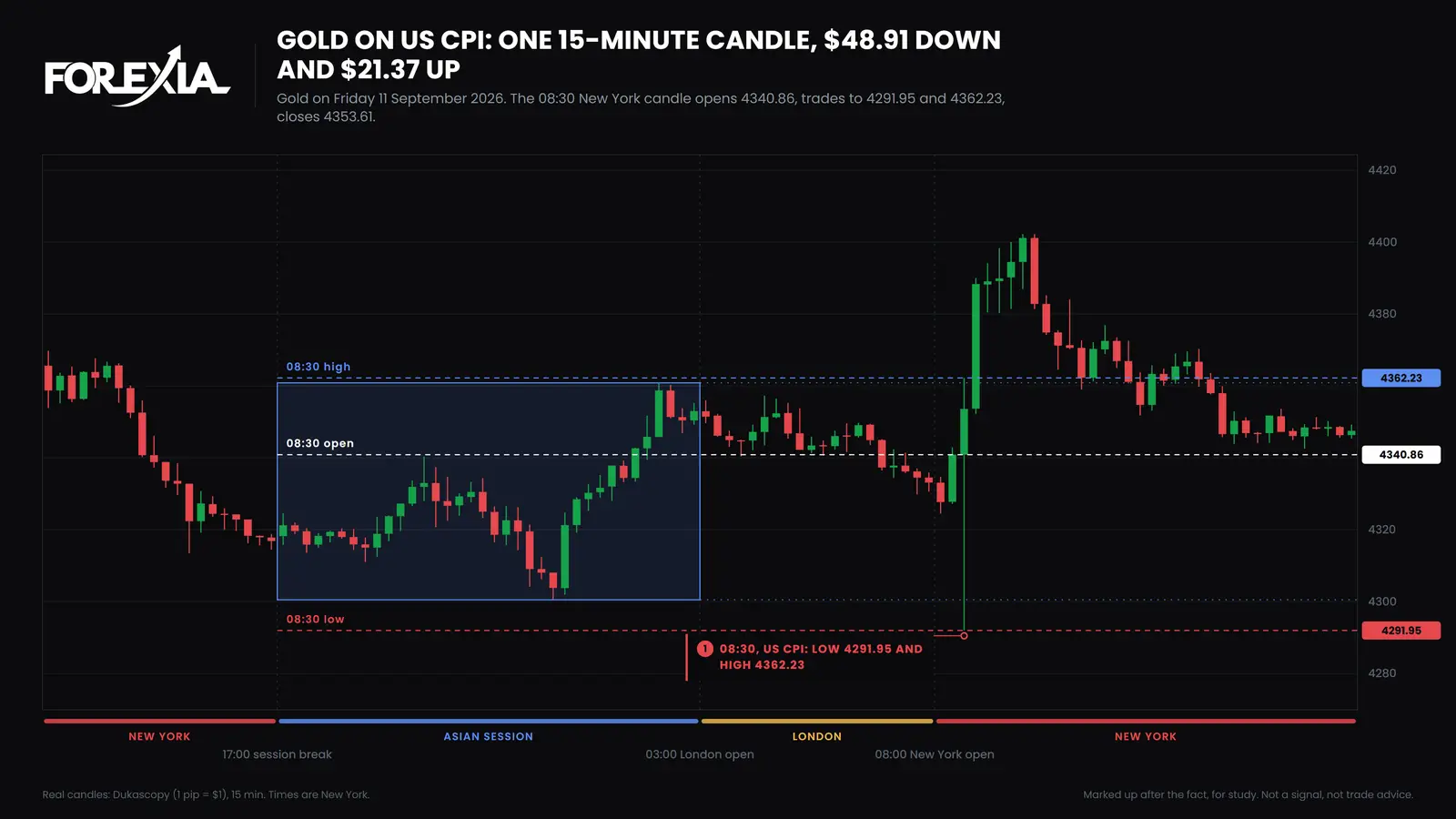
Take 0.10 lots, which is 10 ounces. The position is worth 10 × 4340.86 = $43,408.60. Each dollar of movement is $10, so the move to the low is $489.10. Here it is on a $1,000 balance:
| Account leverage | Margin held | Left of the $1,000 | Cost of the move to the low |
|---|---|---|---|
| 1:30 | $1,446.95 | none: the margin is above the balance | $489.10, if it could be opened |
| 1:100 | $434.09 | $565.91 | $489.10 |
| 1:500 | $86.82 | $913.18 | $489.10 |
The cost is $489.10 in every row. What differs is the margin. At 1:30 the position cannot be opened on this balance. At 1:500 it opens easily, and the same candle then costs $489.10 against a $1,000 balance, which is 48.9% of it. The effective leverage on that balance is 43.4 to 1.
Now take 0.50 lots at 1:500. The margin is $434.09, which the account can hold. The same move to the low costs $2,445.50, which is more than the whole balance. Where a broker closes a position before then depends on its own rules, and this calculator does not model it.
A higher account leverage makes the larger size easy to open. The stop and the size decide what a move costs, and the lot size calculator sizes a position from a stop.
How does the leverage you use change with the size you hold?
Effective leverage is the number to watch, because it is the one your own choice sets. On a $10,000 balance and EUR/USD at 1.10, 0.10 lots is a position of $11,000, or 1.1 to 1. Half a lot is $55,000, or 5.5 to 1. One lot is $110,000, or 11 to 1. Each step multiplies what a price move does to the balance by the same factor, and the account's leverage is not in any of those sums.
On gold the same balance reaches high ratios faster, because the contract is worth more. 0.50 lots at 4340.86 is 50 ounces and a position of $217,043.00, which is 21.7 to 1 on $10,000. At 1:100 the margin is $2,170.43, and at 1:20 it would be $10,852.15, more than the whole balance. Margin only says whether a position can be opened. It says nothing of what the position can cost.
The page does not say which of these is right for you. It shows what each choice comes to, so you can see a figure before you hold it.
What should you check before you open a position?
Read the margin figure against your free balance first, because the margin is money the broker holds while the trade is open. Then read the effective leverage, because it tells you how much a small move does to the whole balance. A 1% move in the market is a 1% move in the balance at 1 to 1, and about 11% at 11 to 1.
Then ask where the stop goes. The size comes from the stop and the amount you accept losing, and the lot size calculator does that sum. Margin and leverage are the checks that the size can be held, not the reason for choosing it.
Can the same calculator be used for gold and for currency pairs?
Yes, with one difference. On a pair such as EUR/USD the position's value is the lots times 100,000 times the price. On USD/JPY it is the lots times 100,000, with no price needed, because the contract is in dollars. On gold it is the lots times 100 ounces times the price in dollars. The calculator picks the right rule from the market you choose and asks for a price only when it needs one.
What does the calculator assume?
It assumes the plain case, and each of these can differ on your account.
- The account is in US dollars. Convert a balance in another currency first.
- A lot is 100,000 units, or 100 ounces of gold. Your broker's specification decides this, and on gold it varies.
- Margin is the position over your leverage. Brokers can hold more, hold different amounts by market or change the figure around news. Some regions cap the leverage retail accounts may use, so read your broker's terms.
- Positions are counted one at a time. It does not net or add up several open trades.
- It does not model a margin call. It does not know the level at which your broker closes a position.
Trading leveraged products carries a high risk of losing more than you can afford. Nothing on this page is advice, and a position that fits your margin is not for that reason a safe one.
The pip value of a position is on the pip calculator, and the ratio of a target to a stop is on the risk-reward calculator.
Frequently asked questions
What is a leverage calculator?
It turns a position into the margin your broker holds back and the leverage you are really using. Enter a balance, a size in lots and your account's leverage. One lot of EUR/USD at 1.10 is a $110,000 position, so 1:100 holds back $1,100, and on a $10,000 balance you are using 11 to 1.
How is margin calculated in forex?
Divide the position's value by your account's leverage. One lot of EUR/USD at 1.10 is worth $110,000. At 1:30 the margin is $3,666.67, at 1:100 it is $1,100 and at 1:500 it is $220. Brokers can add their own rules, so the figure on your platform may differ.
What is the difference between account leverage and effective leverage?
Account leverage, the 100 of 1:100, is the most your broker lets you borrow against. Effective leverage is the position's value divided by your balance, and it is what you actually use. 0.10 lots of gold at 4340.86 on a $10,000 balance is 4.3 to 1, whatever the account allows.
How much leverage should I use?
This page does not give a figure. Leverage sets how much margin a position holds back, and it does not change what a given price move costs you. The same $489.10 move on 0.10 lots of gold costs the same at 1:30, 1:100 and 1:500. Choosing how large a position to hold is your decision.
What is a good leverage ratio?
There is no good ratio in the page's sums. A higher account leverage lowers the margin each position needs, so it lets you hold a larger one, and a larger one moves your balance more. What matters is the size you hold against your balance, the effective leverage, and the stop you place.