Forex Sunday Open: Why Gaps Happen and What Follows
Dylan Forexia8 min read
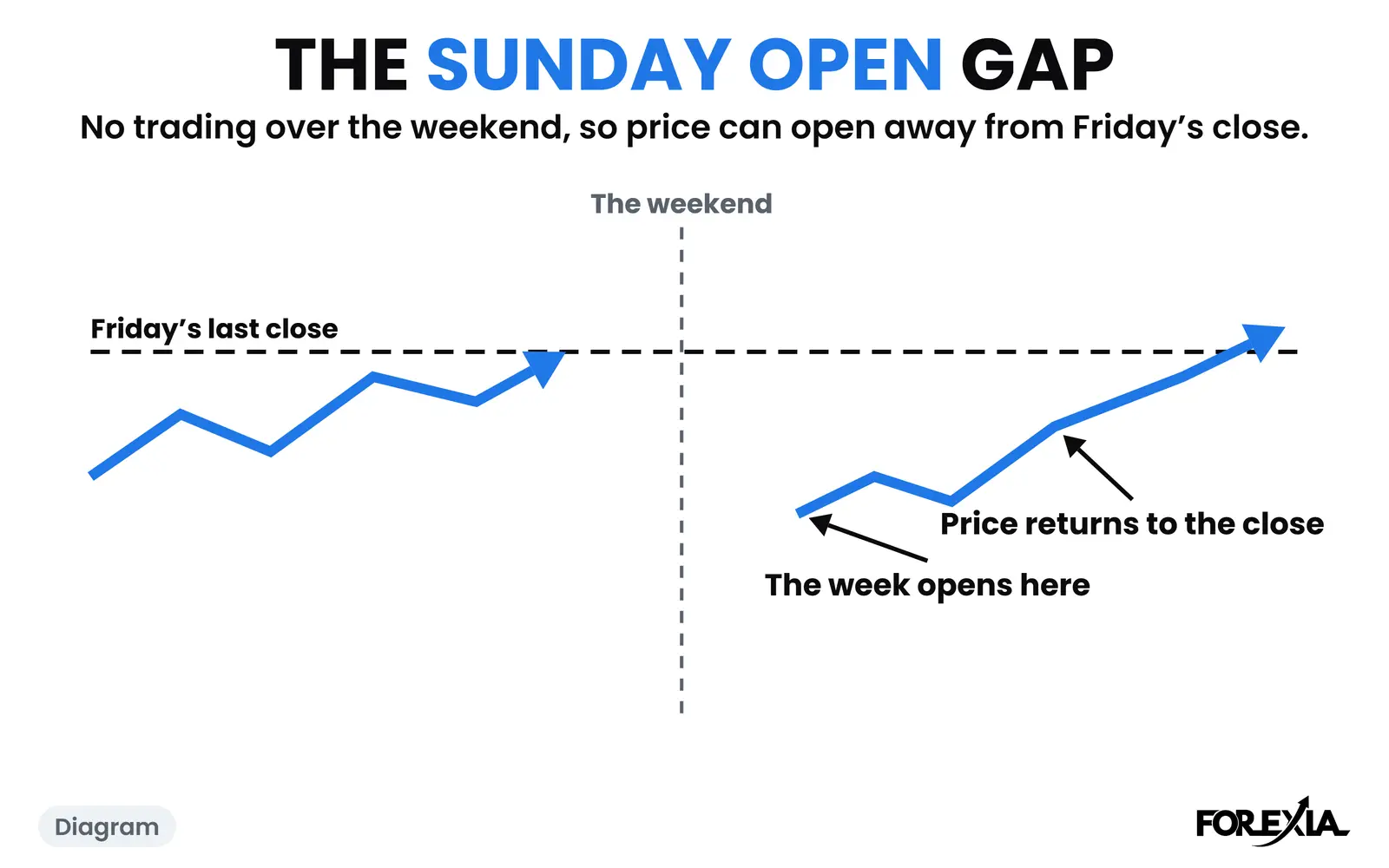
Forex opens on Sunday at 17:00 New York time. That is 22:00 UTC while New York is off summer time, as it has been since 1 November 2026, and 21:00 UTC while it is on summer time. Because nothing trades over the weekend, the first price can sit away from Friday's last, and that distance is the weekend gap. It was small on most Sundays we counted, and larger on a few.
This page gives the opening time, then counts how big the gap was across eight markets and how often price came back, then shows two real Sundays on EUR/USD. The forex sessions page has the rest of the clock.
When does forex open on Sunday?
At 17:00 New York, and it closes at 17:00 New York on Friday. There is no exchange and no bell, so the hour is a convention, and a broker's platform may open a few minutes either side. Gold starts an hour later on our data feed, at 18:00.
The UTC time changes with New York's clocks. In 2026 New York went forward on 8 March and back on 1 November, so the open was 21:00 UTC between those dates and is 22:00 UTC now. In Sydney the same moment is 07:00 on Monday in July, 08:00 in the weeks either side and 09:00 in January. A table saying the week opens with Sydney at 07:00 is only true for part of the year.
What is a weekend gap, and why does it happen?
A weekend gap is the difference between the last price before the close on Friday and the first price at the open on Sunday evening. It happens because the market is shut for two days and the news is not. If the world has changed since Friday, the first price on Sunday has to be where buyers and sellers meet, and no one traded in between to take it there step by step.
We do not know what moved any one Sunday, and a chart cannot say. A gap is a record that price jumped, not a reason. Part of a small one is not a jump at all: the spread is at its widest as the market restarts, and our data is bid prices only, so a few pips can be only the spread.
How big are Sunday gaps, and do they fill?
Across the 26 Sundays from 5 April to 27 September 2026 (25 for gold), the median gap was between 7.5 and 12.2 pips on the seven majors and 14.6 on gold, where we count $1 as 1 pip. Here is each market. "Back by London" counts the Sundays price traded back to Friday's close before London's open on Monday, 03:00 New York in most weeks.
| Market | Sundays | Median gap, pips | Biggest gap, pips | Biggest gap on | Back by London |
|---|---|---|---|---|---|
| EUR/USD | 26 | 9.2 | 47.7 | 12 April | 18 |
| GBP/USD | 26 | 8.8 | 72.2 | 10 May | 17 |
| USD/JPY | 26 | 9.2 | 40.9 | 12 April | 21 |
| USD/CHF | 26 | 7.5 | 32.4 | 3 May | 19 |
| AUD/USD | 26 | 12.2 | 69.1 | 12 April | 18 |
| USD/CAD | 26 | 8.3 | 54.8 | 23 August | 19 |
| NZD/USD | 26 | 8.0 | 39.3 | 12 April | 20 |
| Gold | 25 | 14.6 | 111.9 | 12 April | 15 |
Three things stand out. The median gap is a small part of a day: on EUR/USD it was about 16% of the market's average daily range, and between 12% and 24% on the other markets. Price went back to Friday's close by London's open on 147 of 207 Sundays, and did not on 60. And one Sunday, 12 April, held the biggest gap of the sample on five of the eight markets.
The count is of gaps and fills, with no entry and no stop. It says what price did on 26 Sundays in one setting of the clocks, and it does not say what a trade would have made.
A Sunday where the gap took 19 hours to fill: EUR/USD, 12 April 2026
Friday's last candle on EUR/USD closed at 1.17216. The week opened at 1.16739 at 17:00 on Sunday, 48 pips lower. Price dipped to 1.16638 by 19:15 and then drifted inside a 31-pip range, 1.16638 to 1.16948, all through Asia. London opened on Monday with the gap unfilled. The first candle to trade back to Friday's close was the 12:30 New York candle on Monday, which reached 1.17263, 19 and a half hours after the open. Price kept going to 1.17653 at 14:45. Our calendar had an ECB speech at 08:15 and existing home sales in the US at 10:00, both medium impact, and nothing larger.
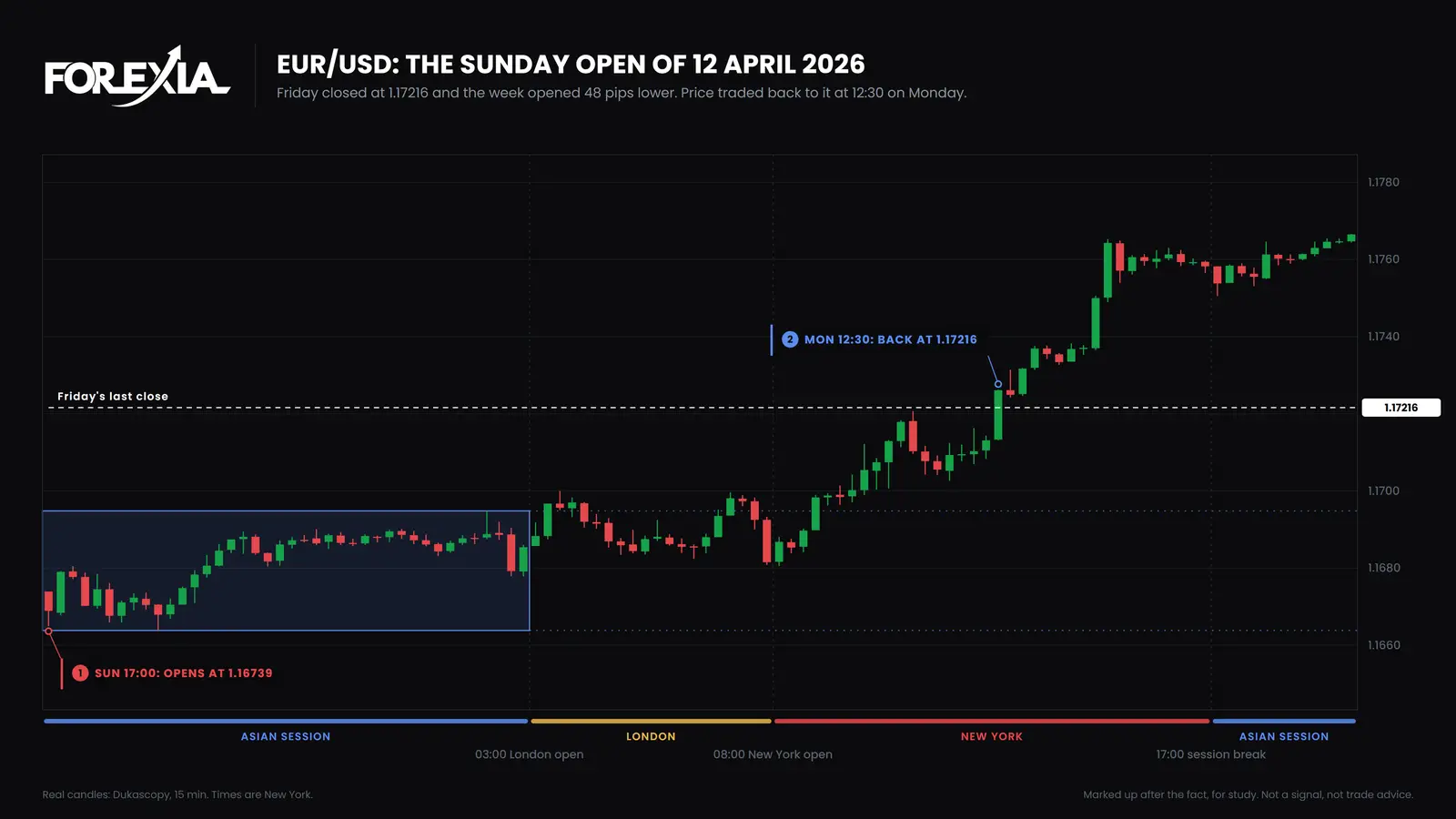
A reading made afterwards makes the fill look inevitable. At London's open the 03:00 candle opened at 1.16857, still 36 pips under, and the gap-fill idea would have been waiting another nine and a half hours, past London's whole morning, for a candle that came after New York's open. This day was one of the 60 that did not fill by London.
A Sunday where it filled in four hours: EUR/USD, 26 April 2026
A smaller Sunday ran the other way. Friday closed at 1.17192 and the week opened at 1.16947, 24.5 pips lower. Price climbed through the first hours and the 21:00 New York candle reached 1.17266, through Friday's close, four hours after the open. By the 22:00 candle it was back at 1.17229. The Asian box that day, 1.16928 to 1.17324, ran about 40 pips, against a median night of 23 on EUR/USD, because the box includes the climb that closed the gap. The high of the day was 1.17548 at 08:15 on Monday.
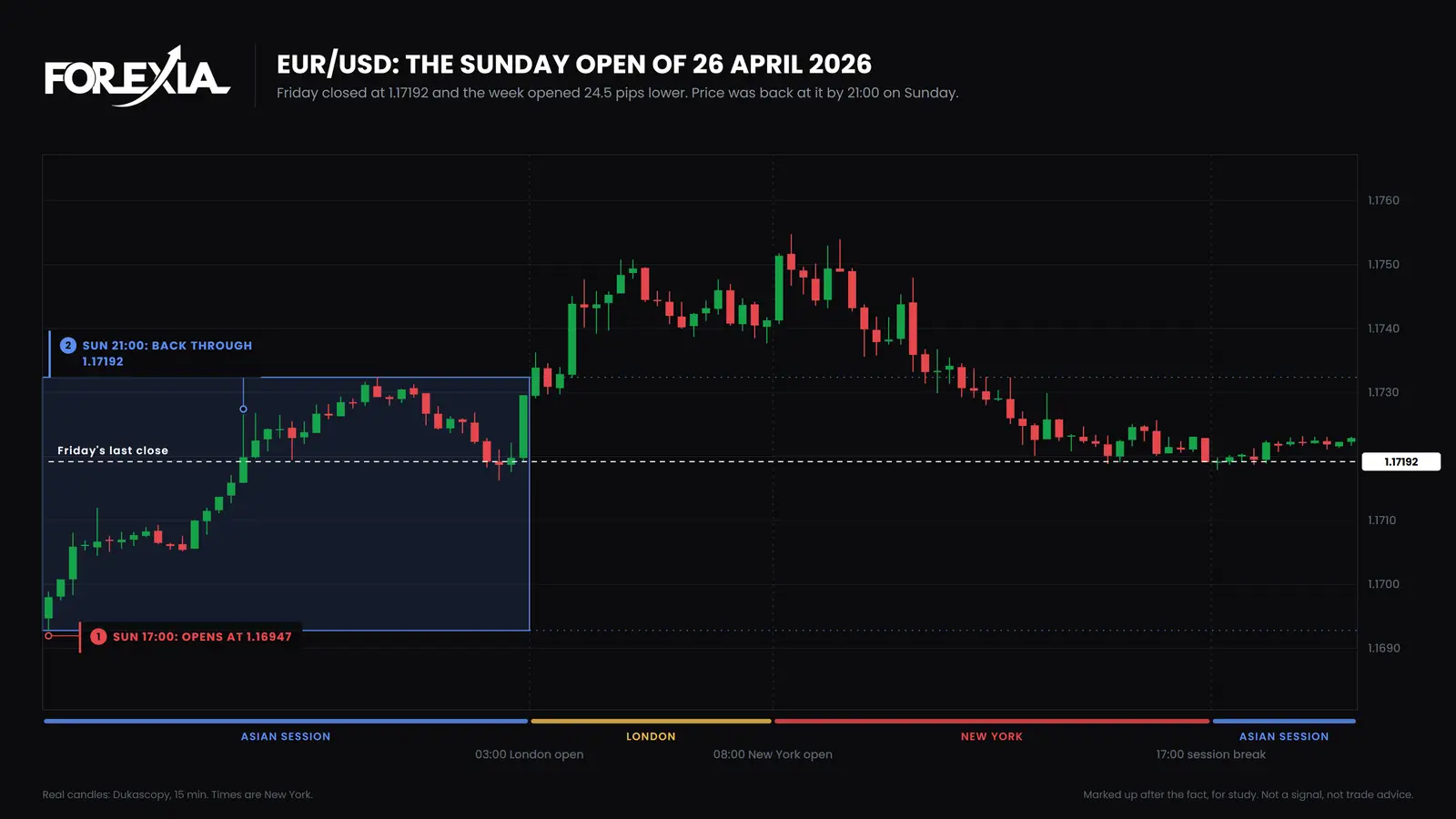
Neither day says what the next Sunday will do. Together they show the spread of outcomes: the same pair, a 48-pip gap that took most of a day and a 24-pip gap that took four hours.
What did each seat see?
Retail sees a gap and a rule: gaps get filled. On 147 of 207 Sundays that was true by London's open, and that is a count of Sundays and not a promise about the next one. The 60 that stayed open are the part of the rule the saying does not mention.
The market maker's seat is the one we cannot see. We read the week's first hours as a thin market finding its first orders, and the first orders are not where the crowd's stops are, because the crowd has not placed them yet. That is a reading, and no chart shows it.
The observer sees what happened and nothing more: a gap of so many pips, a fill at 12:30 or at 21:00, a range afterwards. The Weekly Script is our way of reading the week as an order of events, and the induction trend is the Sunday to Tuesday trend we say the crowd follows. Those pages say how our courses read the early week. Neither says a gap will fill.
What does this not tell you?
It does not tell you how wide the spread was at the open, because our feed is bid prices only and we did not count it. It does not tell you what any gap meant, and it stops at 27 September 2026, with 26 Sundays in a six-month window. It is not a gap strategy, and our own test of the setup as a fixed rule did not make money. A fill seen afterwards is not a setup.
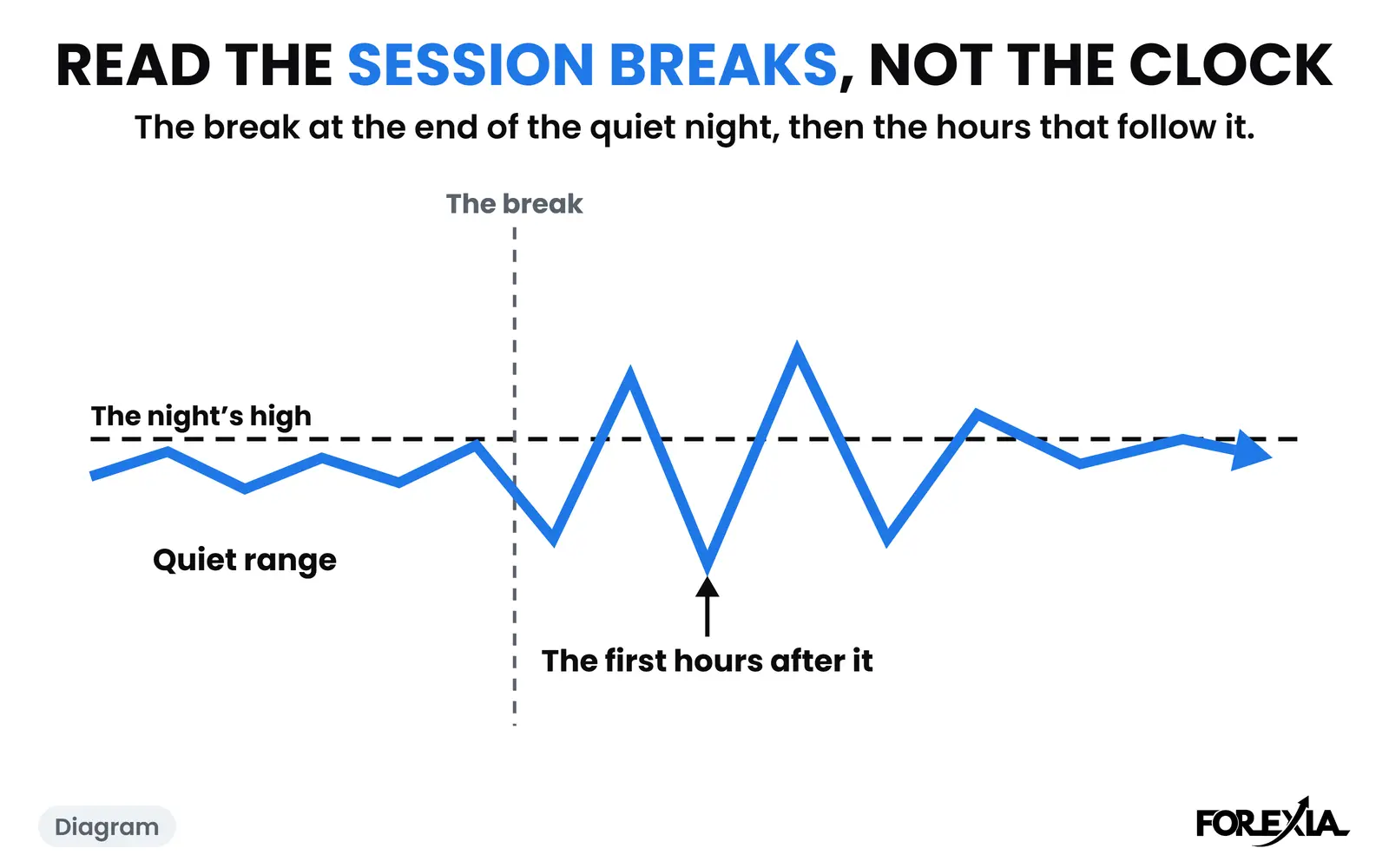
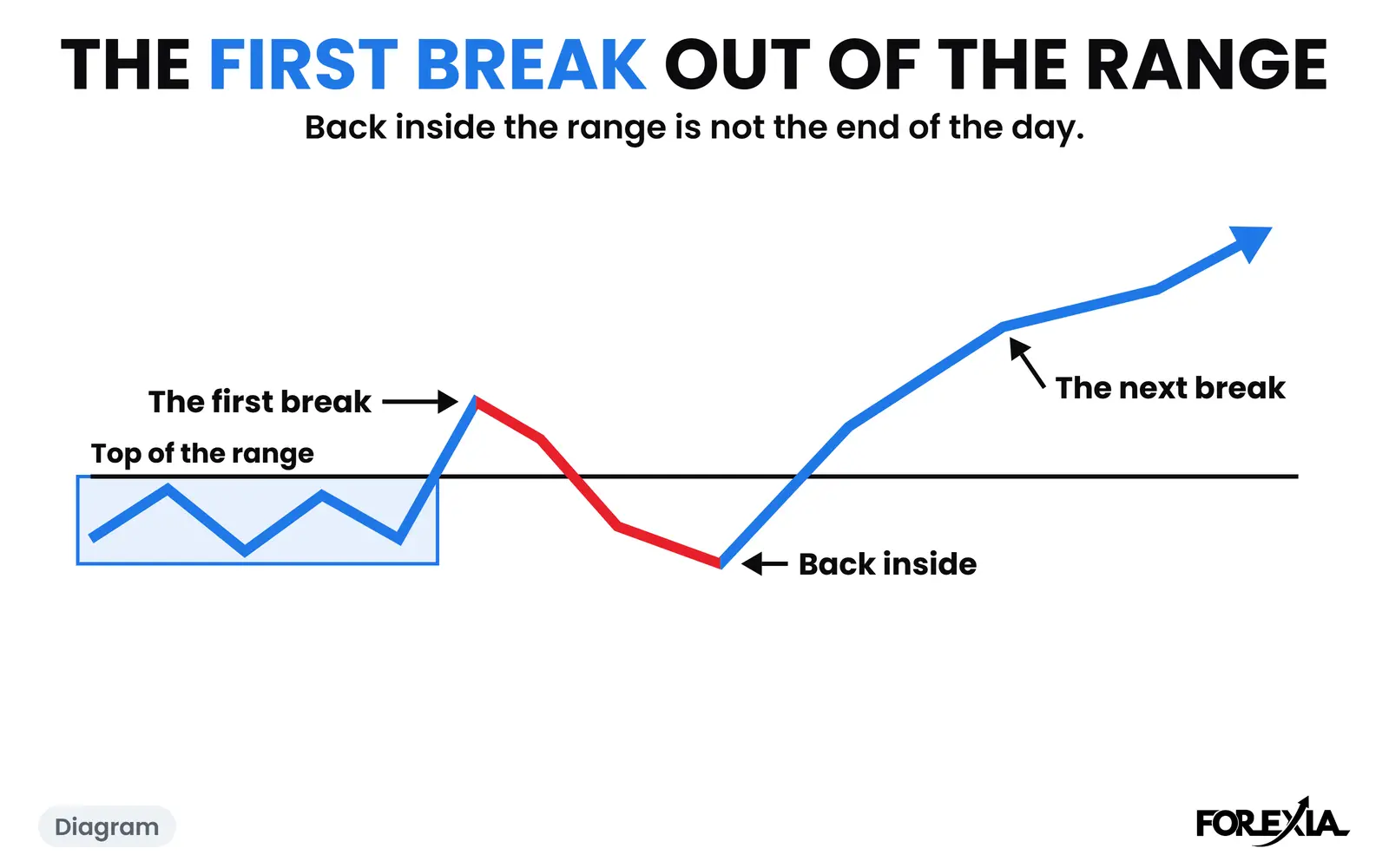
To read the hours that follow the open, see the best time to trade GBP/USD, and the first break of the night's range in why the first break of the Asian range often fails. When London opens and what it did after a gap Sunday is in London session reversal.
Common mistakes
Three misreadings account for most of the confusion about the Sunday open.
- Taking a few pips for a gap. A median gap of 8 to 12 pips on a major is partly the spread at the restart. Check a second chart before calling it a jump.
- Using the wrong clock. The open is 17:00 New York all year, and its UTC time moves twice. Read it off a clock that handles New York's change, such as the forex market hours clock.
- Treating "gaps fill" as a law. It held on 147 of 207 Sundays by London's open and did not on 60.
Course 2 of ForexiaPRO, The Chaos Pattern, teaches how the week's first hours fit the day, starting with lesson 2.1.1, Asia Sets It, London Breaks It, New York Turns It.
Frequently asked questions
When does forex open on Sunday?
At 17:00 New York time. That is 22:00 UTC while New York is off summer time, from 1 November 2026, and 21:00 UTC while it is on summer time. A broker's own platform may open a few minutes either side, and gold starts an hour later on our data feed, at 18:00 New York.
What is a weekend gap in forex?
A weekend gap is the distance between Friday's last price and the first price on Sunday evening. The market is closed in between, so price can reopen away from where it stopped. On 26 Sundays from 5 April to 27 September 2026 the median gap on the seven majors was 7.5 to 12.2 pips.
Do forex weekend gaps always fill?
No. On our data, price traded back to Friday's close by the London open on Monday on 147 of 207 Sundays across seven majors and gold. On the other 60 it had not, and EUR/USD on 12 April 2026 did not come back until 12:30 New York on Monday, after 19 hours. These are bid prices, and a small gap can be only the spread.
Is the Sunday open a good time to trade?
It is the thinnest hour of the week, and spreads are wide as the market restarts. We have not counted spreads, because our feed is bid prices only. Our own test of the setup as a fixed rule did not make money, and nothing here is a signal.