
Fade the Crowd: What the COT Report for Forex Rules Out, and What It Cannot Tell You
Fade the Crowd is the COT read that when the large speculators are crowded, you never trade with them. Crowded means an index of 20 or under, or 80 or over. Our stance is against joining the crowd: we read a crowded extreme as the thing not to join. The COT report for forex can say that much, and it never says when.
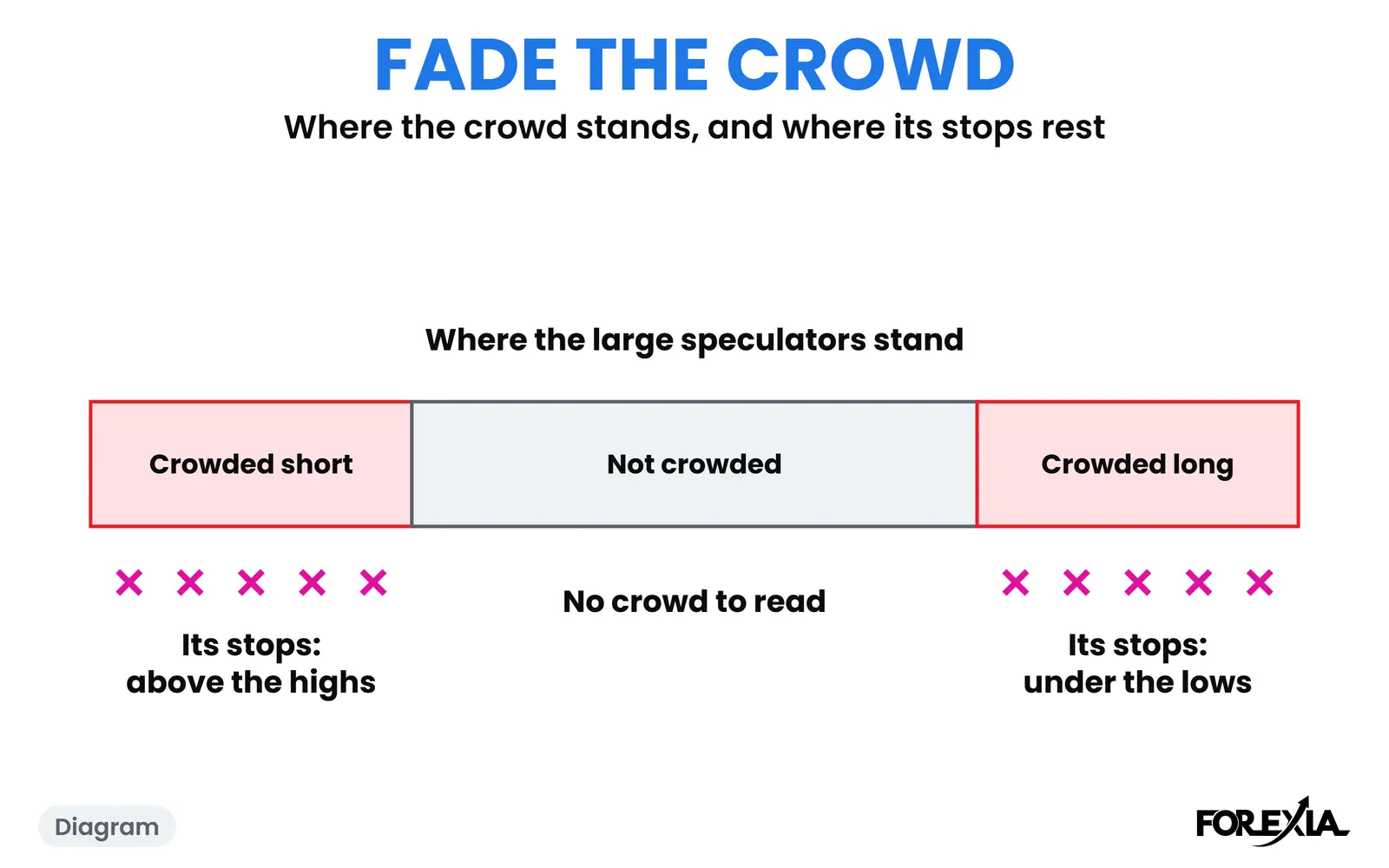
What does Fade the Crowd look like on a chart?
It looks like a fall that a crowded side kept selling. The COT report counted on Tuesday 21 July 2026 and published on Friday 24 July had the large speculators net short 41,338 euro contracts, 5.2% of open interest. Their index was 18: crowded short. Our stance on a reading like that is against joining the crowd, and we read each of those shorts as a stop resting above the highs.
On Monday 27 July the euro fell to 1.13668. On Tuesday 28 July it kept falling, under the low of the week before, and at 06:00, in London, it reached 1.13531. To a seller that was a breakdown. That day ended at 1.13859, 33 pips higher. The next count, taken that same Tuesday, shows what the crowd had done in the week: net short 72,447 contracts, index 8. It had added to its shorts.
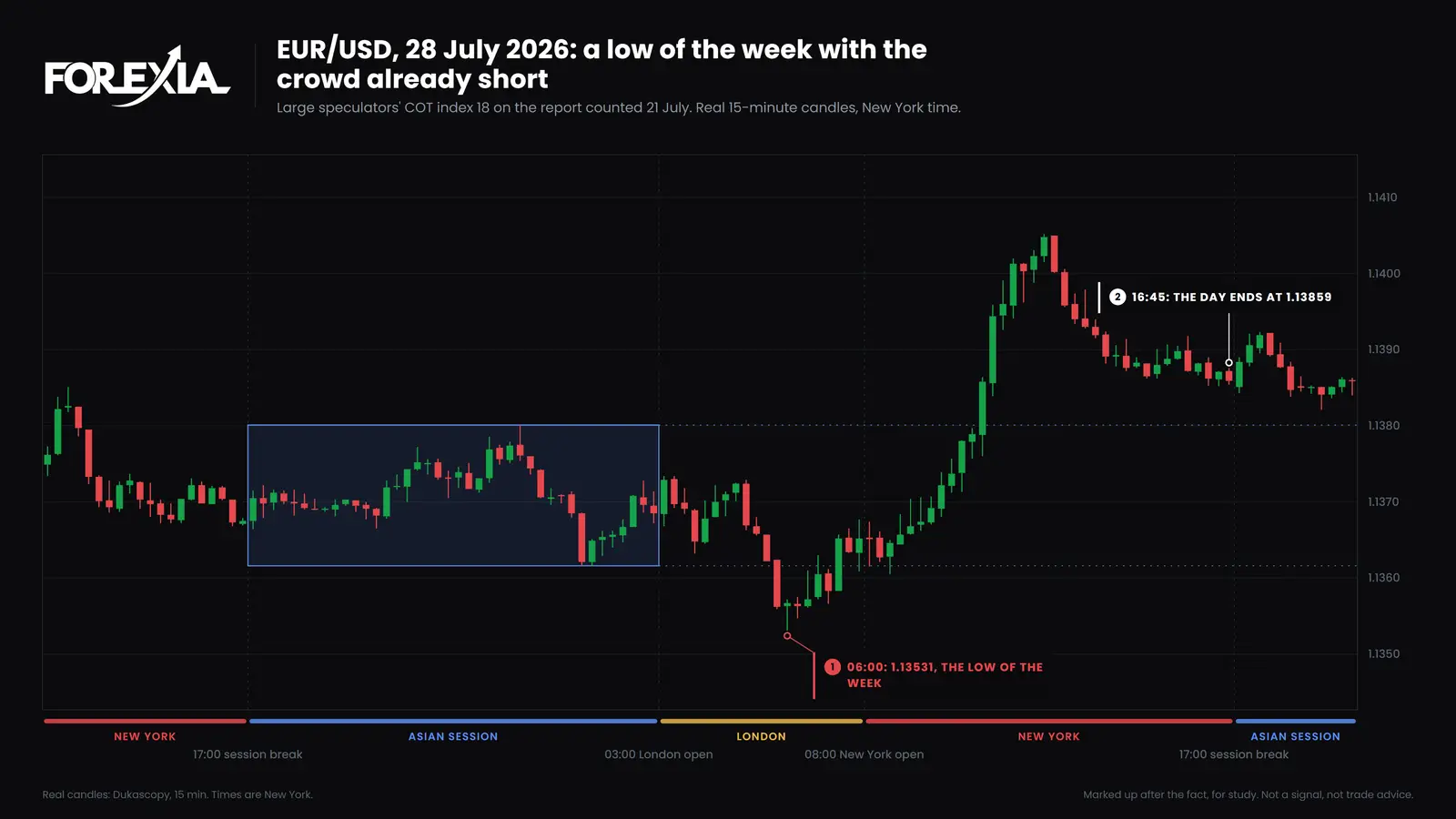
Whoever sold that break sold with a crowded side, at the low of the week. On Wednesday 29 July the euro rose to 1.14709, with a Federal Reserve decision that afternoon. On Thursday 30 July it reached 1.15369. At the count of Tuesday 4 August the crowd was still net short 58,091 contracts, at an index of 13.
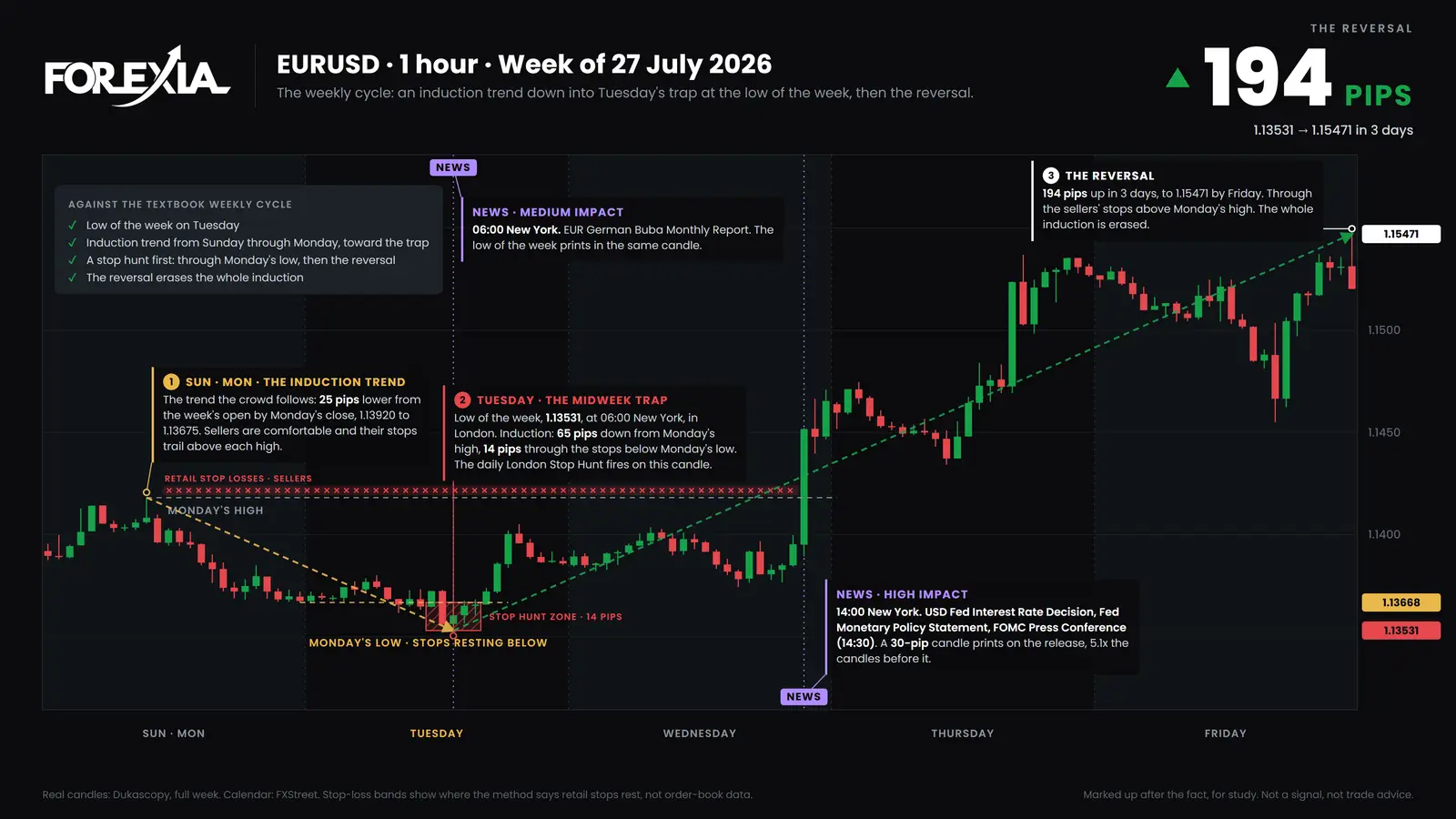
Now the limits. This report was published before 2 October 2026, so ours was built afterwards, by the same rules. Most weeks nothing like this comes, and one that does, seen afterwards, is not a setup. The report itself only said which side not to join. It did not call that Tuesday.
Fade the Crowd and the COT report forex traders read: how do they differ?
The report is raw data, and our word is one reading of it. The CFTC counts who holds the futures as of Tuesday, and publishes on Friday. How to read the COT report covers that, and the COT index covers the 0 to 100 scale.
The word differs from the usual contrarian guide in three ways.
- It is a stance, not an order. "Fade" normally means take the other side. We read a crowded extreme as the thing not to join, and stop there. The Three Seats put it this way: the first seat sees conviction, the market maker sees fuel, and the observer sees a crowd it does not want to be part of, not which side wins.
- The lines are ours. We use 20 and 80, and others use 10 and 90. Nobody's lines are a law. What is a COT extreme goes into it.
- The crowd is not retail. Large speculators are funds and other big traders, not Dumb Money. At the ends of their range they behave much like it, by our reading.
Whether fading pays is a separate question, and the research pages hold it: fading the crowd on a level hunt and does the COT report work give our figures with their caveats, and how thin the evidence is.
How do you spot a crowded side?
You read the index for that market, not the headline. A big net position means nothing until you set it against that market's own three years: 0 is the most short they have been, 100 the most long. At 20 or under they are crowded short, at 80 or over crowded long, and between the two the report gives no read.
Check the direction too, because yen futures look backwards, and so do the franc and the Canadian dollar. And remember it is a map of Tuesday, not a clock. On that report the euro closed Tuesday at 1.13977 with the index at 18. On 18 August the index was 13 and the euro was 177 pips higher. By 13 October the index was 0 and the euro was 377 pips under the August price. The crowd was short throughout: first price went against it, then with it.
What do traders get wrong about Fade the Crowd?
Three readings cost the most.
- Reading 80 as a buy. An index of 80 means the crowd is long. Buying there is trading with it.
- Stretching the lines. An index a little inside 20 or 80 is not crowded on our read, however close it looks.
- Expecting the crowd to lose soon. A side can stay crowded for weeks while price runs its way, as it did from late September to mid-October.
Which words does Fade the Crowd lead into?
Four sit next to it.
- Dumb Money: the predictable retail herd the chart is built to trap.
- The Week's High and Low: the pool the WTF Reversal runs for.
- The WTF Reversal: Wednesday, Thursday, Friday, the reversal through the herd's stops.
- Perceptual Positioning: seeing the same chart from three seats.
Where is Fade the Crowd taught?
Course 1 of ForexiaPRO, Reading the Map, teaches this read step by step in lesson 1.3.3, The Lean and the Trade, in its module named Fade the Crowd.
Related words
- Dumb Money: What It Means, and Where Dumb Money vs Smart Money Goes Wrong
- The Week's High and Low: the Biggest Pool of Stops, and Why It Moves
- The WTF Reversal: the Midweek Reversal in Forex, Through Wednesday, Thursday and Friday
- Perceptual Positioning: The Trading Psychology of Reading One Chart From Three Seats
Frequently asked questions
What does fade the crowd mean in forex?
On Forexia it is a read of the COT report: when the large speculators are crowded, at an index of 20 or under or 80 or over, we read that as the thing not to join. Elsewhere 'fade' usually means taking the other side. Here it is a stance against joining the crowd, and it goes no further than that.
What counts as crowded on the COT index?
The index sets the large speculators' net position against its own last three years, from 0, the most short, to 100, the most long. We call 20 or under crowded short and 80 or over crowded long. The lines are our choice. Other readers use 10 and 90.
Are large speculators the same as retail traders?
No. They are hedge funds and other big traders betting on direction, and the COT report counts them in futures. Our read is that at the ends of their range they behave the way the first seat does: they sell after the fall, buy after the rise, and sit in the position.
Does fading the crowd work?
That is a question for a test, not a glossary. Forexia's figures, with their caveats beside them, are on the research page Fading the Crowd on a Level Hunt. On this page, the honest answer is that a crowded index says which side not to join and never says when anything will happen.