
The Third Tap: Why a Double Top's Third Touch Is Where the Trap Is Set
The Third Tap is the perfect third touch of a level, where the trap is set. "Why would the market give you such a perfect entry?" The textbooks teach the double top and the double bottom, and add that a third touch makes a level stronger. We read that third touch from the other side: three touches have taught the crowd one price, and parked its stops just past it.
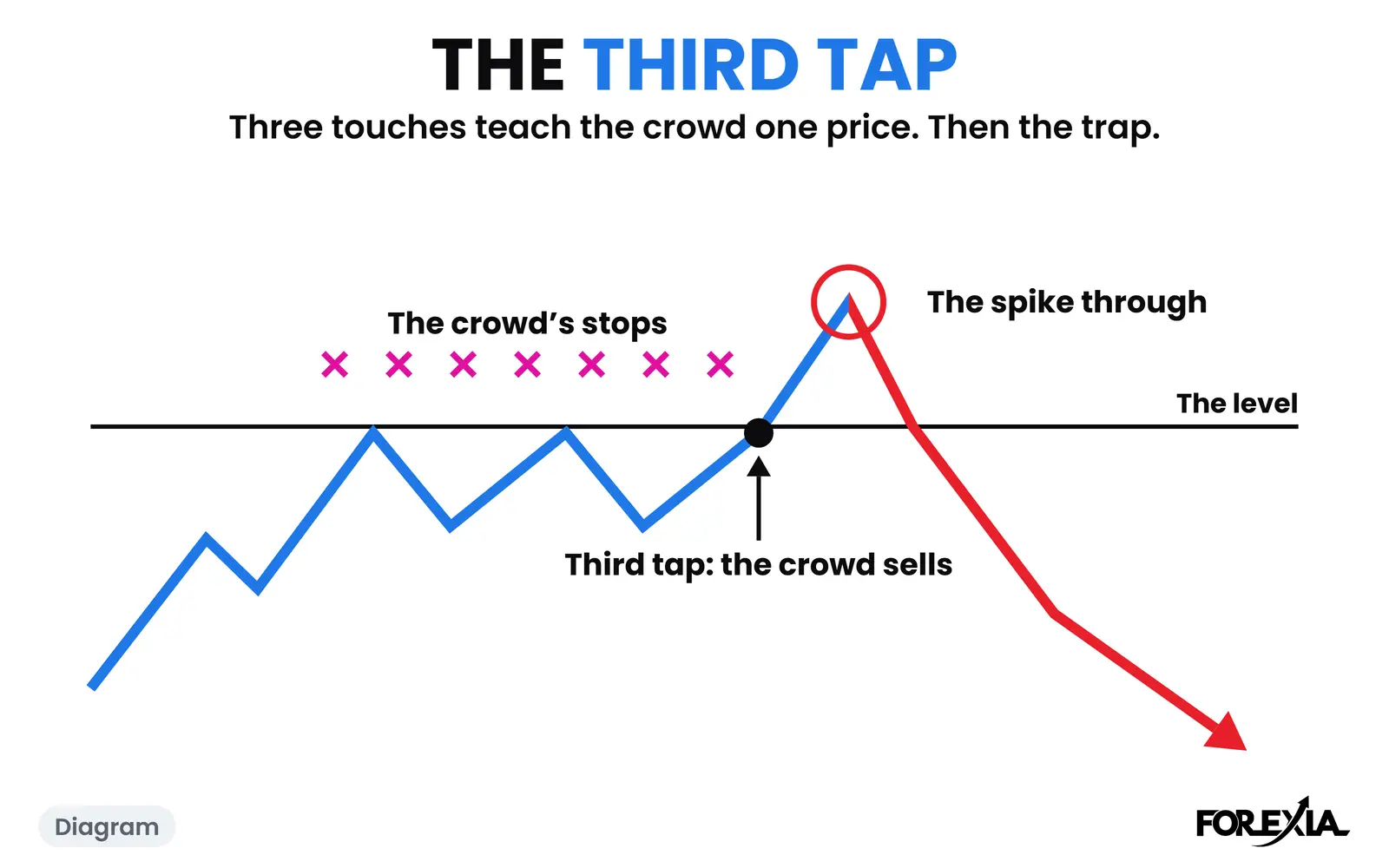
What does the Third Tap look like on a chart?
It looks like a level holding perfectly. On EUR/USD on Friday 28 August 2026, the Asian Box ran from 1.16424 to 1.16553, 13 pips. Inside it, 6 pips under the top, price kept stopping at one level, with no high between the first and third touches going over it.
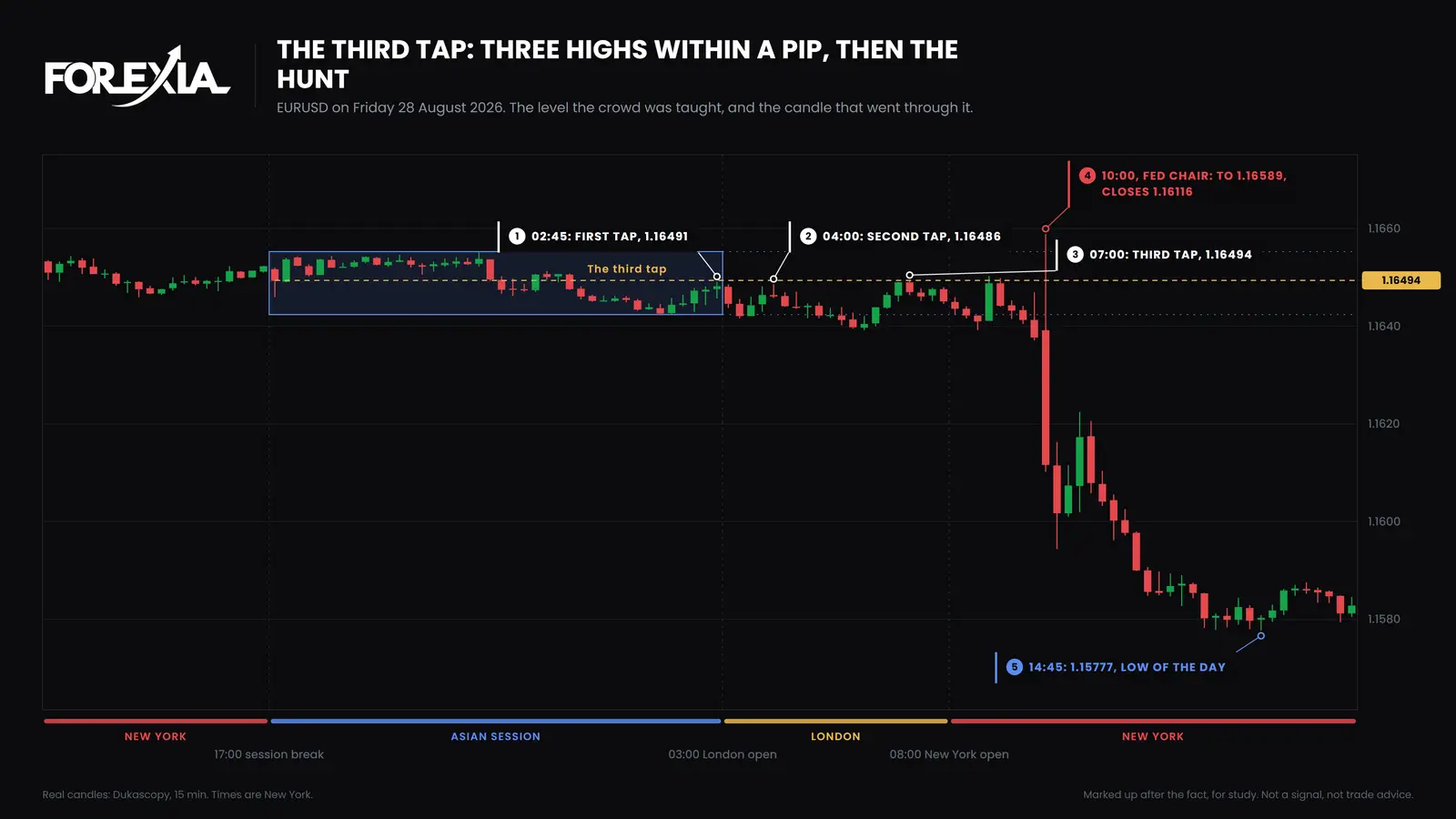
- Three taps. Highs of 1.16491 at 02:45 New York, 1.16486 at 04:00 and 1.16494 at 07:00. From the first seat, that is a triple top: sell the third tap, stop just over the level.
- Touches, not a hunt. At 08:45 and 09:00 price pokes to 1.16503 and 1.16499, under a pip over the level, and comes back.
- The hunt, 10:00. With the Fed chair's speech and the payrolls benchmark revision on the calendar, one candle opens at 1.16392, trades up to 1.16589 and down to 1.16102, and closes at 1.16116. Dukascopy's one-minute candles put the high in its first minute. The high is 10 pips over the third tap and 4 over the box: the Stop Hunt, what most traders call a liquidity sweep. The close is 38 pips under the level.
- After. The low of the day, 1.15777, comes at 14:45, 81 pips under the hunt's high.
Look at who that hurt. The third tap's sellers were right about the direction, and they were stopped first if their stop sat within 10 pips of the level. That is the word's whole point. The trap is not that the pattern was wrong. It is where the pattern told them to put the stop.
The Third Tap and the double top and double bottom: how are they related?
The Third Tap is what a double top or double bottom becomes when price comes back a third time. A double top is two failures at one high, a double bottom two at one low, and a third test makes it a triple. The guides then split: some say sell the third test with a stop a few pips above, others wait for the neckline to break. The honest ones add that no reliable published figure ranks one pattern above the other.
Our word differs in what it is for. A double top or a triple top is a pattern to trade. The Third Tap is a question about the trade: where did three touches tell everyone to put their stops, and who can use that? It works the same way under a low.
Our guide to double top double bottom patterns has the shapes, why double tops and double bottoms fail takes up the failures, is a double top a stop hunt takes up that reading, and the stop hunt guide has more days.
How do you spot the Third Tap?
Look at the highs from 02:45 to 07:00 on 28 August. One line fits the three of them, under a pip apart, and nothing between them goes over it. Price came near that line at other times too, such as 03:00 and 06:45, without breaking it. That is what the crowd was shown for four hours: one price. Liquidity Mapping puts a line like that on the chart before anything happens. Then compare what came after: under a pip over at 08:45 and 09:00, 10 pips over at 10:00. You only know which kind you saw once the candle closes.
What do traders get wrong about the Third Tap?
Three things cost the crowd most that day.
- Selling the 07:00 high. It looked like the textbook sell, and price did fall from it. Then the 10:00 candle went 10 pips over the level before it fell, and a stop inside those 10 pips went first.
- Calling the 08:45 poke the hunt. That candle and the next went over the level by under a pip and came back. The candle that mattered was still an hour away.
- Reading it as a forecast. A third tap says where stops may rest, not that a level will break. We have not counted how often one does. This day is here because it turned, a reversal seen afterwards is not a setup, and our own test of the setup as a mechanical rule did not make money.
Which words does the Third Tap lead into?
Four sit next to it.
- Reverse Price Action: reading a pattern backwards, from where its stops sit to how the bigger players use that pool.
- The Trap: the averages cross late, pull the crowd in, then cross back onto their stops.
- Dumb Money: the predictable retail herd, entering on the textbook signal with its stops where everyone else puts them.
- The Stop Hunt: price driven into clustered stops to fill the other side.
Where is the Third Tap taught?
Course 3 of ForexiaPRO, Reverse Price Action, teaches this read step by step in lesson 3.1.3, The Third Tap: the Perfect Entry Is the Trap.
Related words
- Reverse Price Action: Reading a Pattern Backwards, and What a Fake Breakout Really Is
- The Trap: Why the Crowd's Averages Cross Late, and the Best Indicator for Scalping
- Dumb Money: What It Means, and Where Dumb Money vs Smart Money Goes Wrong
- The Stop Hunt: What It Means, and How It Relates to a Liquidity Sweep
Frequently asked questions
What is the Third Tap?
It is Forexia's word for the perfect third touch of a level, where the trap is set. From the first seat it looks like the textbook entry. We read it as a level that has taught the crowd one price, with its stops parked just past it. The question it asks is why the market would give you such a perfect entry.
Is the Third Tap the same as a triple top?
The shape is the same, and the reading differs. A triple top is a pattern you trade: sell the third test or the break of its low, with a stop just over the peaks. The Third Tap is a warning about that stop, read from the other side.
Does a third touch make a level stronger?
That is the textbook view, and even guides that teach it say there is no reliable published figure for it. What three touches certainly do is show the crowd one obvious price and one obvious place for a stop. We have not counted how often a third touch holds, so we do not claim a rate.
Does a third tap mean the level will break?
No. It marks where stops are likely to rest. A level can hold for the rest of the day, or be touched again by under a pip and stay there. Forexia's own test of the setup as a mechanical rule did not make money.