How to Choose a Forex Signal Provider: Seven Questions to Ask Before You Follow One
Forexia Academy9 min read
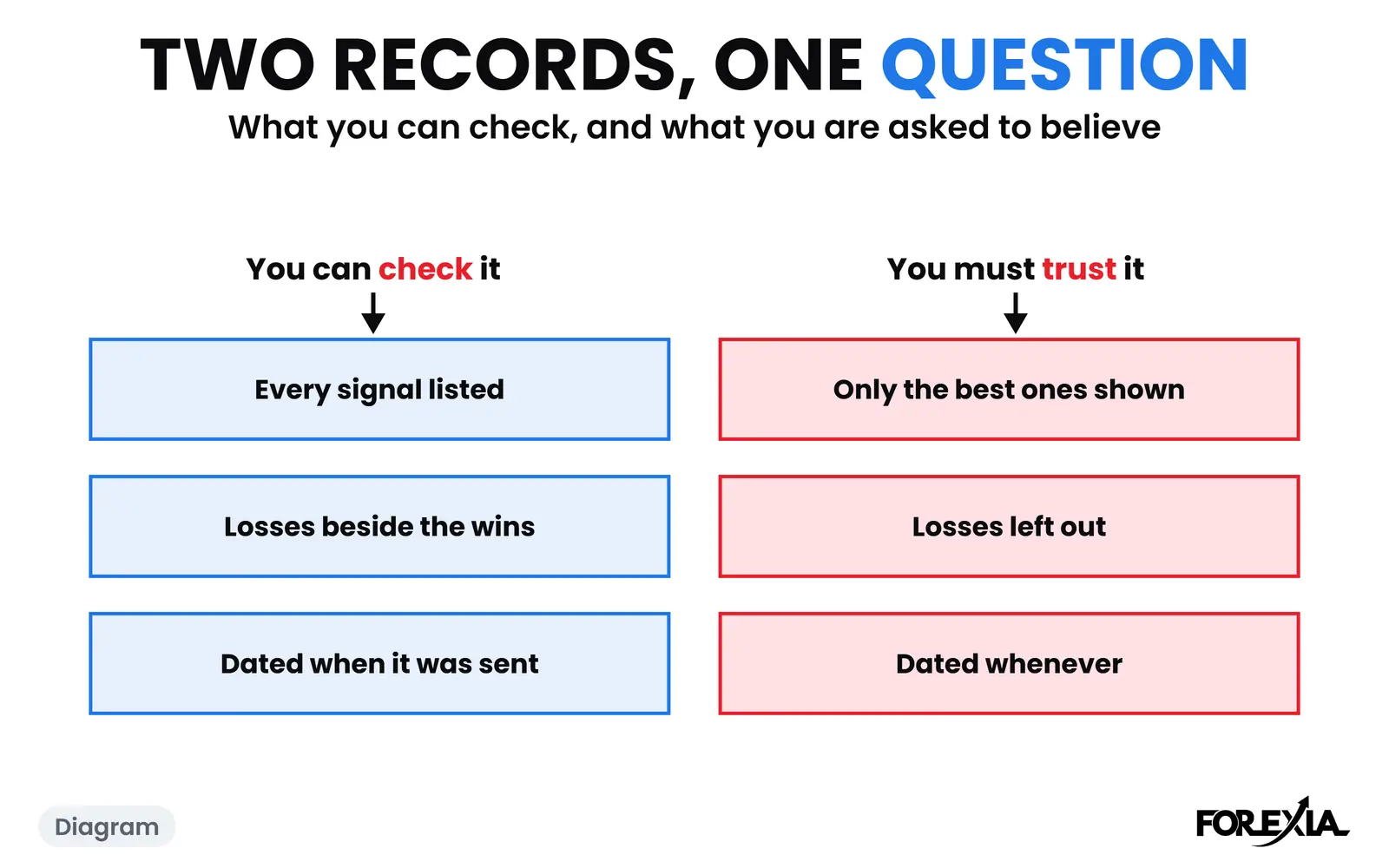
How to choose a forex signal provider comes down to a few questions that you can check before you follow any signal, from anyone. A provider you can judge shows every signal with its stop and its outcome, losses included, and says what it does after a target is hit. One that only shows its best trades, or promises results, is asking you to trust it. This page lists seven questions and answers each for ourselves from our own public record.
In brief
- The test: can you check the record yourself, or are you asked to believe it?
- The five things to ask for: a full record, the losses, how a stop after a target is shown, the risk per trade, and no promise of returns.
- Our answers: counts only, read on 11 November 2026, from a public record that lists every free-channel signal.
- The limit: a good record is not a forecast. Any signal can be stopped.
This page is for judging providers. It does not tell you to follow ours or anyone's.
How do you choose a forex signal provider: what should you ask?
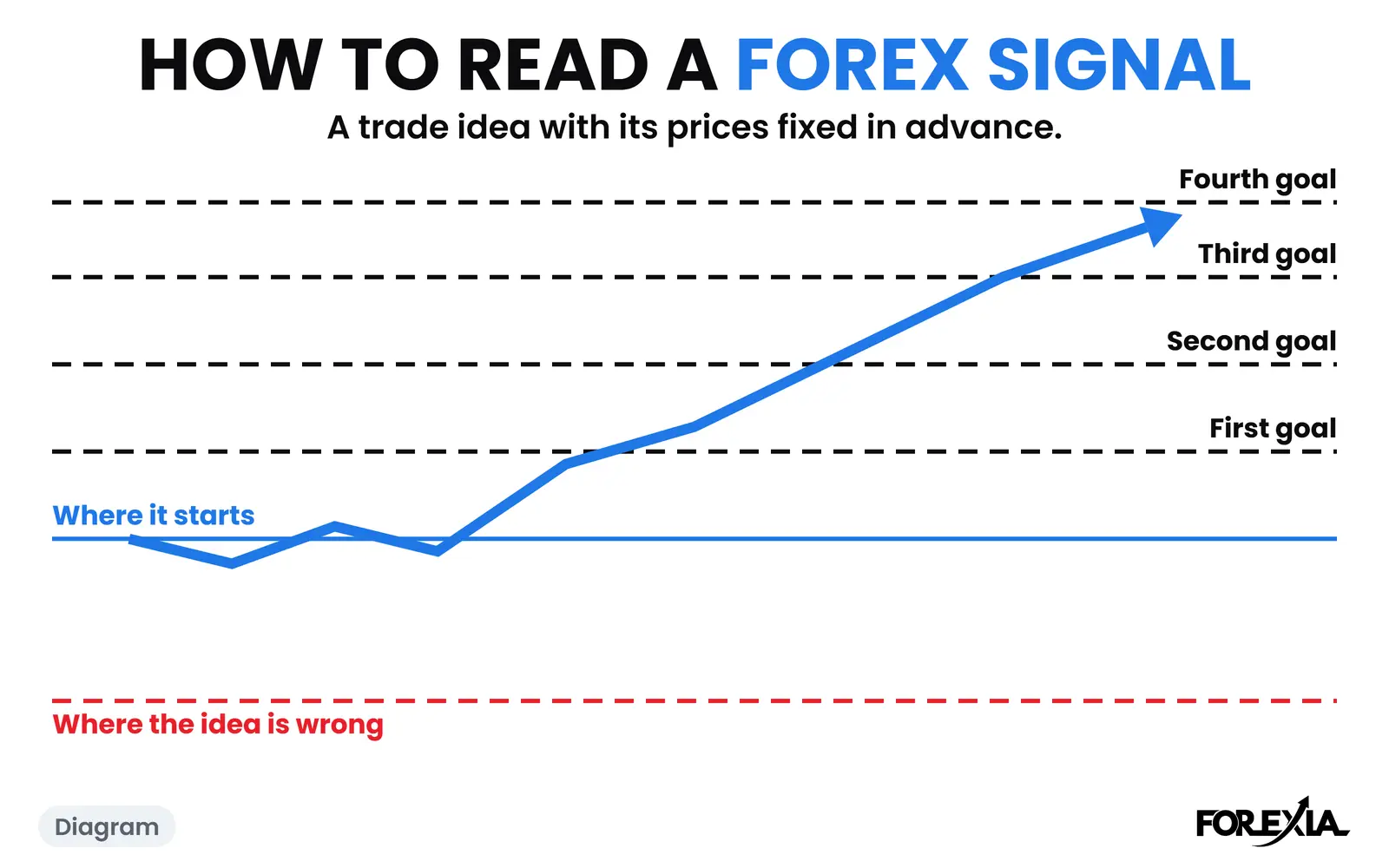
A signal is a message with a pair, a direction, an entry, a stop and targets. Reading one is covered in how to read a forex signal. Choosing who sends them is a separate job, and these are the questions to put to any provider. Where it helps, each is answered below for us.
- Is there a record anyone can read, signal by signal?
- Are the losses in it?
- Was each signal dated when it was sent?
- What does the record show when a trade reaches a target and is then stopped?
- How much of an account does one signal put at risk?
- Does it say what it does and does not do?
- Does it promise anything about returns?
If a provider will not answer one of them, that is the answer.
Is there a verifiable record, with each signal listed?
Ask for the signals, not a summary. A screenshot of a good week is not a record. A list of every signal sent, each with its pair, side, time and outcome, is one, because you can count it yourself and nothing has been chosen for you.
Then ask whether you can check it without the provider's help. A record kept in a public place, written by the system that sends the signals and not typed up afterwards, is stronger than one the provider edits.
Ours is the free channel's public ledger at /case-files/. A free signal is copied into it when it is sent, with a hash of its fixed fields, and its outcome follows. Each signal has its own page, and every Signature Trade is on the trade log. Signals for paying members are not in it.
Are the losses shown beside the wins?
This is the question that sorts providers fastest. A record with only winners is a selection, not a record. You want stopped signals listed in the same place, in the same form.
As read on 11 November 2026, our ledger held 8 closed signals. Two reached a target and did not end in a stop. Two reached TP1 and were then stopped. Four were stopped before TP1. None closed any other way. The losses are on the pages with the rest, and none has been removed.
We do not turn those counts into a rate, and neither should you from 8 signals. A rate from a sample that small would not be evidence, and a provider quoting one should be asked how many signals stand behind it.
Two limits on any record, ours included:
- It starts on a date. Ours begins when the ledger was switched on, 4 October 2026. Earlier free-channel rows were found afterwards on real prices, and they are never presented as sent.
- A hash proves what the figures were when it was taken. Each case file says when its hash was taken. If that was after the outcome, it does not show the figures were fixed before it.
Was the signal dated when it was sent?
A signal that appears in a record after the price has moved tells you little. Ask when each signal was published and when it was recorded, and whether the two can be told apart. If the provider cannot show a time for the signal that came before the outcome, you are reading a history, not a record.
What does the record show when a trade reaches a target and is then stopped?
Price often reaches the first target, then comes back to the stop. How a provider shows that tells you a lot. Some count it as a win because a target was hit. Some quote the distance to the target and leave out that the trade then closed at the stop. Either can look good and say little.
Ours is stated as it happened. The record names the furthest target reached and shows that the trade then closed at the stop, and the stop is not moved. In the bot's closing message the card shows the distance to that target. It is not what a trader who held the whole position made.
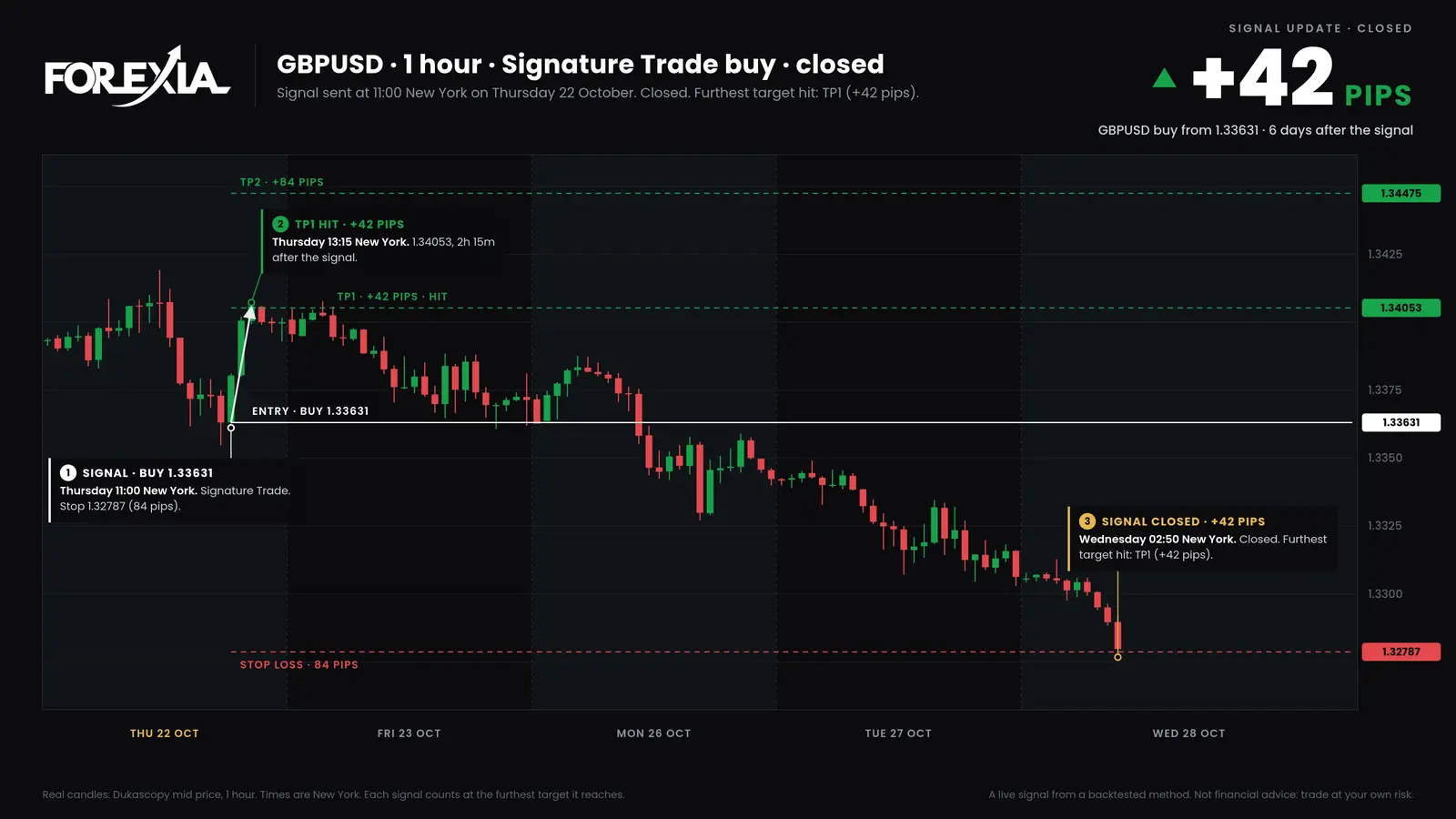
GBPUSD, 1 hour, 22 to 28 October 2026. Entry 1.33631, TP1 1.34053 hit, stop 1.32787 reached on 28 October. Image: the Forexia signal bot.
- The signal. A buy at 1.33631 with the stop at 1.32787, 84 pips below.
- TP1. Price reached 1.34053, 42 pips above the entry, on 22 October.
- The stop. Price came back and reached the original stop on 28 October. The record's outcome is "stopped", with one target hit.
That is two facts, both on the record, and the case file holds the rest. A provider worth following shows you its equivalent.
How much does one signal put at risk?
The stop distance is the risk, and it is on every signal. What it costs you depends on your size, which only you set. Ask whether the provider tells you how to size a trade, or whether it just says "buy". A provider that leaves out a stop, or that tells you to remove it, is not giving you a signal.
Work out the size from the stop before you place anything. The lot size calculator turns a risk you accept and a stop in pips into lots. Pick a risk per trade small enough that a run of stops does not end your account. That figure is yours to set, and no provider can set it for you.
Does the provider say what it does and does not do?
Honest providers say where their method stops. Ours does. The live bot automates the induction and the reversal. It does not read the wedge itself: its test for the first move is that yesterday consolidated, an inside day or a small range. So its trades are the Signature Trade in its mechanical form, not the full course setup with a drawn wedge. You can read the three moves in the Signature Trade.
Ask the same of anyone: what is automated, what is judged by a person, and what is left out. For how signals differ from having trades placed in your account, see copy trading vs forex signals.
Does the provider promise returns?
Nobody can guarantee a result in trading, and a provider who does is describing something that does not exist. Treat the following as reasons to walk away:
- A guaranteed or "risk-free" return, in any wording.
- Only winning trades shown, with no list to check against.
- Pressure to act now, before you have seen the record.
- A stop you are told to remove or widen after the trade is open.
Leverage makes losses larger as well as gains. Check what it does to your own account with the leverage calculator before you size anything.
What does a short checklist look like?
Copy this and put it to any provider, free or paid:
- Can I read every signal sent, with its outcome, without asking you?
- Are the stopped signals in the same list?
- When was each signal recorded, and can I see it?
- How do you show a trade that reached a target and was then stopped?
- What is the stop on each signal, and do you ever tell me to move it?
- What does your method do, and what does it leave to me?
- Do you promise anything about results?
Our free signals and their record are on the forex signals page, and the full ledger is at /case-files/. Read them against these questions first, and then read anyone else's against them too.
Frequently asked questions
Four questions people type most, answered short.
How do I know if a forex signal provider is legit?
Look for a record you can check without their word: every signal listed, losses beside the wins, and a time showing when each signal was sent. Be wary of anyone who guarantees returns or shows only winning trades. No record proves the next signal will work.
What should a forex signal include?
A pair, a direction, an entry, a stop and at least one target, all fixed when the signal is sent. The stop matters most, because the distance from entry to stop is your risk and sets your position size.
Is a high win rate a good sign in a signal provider?
Not on its own. A rate does not say how large the losses were against the wins, how many signals sit behind it, or whether losing signals were left out. Ask for the signals themselves, with their stops and targets, and count them.
Should I pay for forex signals?
Decide after reading the free record, if there is one, and only with money you can afford to lose. A paid service should answer the same seven questions as a free one. Nothing a provider sells removes the risk of a stop being hit.
Sources
Four sources, and what each one gave this page.
- The free-channel ledger: the count of closed signals by outcome, read on 11 November 2026 through the public record function with the public key.
- Case file: GBP/USD buy, 22 October 2026: the signal's prices, TP1 and the close.
- The Signature Trade trade log: every Signature Trade sent, with its levels.
- Dukascopy historical candles: the candles on the bot's charts.
Learn to read the chart this way. The courses teach the method behind our signals before the signals themselves. Browse the courses.
This post is for study. It is not a signal and not trade advice, and no signal provider can remove the risk of loss. Charts: the Forexia signal bot, Dukascopy mid-price candles, New York time.
Frequently asked questions
How do I know if a forex signal provider is legit?
Look for a record you can check without taking their word: every signal listed, losses beside the wins, and a date showing when each signal was sent. Be wary of anyone who guarantees returns or shows only winning trades. No record proves the next signal will work.
What should a forex signal include?
A pair, a direction, an entry, a stop and at least one target, all fixed when the signal is sent. The stop matters most, because the distance from entry to stop is your risk and sets your position size.
Is a high win rate a good sign in a signal provider?
Not on its own. A rate says nothing about how big the losses were against the wins, how many signals sit behind it, or whether losing signals were left out. Ask for the signals themselves, with their stops and targets, and count them.
Should I pay for forex signals?
Decide after you have read the free record, if there is one, and only with money you can lose. A paid service should answer the same seven questions as a free one. Nothing a provider sells removes the risk of a stop being hit.