
Trading on the Forex: What a Forex Trade Is, From Open to Close
Forexia Academy6 min read
Trading on the forex means opening a position on one currency against another and closing it later. What are forex trades, then? Each one is a pair, a side (buy or sell), a size and a price to open at, and it ends at a price to close at. The difference, less the costs of the trade, is the gain or the loss. This page walks through one example on a real day, from open to close.
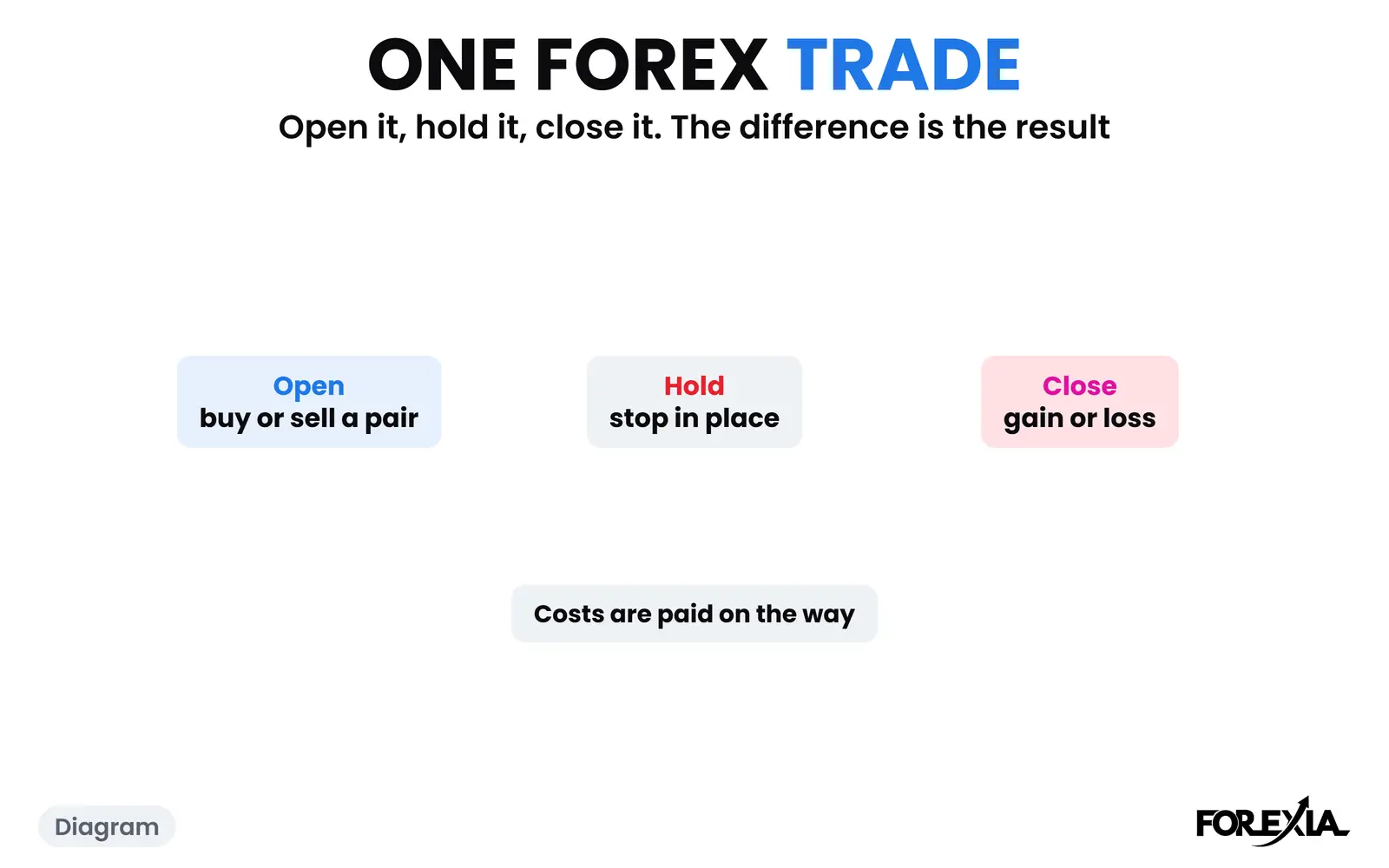
What are the parts of a forex trade?
The diagram above gives the three moments of a trade. At the open you choose a pair and a side and the trade starts at the price on screen. While it is held, the price moves and your stop waits at the level you set. At the close, either you close it, or a target or the stop does, and the trade ends at that price. Between the two prices there is the spread, which you have already paid, so a trade that closes at exactly the price it opened at is a small loss. Nothing in those three moments is complicated, and the difficulty is all in the choices made before the first one.
A trade is not an investment in the sense of owning something to hold for years. It is a position with an opening and a closing, and the things that decide how it goes, its size, its stop and its cost, are chosen at the opening or fixed by it. That is what makes it possible to describe a trade completely before it starts, and it is why a beginner who cannot describe theirs is not ready to place it. The description needs only four decisions, and the order matters. Each one answers a question you can write down before you place anything: what am I trading, which way, where am I wrong, and how much is at stake. A trade you cannot describe in those four answers is not yet a trade, it is a hope with a button. Here they are in order, with a pointer to where each is covered in full.
- The pair. The two currencies, such as GBP/USD. What to trade in forex covers how to choose.
- The side. Buy if you expect the first currency to rise against the second, sell if you expect it to fall.
- The stop. The price at which the idea is wrong and the trade closes at a loss. The distance from your entry to it is what the trade risks.
- The size. How big the position is, set from the stop and the amount you accept losing. The position size calculator does the sum.
The size belongs after the stop and before the order, because a large position on a wide stop is how a single trade damages an account.
You do not take delivery of the money. The CFTC's customer advisory says most retail forex is traded off-exchange, and that in this case you are trading only against your dealer, who controls the platform and the prices it shows. That is also why you can sell a pair you do not hold: you have a position on the price, not a pile of currency.
A forex trade from open to close, on a real day
This is NZD/USD on Monday 9 November 2026, on real 15-minute candles. Nobody took this trade and it was not a signal. We picked the day after it was over, to show the arithmetic on real prices. It says nothing about how often price goes the way a trade wants. Times are New York.
- Open: a buy at 0.55989, the price at 03:00, the London open.
- The stop: 0.55489, 50 pips below the entry. By 03:00 the lowest price of the day was 0.55536, so this sits under it.
- The close: at the end of the trading day, 0.56308.
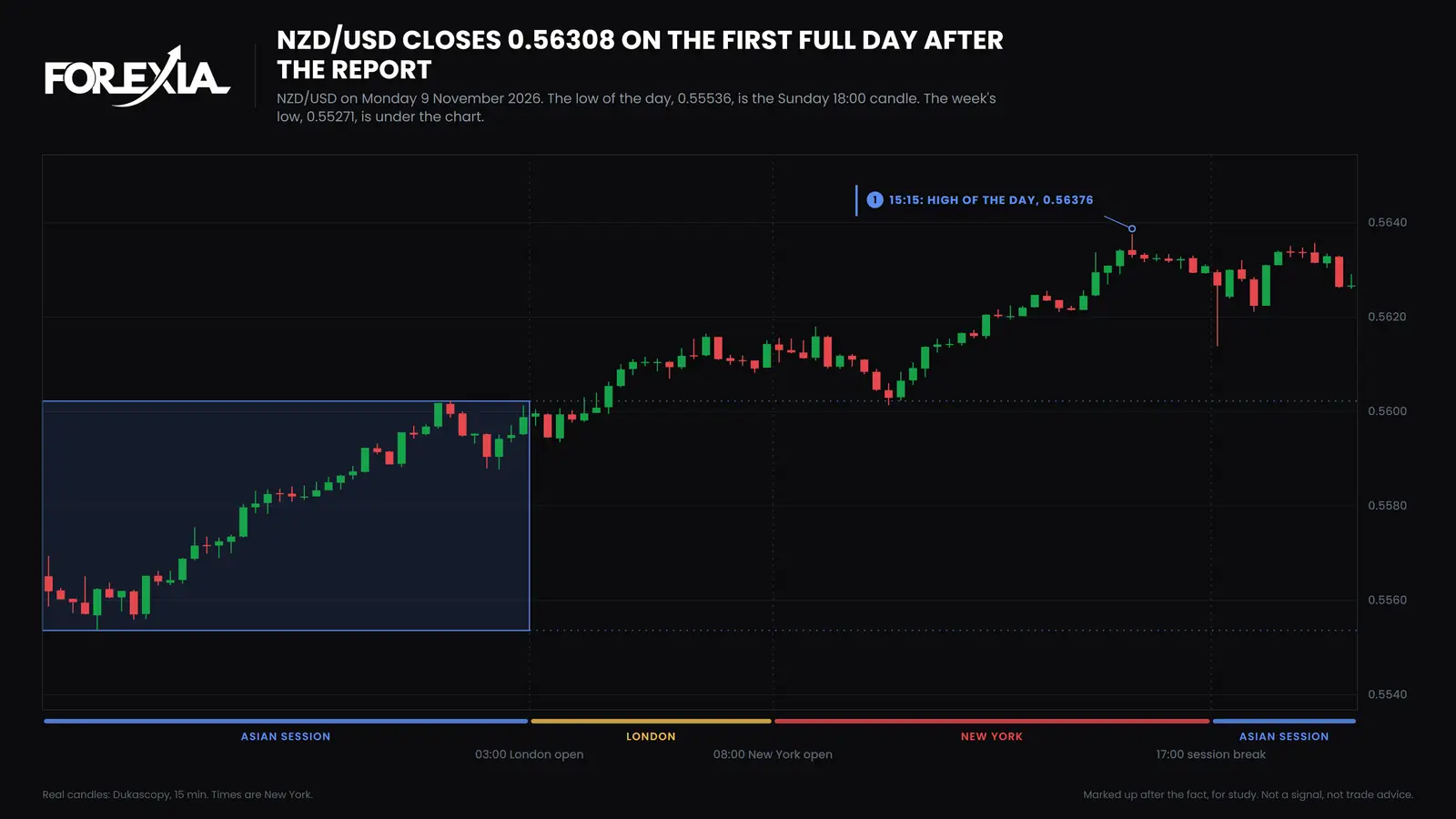
Hold: after 03:00, price stayed above the stop. Closed at the end of the day, the buy ends 31.9 pips above its entry, before costs. Had price fallen to 0.55489 first, the trade would have closed there, 50 pips down, whatever price did afterwards. Only one of those two numbers was known at the open: the 50 pips at risk. Where the day would end was not.
If you want to see how a sent signal sets out its entry, stop and targets, that is how to read a forex signal.
In brief
- A trade: a position on a currency pair, opened at one price and closed at another.
- Its four parts: the pair, buy or sell, the size, and the price at which you accept being wrong.
- Its cost: the spread, paid when it opens, and any other fees your broker charges.
- Its end: a gain, a loss, or close to nothing. Some trades end at the stop.
What does a trade cost at a given size?
Take the stop in that example, 50 pips. On a pair quoted in US dollars, as NZD/USD is, a pip is worth $10 per standard lot, which is $0.10 per 0.01 lot. So a position of 0.01 lots that is stopped out loses 50 times $0.10, which is $5.00. The same position closed 31.9 pips up gains $3.19 before costs. A position ten times the size makes those $50 and $31.90. The pips do not change. The size does, and the size is the part you choose.
That is why a beginner's first question about a trade is the loss, not the target. How much money to start forex works one stop through five account sizes, and how much to risk per trade covers the percentage. On top of the loss there is the spread, which is the gap between the buying price and the selling price, paid the moment a trade opens. We name no spread because it differs by broker, pair and hour.
What is trading on the forex not?
It is not a promise. A trade can end at its stop, and the CFTC's customer advisory says you could lose all of your margin and more because leverage amplifies losses as well as gains. It is not a way to run money you need soon. And it is not something to start before you can say your stop and your size aloud. The beginner path in learn forex puts the chart and the size of a loss before any account.
If you want the idea of the market before the idea of a trade, read what is forex.
Sources
- US Commodity Futures Trading Commission, Eight Things You Should Know Before Trading Forex: off-exchange trading against your dealer; losses beyond your deposit. The page shows no date.
- Candles and chart: Dukascopy. All times are New York.
This page is for study. It is not a signal and not trade advice. Trading forex can lose you money.
Frequently asked questions
What is a forex trade?
A forex trade is a position on one currency against another: you buy or sell a pair at a price, hold it, and close it at a later price. The difference, less the costs of the trade, is your gain or your loss.
What is trading in forex?
It is buying and selling currency pairs to profit from changes in their price, usually through a broker. You do not take delivery of the money. You open a position, then close it.
Do you own the currency when you trade forex?
Not in the usual retail case. A retail forex trade is a position with a broker on the pair's price. The CFTC's customer advisory says most retail forex is off-exchange and that you are trading only against your dealer.
How long does a forex trade last?
As long as you hold it. Some are closed within minutes and some stay open for days. The worked example on this page opens and closes within one trading day.
Can a forex trade lose more than you put in?
Yes, it can. The CFTC's customer advisory says you could lose all of your margin and more, and that you may owe losses beyond your initial deposit. A stop-loss is an attempt to limit a loss, and it does not guarantee a fill at your price.