USDJPY Pip Value: What One Pip Is Worth on a Lot, Mini and Micro Lot
Forexia Academy8 min read
Enter the USDJPY price to turn a pip into USD.
What it assumes: a pip is the fourth decimal, the second in yen pairs, and $1 on gold, as our charts count it. A standard lot is 100,000 units, or 100 ounces of gold. Your broker's contract sizes may differ. A sum, not advice.
What is the USDJPY pip value?
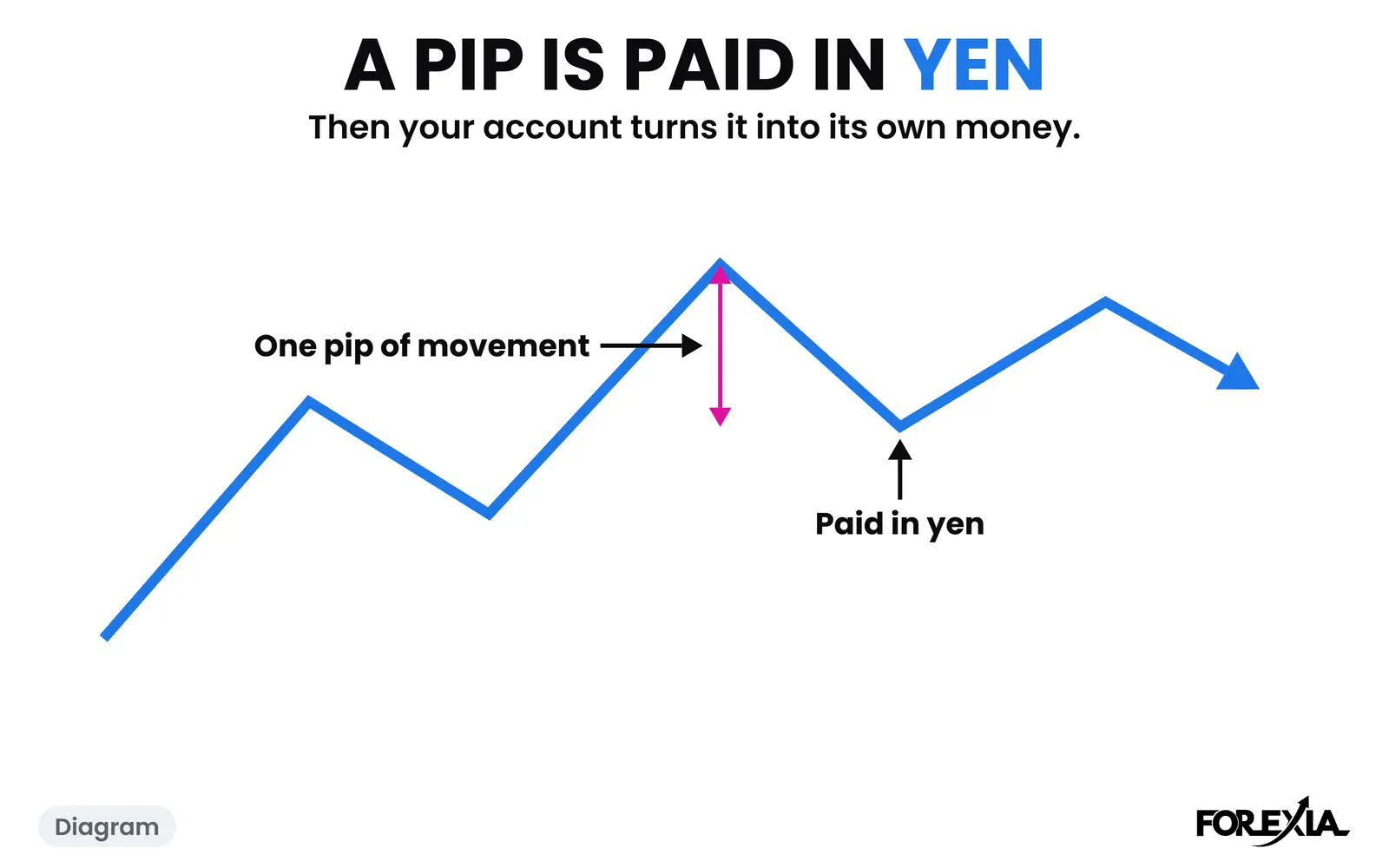
The USDJPY pip value is the amount of money one pip of movement in the pair is worth on your position. On a dollar account it was $6.33 on a standard lot, $0.63 on a mini lot and $0.063 on a micro lot at 157.896, the latest close in our data, on 9 November 2026. It is not a fixed figure: USDJPY is paid in yen, so the value follows the price.
The pair is the US dollar against the Japanese yen. The price tells you how many yen one dollar costs, a pip is the second decimal place (0.01), and a standard lot is 100,000 dollars. Everything below follows from those three facts and from the price. The figures are arithmetic from the site's pip calculator, which this page is set to open on USDJPY, and they say nothing about whether a trade is worth taking.
How is the USDJPY pip value worked out?
A pip is 0.01, and a standard lot of USDJPY is 100,000 dollars. One pip of movement on one lot is therefore 0.01 times 100,000, which is 1,000 yen. That is not yet a dollar figure: the pair is paid in yen, so the sum is divided by the price of USDJPY itself. At 157.896, 1,000 divided by 157.896 is $6.33.
Because the price is in the divisor, the pip value moves with it. A higher USDJPY gives a smaller pip, since each yen is worth fewer dollars, and a lower USDJPY gives a larger one. The table shows the figure for a price five per cent lower and five per cent higher than the latest close.
At 150.001 a standard lot would be $6.67 a pip, at the latest close of 157.896 it is $6.33, and at 165.791 it would be $6.03.
A trade that stays open while the price travels five per cent is paid or charged a pip value that has changed by about that much, which is why the figure on a position's ticket is close and not exact by the time it closes.
What is the USDJPY pip value on a standard, mini and micro lot?
A standard lot is 100,000 units, a mini lot 10,000 and a micro lot 1,000, and the pip value scales with the size in a straight line. The table gives the dollar value of a pip on each size at the latest close of 157.896, and what a stop of 5, 10, 20 and 50 pips comes to on each.
| Size | Lots | Units | One pip | 5 pips | 10 pips | 20 pips | 50 pips |
|---|---|---|---|---|---|---|---|
| standard lot | 1.00 | 100,000 | $6.33 | $31.67 | $63.33 | $126.67 | $316.66 |
| mini lot | 0.10 | 10,000 | $0.63 | $3.17 | $6.33 | $12.67 | $31.67 |
| micro lot | 0.01 | 1,000 | $0.063 | $0.32 | $0.63 | $1.27 | $3.17 |
Brokers also sell sizes in between. A position of 0.25 lots is worth $1.58 a pip and one of 0.05 lots $0.32. Check your broker's contract specification before relying on a table: a few brokers call a different number of units a lot.
What is the USDJPY pip value on a euro, sterling or yen account?
The dollar figure above is for a dollar account. If your account is in another currency, your broker converts the dollars at its own rate, so the same pip is worth a different number. The table converts USDJPY at the latest daily close of each currency against the dollar in our data, dated 9 November 2026.
| Account currency | One pip on 1.00 lot | 0.10 lots | 0.01 lots |
|---|---|---|---|
| USD | 6.33 USD | 0.63 USD | 0.06 USD |
| EUR | 5.64 EUR | 0.56 EUR | 0.06 EUR |
| GBP | 4.71 GBP | 0.47 GBP | 0.05 GBP |
| AUD | 9.15 AUD | 0.91 AUD | 0.09 AUD |
| NZD | 11.25 NZD | 1.12 NZD | 0.11 NZD |
| CAD | 8.94 CAD | 0.89 CAD | 0.09 CAD |
| CHF | 5.19 CHF | 0.52 CHF | 0.05 CHF |
| JPY | 1,000 JPY | 100 JPY | 10 JPY |
A rate that is a day old is good enough to size a trade and not good enough to settle one. The conversion moves all day, so treat these figures as close and not exact, and let the platform's own number win when the two differ.
How many pips did USDJPY move on a real day?
Friday, 6 November 2026 is a day we hold in full: the 15-minute candles from 17:00 to 17:00 New York time, 96 of them. USDJPY ran from a low of 157.253 at 18:15 to a high of 158.581 at 08:30, a range of 132.8 pips, and closed the day at 158.438.
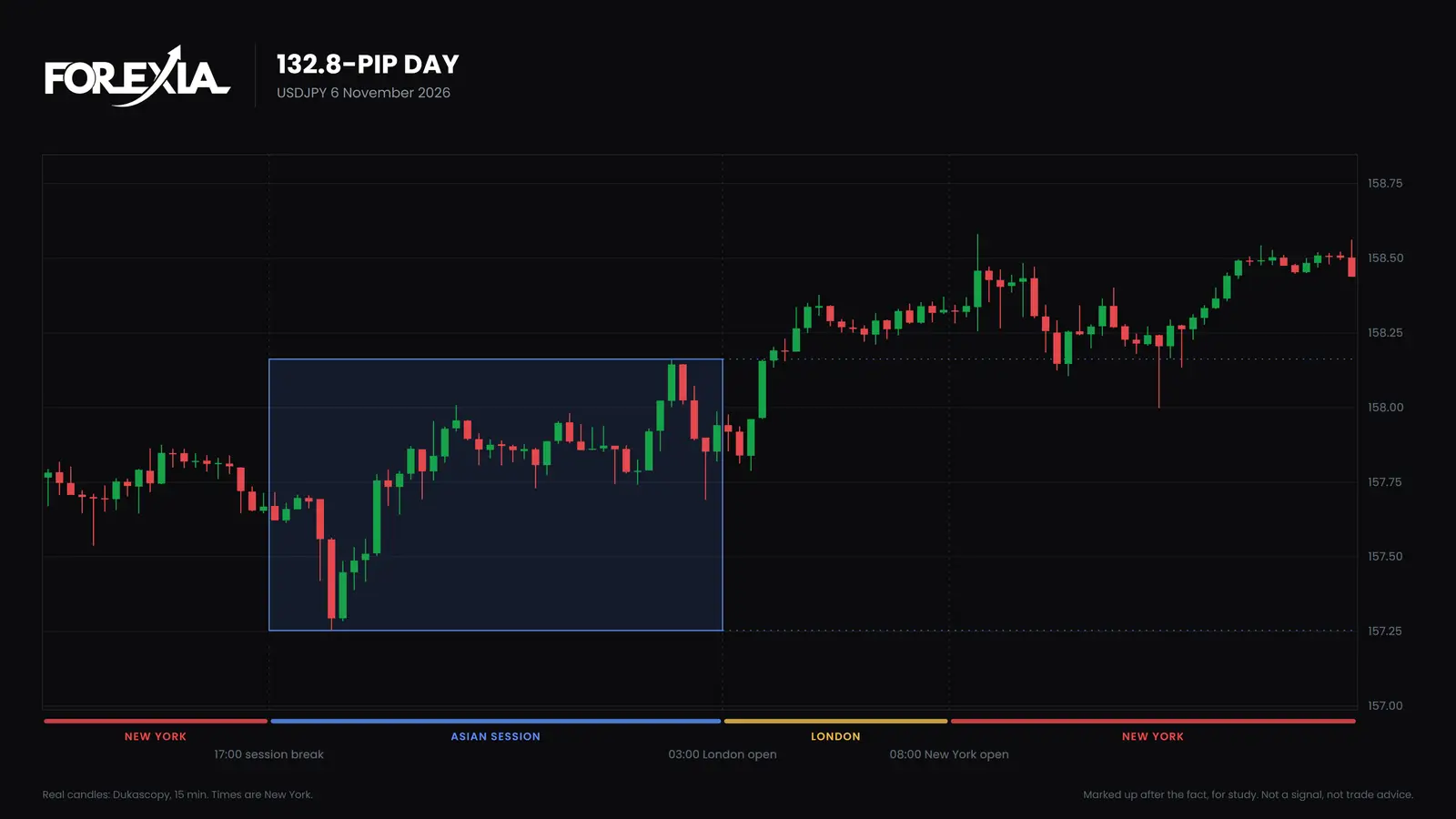
Nobody trades the whole range, but it is the right yardstick for what a pip count means in money. On a standard lot that day was $841.06 from low to high, on a mini lot $84.11 and on a micro lot $8.41. A range is a distance on the chart and not a result: a trade that caught all of it would have needed the low and the high exactly, and none of the figures here say anything about how to find them.
How many pips does USDJPY move in an average day?
Over the last 20 completed trading days to 9 November 2026, the average range from high to low was 88.8 pips. Over the last 10 it was 88.0, and over the last 5, 110.8. Days turn over at 17:00 New York time. The table gives each window in dollars on the three sizes, using the pip values above.
| Window | Average range | 1.00 lot | 0.10 lots | 0.01 lots |
|---|---|---|---|---|
| Last 20 days | 88.8 pips | $562.40 | $56.24 | $5.62 |
| Last 10 days | 88.0 pips | $557.33 | $55.73 | $5.57 |
| Last 5 days | 110.8 pips | $701.73 | $70.17 | $7.02 |
A window is an average and not a forecast. Windows disagree because the recent days were quieter or busier than the month: the five-day figure is above the twenty-day one by 22.0 pips. The same measure for the other majors is in the site's daily range data.
Which hour of the day does USDJPY move most?
A pip is worth the same all day, but the number of them on offer is not. We measured the high-to-low range of every hourly candle, grouped by the hour of the New York day, over 1,125 hourly candles from 6 September 2026 to 10 November 2026. The largest average range came in the hour from 08:00 New York time, 29.9 pips, which on a mini lot is $18.96. The smallest came from 17:00, at 4.6 pips.
| Session (New York time) | Hours | Average hourly range |
|---|---|---|
| Asia | 17:00 to 02:59 | 19.4 pips |
| London | 03:00 to 07:59 | 22.2 pips |
| The London and New York overlap | 08:00 to 11:59 | 26.3 pips |
| New York's afternoon | 12:00 to 16:59 | 16.2 pips |
The sessions are averages of their hours, so a long session is not larger than a short one for being long. A quiet hour is not a bad hour to hold a position, and a busy one is not a good hour to open one: this is a count of movement and says nothing about direction. The spread, which is wider in thin hours, is a cost on top of all of it and is not in these numbers.
Worked examples: what a USDJPY stop costs and how many lots a risk allows
Take a stop of 20 pips. On a standard lot it costs 20 times $6.33, which is $126.67. On a mini lot it costs $12.67 and on a micro lot $1.27. The same 20 pips are three different sums of money, and the pip value is the bridge.
Now turn it round: if the sum is fixed, the size follows. With a 25-pip stop, risking $50.00 allows 0.31 lots, risking $100.00 allows 0.63 lots and risking $250.00 allows 1.57 lots, rounded down to the nearest 0.01. The working for the first is 50 divided by 25 times $6.33. The forex lot size calculator does this with your balance and your risk per trade, and the risk reward calculator turns a stop and a target in pips into a ratio.
A stop is a distance chosen from the chart, and nothing here chooses it. The 88.8-pip average day is a reminder that a 5-pip stop sits well inside ordinary noise and a 89-pip stop is a whole average day, and which is right for a trade is a matter for the trade.
Which mistakes change the USDJPY pip value?
The most common is assuming a pip is $10 because it is on EURUSD. On USDJPY it is $6.33 at 157.896, and sizing as if it were $10 changes the risk by 58 per cent. The second is counting in points: a fifth decimal is a point, and ten points make one pip. The third is using a stale price. The pip value above is for 157.896, and USDJPY will not be there when you read this.
Where do the USDJPY figures on this page come from?
The pip values are computed by the same function the pip calculator runs. The price and the daily ranges come from the site's daily data as of 9 November 2026, the hourly ranges from 1,125 hourly candles from 6 September 2026 to 10 November 2026, and Friday, 6 November 2026 from 15-minute candles. Dukascopy bid prices supply the candles. Nothing on the page is typed by hand, and the page is rebuilt from the data when the data moves. For margin rather than pips, see the leverage and margin calculator.
Trading leveraged products carries a high risk of losing more than you can afford. Nothing on this page is advice, a pip value does not make a trade safe, and a figure worked from past candles says nothing about the next day.
Frequently asked questions
What is the USDJPY pip value?
On a dollar account, one pip of USDJPY was $6.33 on a standard lot, $0.63 on a mini lot and $0.063 on a micro lot at 157.896 on 9 November 2026. A pip is paid in yen, so the figure moves with the price: $6.67 at 150.001 and $6.03 at 165.791.
How do I work out the USDJPY pip value on my account?
Multiply the pip (0.01) by the contract (100,000) to get 1,000 yen, then divide by the price of USDJPY (157.896) to get dollars. For a non-dollar account, convert again: on 9 November 2026 one standard lot was worth 5.64 EUR on a euro account and 4.71 GBP on a sterling account.
How many pips does USDJPY move in a day?
The average high-to-low range of the last 20 completed trading days was 88.8 pips, and of the last 5 it was 110.8 pips, as of 9 November 2026. On a mini lot that is about $56.24 and $70.17. It is an average over a window, not a forecast.
Which hour does USDJPY move most?
In 1,125 hourly candles from 6 September 2026 to 10 November 2026, the hour from 08:00 New York time had the largest average range, 29.9 pips, and the hour from 17:00 the smallest, 4.6 pips. Movement is not profit, and spreads are not counted.