Is Forex Trading Hard? What Makes It Hard, and What Does Not
Dylan Forexia6 min read
Forex trading is not hard to understand. A chart, a level, an order and a stop are a few weeks of learning. It is hard to sit through, because the result of any one trade is uncertain and the hours between are long. And the odds are hard: the CFTC reports that about two-thirds of customers at registered retail dealers lost money.
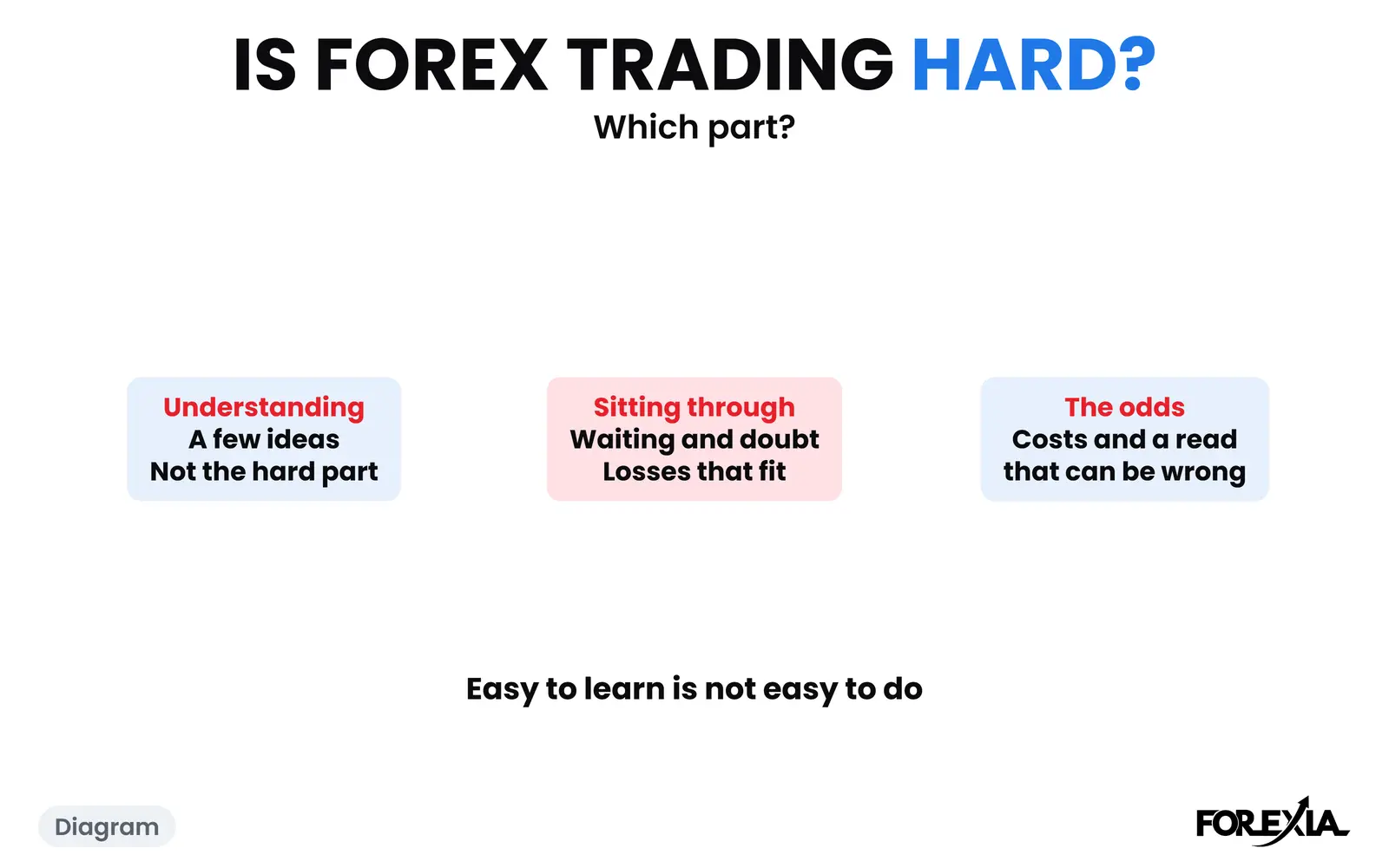
We have felt all three. This page splits them so that you can tell which one you are struggling with, shows a real day that makes the second one concrete, and says what the research does and does not show.
Is forex trading hard to learn?
No, not in the sense of the ideas. A price is a price at which someone bought and someone sold, a level is where many orders are known to sit, and a stop is an order that closes a trade at a loss you chose. Most of what is on this site can be read in an afternoon. What is trading psychology is a good start.
Where "hard to learn" bites is the step after, which is learning whether anything you have learnt works. That is a question for a record, over enough trades that luck is a poor explanation, and it is slow. It can also end in the answer that the method does not work. Our own did not, as a fixed rule, and we say so in the trading psychology hub for the same reason.
Why is forex so hard? Three parts
The odds start behind you. Most retail forex goes through a dealer that is on the other side of your trade, and the CFTC's customer advisory says that about two-thirds of customers at registered dealers lost money. It also says that leverage "amplifies both gains and losses", with an example in which a 2 percent margin requirement lets you open a $100,000 position with $2,000. Costs on every trade and a position larger than your account can bear are not psychology. They are arithmetic.
A read can be right and lose. Our own count shows why. On 1,030 market-days across seven dollar majors and gold, from 6 April to 1 October 2026, the same Asian range did four different things: London never closed outside it on 285 days, London closed outside and undid its own break by New York on 287, London's break stood and New York turned it back inside on 264, and London's break stood and no New York candle closed back inside on 194. The count says what the candles did, not what any trade made. It does say that one chart does not tell you which of four days you are on.
The waiting is where mistakes are made. Doubt, a small loss and a missed move all arrive while you hold still, and holding still is the skill. That is the part with the most research behind it, further down.
What does sitting through look like? EUR/USD, 13 April 2026
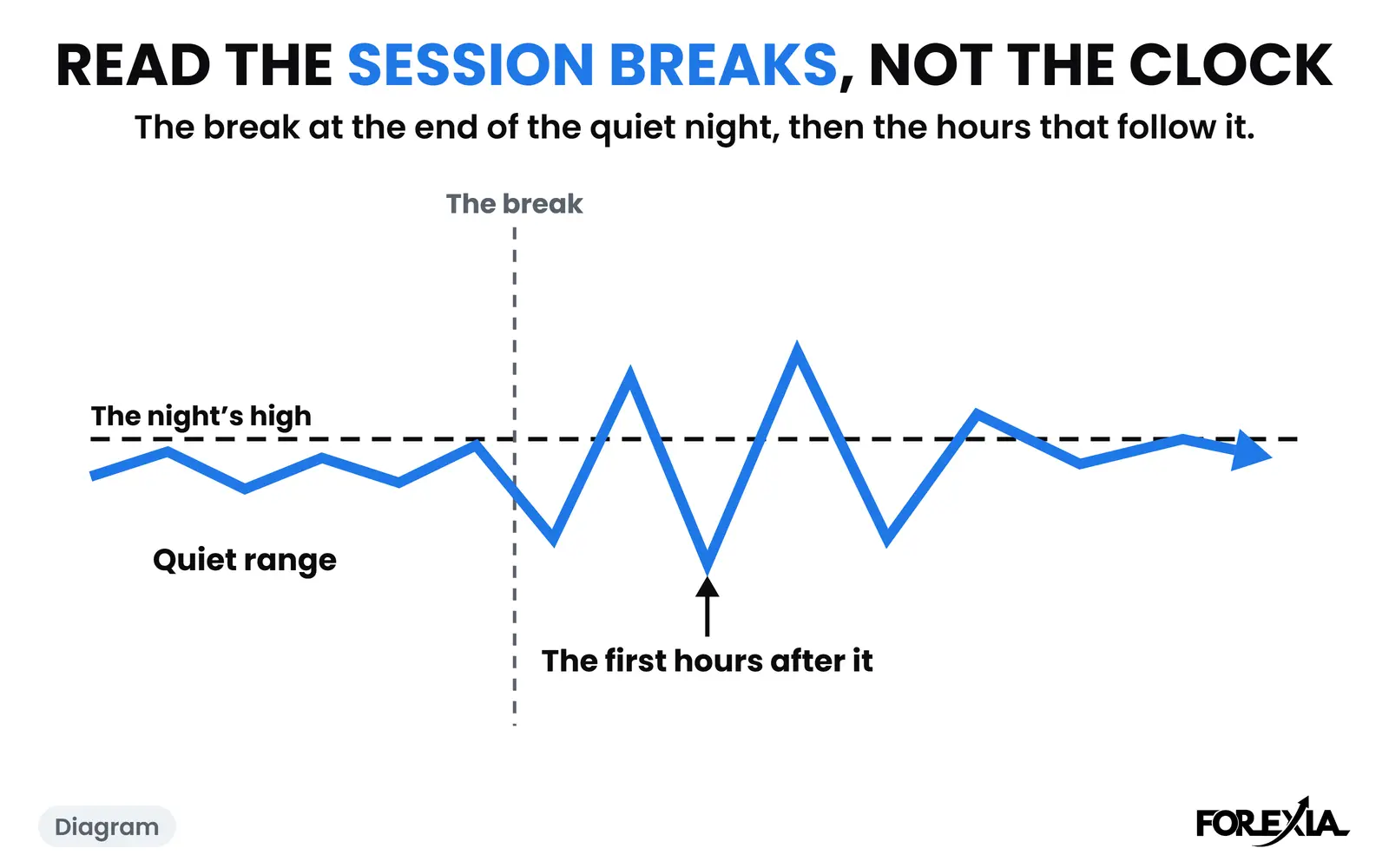
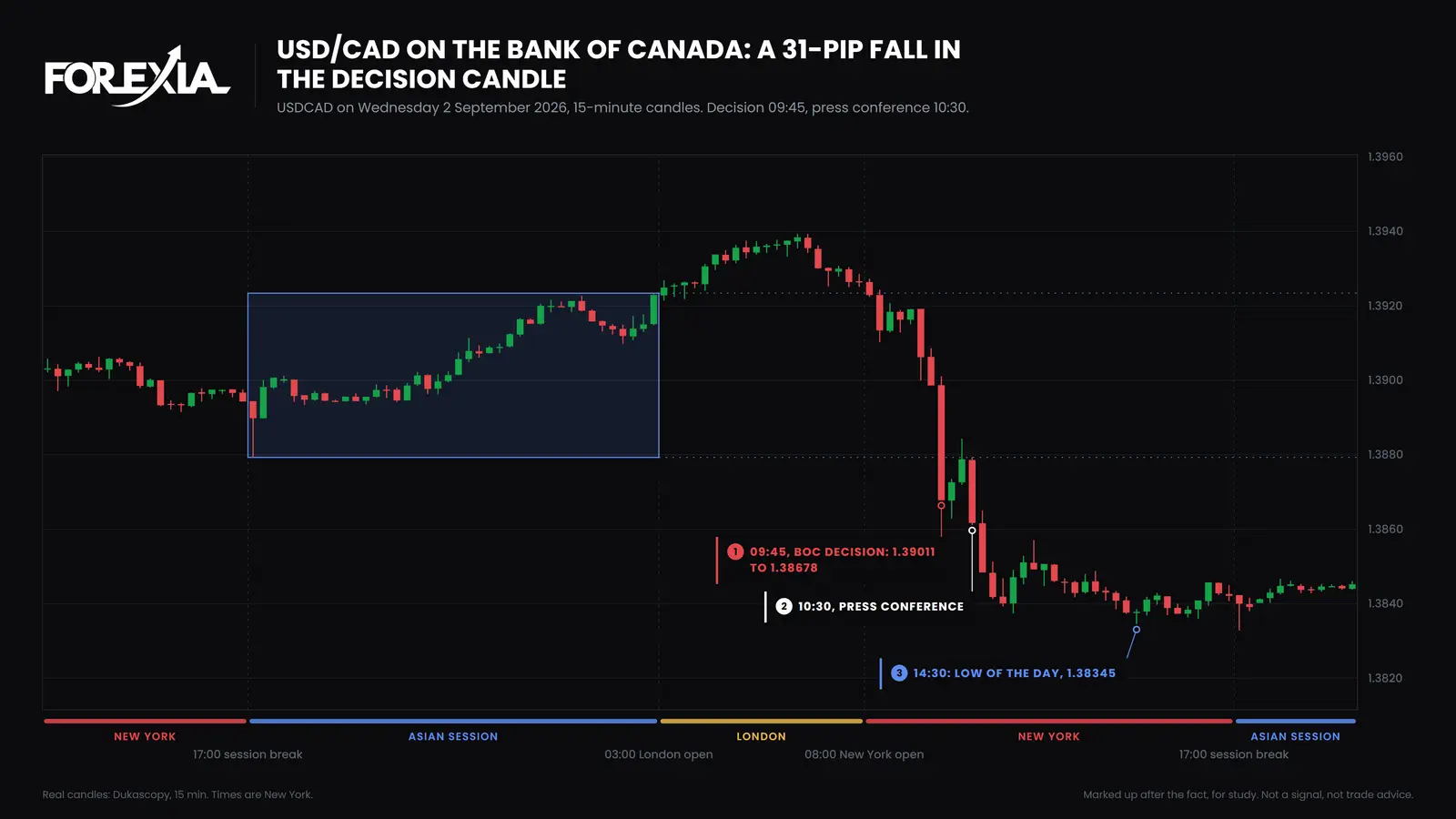
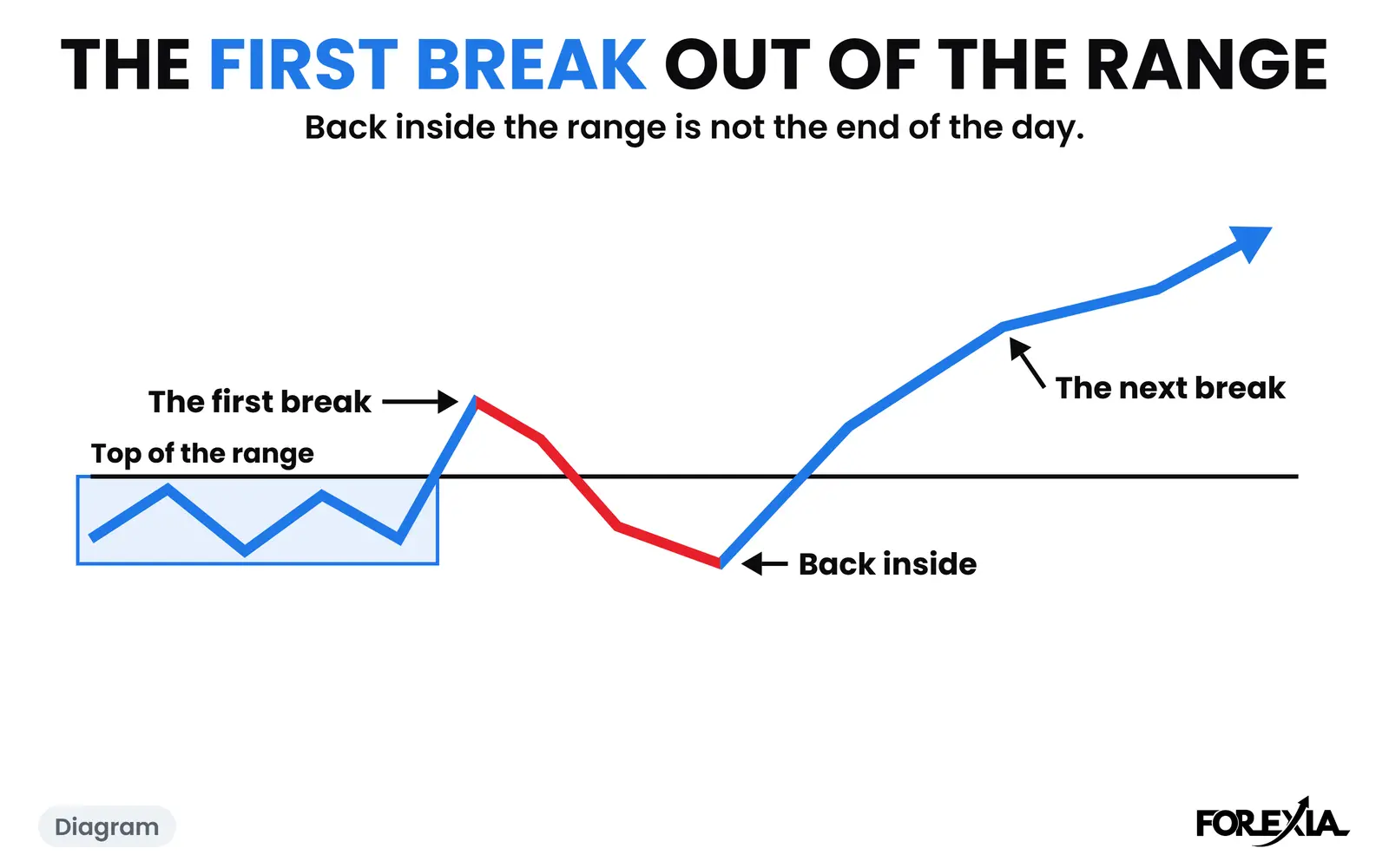
On Monday 13 April the Asian box ran 31 pips, from 1.16638 to 1.16948. The 03:15 New York candle closed over it at 1.16967, two pips over the edge. The 04:00 candle closed back inside at 1.16920. Anyone who believed the break was a fakeout felt right for three hours, because price drifted inside the box. Anyone who bought it felt wrong, with a small loss they could have taken and a reason not to.
Then at 14:45 price reached 1.17653, 70 pips over the box's high, and the day's last close was 1.17582. Our calendar had an ECB speech at 08:15 and existing home sales at 10:00, both medium impact, nothing larger.
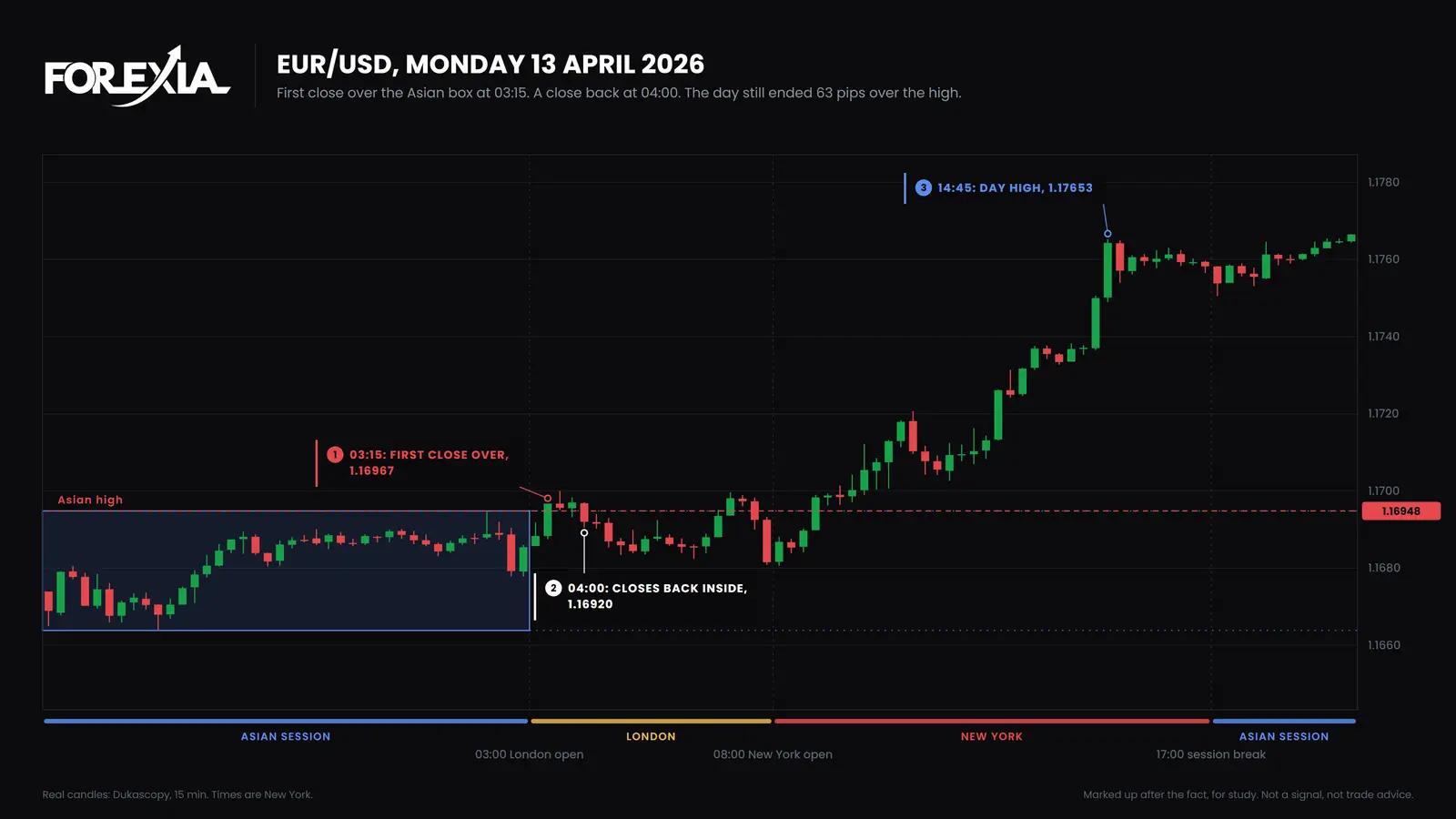
Neither the reading made at 04:00 nor the one made at 07:00 was foolish. Both were reads of a candle, and the candle that settled it came ten hours later. That is the part of trading no course can shorten. The first break of the night's range counts how often a break like this comes back, and how often the day ends past it anyway.
What does the research say about the person?
Less than headlines suggest, mostly on stock and futures traders, and none of it measured forex directly. We read the same studies as the trading-psychology hub, and state the limits.
- Emotion and results. Lo, Repin and Steenbarger (2005) followed 80 day traders for five weeks. Those whose emotional reaction to gains and losses was more intense did significantly worse, and personality tests showed no single "trader personality profile". It was a small group, and it shows a link and not a cause.
- The body. Coates and Herbert (2008), on 17 traders on a London floor, found cortisol rising with the swings in a trader's results and with market volatility. Your body is in the trade, whatever you decide.
- Coming back. In a Taiwanese study of day traders, Barber, Lee, Liu, Odean and Zhang (we read the draft of December 2018) found that among the experienced, losing barely changed whether people came back: 95.3% of those with a record of losses traded again within twelve months, against 96.4% of those with a record of profits. That is stocks, and it says that stopping is hard even when the record says to.
What makes it less hard?
We make no promise that any of this improves results. It is what we would do about each of the three parts.
- For the odds: size so that a run of losses does not end the account, and keep a record of every trade after costs. A record is the only way to find out whether you are on the wrong side of the arithmetic.
- For the read: decide what a close back means to you before the candle, and write it down. How to stop revenge trading covers the hour after a loss.
- For the waiting: know what you will do if nothing happens, as well as what you will do if something does. Why you take trades you know you shouldn't is about what fills that gap.
The three seats help with the second. Retail sees a candle and wants to act. The market maker's seat is the one nobody outside can see. The observer asks only what has closed and what has not.
What does this not tell you?
It does not tell you that you will fail, or that you will not. The loss shares are for particular dealers, products and years, and they count accounts and not people. The studies above are small or old or about other markets. One day on a chart shows what one day did. Our own result, that the setup as a fixed rule did not make money, says nothing about a person reading a chart, either way, and a reversal seen afterwards is not a setup.
Common mistakes
Three misreadings of the question cost the most.
- Treating easy to learn as easy to do. Understanding a stop does not make a stop easy to keep.
- Calling every loss a discipline problem. Some rules lose. Test the rule first, and our own result is why we say it.
- Reading one day as the answer. The day above settled at 14:45, and the read that was right at 04:00 was not the one that paid.
Course 1 of ForexiaPRO, Reading the Map, teaches reading a chart from three seats, starting with lesson 1.1.
Frequently asked questions
Is forex trading hard to learn?
The ideas are not. A chart, a level, an order and a stop take a few weeks to understand. What is hard is doing it with money on the line, over many trades, when the result of any one of them is uncertain. Most of the difficulty is in sitting through, and in the odds, which the CFTC reports as about two-thirds of customers at registered dealers losing money.
Why is forex so hard?
Three things stack up. Costs and leverage mean you start a little behind. A read can be right and still lose, because no setup works every time. And the hours of waiting, doubt and small losses are where most mistakes are made, which research on real traders has linked to stronger emotional reactions and worse results.
How long does it take to learn forex?
We do not have a number we could stand behind, and no study we read gives one for forex. Learning what the pieces are is a matter of weeks. Whether a method works is a question of a record over enough trades, which takes longer and can end with the answer that it does not.
Is forex harder than stocks?
We cannot say, and we found no study that compares them fairly. Leverage is usually higher in retail forex, which makes mistakes cost more. The research that exists on emotion and trading was done mostly on stock and futures traders, and it is the nearest evidence we have.