How to Stop Revenge Trading: What to Do in the 15 Minutes After a Loss
Dylan Forexia9 min read
To stop revenge trading, decide before the session what happens after a loss: leave the order screen for a set time, keep your size the same or smaller, and write down why you want the next trade. We found no study proving this improves results. What it does is put a gap between the loss and the next order.
You know the moment. The stop went. Your read was fine an hour ago, and now the chart is moving without you. Your jaw is tight. You have the ticket open with a bigger number in it, and you do not remember deciding that. We have been there too. It does not feel like a decision. It feels like fixing something.
This is not a flaw in your character. Professional traders have been caught doing it in the data, as you will see below. It is also expensive enough to deserve more than "stay disciplined".
What is revenge trading, and are you doing it?
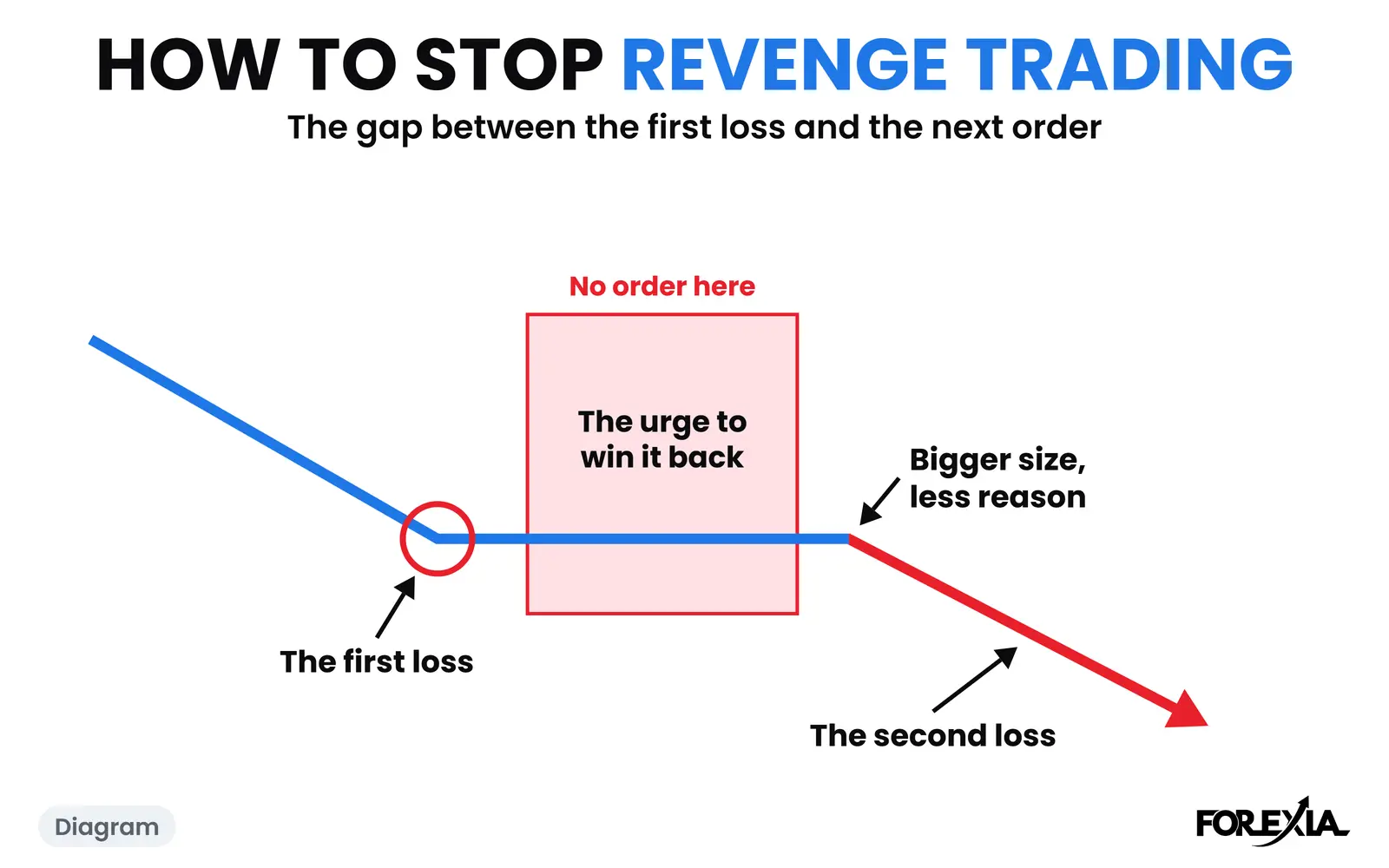
Revenge trading is taking a new position to win back a loss, usually bigger and with less reason than the last. It takes a few forms: straight back in, the same trade at double the size, the opposite trade because the other way is now running, or tomorrow's first trade carrying today's anger.
Memory is a poor witness here, so ask your broker's history. Export your last 30 closed trades and write three things beside each one.
- The gap. Minutes since your previous trade closed, and whether that trade lost.
- The size. This trade's money at risk against your usual. Measure money at risk and not only the lot, because a wider stop on the same lot raises it too.
- The reason. If you noted one, does it name a setup, or a loss, a price you missed, or a number you need to get back to?
Mark every trade that opened soon after a loss and with more money at risk. You choose what "soon" means. Half an hour is a fair place to start. Then total the marked trades and the rest, after costs.
Thirty trades prove nothing about your future. They do show whether this is your problem, and how often. If you marked none, you may have a different problem, and why you take trades you know you shouldn't looks at those.
How to stop revenge trading: the first 15 minutes after a loss
Treat this as a suggestion. It is ours, it is no rule from our courses, and we have not tested it. The 15 is a convention, and this routine promises no result. Write your own version before the session, because you will not be able to write one after the stop goes.
The first minute: close the ticket. Not only the position. If the loss is still partly open, close it. Then take your hand off the mouse and stand up. If your platform can lock you out for a set time, use that.
Minutes 1 to 3: write the numbers. The pair, your size, the loss in money, the time, and one word for how you feel. Angry, ashamed and panicked are all fine. Writing down a word is a very small thing, and it gives you something to do that is not an order.
Minutes 3 to 10: sort the loss. Did it come from your plan, or from breaking it? A loss inside your plan is a cost of the plan, and there is nothing to fix today. A loss from breaking it is a different problem. Stop too tight or a stop hunt helps if you are not sure what the stop did.
Then change your seat. The Three Seats are three places to read one chart from, and the feeling usually tells you which one you are in. "The market owes me" is the first seat at its loudest. The third seat asks what has printed so far, and what you are only hoping. Doing that on purpose is what we call Perceptual Positioning. It is a way of reading, and we found no study that tests it.
Minutes 10 to 15: decide the next order. Three checks, set in advance.
- The size is the same or smaller. A bigger next trade is the plainest sign this has started.
- Write one sentence saying why you want this trade. If the sentence mentions the loss, the session is over.
- If this was your second loss, or you have reached your daily limit, the session is over anyway. The number is yours to choose.
None of that says the next trade will work. It only makes the order yours rather than the loss's.
What does a revenge sequence look like on a chart?
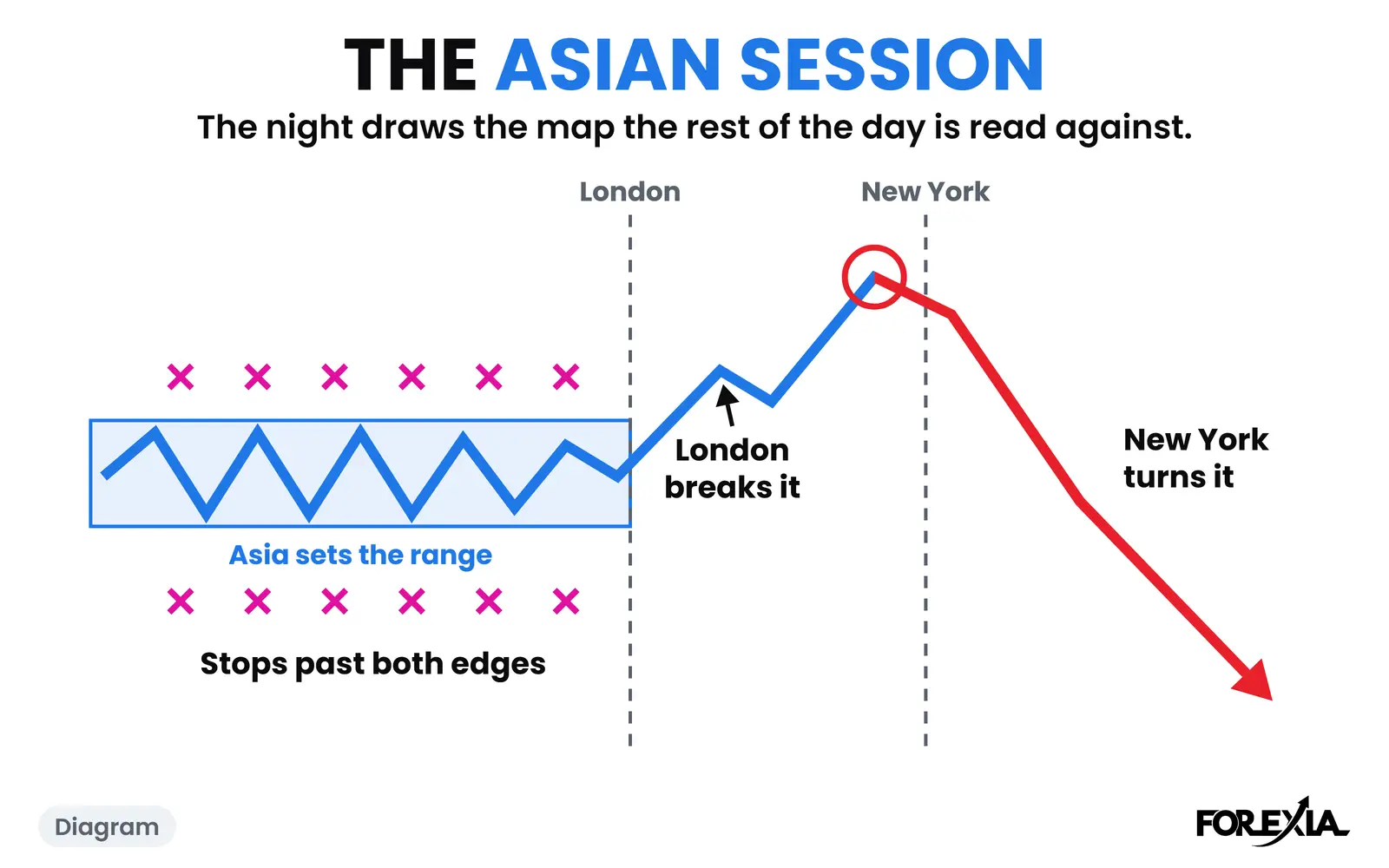
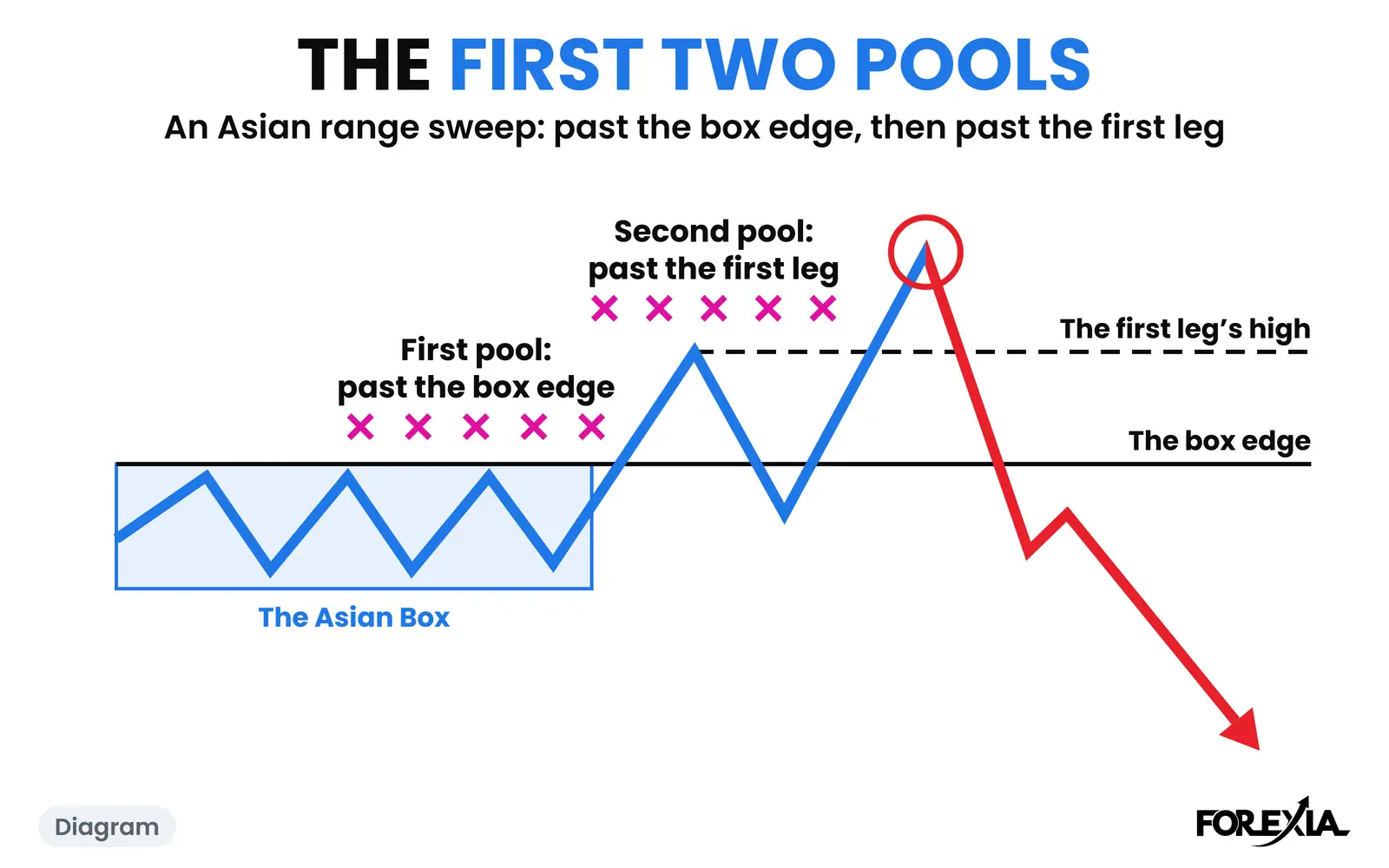
AUD/USD on Friday 31 July 2026 shows how a day can do this to you. Nothing shows that anyone traded it this way. These are 15-minute Dukascopy candles in New York time, named by when they open, and the day was picked afterwards. The Asian Box ran 28 pips, 0.70103 to 0.70380.
The first loss. The 04:45 candle closed at 0.70415, over the box, with nothing due on the calendar. It looks like the break to buy. A buyer there with a stop under that candle's low, 0.70321, risks about 9 pips. The 05:30 candle went through it.
The long wait. Now you are out, and price slides for four hours exactly the way you did not want. The 08:30 candle closes a fraction of a pip under the box, at 0.70101, and the next ones close back inside it. The 09:30 candle falls from 0.70231 to 0.70072. The 09:45 candle, with Chicago PMI due, closes at 0.70018, well under it. You were on the wrong side all morning, and the other way is running.
The revenge. The urge says sell it. A stop over the 09:30 candle's high, 0.70234, makes that about 22 pips, more than twice the first loss on the same lot. At double the lot, to get it back faster, more than four times the first loss is at risk.
The second loss. The 10:00 candle, with Michigan sentiment due, printed the low of the day, 0.69909. The 10:45 candle went through 0.70234. By 15:45 price was at 0.70416, 51 pips off the low.
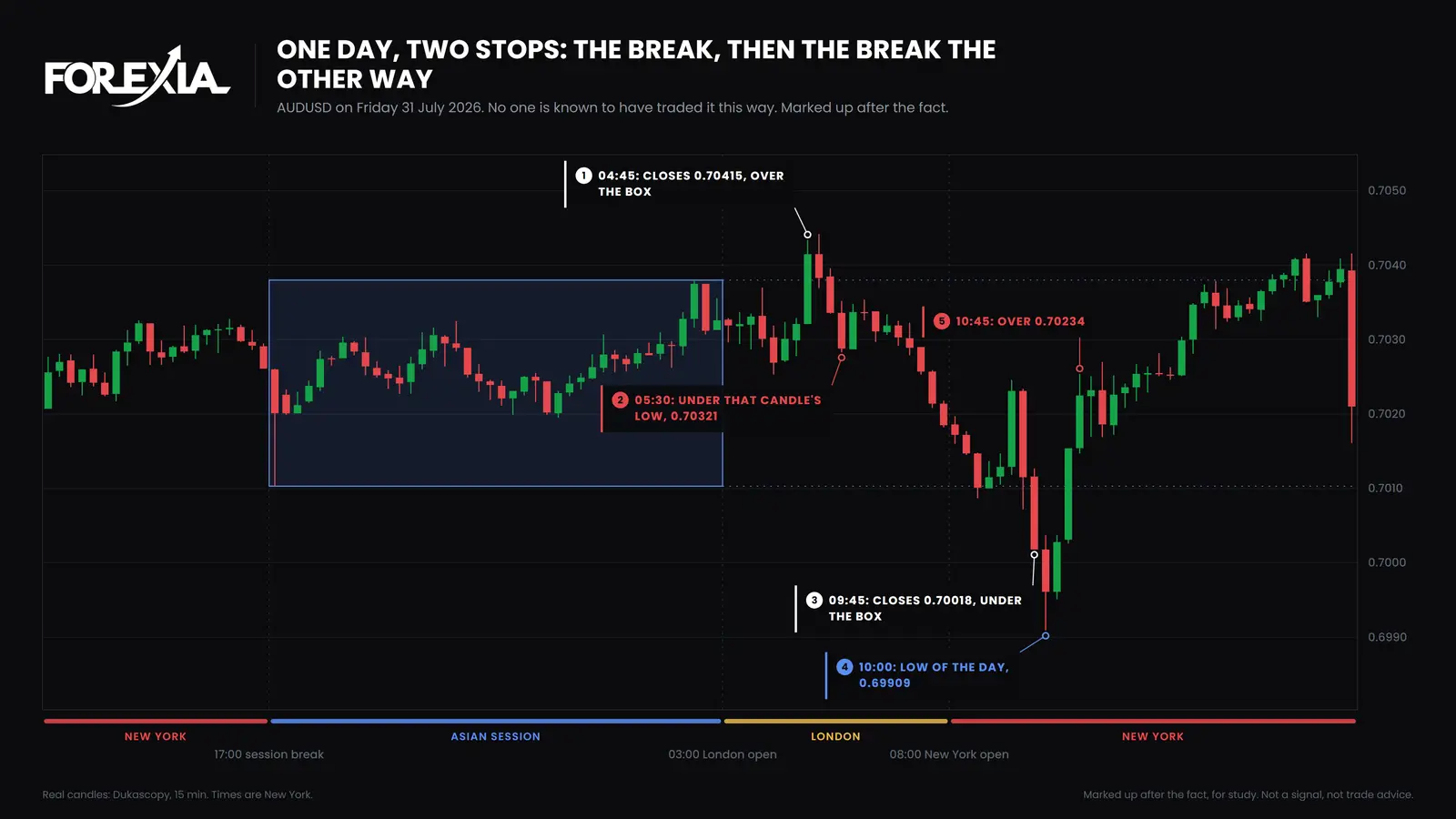
We read a day like this from the first seat as two mistakes, and from outside as one crowd feeding both sides of a range. Stops and flips are predictable orders, which is the idea behind Dumb Money vs smart money, and the reflex that sends them is what we call the NPC. That is a reading. We cannot see who was on these candles.
What if the revenge trade wins?
Then you have the harder problem. USD/CAD on Thursday 6 August 2026 shows it, on a day picked afterwards, and again nothing shows that anyone traded it this way. It is a warning and not a trade to copy. The box's low was 1.40022. The 07:30 candle closed at 1.40017, around that low, and a buyer with a stop under the 07:15 low, 1.39940, risks about 8 pips. The 07:45 candle went through it.
The 08:00 candle fell to 1.39901 and closed at 1.40016. It looks as if the chart is laughing at you. The urge says buy again at double the lot. With a stop under 1.39901 that is about 12 pips, and three times the money at risk. By 11:30 price was at 1.40375, 36 pips higher.
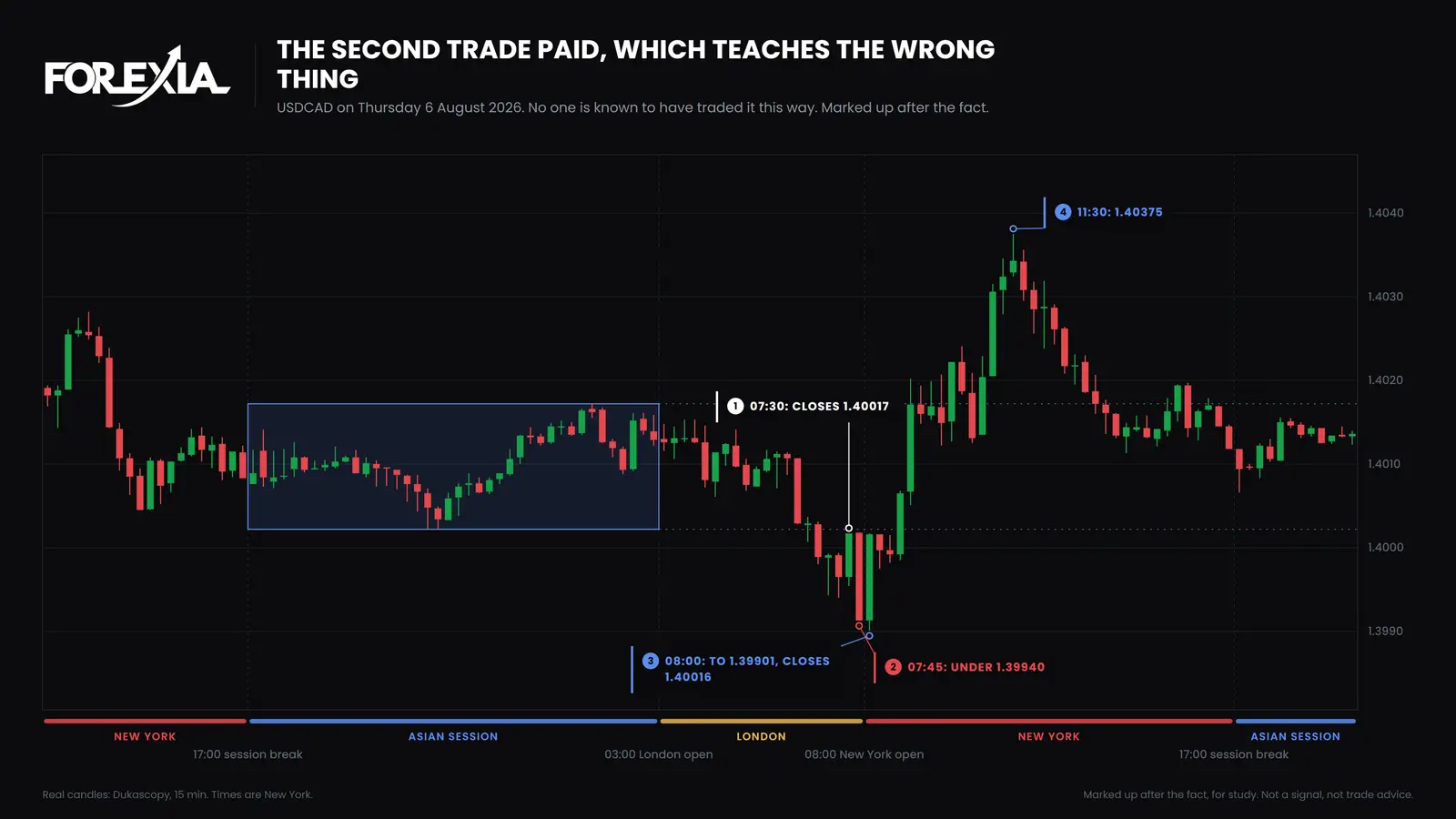
Nothing about that trade got better because it won. It carried three times the risk, and what it taught was that the urge works. That lesson costs more on a day like the Aussie's. So the result of the trade cannot be your test. That is why the check near the top of this page looks at the gap, the size and the reason, and not at how the trade ended.
A 15-minute pause that morning would have changed little: the 08:15 candle still opened at 1.40016. That is luck too. On other days price leaves without you, and that is the price of a pause.
What does the research say about revenge trading?
It shows the urge is real, disagrees about how general it is, and has not tested the cure on traders. This is where we found it in October 2026, and a gap here means we did not find it.
- Professionals do it. Coval and Shumway (2005) studied Chicago Board of Trade proprietary traders and found them "regularly assuming above-average afternoon risk to recover from morning losses". That is futures, and it is not retail.
- It is not universal. Liu, Tsai, Wang and Zhu (2010) looked at market makers' accounts in Taiwan's index options and found the opposite pattern: more afternoon risk after morning gains. They argue that prospect theory can predict either.
- An open loss may be the risky state. Imas (2016) reported that people avoid risk after a realized loss and take more after a paper loss. These were mainly experiments. Merkle, Müller-Dethard and Weber (2021) repeated the main experiment, confirmed the first half, could not replicate the second, and called the evidence mixed. This is one reason our routine starts by closing the loss, and it is thin support.
- Forced breaks buy time. This is the closest thing to a controlled test we found, and it comes from gambling. Norway's state operator randomly gave 21,129 online players breaks of 90 seconds, 5 minutes or 15 minutes after an hour of continuous play, as Hopfgartner and colleagues (2022) report. The 15-minute break led to a longer voluntary pause, and no break changed the money wagered once they resumed. A follow-up with 23,234 players found that only a fraction of the effects lasted. Those breaks were triggered by time and not by a loss, and those players were not traders.
- Naming a feeling. Lieberman and colleagues (2007) found that labelling negative images with an emotion word reduced the amygdala's response, in a brain scanner. That is a laboratory, and it says nothing about your next order.
So here is the honest position. We found no controlled study of a cool-down, a journal or a daily limit on retail forex traders. If your routine helps, your own records will show it, and nothing on this page can promise it. A pause also does not make a losing plan pay: run as a fixed rule with no emotion at all, our own setup lost money.
When is it more than a bad habit?
When you cannot stop. We are not clinicians. Going back to get even is among the signs the American Psychiatric Association lists for gambling disorder. If you are hiding losses, borrowing to trade, or breaking limits you set yourself, talk to a doctor or a gambling support service. Forex trading vs gambling draws the line in more detail, and it is no failure to need more than a routine.
For the wider subject, start with trading psychology.
Course 1 of ForexiaPRO, Reading the Map, teaches reading a chart from each seat, in lesson 1.1.2, Retail, Market Maker, Observer.
Frequently asked questions
How long should I wait after a losing trade?
Choose a time before the session and keep to it. You will read 5, 15 or 30 minutes, and those are conventions. We found no controlled study of any of them on retail traders. In a Norwegian gambling experiment, a 15-minute forced break led to a longer voluntary pause, and no break changed the money wagered afterwards.
Is it revenge trading if the next trade is a good setup?
It can be. Check what changed, not how the trade looks. If the size went up, the reason names the loss, or the order came before you had finished looking, the loss is driving it. A good-looking chart and a win afterwards do not change that.
What should I do after a losing trade?
Our suggestion, which we have not tested and which is no rule of our courses: close the ticket, leave the order screen for the time you set in advance, and write down the trade and how you feel. Do not raise your size. Then ask whether the loss came from your plan or from a break in your plan, because those need different fixes.
Should I stop trading for the day after a loss?
It is a personal limit, and one worth setting while you are calm. Stopping after two losses or at a fixed daily loss is common advice, and we found no controlled study showing it improves results. It does limit how much one bad morning can cost you.
When is revenge trading a sign of something more serious?
If you are hiding losses, borrowing to trade, or cannot stop when you have decided to. Chasing losses is among the signs the American Psychiatric Association lists for gambling disorder. Talk to a doctor or a gambling support service. That matters more than any routine on a trading page.