Why the Yen COT Report Looks Backwards, and How to Turn It Round
Dylan Forexia7 min read
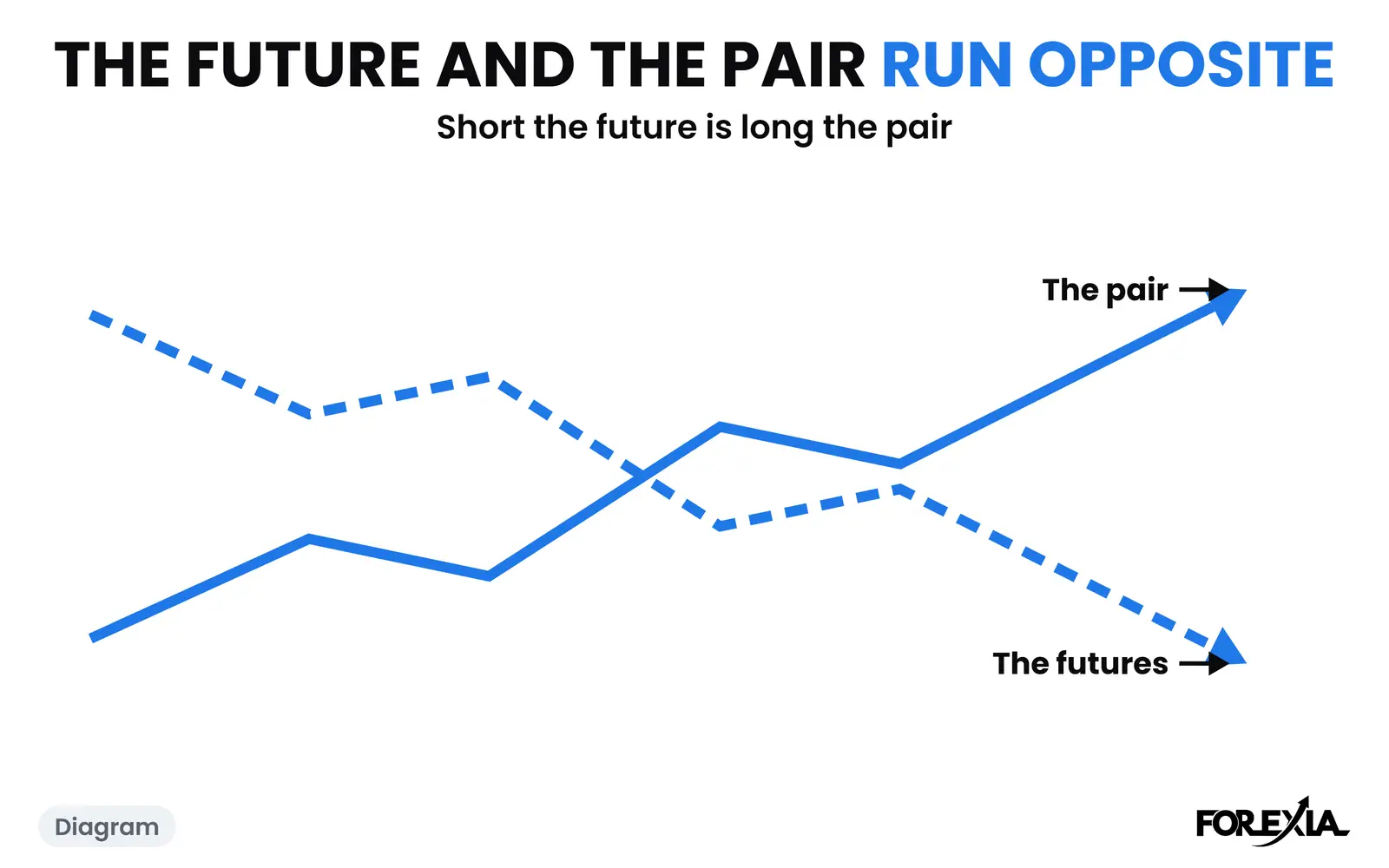
The yen COT report looks backwards because the yen future is quoted the other way round to USD/JPY. When the large speculators are net short yen futures, they are net long the pair. The Swiss franc and the Canadian dollar do the same. So a yen COT report backwards is not a mistake in the data. It is the same position, in the other currency's terms, and you turn it round before you read it.
This page shows the turn on real numbers, how it changes what is crowded, and what it cost to read it the wrong way. For the whole report, start with the guide to the Commitment of Traders report, and for the yen's own week, the yen COT report.
Why does the yen COT report look backwards?
Because a currency future is priced as the foreign currency in dollars, and USD/JPY is priced as dollars in yen. The CFTC's yen contract is Japanese Yen on the Chicago Mercantile Exchange, code 097741, quoted in dollars per yen. USD/JPY is the dollar's price in yen. When the yen gains, its future rises and the pair falls.
So a position in the future is the opposite position in the pair:
- Long yen futures is long the yen against the dollar, which is short USD/JPY.
- Short yen futures is short the yen against the dollar, which is long USD/JPY.
The report does not say this anywhere on the row. It gives long and short contracts of the future, which is correct. The turn is yours.
What does a turned-round row look like? The yen on 21 July 2026
On Tuesday 21 July 2026 the large speculators held 107,590 yen futures contracts long and 259,715 short. Subtract the short from the long.
107,590 − 259,715 = −152,125 contracts.
In the futures that is a net short of 152,125, and a reader who sees "funds short the yen" may expect USD/JPY to be sold. Turn it round and it is net long USD/JPY by 152,125. With open interest of 423,796 that is a share of +35.9%, and against its own 156 weeks the index was 83, which we call crowded long.
The turn flips more than the sign. On the raw futures, the same week would have read an index of about 17, crowded short. Flipping every share swaps the lowest and the highest of the range, so the pair's index is 100 minus the raw one. Both readings describe one position. Only one of them is a statement about USD/JPY. At 83 we read the crowd as the side not to join, which is Fade the Crowd. At 17 on the futures you would have read the opposite, and you would have been wrong about the pair.
Which markets do you turn round?
Three of the eight. The rule is the pair's quote: where the dollar comes first, the future runs the other way.
| Pair | Future | Turn it round? |
|---|---|---|
| EUR/USD | Euro | No |
| GBP/USD | British pound | No |
| AUD/USD | Australian dollar | No |
| NZD/USD | New Zealand dollar | No |
| USD/JPY | Japanese yen, 097741 | Yes |
| USD/CHF | Swiss franc, 092741 | Yes |
| USD/CAD | Canadian dollar, 090741 | Yes |
| Gold | Gold, COMEX, 088691 | No |
Our own report applies the turn to USD/JPY, USD/CHF and USD/CAD and to no others, and every position, share and index on our pages is in the pair's terms.
The franc and the Canadian dollar, on real rows
The Canadian dollar counted on Tuesday 11 August 2026 is the clearest case. The row says 12,854 contracts long and 186,216 short, with open interest of 364,104. In the futures that is 173,362 short. Long Canadian dollars is short USD/CAD, so short Canadian dollar futures is long USD/CAD by 173,362, a share of +47.6%. Against a range of −12.5% to +55.8% the index was 88. Read raw, "the funds are heavily short the Canadian dollar" sounds like a sell signal on the pair, and it is a crowded long.
Here are all three, as counted on Tuesday 27 October 2026 and published on Friday 30 October. The long and short columns are as the CFTC prints them. The net, share and index are in the pair's terms.
| Market | Long (futures) | Short (futures) | Net in the futures | Net, pair's terms | Share | Index |
|---|---|---|---|---|---|---|
| USD/JPY | 225,516 | 123,925 | +101,591 | −101,591 | −27.2% | 23 |
| USD/CHF | 26,254 | 46,303 | −20,049 | +20,049 | +14.8% | 17 |
| USD/CAD | 89,942 | 156,366 | −66,424 | +66,424 | +18.4% | 45 |
Look at the franc. In the futures the crowd is net short, 20,049 contracts. In the pair's terms it is net long by the same number, and still at an index of 17, which is crowded short against its own range. So a crowd can be net long a pair and crowded short at once. That is the second reason to read the index and not the sign, as what the COT index means explains.
What did the wrong read cost? USD/JPY on 30 July 2026
It would have put you on the wrong side of the crowd. The report counted on Tuesday 28 July had the large speculators net long USD/JPY by 163,412 contracts, 37.8% of open interest, index 85. Someone reading the yen futures instead saw a net short of 163,412 and a weak yen, and had two ways to go wrong: sell USD/JPY believing they had joined the funds, or buy it believing they had not. The first has it backwards.
The pair closed that Tuesday at 163.792. On Thursday 30 July it opened at 163.383 and traded to 163.738 at 03:45 New York. The 09:30 candle was the first under last week's low and reached 160.279, and at 10:15 the pair printed 157.963, 578 pips under the high. The day ended at 159.514. Our calendar lists US GDP and core PCE at 08:30, and Tokyo CPI and the Bank of Japan's decision that evening, so a chart cannot show which of those, if any, moved it.
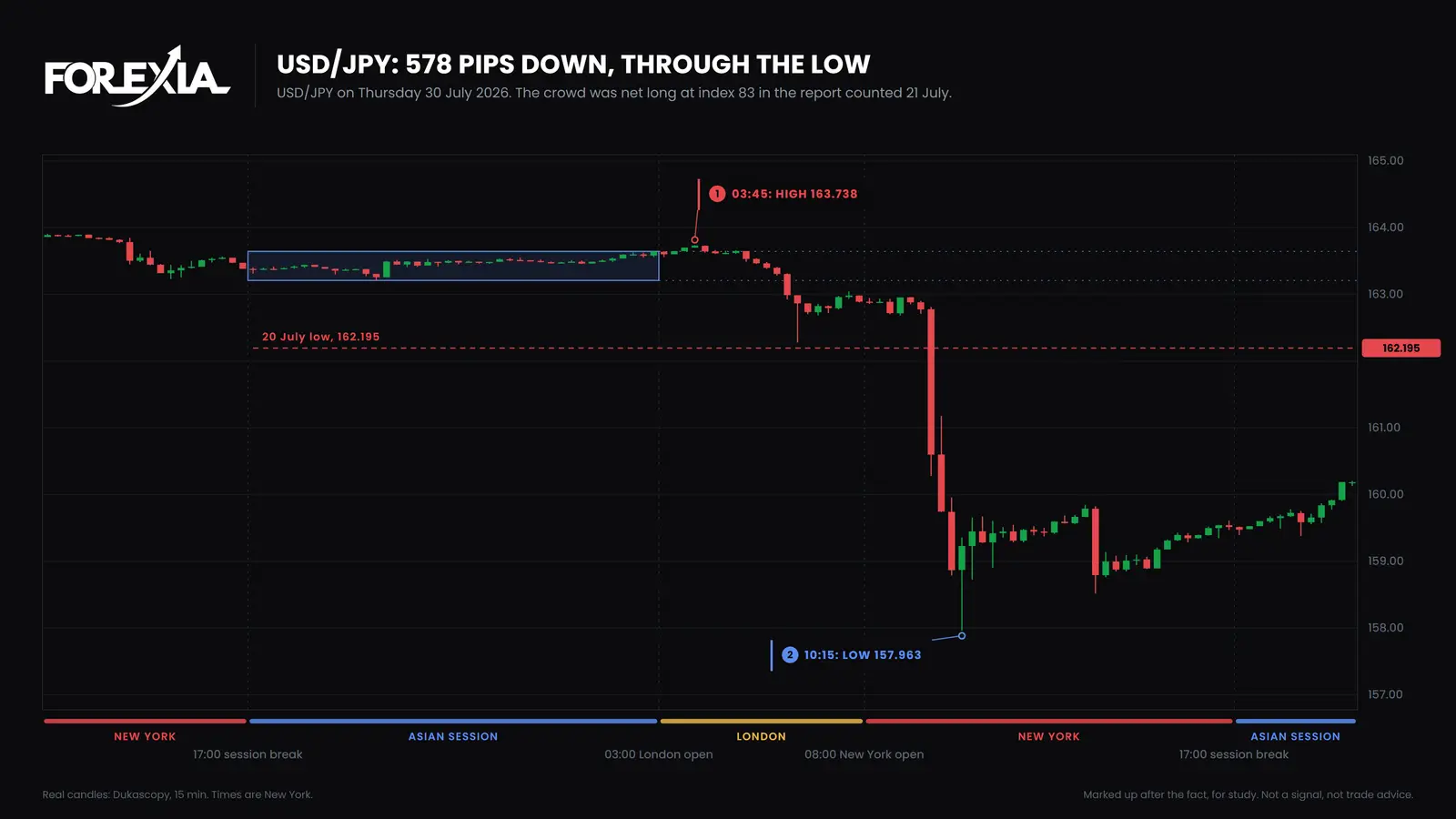
Read that with care. A crowded long did not call the fall: the index rose from 83 to 85 in the week the pair began to fall, and the report was published on Friday 31 July, a day after it. What the turn gives you is the right label. The crowd was long the pair, which is the side we would not join, and a reader who had not turned the futures round would have seen the reverse. In our own test of the report, joining a crowded side lost in 12 of 16 years, and fading it is promising and not proven.
Does the turn change how often the yen is crowded?
It swaps the two ends and keeps the count. In the 156 reports to 29 September 2026, with the futures turned round, the yen's crowd was crowded short in 35 weeks and crowded long in 31, net long USD/JPY in 87 of the 156, and its longest run on one side was 24 weeks, short. On the raw futures those 35 and 31 would trade places. The totals are the same and every label is reversed.
How do you check any chart for the turn?
Ask three questions before you read a net position from any COT chart or table, ours or someone else's.
- Which way is the contract quoted? Dollars per foreign currency, or foreign currency per dollar. If the pair has the dollar first, the future runs opposite to it.
- What does the page say it did? Our members' report turns the three round. Our Trading Tools page shows the CFTC's positions as published, in the futures' own terms, so net long yen there is long the yen.
- Does the index agree with the net? A net that points one way while the index says the other, as on the franc, is a reason to check the sign, not to trade.
Do not mix the two ways in one study. A rule written on turned-round shares does not carry over to raw ones, because the ends swap.
What does the turn not fix?
It does not fix the lag, the group or the timing. The report is three days old when it comes out, the large speculators are one group in one report, and a crowded reading can last for months. Is the COT report lagging takes the first of those, and which report to use the second. You can work the index for any turned-round market yourself with the COT index calculator.
Course 1 of ForexiaPRO, Reading the Map, teaches this read step by step in lesson 1.3.4, and members see each week on the COT Report page, already turned round.
Frequently asked questions
Is the yen COT report inverted?
Against USD/JPY, yes. The contract is quoted in dollars per yen, so it runs the opposite way to the pair. Net long yen futures is net short USD/JPY, and net short yen futures is net long the pair. The Swiss franc and the Canadian dollar are quoted the same way, so they need the same turn.
How do you turn the yen COT report round?
Change the sign of the net position. If the large speculators are net short 152,125 yen futures contracts, they are net long USD/JPY by 152,125. Divide by open interest for the share, then work the index on the turned-round shares, not the raw ones.
Which COT markets need turning round?
The yen, the Swiss franc and the Canadian dollar, when you want the position as USD/JPY, USD/CHF and USD/CAD. The euro, pound, Australian dollar and New Zealand dollar futures run the same way as EUR/USD, GBP/USD, AUD/USD and NZD/USD, and gold needs no turning.
Does a free COT chart show the yen turned round?
Check each one. Our Trading Tools page shows the CFTC's positions as published, so net long yen futures there is long the yen against the dollar. The members' COT report turns the three markets round and says so.