
Mid-Week Reversal: How to Spot the Turn on the Hourly Chart
The Mid-Week Reversal is the turn itself, after the trap, and it happens on almost every forex pair, though not always on Wednesday. It is what people mean by a midweek reversal, read on the hourly chart: the point where a week that has run one way stops and starts running the other. It is clear only once the week has gone on.
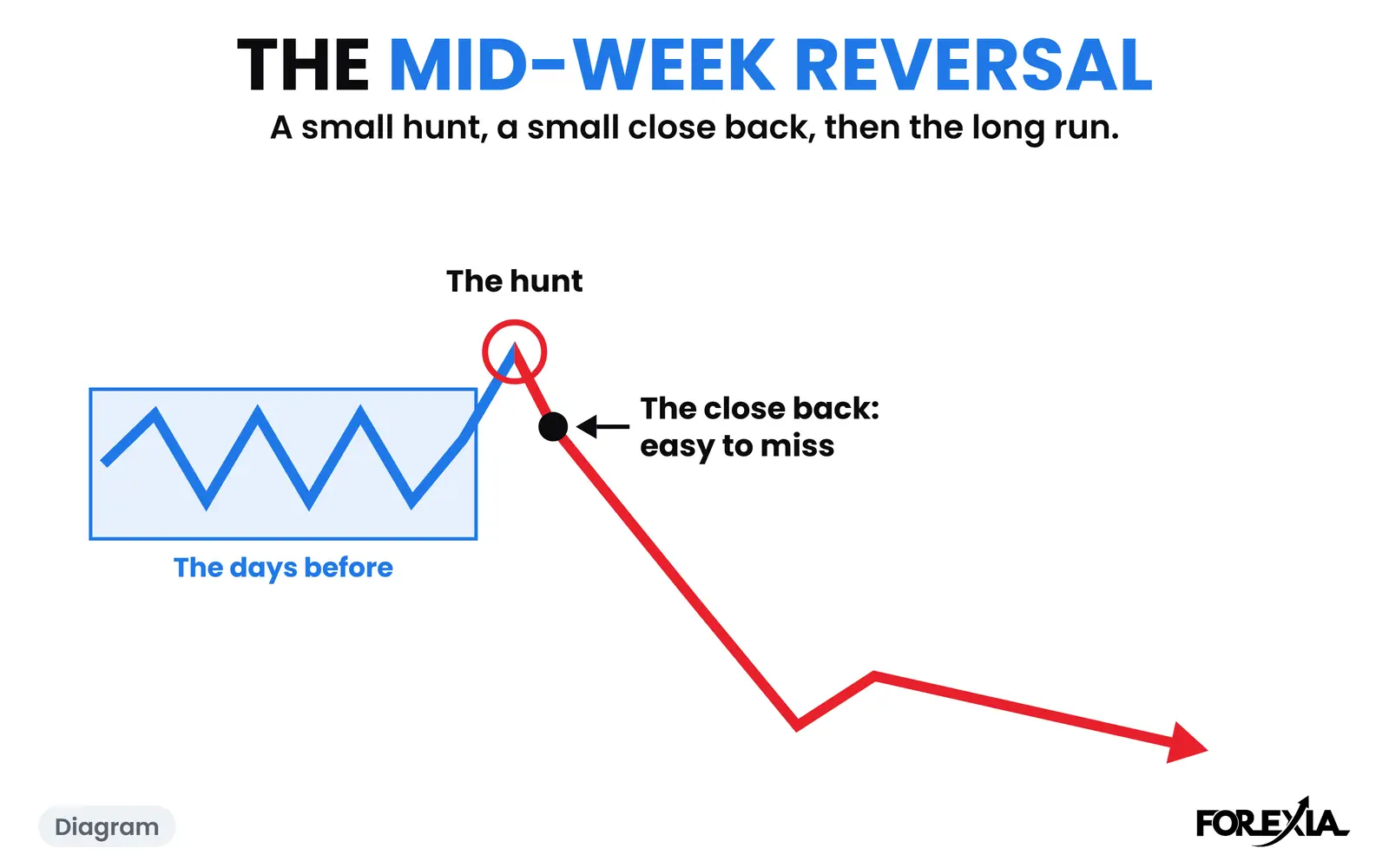
What does the Mid-Week Reversal look like on a chart?
It looks like one small candle and then a long way down. USD/JPY spent the start of the week of 31 August 2026 going nowhere, only 20 pips from its open by Tuesday's close, with Tuesday's high at 160.273 and Tuesday's low at 159.634. The trading day rolls over at 17:00 New York, so Tuesday evening is already Wednesday's session. Two hours tell the turn.
- 21:45 New York, the hunt. Price reached 160.392, the high of the week, 12 pips over Tuesday's high. That is the Stop Hunt of the Midweek Trap, what most traders call a liquidity sweep.
- 22:00, the close back. The hour closed back under Tuesday's high at 160.263. It was only 13 pips off the high, and nothing about it looked large. Price then fell. By 02:00 it had gone through Tuesday's low, and Wednesday closed at 158.699, 147 pips down on the day, and Thursday at 155.797. By 20:00 on Thursday price was at 155.294, 510 pips off the high. The jobs report came at 08:30 on Friday, about 12 hours after the low, so that release did not cause the fall.
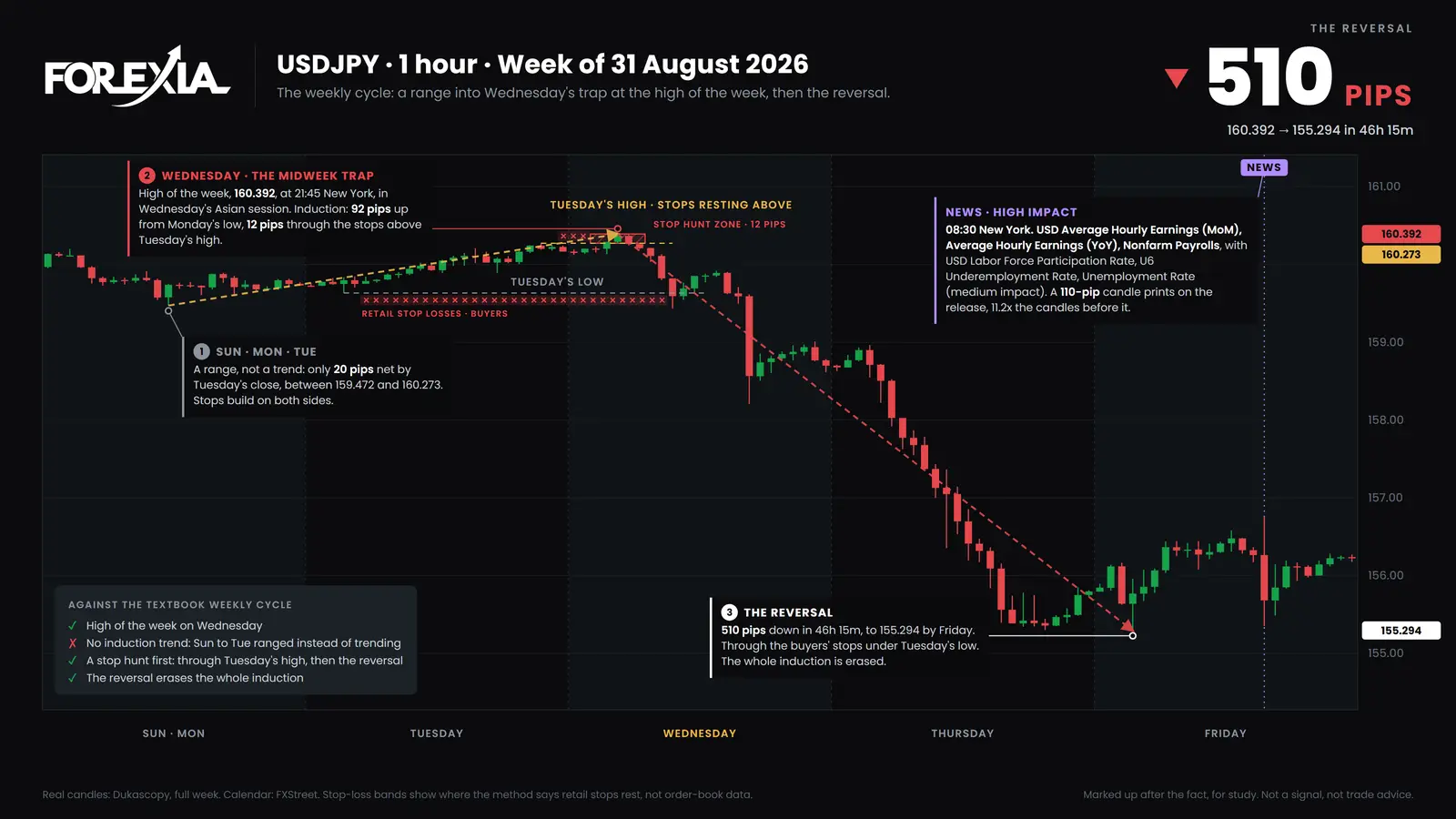
That week all eight markets we chart turned in the same session. It looks like a strong finding and it is not. They moved on one dollar, so it is one event seen eight times, and one week says nothing about Wednesdays in general.
Mid-Week Reversal and the midweek reversal people search: what is the difference?
The two are close, and the difference is what comes before. Most midweek reversal pages describe a Wednesday shape: consolidation on Monday and Tuesday, a run into a level, a strong move the other way, drawn as a schematic. Ours is the same turn with two conditions. It follows a trap, so an extreme has been hunted first. And its day can move, so the name gives a usual place and not a date.
The Three Seats read the same hour differently. Retail sees a small pullback after a new high, and buys it. The market maker, on our reading, has what it came for. The observer sees an hour close back under a level the week had been leaning on.
The word also has a neighbour. Mid-Week Reversal is the moment. The WTF Reversal is the run that follows, through the herd's stops, on Wednesday, Thursday and Friday. The midweek reversal guide shows the whole week around them, and another week marked up shows the same read on a larger move.
How do you spot the Mid-Week Reversal?
You read it on the hourly chart, in order: the hunt, then the close back. No single candle is the turn. Both also happen on days that do not turn, which is why the Close Back page shows how often price runs past the wick again.
Then check the day and let it move. On gold in the week of 8 June 2026 the turn came on Tuesday: a high of 4363.20 at 09:45 New York, then 340 pips down to 4023.59 by Thursday. On USD/CHF in the week of 28 September 2026 it came on Thursday, shown on the Weekly Script page.
This page gives no rate for how often the turn lands on a Wednesday. We only draw a weekly chart when the week turned, so these are chosen examples, not a sample, and no count of them could show it.
What do traders get wrong about the Mid-Week Reversal?
Three readings cost the most.
- Waiting for Wednesday. The calendar does not call the turn. On gold above it came a day early.
- Expecting a big candle. On USD/JPY the hour that closed back ended 13 pips off the high. The size came later.
- Reading the news as the cause. The biggest move of that week was over before Friday's jobs report. A reversal seen afterwards is not a setup, and our own test of the daily setup as a mechanical rule did not make money.
Which words does the Mid-Week Reversal lead into?
Three sit next to it.
- The Midweek Trap: the multi-day M before the turn.
- The WTF Reversal: the reversal through the herd's stops that follows it.
- The Week's High and Low: the biggest pool of stops on the chart.
Where is the Mid-Week Reversal taught?
The Mid-Week Reversal is taught in Course 4 of ForexiaPRO, The Week, in production.
Related words
Frequently asked questions
What is a mid-week reversal in forex?
It is the turn itself, after the trap: the point where a week that has run one way stops and starts running the other. It happens on almost every forex pair, though not always on Wednesday. Forexia calls the trap before it the Midweek Trap, and the run after it the WTF Reversal.
How do you spot a mid-week reversal on the hourly chart?
Look for a run past an earlier day's extreme, then an hour that closes back inside it. On USD/JPY in the week of 31 August 2026 those came at 21:45 and 22:00 New York. Both also happen in weeks that do not turn.
Does the market always reverse on Wednesday?
No. On gold in the week of 8 June 2026 the turn came on Tuesday, and on USD/CHF in the week of 28 September 2026 it came on Thursday. This page gives no rate for Wednesdays. A chosen week cannot show one.
Is a mid-week reversal a trade signal?
No. A reversal seen afterwards is not a setup. Both can also fail, and the turn is only clear once the week has gone on. Our own test of the daily setup as a mechanical rule did not make money.