
Pending Limit Orders: What Resting Orders Before London Face
Pending Limit Orders are orders placed a few hours before London, in the liquidity zones, expecting the stop hunt past a level to fill them, the order side of the signature trade forex setup. A pending limit order is the plain kind: buy below the market or sell above it, and wait. Forexia's word is that order placed ahead of the spike, so the trader is not chasing it afterwards.
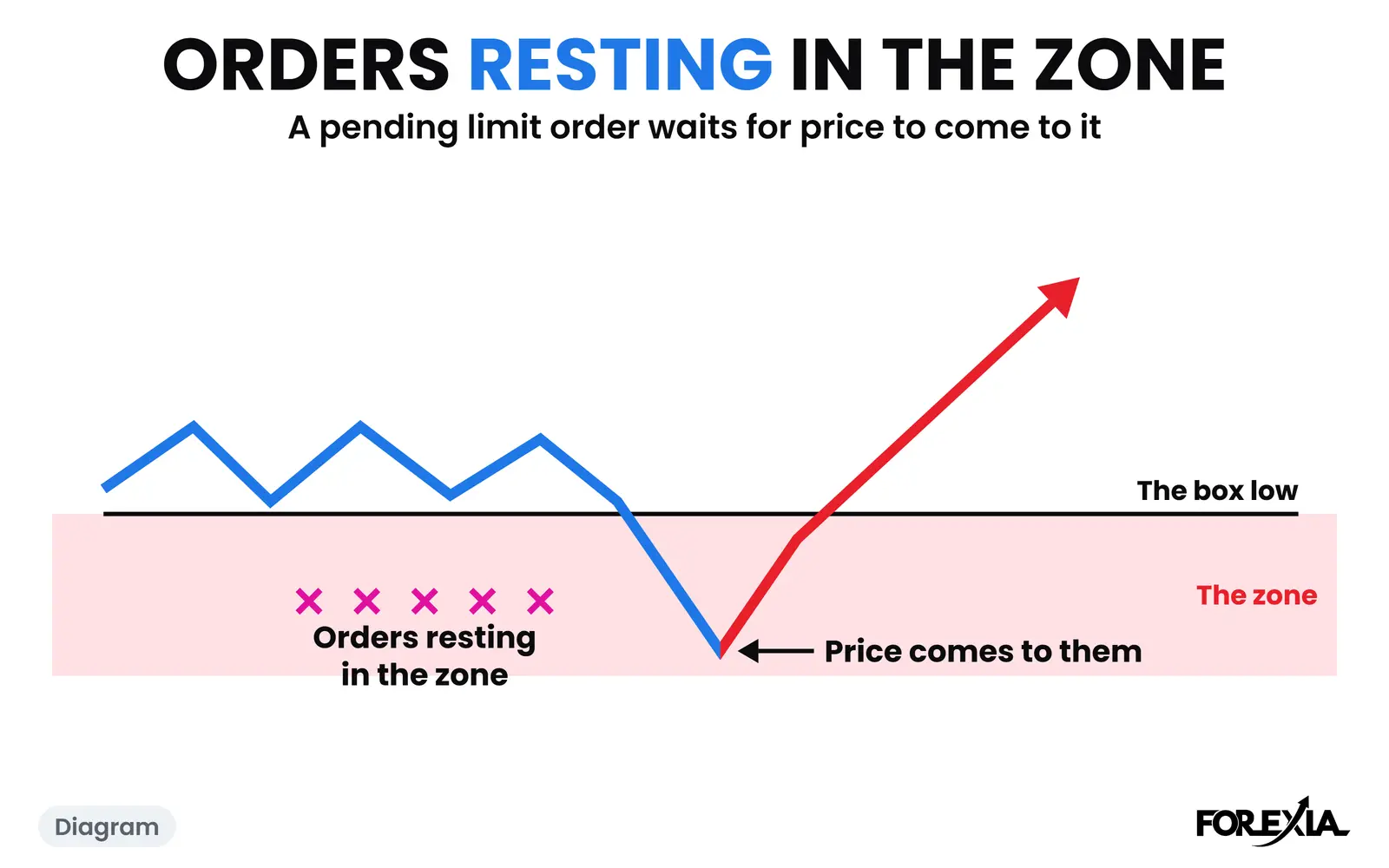
What does a pending limit order do?
It waits. A buy limit sits below the current price and a sell limit sits above it. Nothing happens until price reaches the level, and if price turns short of it, the order is never filled. A stop order is the opposite kind: it sits beyond the price and fills when the market runs on.
That is all the textbook order types say. What our word adds is where and when. The zone is a place where we read the crowd's stops resting, such as an edge of the Asian Box or the previous day's high or low. The hours are the quiet ones before London, which is the idea behind Liquidity Mapping: mark the pools while the chart is calm.
What does a pending limit order face on a real day?
On GBP/USD on Friday 22 May 2026, the Asian Box ran from 1.34167 to 1.34336, 17 pips, between the 17:00 session break and the London open at 03:00 New York.
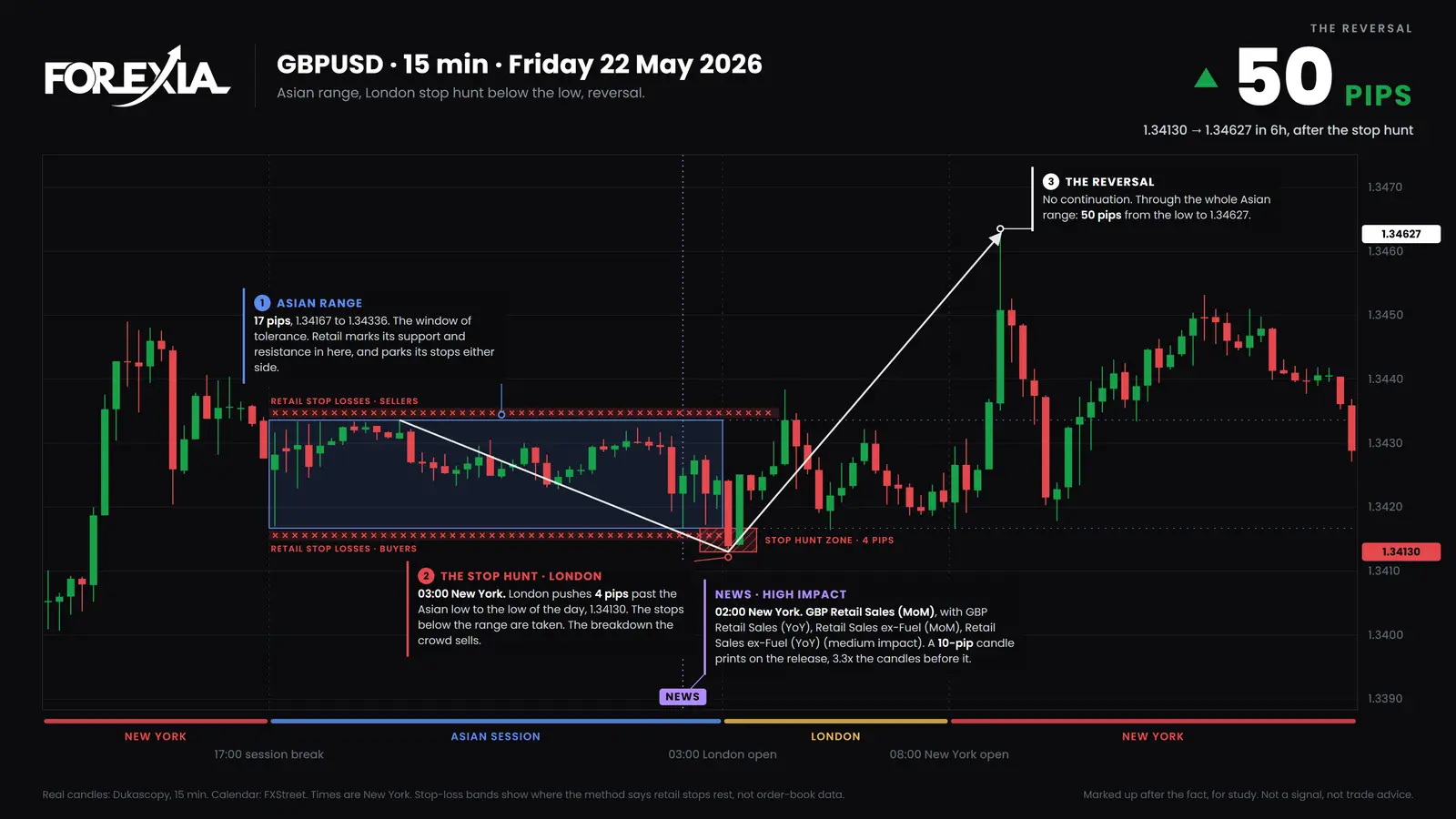
Candles here are named by when they open. Here is what a resting order at the zone around the low met.
- The line was touched before the hunt. The 02:00 candle, which opened on the release of UK retail sales, set the box low at 1.34167. The 02:30 candle came to 1.34172. An order resting at the line fills on a touch like these, not on the hunt.
- The hunt took it by about 4 pips. The 03:00 candle, London's first, traded to 1.34130 and closed at 1.34139, still under the box. We read that as the Stop Hunt, a liquidity sweep of the buyers' stops. An order resting in those 4 pips was filled. One resting under 1.34130 was not.
- The close back came a candle later. The candle that opened at 03:15 closed at 1.34251, back inside the box. That is the Close Back.
- Price went on, then gave it back. The 09:00 candle reached 1.34627, 50 pips above the low and past Thursday's high of 1.34546, then closed at 1.34508. At 17:00 the day ended at 1.34288, 16 pips above the low and inside the box.
This is not a day without news. The pound's retail sales came at 02:00, our calendar file marks the monthly figure high impact, and a Fed speaker was due at 04:00. US consumer sentiment came at 10:00, the hour the candle fell back from 1.34375 to 1.34203.
Pending Limit Orders and pending orders before the London open: how do they differ?
The searched phrase is about order mechanics: which button, which price. Our word is about a read of the market. The textbook asks where to put the order. We ask who else has orders there and what their stops mean for the candle that fills yours.
Most pages that cover this set stop orders outside the range, to catch the break. A pending limit order stands on the other side of that crowd. It is the same Asian Box and the same London open, read from the observer's seat instead of the crowd's.
Where to place such an order, and how far to let price run, is the lesson, and this page does not give it.
How often does the level get taken, and what does it do next?
A resting order is filled by a touch. It does not know which kind of day it is in, so this count shows both kinds. We counted seven majors and gold on 15-minute candles from 6 April to 1 October 2026. A level is an edge of the Asian Box, or the previous day's high or low if Asia had not traded past it. Taken means through it after the London open by at least 3% of the average daily range. Of 1,601 levels taken:
- 1,310 closed back the same day, by a median of 9% of the average day past the level
- 291 (18%) had not closed back by the end of the day, and ran a median of 65% of the average day past it
Of the 1,310 that closed back, 825 had a later candle trade past the wick again. This counts candles, not trades: no order, fill, stop or cost. Our own test of the setup as a mechanical rule did not make money.
What do traders get wrong about resting orders?
Three readings cost the most.
- Reading a fill as a signal. A fill says price arrived. On 22 May the line was touched at 02:00 and 02:30 and held, then gave way at 03:00. A reversal seen afterwards is not a setup.
- Taking one good day as the pattern. The 291 levels with no close back look like this one until the day ends.
- Treating a zone as a price. A level is a place where stops cluster, and the hunt can stop short of it or run through it.
Which words does it lead into?
Four sit next to it.
- Liquidity Mapping: marking where the stops sit.
- The Window of Tolerance: the calm hours that build the box.
- The Asian Box: the range whose edges are the zones.
- The Stop Hunt: the move that fills the orders.
Where is it taught?
Course 5 of ForexiaPRO, The #SignatureTrade, in production, teaches this in lesson 5.3.1, Pending limit orders for the window.
Related words
Frequently asked questions
What are Pending Limit Orders?
A pending limit order is an order to buy below the market or sell above it that waits until price reaches the level. If price never gets there, it is never filled. Forexia's word, Pending Limit Orders, means such orders placed a few hours before London, in the liquidity zones, expecting a stop hunt past a level to fill them.
Why place pending orders before the London open?
Because the move that matters can last a few candles. An order already resting at a level is filled by the first touch, where a trader watching the screen reacts after the spike. The cost is that a resting order cannot tell a hunt from a real break.
Does a pending limit order fill only on a stop hunt?
No. It fills whenever price touches it, whatever comes next. On GBP/USD on 22 May 2026 the Asian low was touched at 02:00 and again at 02:30 before the candle that took it by about 4 pips. Of the 1,601 levels we counted, 291 never closed back the same day.
Do pending orders before London make money?
Our own test of the setup as a mechanical rule did not make money. The page shows what a resting order faced on one real day and counts how often a level taken closed back. It is a description of the market, not a method to copy.