
The Window of Opportunity: When the Signature Trade's Entries Cluster Around the London and New York Open
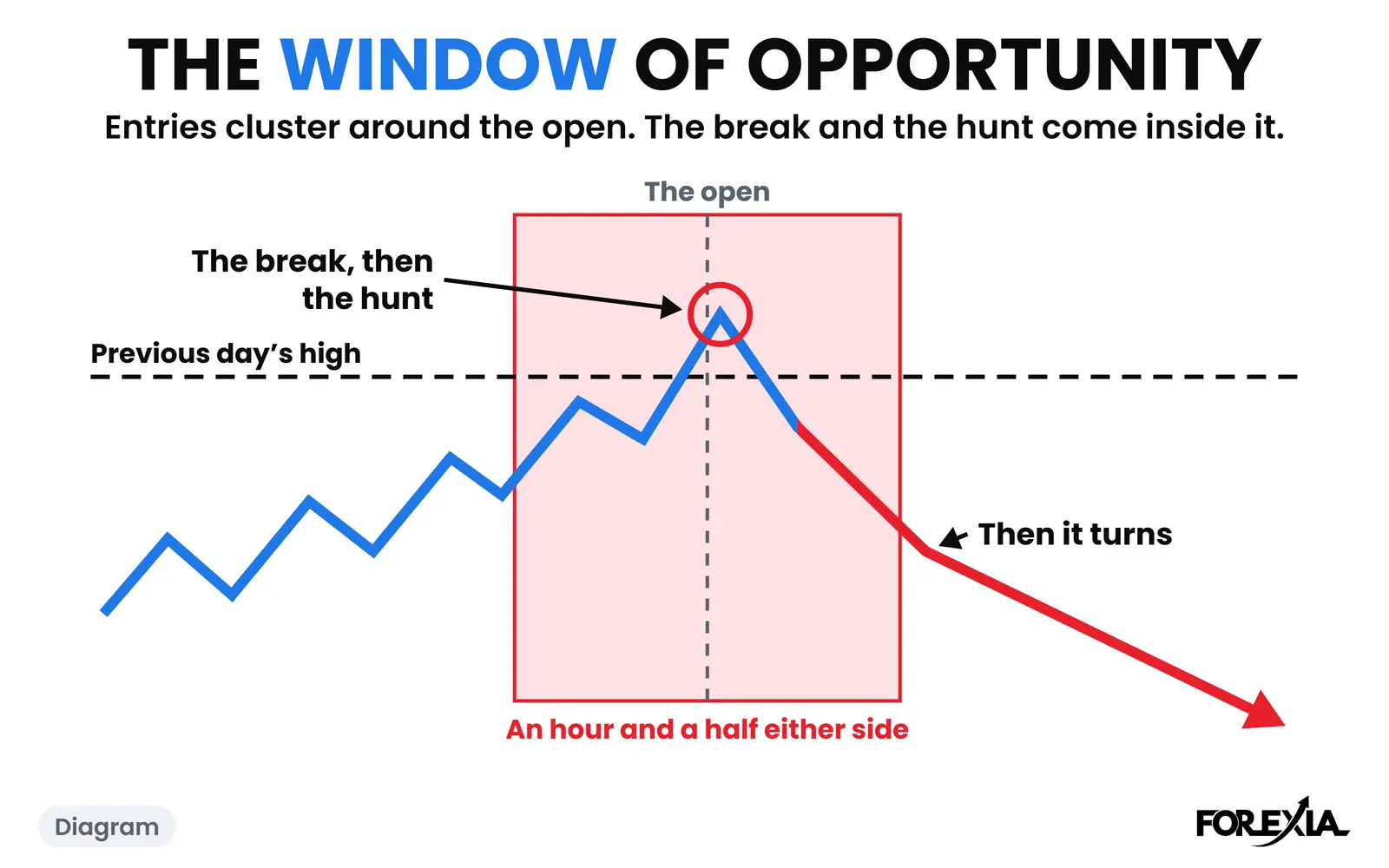
The Window of Opportunity is the stretch of the clock where the Signature Trade's entries cluster: from an hour and a half before to an hour and a half after the London open or the New York open. Price breaks the wedge, goes for the high or low, then reverses. It is a place to look on the chart, never a signal that the clock alone makes. It is where the signature trade is looked for.
What is the Window of Opportunity?
It is the part of the day the Signature Trade is read in. The Signature Trade is a wedge on day one, a clear Asian range on day two, and a break of the wedge and the previous day's high. The window is when that break tends to arrive.
London is the usual place, not the only one. A New York break counts. The same hour and a half applies around a high-impact news release that supplies the second leg. Search "best time to trade forex" and you get the London and New York overlap, a four-hour block of busy hours. The window is narrower and is tied to the open itself, and to the level price goes for.
What does the Window of Opportunity look like on a chart?
On EUR/USD on Wednesday 12 August 2026, the Asian Box was 13 pips, from 1.15320 to 1.15446. Tuesday's high was 1.15497.
The London window ran from 01:30 to 04:30 New York, around the 03:00 open. Euro inflation figures came out at 02:00 and 04:00 in it, and price moved about 7 pips in the three hours. At 05:15 a candle touched Tuesday's high at 1.15497 and closed at 1.15426. That is 2 hours 15 minutes after the open, outside the window.
The New York window ran from 06:30 to 09:30, around the 08:00 open. At 08:30 US inflation came out, and that 15-minute candle ran from 1.15329 to 1.15623, 29 pips, the first to go past Tuesday's high by a real margin. It closed at 1.15580. The furthest price came on the 09:00 candle at 1.15628, 13 pips past the level.
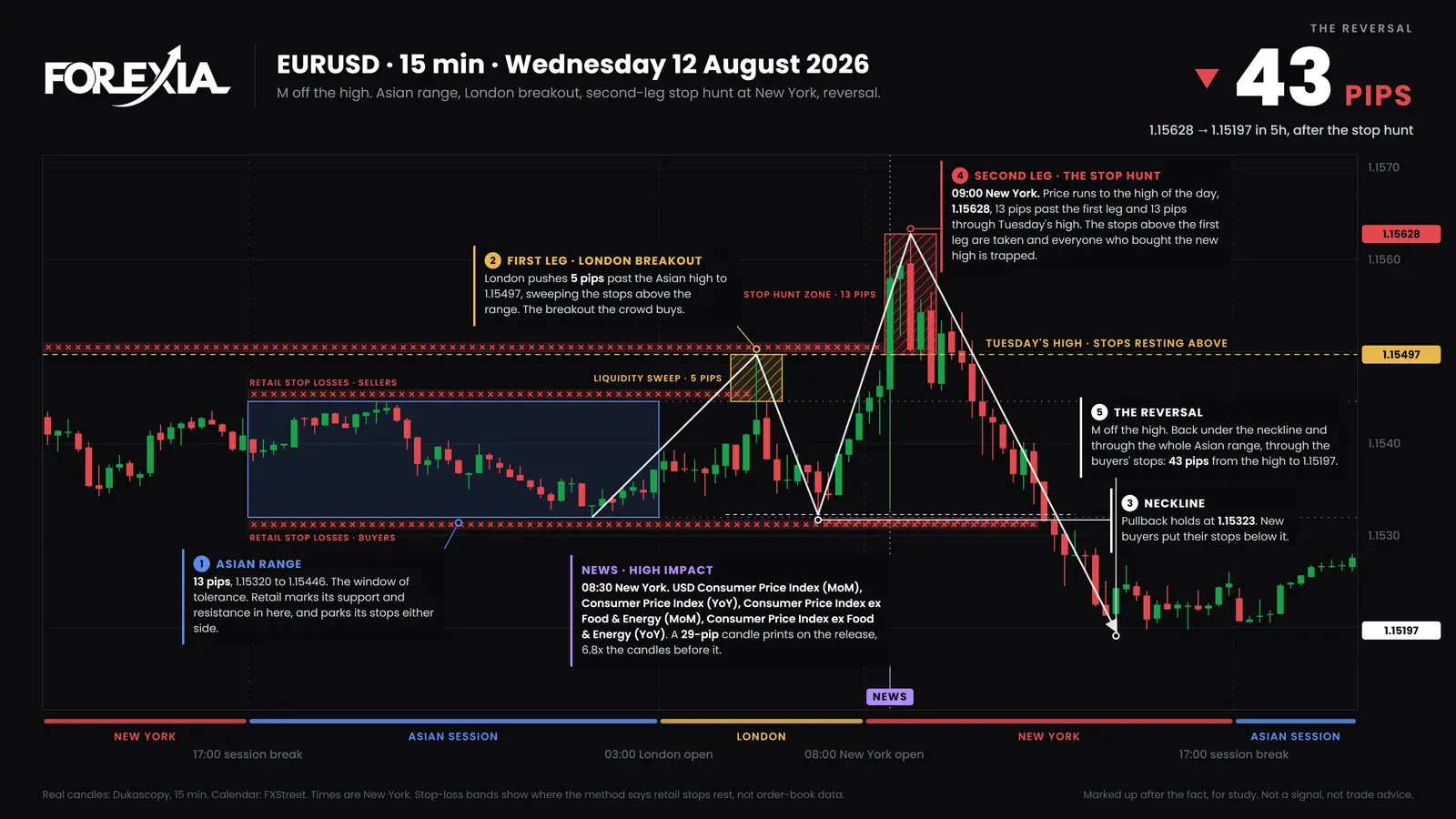
The 09:30 candle closed at 1.15466, back under Tuesday's high. We read the stops above that level as filled by someone selling into them: a Stop Hunt, here after a release, with the second leg arriving on the news. No release was due between 04:00 and the 08:30 inflation print. This day is not offered as a wedge day, and it hunted the previous day's high rather than the Asian Box.
How is the window different from the London Breakout?
The London Breakout is the move out of the Asian Box at the London open. The window is the clock the Signature Trade is read by, and it reaches New York and news minutes too. They overlap on some mornings and not on others, and the London Breakout's own counts stay on that page.
How often is a previous-day level taken inside the window?
Not on most days, and not mostly inside it. We counted seven majors and gold on 15-minute candles from 6 April to 1 October 2026. A previous day's high or low was first taken 422 times, by the first candle from the London open to trade past it by 3% of the average daily range. A level Asia had already passed is left out.
- 59 of those candles opened in the 90 minutes after the London open
- 117 opened in the window around the New York open, 06:30 to 09:15
- 246 opened outside both
That is 176 of 422, about two in five, in 4.5 of the 14 hours between the London open and the New York close. The count starts at the London open, so the hour and a half before it is not counted. It counts candles, not trades, with no entry, stop or cost. Our own test of the setup as a mechanical rule did not make money.
What do traders get wrong about the window?
Three readings cost the most.
- Treating the clock as a signal. A candle inside the window is not a setup. The setup is not forced, and without a clear wedge or a clear range it is not the Signature Trade.
- Trusting a quiet morning. On this day price moved about 7 pips in the London window and about 30 in the New York one.
- Reading a reversal afterwards as a trade. The 43 pips are measured after the fact. A break of a previous high on another day can run on.
Where is the Window of Opportunity taught?
Course 5 of ForexiaPRO, The #SignatureTrade, in production, teaches the window in lesson 5.1.3 step by step, on ForexiaPRO. Its confirmations come after, in Confirmation Stacking.
Related words
- The #SignatureTrade: a Wedge, a Clear Asian Range and the Break Everyone Believes
- The Previous Day's High and Low: What Rests There, and How Often Price Closes Back
- The London Breakout Strategy: The Textbook Rules, and Why the Crowd Buys the Top
- The Stop Hunt: What It Means, and How It Relates to a Liquidity Sweep
Frequently asked questions
What is the Window of Opportunity in forex?
It is Forexia's name for the stretch of the clock around a session open: from an hour and a half before to an hour and a half after the London open or the New York open. We read the entries of the Signature Trade as clustering there. It is a place on the clock to look, and the clock alone is never a reason to enter.
Is the Window of Opportunity only at the London open?
No. London is the usual place, and a New York break counts. The same hour and a half either side applies around a high-impact news release that supplies the second leg of the move.
Does price have to break the previous day's high inside the window?
In the Signature Trade's definition, the window opens when price breaks the wedge and the previous day's high. A move inside the window that has no such break and no clear wedge or range is not the Signature Trade, because the setup is never forced.
Does trading the Window of Opportunity make money?
We do not claim it does. Our own test of the setup as a mechanical rule did not make money, and a reversal seen afterwards on a chart is not a setup. The window says when to look at a chart, not what to do.