How Banks Trade Forex vs How Retail Traders Do
Dylan Forexia6 min read
Banks trade forex mostly for other people. A dealer bank quotes prices to companies, funds and other banks, takes the other side, and then manages the risk it is left with, often by matching it against other clients inside its own books. A retail trader takes a view and pays the spread. A bank has a problem a small account never has: it cannot buy or sell its size at once.
This page covers how banks trade. The wider map of who is in the market is on the institutional trading page.
How do banks trade forex, and for whom?
For clients first. The Bank for International Settlements asks dealers every three years what they traded. Its survey for April 2025 put foreign exchange at $9.6 trillion a day, counted so that a trade between two dealers is not counted twice.
| Who the dealers traded with | Share of turnover | A day |
|---|---|---|
| Other dealers | 46% | $4.4 trillion |
| Other financial institutions | 50% | $4.8 trillion |
| of which hedge funds and proprietary trading firms | 8% | $0.8 trillion |
| Non-financial customers, mainly companies | 5% | $0.4 trillion |
Shares are rounded, and the survey sees only what dealers report. The figures are from the BIS's final tables of June 2026. The largest instrument is not spot, the price on your chart, but FX swaps at $4 trillion, 42% of turnover, used for funding and hedging. Spot is $3 trillion, 31%.
So a bank trading forex is, in large part, a company paying for imports, a pension fund hedging dollars and a bank rolling its funding. Little of it is a view on the next candle.
How does a bank's order reach the market?
Directly or through a platform, and most of it then stays inside the bank. Customers reach a dealer by phone, by chat, by the bank's own platform or by a multi-dealer platform. Dealers trade with each other through electronic brokers with anonymous order books. About 59% of activity was electronic in April 2025, and voice stays important for larger trades.
The figure that matters most is this one. In the major hubs, dealers match more than 80% of customer trades within their own internal liquidity pools. The BIS calls it internalisation. One client's buy meets another's sell on the bank's own book, and no outside venue ever shows it. What is left over is hedged outside, in the pieces a bank decides to show.
That is why spot forex has no public tape. Nobody sees the whole.
The desks are also in few places. The UK has about 38% of trading and the US about 19%, and with Singapore and Hong Kong they hold 75%. A bank's day follows its own city's clock, which is one reason the sessions behave differently. The trading hours are covered on our forex sessions page, not here.
What is different about a bank's order?
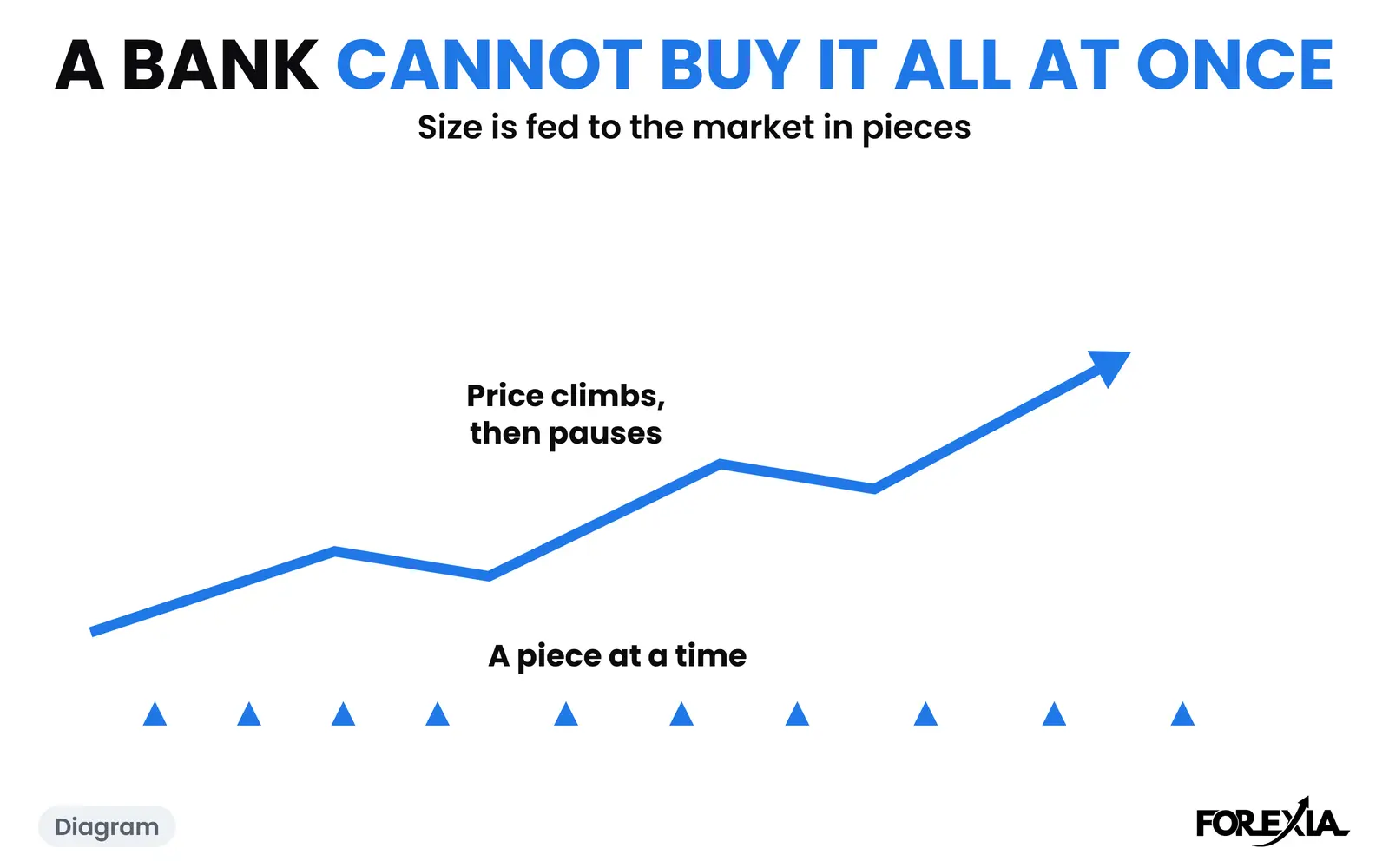
Its size. A retail order of a lot or two fills at the quoted price, and no one else notices. A bank order can be many times larger than the depth quoted at one price. If it went to market all at once, the price would move against it as it filled.
So a large order is worked: split, timed, matched against other flow where it can be, and hedged as it goes. We do not know how any one bank does this, and no published data ties a candle on a chart to one bank's order. What follows from size is simple. A buyer of size needs sellers, and a seller of size needs buyers, and the easier they are to find, the less price moves against the order.
What do banks do that retail traders do not?
They hold a book, and they have flow. Three differences matter for reading a chart.
- They are paid by flow, not by direction. A dealer earns on the volume passing through it, so a view on the next candle is optional.
- They see their own clients. Each dealer sees its own book and no one else's.
- They have a funding and hedging business. A great deal of what banks do in currencies is lending one against another for a period, and none of it is chosen for the chart.
What a retail trader has instead is freedom: no size problem, no client, no deadline. Retail-driven trading is a memo line in the BIS tables, $242 billion a day, 2.5% of the total in April 2025. The survey sees only the retail trades that reached a dealer.
What does a bank's size look like on a chart?
We cannot see it, only what it might leave behind. Here is one dated day, read from the three seats: retail, the market maker and the observer. Candles are 15-minute Dukascopy, in New York time.
USD/JPY on Thursday 14 May 2026 held a 48-pip Asian range, 157.514 to 157.992. Wednesday's low, 157.513, sat a tenth of a pip under the range low, so the two lines nearly coincided. At 09:45 New York a candle pushed to 157.307, 21 pips under both, the low of the day. The first 15-minute close back above the Asian low came at 10:00, at 157.908. Price then rose 111 pips, to 158.419 at 16:30, through the whole Asian range. We found no medium or high-impact release for the dollar or the yen lined up with that push.
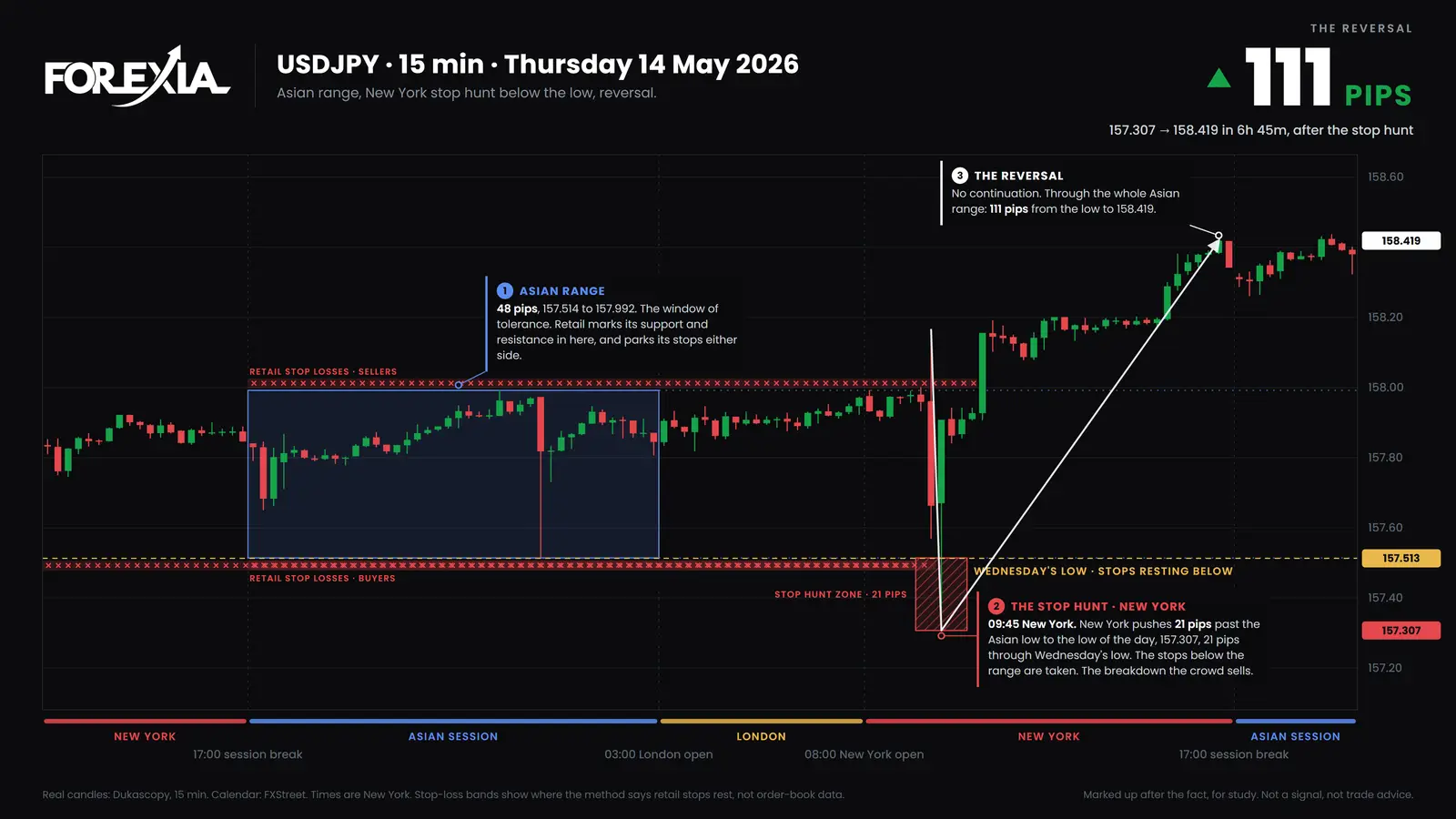
- Retail sees support breaking, with two lines under price, and sells the break.
- The market maker, as we read it, sees orders. A buyer of size needs sellers, and the stops under two obvious lows are sellers in one place.
- The observer waits to see whether price closes back above the low.
Be careful with the second line. It is a reading. We do not know that a bank bought at 157.307, and a UK regulator's 2014 finding, that traders had attempted to trigger client stops, is evidence that it has happened and not that it happened here. Whether another reason, such as a hedge or a client order, moved that candle, no chart can say. The day was chosen because it reversed. A reversal seen afterwards is not a setup, and when we ran the idea as a fixed rule it did not make money. The stop hunt page has the sample and the limits.
What do traders get wrong about banks?
Three errors recur.
- Assuming a bank wants your stop. If dealers match most customer trades inside their own books, they do not need it for most of their flow.
- Copying a size problem you do not have. Your order fills at once. Acting as if you had to find sellers teaches you little.
- Treating a job title as an edge. A former bank trader leaves the balance sheet, the credit lines and the client flow at the bank.
For the role of the dealer itself, read what market makers do in forex, and for what a chart can show of orders, forex order flow explained. The habit of reasoning from another seat is what we call Perceptual Positioning, and marking where orders probably rest is Liquidity Mapping.
Course 1 of ForexiaPRO, Reading the Map, teaches this read step by step, starting from lesson 1.1.2, Retail, Market Maker, Observer.
Frequently asked questions
How do banks trade forex?
Mostly for clients and for themselves as dealers. A dealer bank quotes prices to companies, funds and other banks, takes the other side, and manages the risk that is left on its books. The Bank for International Settlements says dealers match more than 80% of customer trades within their own internal pools in the major hubs, so much of it never reaches an outside venue.
Do banks trade against retail traders?
Not directly. A retail trade reaches a dealer through a broker, and the BIS describes retail clients' access as one step removed from the wholesale market. Retail-driven trading was $242 billion a day in April 2025, 2.5% of turnover. A bank does not see you as a person, only as part of its flow.
How big are banks' orders compared with retail?
Far larger, and that is the main difference. A retail order fills at once at the quoted price. A large order cannot, without moving it, so it has to be worked over time or matched against other flow. The size is the problem a bank has and a small account does not.
Do banks hunt retail stops?
It is our read, not something a chart proves. Most customer flow is matched inside dealers, so a bank does not need your stops for most of its business. What can be shown is that a dealer's hedging near a client's stop can set it off, and that a UK regulator found in 2014 that traders had attempted to trigger client stops.
How much of forex do banks trade?
The BIS counted $9.6 trillion a day in April 2025. Dealers trading with other dealers were 46% of it, and other financial institutions, which include smaller banks, funds and hedge funds, 50%. Non-financial customers, mainly companies, were 5%. Shares are rounded and cover only what dealers report.