Best Forex Trading Books: Seven Worth Reading, and What Each Gets Wrong
Dylan Forexia8 min read
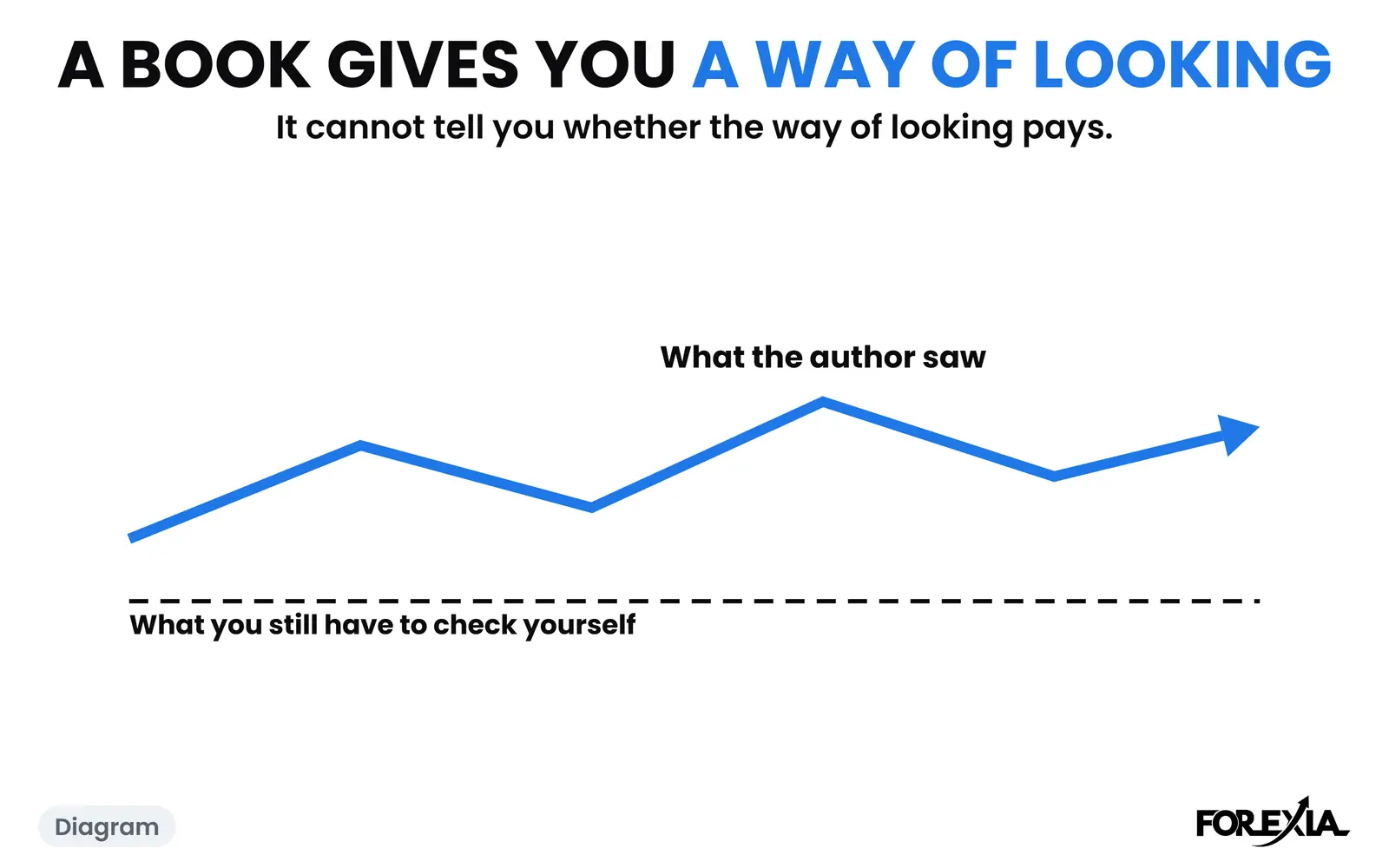
The best forex trading books are the ones that change how you look at a market, and not one of them proves that its method pays. This list gives seven well-known titles, what each is good for, and what each gets wrong or leaves out. We have not given a ranking with stars, because a ranking would suggest a test that nobody has run.
In brief
- What a book is good for: vocabulary, ideas about risk and temper, and ways of reading a chart.
- What it cannot do: show that its method pays on your account, with your broker's spread and your discipline.
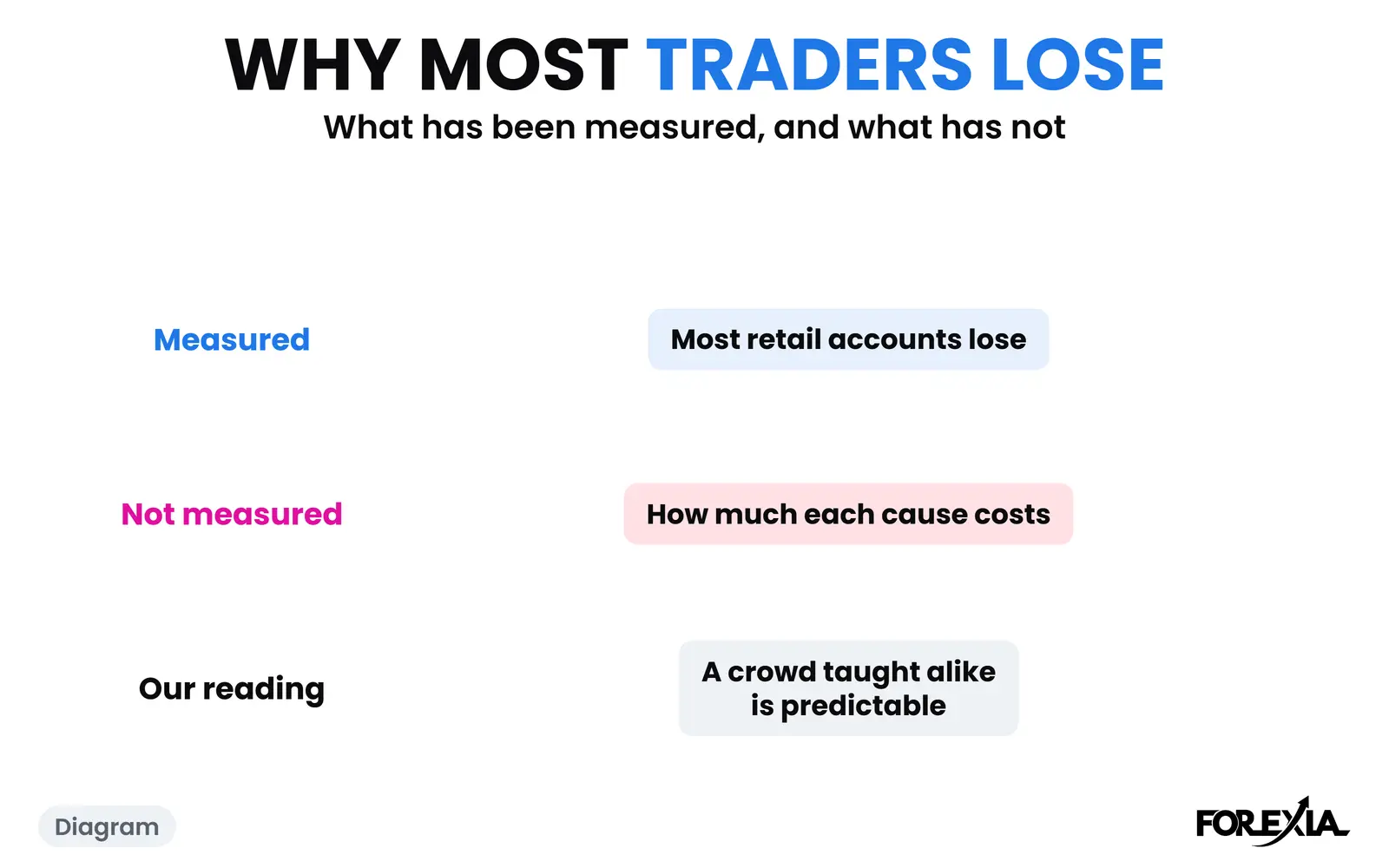
- What most of them get wrong: they were written for stocks or futures, they choose their examples after the fact, or they describe a market that has changed.
- The rule: read a book for its way of looking, then test the idea on dated charts before it meets money.
What are the best forex trading books?
Seven, in a reading order for a beginner. The critique is of the kind of book each one is. Where we say what a book contains, it is described in our words, with no quotation, and you should check the edition you buy.
1. Currency Trading for Dummies, by Kathleen Brooks and Brian Dolan
A plain overview of the currency market: pairs, pips, lots, how brokers work and what moves prices. It is the best fit for a reader who has never placed an order.
What it gets wrong. It trades depth for breadth, so the strategies are summaries and not tested methods. Broker and platform details in a general book date quickly, so check them against your broker's current pages. There are several editions, so read a recent one.
2. Trading in the Zone, by Mark Douglas (2000)
A book about the trader's mind: why people break their own rules, and the case for thinking of a trade as one outcome in a long series. It is widely read for the way it treats fear and the need to be right.
What it gets wrong. It gives you a frame and no method. Thinking in a series of outcomes only helps if your method has an edge, and the book does not show you how to find out whether yours does. A reader can finish it calmer and still without a tested rule.
3. Market Wizards, by Jack Schwager (1989)
Interviews with successful traders about how they work. It shows how different two good traders' approaches can be, which is a useful correction for a beginner who thinks there is one way.
What it gets wrong. It hears only from people who did well, so you do not hear from those who used the same ideas and failed. That is survivorship. The book reports what each trader told the author, and most of the interviewees worked in futures and stocks, not in retail forex.
4. Reminiscences of a Stock Operator, by Edwin Lefèvre (1923)
A fictionalised account, widely read as the life of the speculator Jesse Livermore, of an early twentieth-century stock and commodity trader. It is read for its picture of a trader's temper: impatience, hope and the habit of staying in a trade too long.
What it gets wrong. It is about a market that no longer exists, with no retail forex in it, and its lessons come as stories. A story with a moral is not a rule that can be tested, and a story's trader is not an audited result.
5. Trading for a Living, by Alexander Elder (1993)
A book organised around mind, method and money management. It states fixed rules for risk: a limit on the share of the account lost on one trade, and a limit on the loss in a month.
What it gets wrong. Its examples are mostly stocks and futures, and its indicators are not tested on forex in the book. A fixed percentage also fixes the loss and not the stop, which is the point in the real-day section below. A beginner who reads a risk figure as a rule from a regulator should know it is the author's convention.
6. Technical Analysis of the Financial Markets, by John J. Murphy (1999)
A large reference on charts: trends, support and resistance, patterns, indicators and the links between markets. It is a book to keep on a shelf and look things up in.
What it gets wrong. A reference describes dozens of tools and does not tell you which to drop. Many of the tools lag the price, and a reader can come away with more indicators than a chart can hold. It also dates from before retail forex trading became common.
7. Japanese Candlestick Charting Techniques, by Steve Nison (1991)
The book that brought candlestick charts to many Western traders. It names the patterns and shows what each is said to mean, and most chart platforms draw the same candles it describes.
What it gets wrong. A book of chosen examples cannot say how often a named pattern failed, because a failed pattern makes a poor example. The names also invite a reader to treat a shape as a signal. A candle's shape says what price did in a window, and it does not say what comes next.
How can you test a book's idea on a real day?
Take any idea from any of these books and put it on one dated chart. Here is a day to try it on. The chart is real Dukascopy candles, in New York time.
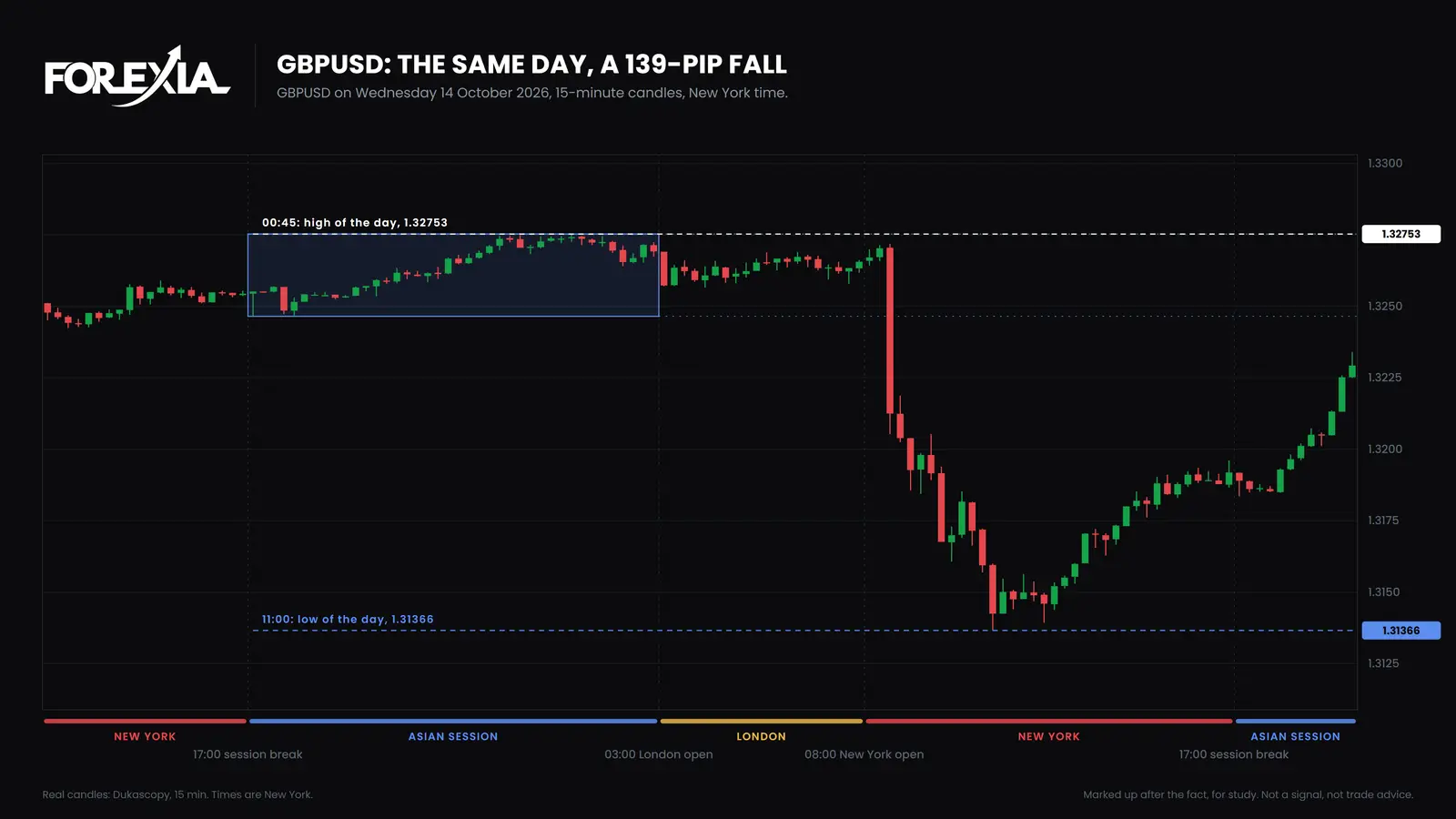
GBPUSD, 15 minutes, 14 October 2026, New York time. High of the day 1.32753, low 1.31366, 139 pips from high to low. Chart data: Dukascopy.
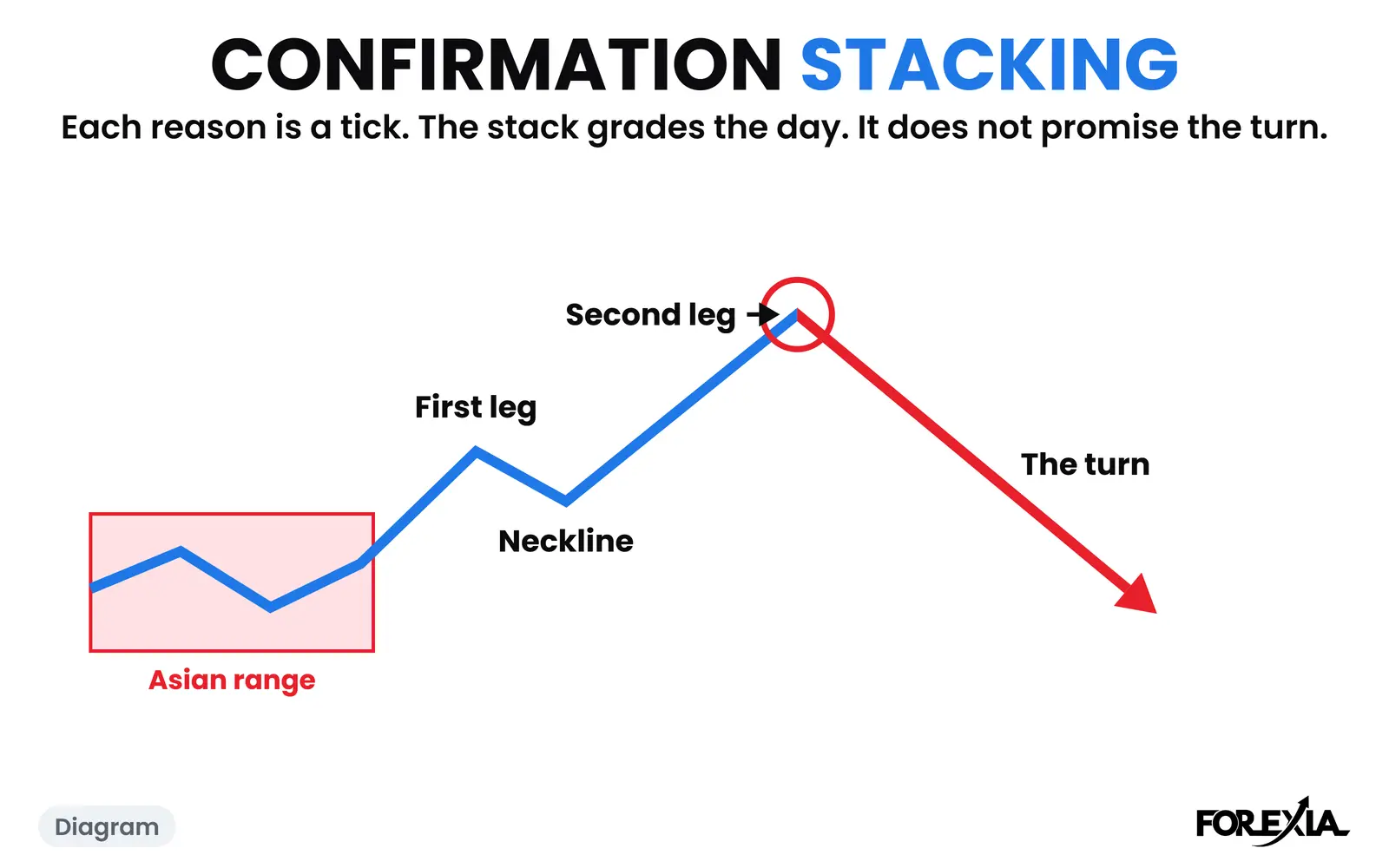
- The Asian range was 29 pips. From the 17:00 break to the London open at 03:00 the range was narrow.
- The high of the day came at 00:45, at 1.32753, in the Asian session.
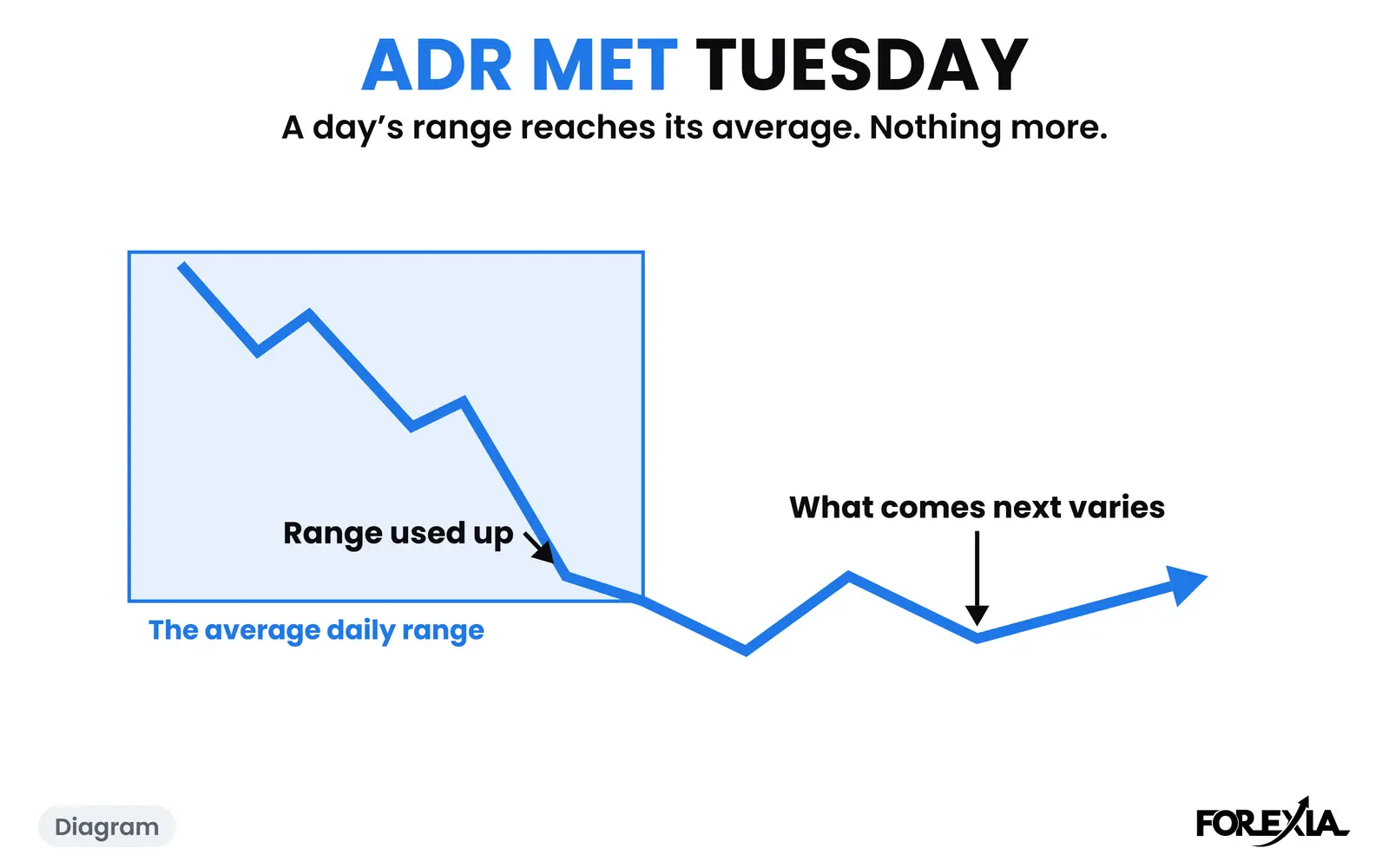
- The low came at 11:00, at 1.31366, 139 pips below the high.
Cover the right-hand side of the chart and ask three questions of the book you are reading. What would it have you do at 03:00? Where would its stop sit, and why there? What would it say about the fall that followed? A book that answers all three on a dated day has given you something to test. A book that answers only in general terms has given you a mood.
Elder's kind of risk rule shows why the second question matters. If a rule caps the loss at 2% of a $5,000 account, the loss is $100 whatever the stop. The stop's distance changes the lot size, not the loss. A rule like that tells you how much to lose, and it does not tell you where to put the stop. The chart does. The how much money guide works those sums on a real day.
What should you read first, and what next?
A reading order that matches the problem you have.
- You do not know the vocabulary yet: the overview first, and then the step-by-step start guide.
- You break your own rules: Trading in the Zone, then a journal. The forex trading journal page shows what to write.
- You want to see how others work: Market Wizards, and keep the survivorship problem in mind.
- You want to read charts: Murphy to look things up, Nison for the candles, and then your own dated days.
Our own pages follow the same limit we put on the books. A test of our setup run as a mechanical rule did not make money, so we teach the reading of a chart and do not promise a result. The method is taught on real dated days in five free courses, starting with Reading the Map (see the courses).
Frequently asked questions
Three short answers, in the words people type into a search box.
What is the best book for a forex beginner?
There is no single best one. A beginner who wants the market's vocabulary is served by a plain overview such as Currency Trading for Dummies. A beginner who keeps breaking their own rules is better served by Trading in the Zone. Whichever you choose, treat it as a way of looking at a market, not as a test that the method pays.
Can a book teach you to trade forex profitably?
A book can teach you terms, ideas about risk and a way of reading a chart. It cannot show that the method works for you, because nothing in it is tested on your account, your broker's spread or your discipline. Check any idea on dated charts, then on a demo, before it meets real money.
Are older trading books still worth reading?
The older ones are worth reading for how traders behave, since that has changed little. They are not worth reading for how a market is built. Reminiscences of a Stock Operator is a 1923 book about stocks and commodities, with no retail forex market in it.
Sources
The books are described in our words. Each is listed with the year of its first edition.
- Mark Douglas, Trading in the Zone (2000), for the trader's-mind material described above.
- Jack Schwager, Market Wizards (1989), for the interview format described above.
- Edwin Lefèvre, Reminiscences of a Stock Operator (1923), and Alexander Elder, Trading for a Living (1993).
- John J. Murphy, Technical Analysis of the Financial Markets (1999), and Steve Nison, Japanese Candlestick Charting Techniques (1991).
- Kathleen Brooks and Brian Dolan, Currency Trading for Dummies, for the overview described above.
- Dukascopy 15-minute candles for GBP/USD, 14 October 2026: the day's high, low and Asian range as drawn on the chart.
Learn to read the chart this way. The free courses teach the method on real days and promise no result. Browse the courses.
This post is for study. It is not a signal and not trade advice. Trading forex and CFDs carries a high risk of loss, and you can lose all the money you deposit. Chart data: Dukascopy, 15-minute candles, New York time.
Frequently asked questions
What is the best book for a forex beginner?
There is no single best one. A beginner who wants the market's vocabulary is served by a plain overview such as Currency Trading for Dummies. A beginner who keeps breaking their own rules is better served by Trading in the Zone. Whichever you choose, treat it as a way of looking at a market, not as a test that the method pays.
Can a book teach you to trade forex profitably?
A book can teach you terms, ideas about risk and a way of reading a chart. It cannot show that the method works for you, because nothing in it is tested on your account, your broker's spread or your discipline. Check any idea on dated charts, then on a demo, before it meets real money.
Are older trading books still worth reading?
The older ones are worth reading for how traders behave, since that has changed little. They are not worth reading for how a market is built. Reminiscences of a Stock Operator is a 1923 book about stocks and commodities, with no retail forex market in it.