Confluence Trading Forex: Why One Reason Is a Guess, and What a Stack Is
Dylan Forexia6 min read
Confluence trading forex is the habit of wanting more than one reason on the same chart before you trust a setup. One reason is a guess: a line, a candle, an average crossing. Several that do not lean on each other start to look like a setup. This page says what counts as a reason, what counts twice, and shows one real day that kept ticking boxes.
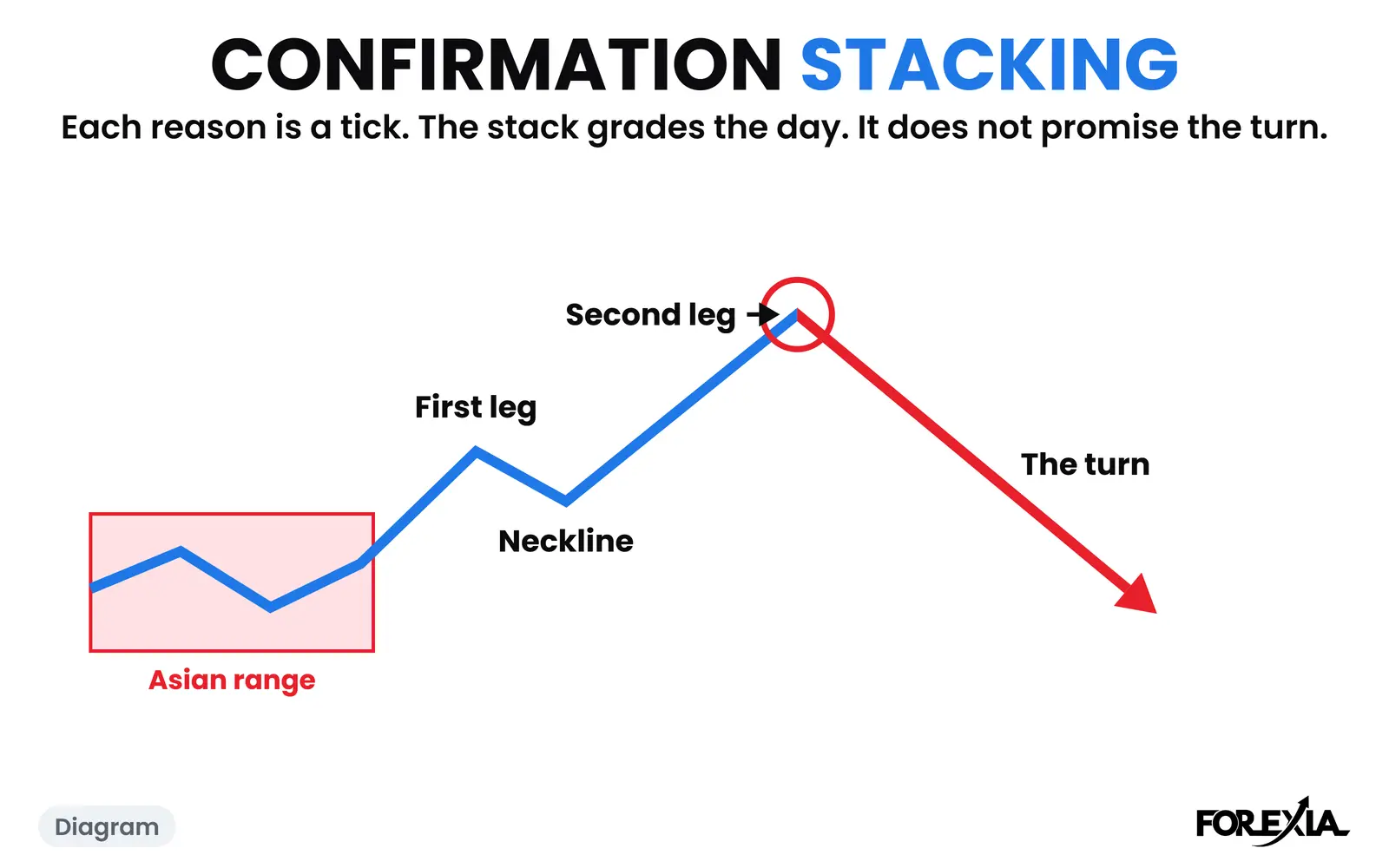
Our word for the stack is Confirmation Stacking, and it belongs to the #SignatureTrade. We use it to grade a day. We do not use it to promise what comes next, and this page gives no number of reasons that is enough.
What is confluence trading in forex?
Most guides mean this: several signals line up at one price. A support level, a trendline, a Fibonacci retracement and a candle shape all sit at the same place, and the trader reads the pile as a stronger reason than any one. The idea is sound, and the guides add one useful rule: the reasons should be independent. An RSI, a stochastic and a MACD all agreeing is one momentum reading said three ways.
We apply the same rule to our own list. The stack on our charts is made of parts of the day, not indicators: a clear Asian range, an M or a W, a hunt at the London open, a second leg, a wedge, the induction trend, the daily range met, and the high or low of the week. A day that has several of them in order has more going on than one that has one.
Why is one reason a guess?
Because one reason is the thing everyone else can see. A level, a pattern or a candle is on every chart, so it explains why a crowd is there, and it does not explain why the crowd is right. That is the retail seat's view: it adds reasons until it feels sure.
The market maker's seat looks somewhere else. It asks where the stops are and who has been led in. A stack, read from that seat, is a list of what the crowd was shown. That is our reading of it, and it is not something a chart can prove. It does explain why the list is made of events in the day and not of indicators.
What does a stack look like on a real day?
It looks like a day that kept ticking boxes. On Friday 17 April 2026 EUR/USD spent Asia in a 15-pip range, 1.17720 to 1.17871. London took the high by 12 pips, to 1.17991, and pulled back to a neckline at 1.17908. At 09:00 New York a second leg ran to 1.18491, 25 pips through Thursday's high at 1.18238. From there price fell 89 pips to 1.17601 by 16:45.
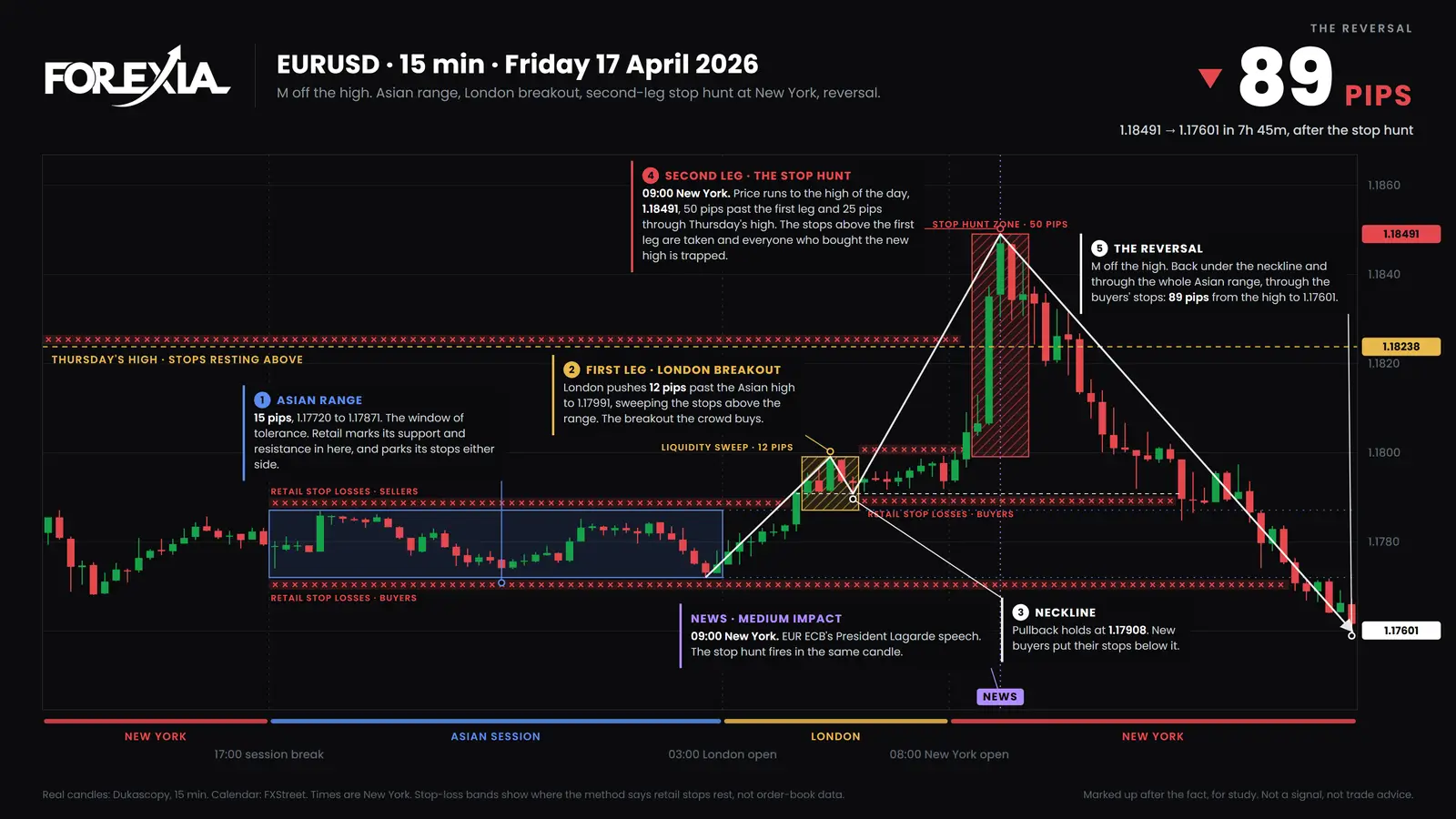
Our markup tool scores each marked day out of eight, and it scored this one 6 of 8. Its list is close to the course's but not the same. It held a clear Asian range, a second leg, a hunt at a session open, Thursday's high taken, the week's high, and a push into it from the week's open. It missed on two. The calendar's only release in that candle was the Lagarde speech, a medium-impact one, and the tool counts high-impact news only. It was also a Friday, not a Tuesday or Wednesday.
Which reasons can be counted twice?
Three kinds of double count turn a short list into a long one.
- Two ticks for one event. An M or a W has a second leg by its own definition. A stack that scores both has scored one thing twice.
- The same reading from two tools. Two momentum indicators agreeing are one view of the same closes.
- A reason you only know afterwards. The high or low of the week is known when the week is over. A score that includes it can only grade a day in hindsight, and our markup tool says so beside its own score.
That last point is why we say a stack grades and do not say it predicts. A count of reasons made before the trade has to leave out whatever you cannot know yet.
Does a thin stack mean the day will not turn?
No. Two days earlier, on Wednesday 15 April 2026, USD/CAD scored 1 of 8 on the same list. Its Asian range was 24 pips and drifted up. At 07:30 New York price pushed 6 pips past the high, to 1.37879, and then fell 62 pips to 1.37263 by 14:15. The 1 of 8 day fell 62 pips and the 6 of 8 day fell 89, and nothing on either chart told you that in advance. How many confirmations a setup needs has that day and the counts, and a good setup against a weak one puts the two ends of the scale side by side.
Does a higher score sort the days?
We have the counts to ask. From 6 April to 1 October 2026 the markup tool marked 332 daily setups, and each of those days had already reversed, because the tool marks only days that turned. Each was filed as Textbook or Partial once the day was over, by how far the reversal ran against the pair's average day.
| Score on the tool's list | Days | Filed Textbook |
|---|---|---|
| One or two | 118 | 76 |
| Three or four | 147 | 90 |
| Five or more | 64 | 42 |
The share is close to the same in each band: 76 of 118, 90 of 147 and 42 of 64. Three more days scored none and are left out. The table counts days that had already turned, so it cannot say whether a high score makes a turn more likely, and it is not a count of trades. It does say that the score did not sort the days we marked, which is why we call it a description.
How is a stack different from a checklist?
A checklist is run before a trade and answers whether to take it. A stack, as we use it, is read on a day and answers how cleanly the day played the setup. The two sound alike and are used at different times. The first needs every item to be knowable when you act. The second can include things like the week's high, which you know only afterwards. Textbook or Partial is the filing that goes with it, and the course teaches both.
What do traders get wrong about confluence?
Four readings cost the most.
- Counting the same reason twice. Two ticks that describe one event add nothing.
- Reading a high count as a promise. The stack grades the day. It does not forecast the next candle.
- Reading a low count as a veto. The 1 of 8 day above fell 62 pips.
- Adding reasons until you feel sure. That is what the retail seat does, and the feeling of certainty is not a measurement.
What does our own test say?
We ran the setup as a mechanical rule, with fixed conditions, and it did not make money. More confirmations did not turn it round, and why trading setups fail says what we found when we tried. A stack of reasons is a way to describe a day we have already seen.
Course 5 of ForexiaPRO, The #SignatureTrade, teaches how to read a stack step by step, in lesson 5.2.1. It is on ForexiaPRO.
Frequently asked questions
What is confluence trading in forex?
It is looking for more than one reason on the same chart before you trust a setup. Most guides say the reasons should be independent, so that an RSI, a stochastic and a MACD agreeing is one momentum reading, not three. We call the Forexia version Confirmation Stacking and use it to grade a day, not to promise its result.
Does more confluence mean a better trade?
Not on our counts. Of the days our markup tool scored from 6 April to 1 October 2026, the share filed as Textbook was close to the same at one or two confirmations, three or four, and five or more. Those are days that had already reversed, so the counts cannot say whether a high score makes a turn more likely.
Can the same reason be counted twice?
Yes, and it is the commonest mistake. An M or a W has a second leg by its own definition, so counting both adds nothing. The high or low of the week is only known when the week is over, so a score that includes it grades a day in hindsight.