How Many Confirmations for a Forex Trade Setup? We Counted 332 Marked Days
Dylan Forexia6 min read
How many confirmations for a forex trade setup is a question with a number in most answers: three, four, sometimes five. We have the data to test that, and our answer is that the number is not there. We scored 332 marked days out of eight. Days with one or two confirmations were filed Textbook about as often as days with five or more. A score described the day. It did not sort them.
This page counts what we have. The idea behind the stack is in confluence trading in forex, and Confirmation Stacking is the glossary word.
How many confirmations for a forex trade setup are enough?
Guides that give a number say three to five and add that the confirmations must be independent. We agree about independence and do not give a number. The reason is the count below, and the limit on it: it is days, not trades, and each of them had already reversed.
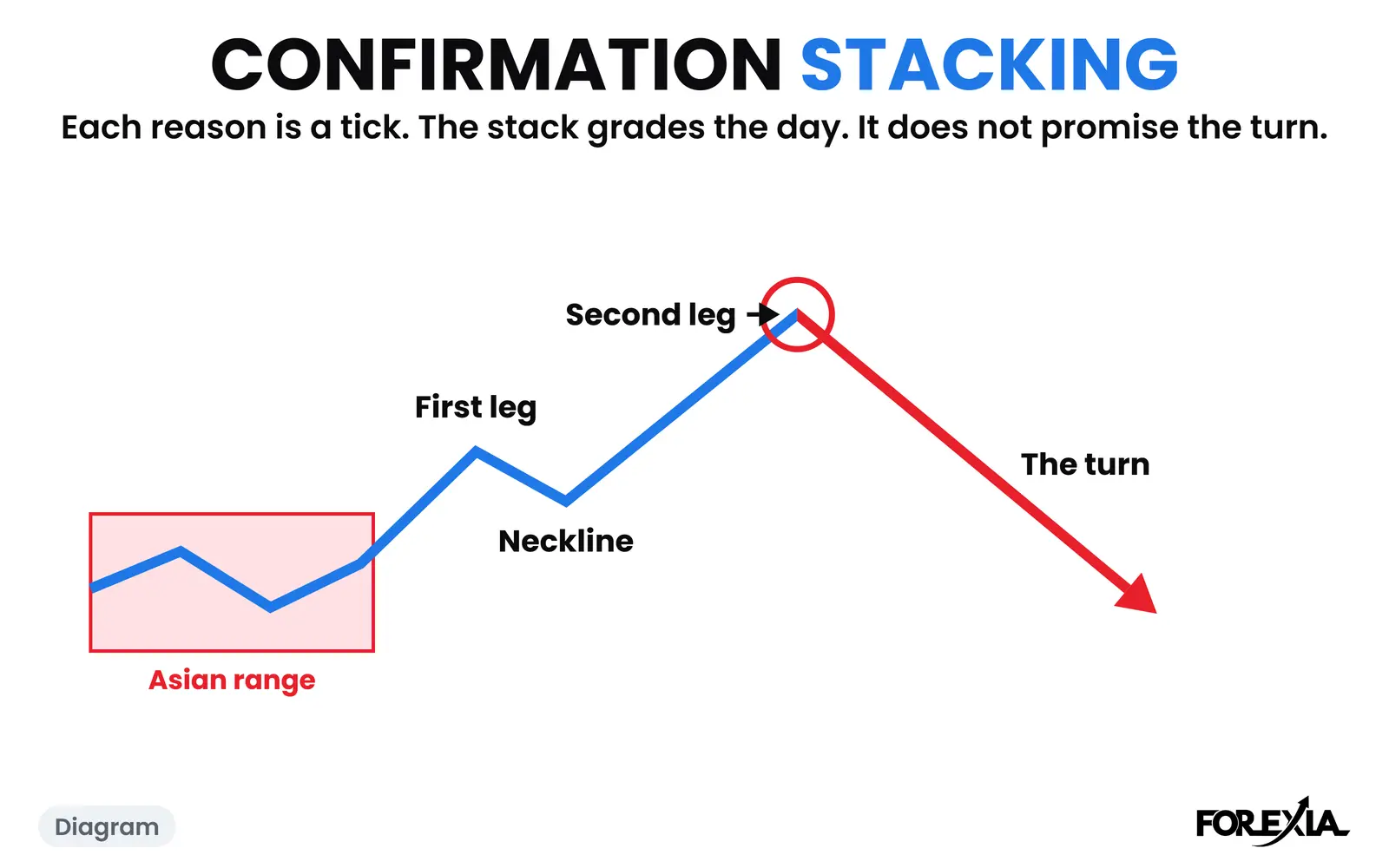
A confirmation here is a part of the day. The markup tool's list has eight. A clear Asian range, a second-leg stop hunt (an M or a W), a hunt that lands at a session open, the previous day's high or low taken, high-impact news in sync, the day being a Tuesday or Wednesday, the high or low of the week, and price having been induced into it from the week's open. It is close to the course's list but not the same. Some lean on each other, as an M and a second leg do, and one is known only afterwards.
What did 332 scored days look like?
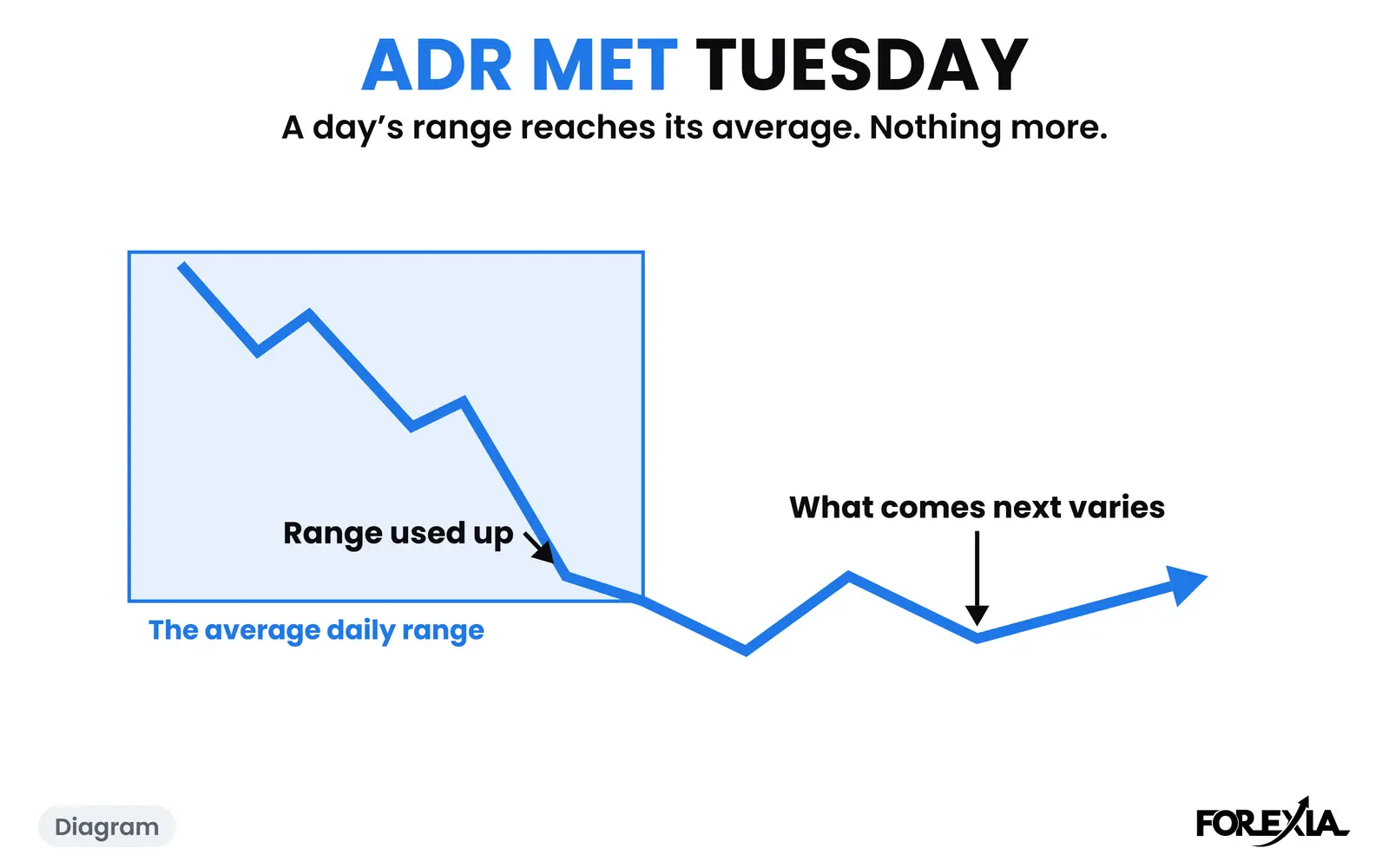
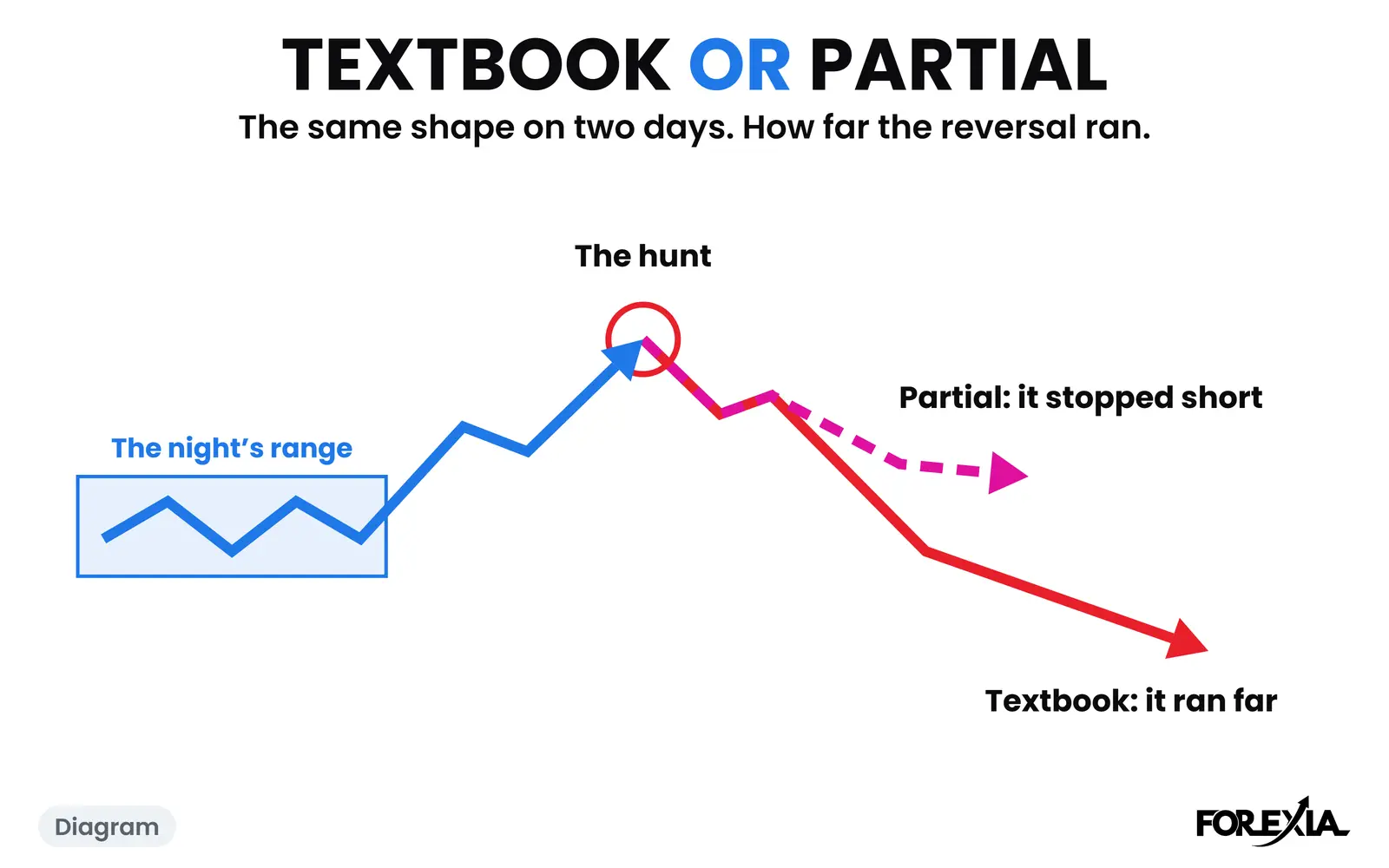
From 6 April to 1 October 2026 the markup tool marked 332 daily setups. It marks only days that turned. Each was scored out of eight and filed as Textbook or Partial once it was over, by how far the reversal ran against the pair's average daily range.
| Score out of eight | Days | Filed Textbook | Filed Partial |
|---|---|---|---|
| 0 | 3 | 1 | 2 |
| 1 | 41 | 28 | 13 |
| 2 | 77 | 48 | 29 |
| 3 | 75 | 36 | 39 |
| 4 | 72 | 54 | 18 |
| 5 | 43 | 25 | 18 |
| 6 | 14 | 12 | 2 |
| 7 | 6 | 4 | 2 |
| 8 | 1 | 1 | 0 |
Group the days and it is flatter. One or two confirmations: 118 days, 76 Textbook. Three or four: 147 days, 90 Textbook. Five or more: 64 days, 42 Textbook. The share does not climb with the score. Three confirmations split almost evenly, 36 Textbook against 39 Partial, and four split 54 against 18. No theory of ours predicts that jump, and we do not build on it.
The days with six or more are few: 21 in all. A pattern in 21 days is not a pattern. This counts markups, so it says nothing about the days we did not mark, and it is not a count of trades.
What does a low score look like on a real day?
On Wednesday 15 April 2026 USD/CAD scored 1 of 8. Its Asian range was 24 pips, 1.37580 to 1.37816, and it drifted up and closed near its own top, so it was not tight. There was no second leg. At 07:30 New York price pushed 6 pips past the high, to 1.37879, and then fell 62 pips to 1.37263 by 14:15, through the whole range.
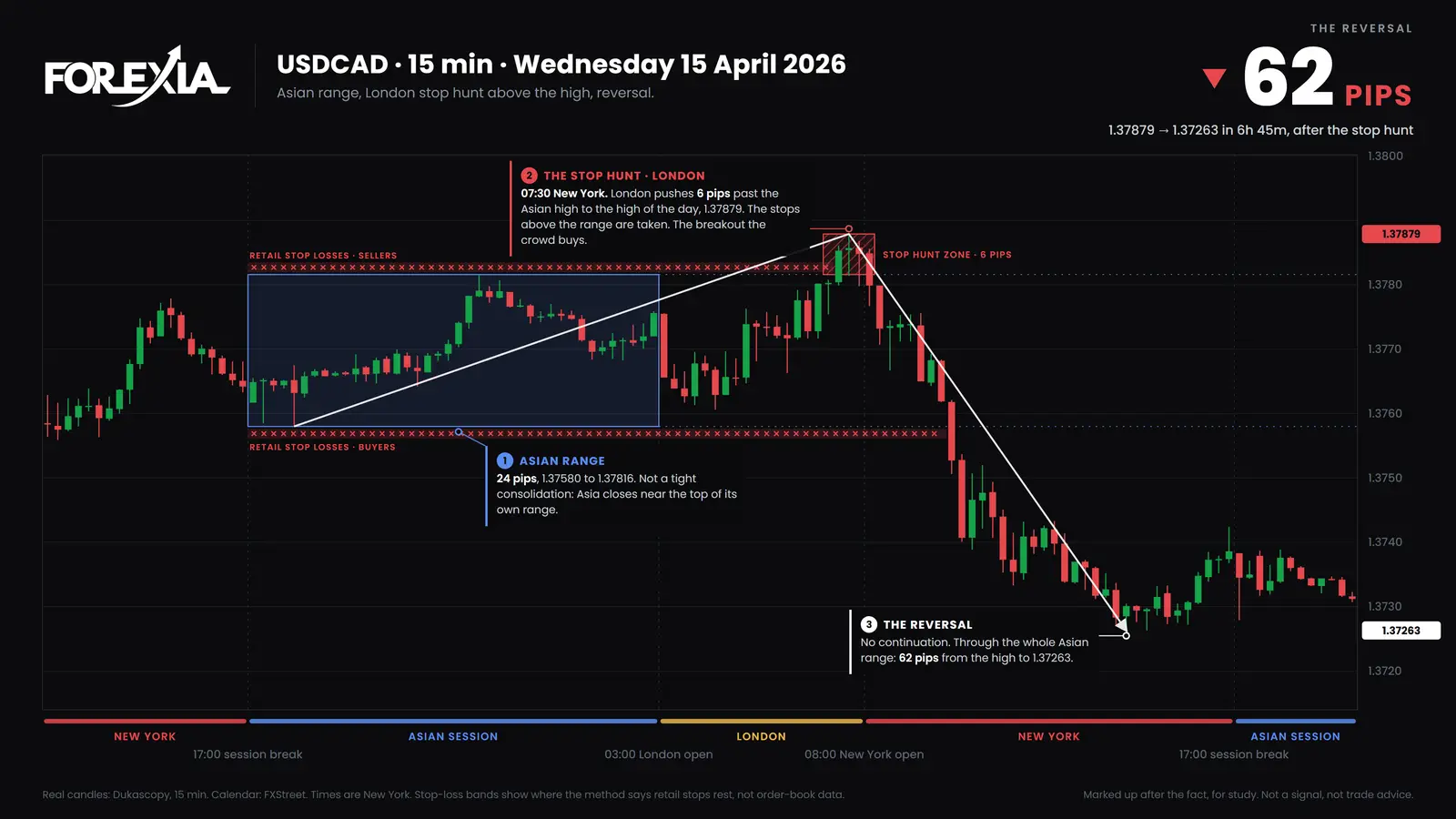
No CAD release was in the calendar that day. Medium-impact US releases came at 08:30, an hour after the high: the Empire State Manufacturing Index and a Fed speech. The day was graded Textbook, because the fall cleared the whole Asian range. On Friday 17 April, EUR/USD scored 6 of 8 and fell 89 pips. Nothing on either chart told you that in advance.
What happened when we made it a rule?
We ran the setup as a fixed rule with real costs, and then asked what more confirmations did. It is in the backtest. In the backtest, setups with six of the method's confirmations lost 0.04R a trade, against 0.18R for those with two. R is the amount risked on one trade. Both lost.
The reason is in how the stack builds. More confirmations arrive later in the move, so a setup with many of them has less left to run, and a wrong one costs more. We also risked more on the best setups, and over 2015 to 2020 the loss rose from 1,069R at level risk to 1,331R. A bigger score did not become a bigger edge. It did not stop us describing the days with it.
What is a score good for, then?
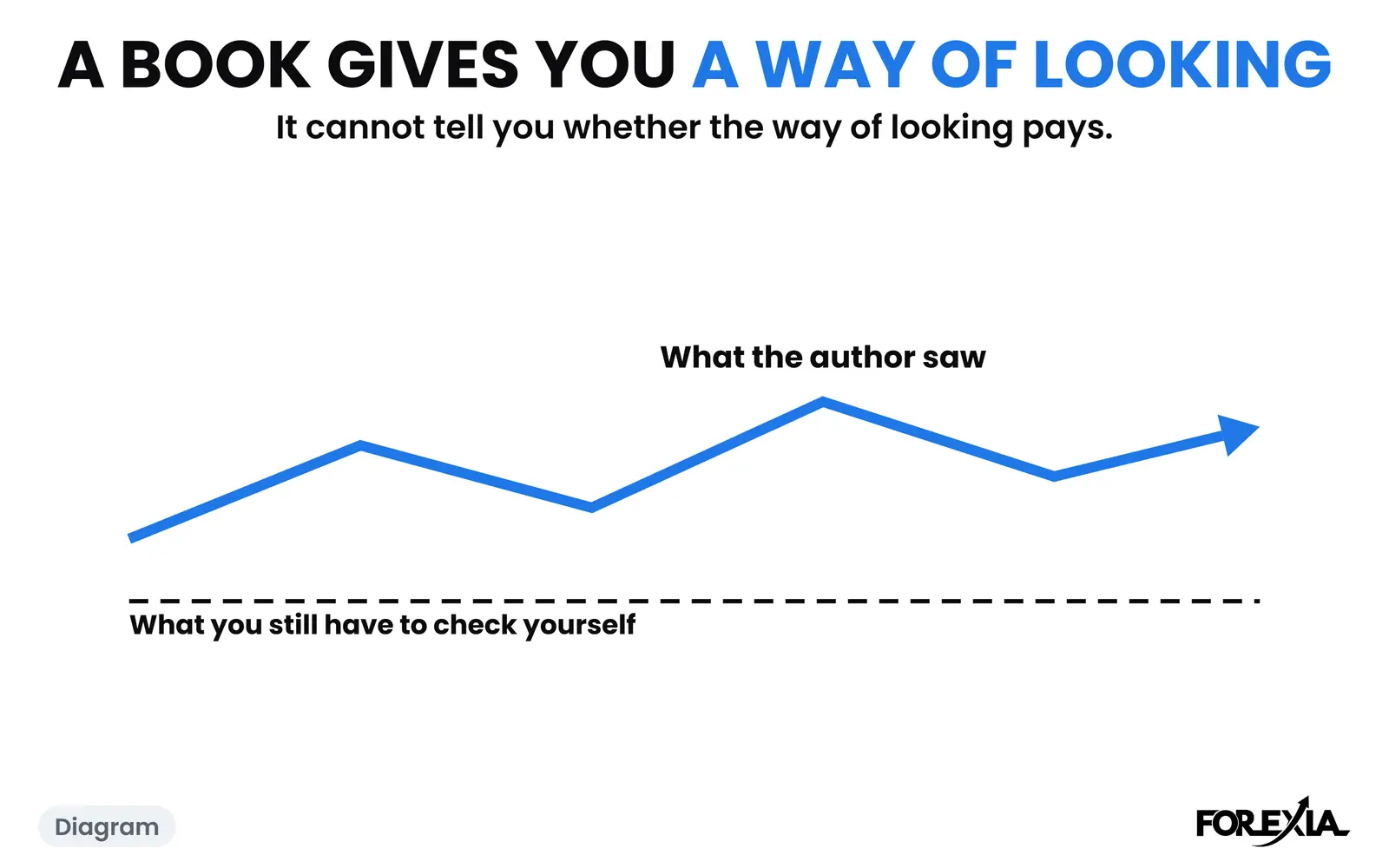
For a log, and for nothing faster. If you write down the confirmations you saw before each day, and what the day did, you build your own table like the one above, from your own markets and your own eyes. After a few months it tells you whether your count sorts anything. Ours did not, on days that had already turned, and yours may behave differently.
The useful habit is to count after the fact as well as before. A stack that looked strong at 07:00 and reads as thin at 17:00, because the week's high was not what you assumed, teaches more than a number. Keep every setup you take or skip, with why, and test whether the taken ones beat the skipped ones. That is the only record that can show whether your reading is worth anything.
Why do guides give a number anyway?
A number is easy to follow, and a score feels like a measurement. Three reasons it is weaker than it looks.
- The same reason is counted twice. An M has a second leg by definition, so scoring both is one fact.
- A confirmation known only afterwards. The week's high is not known on Tuesday. Any score that counts it grades a day in hindsight.
- A score is a count of ticks, not weights. Eight boxes of different weight are added as if they were equal.
Who is on each side of a score?
The retail seat adds confirmations until it feels sure, and sizes up when the number is high. The market maker's seat does not count them. It looks at where the stops are and who has been led in, and a crowd with eight reasons has its stops in the same few places as a crowd with one. The observer's seat, ours, counts afterwards to describe the day. That is our reading of the seats, and it is not something the table proves.
What do traders get wrong about scoring a setup?
Three readings cost the most.
- Treating a threshold as a rule. Any cutoff on our data would have been fitted to days that reversed.
- Reading a high score as a promise. The six of eight and the one of eight above fell 89 and 62 pips.
- Using the score to size a trade. In our test that made the loss bigger, not smaller.
The score is a way to describe the day you have just seen. Our own test of the setup as a mechanical rule did not make money, and a reversal seen afterwards is not a setup. Good vs weak trading setup puts a high and a low score side by side.
Course 5 of ForexiaPRO, The #SignatureTrade, teaches how to score a day, in lesson 5.2.2. It is on ForexiaPRO.
Frequently asked questions
How many confirmations does a forex setup need?
We do not give a number, because the days we counted do not support one. Of 332 marked days scored out of eight from 6 April to 1 October 2026, the share filed Textbook was 76 of 118 at one or two confirmations, 90 of 147 at three or four, and 42 of 64 at five or more. Those days had already reversed, so the count describes days and does not predict a trade.
Is a setup with seven confirmations better than one with three?
On our counts a score did not sort the days. Seven of eight appeared on 6 days, four filed Textbook and two Partial. In our mechanical test, setups with six of the method's confirmations lost 0.04R a trade and those with two lost 0.18R: both lost, because the extra confirmations arrive later in the move.
What counts as a confirmation?
Each is a part of the day, such as a clear Asian range, a second leg, a hunt at a session open, the previous day's high or low taken, or the high or low of the week. They should not lean on each other, and one of them, the week's high or low, is only known when the week is over.