Liquidity Sweep Meaning: the Trading Sense, Not the Bank Sense
Dylan Forexia6 min read
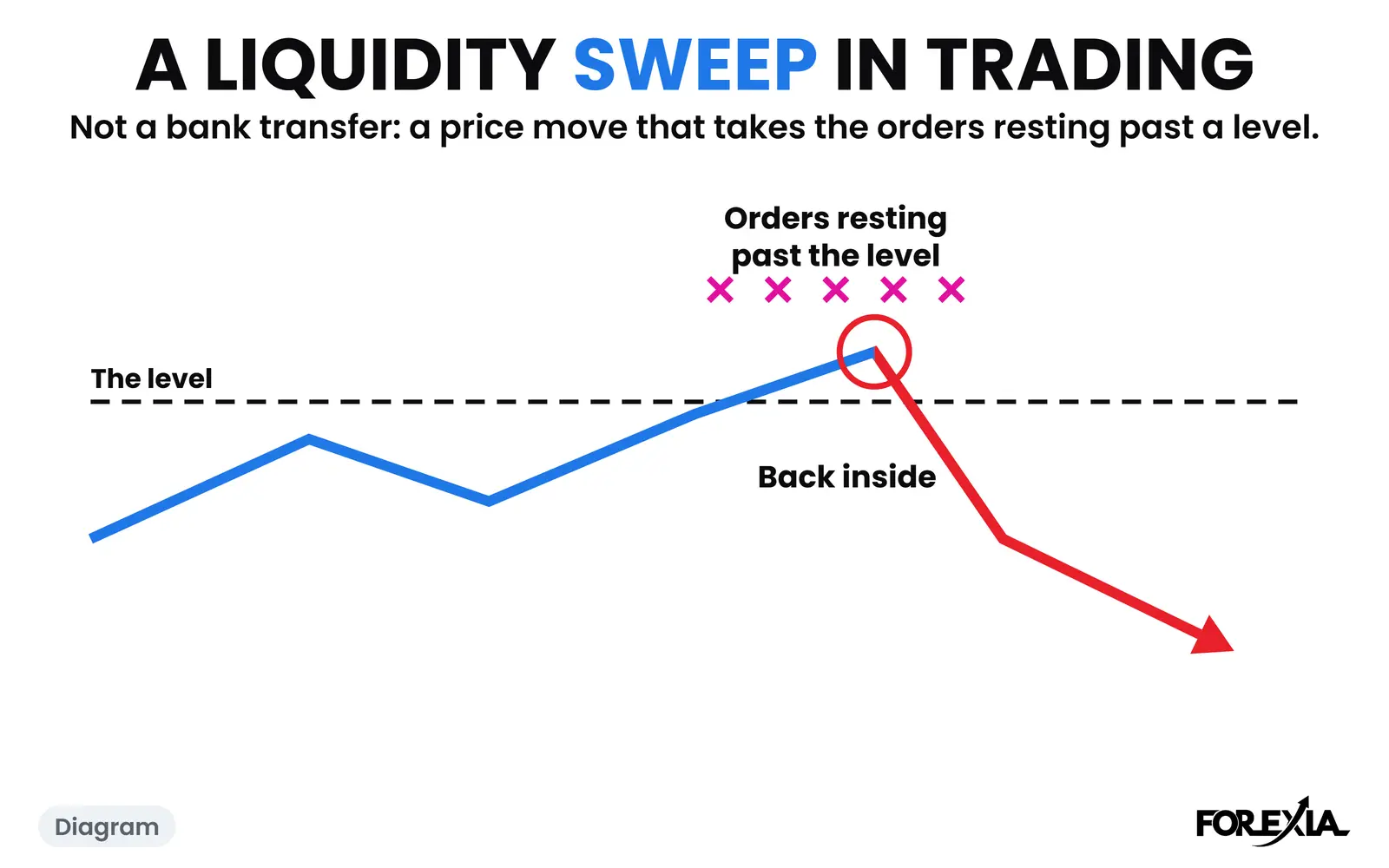
The word liquidity sweep means three different things, depending on who is talking. In banking it is an automatic transfer of spare cash between accounts. In stock execution it is an order routed to many venues at once. In trading it is the one this page is about: price going past a visible high or low, taking the orders resting there and closing back inside.
If you searched "liquidity sweep meaning in banking" and landed here, you are in the right place to sort that out. Search results mix the meanings, and each side's pages never mention the other. Here are all three, then the trading one on a real day.
What does liquidity sweep mean in banking?
In banking and corporate treasury, a sweep moves surplus money between accounts by a rule, usually at the close of each day. The rule might push spare cash into a short-term investment, or pull money in from one account to cover a shortfall in another. People call it a cash sweep, a sweep account or a liquidity sweep, and the "liquidity" is cash on hand.
Nothing in that is a price. There is no chart, no level and no one's stop-loss. A search for the banking sense of the word will not teach you anything about a candle, and the reverse holds too. We do not link a rule for the banking meaning, because we did not find one that defines it in those words, so treat it as common treasury practice and ask your own bank about its product.
What does sweep mean in stock execution?
In US stocks a sweep is a kind of order. The SEC's Regulation NMS defines an "intermarket sweep order" as a limit order that a broker marks as such when it routes it to a trading center, with further orders sent at the same moment to take the full displayed size of better-priced quotes elsewhere. The point is speed: the order reaches every venue at once and takes what is on offer.
This is the third use of the word. It is about how an order is sent, and it describes a decision the sender makes. A candle going through a stop-loss level is not an order type, and no one chooses to send one.
What does a liquidity sweep mean in trading?
In trading, a liquidity sweep is a move through an obvious high or low that takes the orders resting past it and then closes back. "Liquidity" here means those orders. A stop-loss under a low is an order to sell once price gets there, and a stop above a high is an order to buy. Someone who needs to trade in size finds those orders convenient, because they are already waiting.
You will also see liquidity grab, and in our own pages we use The Stop Hunt for the same candle. The difference between the words is a claim, not a picture, and stop hunt vs liquidity sweep goes through it. Some writers also split a sweep, a grab and a run by what happens next, and sweep, grab or run covers that.
| Banking sweep | Stock execution sweep | Trading liquidity sweep | |
|---|---|---|---|
| What it is | An automatic transfer of cash between accounts | A limit order sent to many venues at once | Price going past a level and taking the orders there |
| What moves | Money | An order | A price |
| Who does it | The bank or treasury, by a rule | The broker, by choice | Nobody can be shown from a chart |
| Where you see it | A statement | An order ticket | A chart |
What a liquidity sweep looks like on a real day: EUR/USD, 20 July 2026
On Monday 20 July 2026, EUR/USD spent the Asian session in a 22-pip range between 1.14234 and 1.14450. The London morning then pushed 4 pips past the Asian high, to 1.14495 at 03:30 New York, which is the breakout a crowd buys. That candle closed at 1.14478, 3 pips over the line, so for the moment it looked like a break.
It was not one. The 03:45 candle closed at 1.14439, back under the Asian high. Price then fell 47 pips from the extreme to 1.14023 by 10:45, through the whole Asian range. Times are New York and the candles are 15-minute Dukascopy, so your broker's chart may differ by a pip or so.
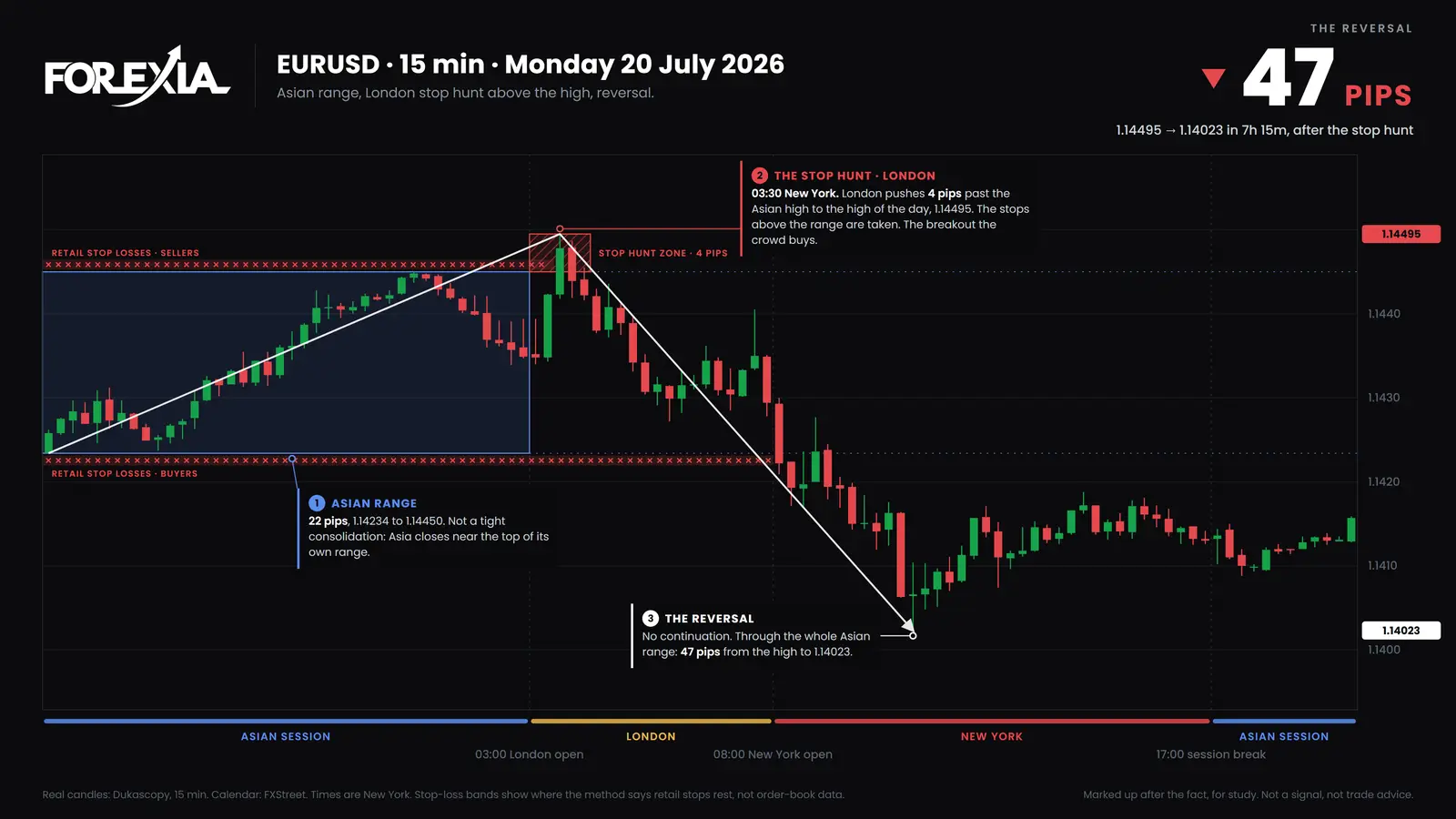
That is a liquidity sweep: a level, a trip past it and a close back. We read it as a stop hunt. Sellers had stops over the range, breakout buyers piled in on top of them, and the turn came once those orders were spent. That is a read, and the chart cannot confirm it. The close back at 03:45 is the part you can check yourself on any feed.
What can a chart show about a liquidity sweep, and what can it not?
A chart shows the trip and the close back. It does not show the orders, who sent them or why price went there.
The red bands on our charts mark where the method says stops rest. They are a reading of the structure, not order-book data, and nobody outside a broker can see those orders. A large order with nothing to do with the level would print the same candle. Our calendar shows no medium or high-impact release for either currency near the sweep. We picked the day because it reversed. A reversal seen afterwards is not a setup, and our own test of the idea as a mechanical rule did not make money.
How do you tell which meaning a page is using?
Look at the nouns around the word. If the page talks about accounts, balances, reserves or yield, it means the banking sweep. If it talks about venues, quotes, routing or an order ticket, it means the execution sweep. If it talks about highs, lows, stops, candles or a close back, it means the one we cover here.
The trading pages carry a second warning. Many of them borrow the vocabulary of one particular trading school and present it as settled fact. A liquidity sweep is a description of a candle. Who caused it and why is a read, and we write "we read this as" every time we use it. The competing words for the same move are listed on the stop hunt hub, with real days beside each. Whichever word you choose, the chart shows the same two things, and only those.
Where does the trading meaning come from?
It comes from a simple fact about stops. Traders are taught to put them just past obvious highs and lows, so many sit in the same few places. Marking those places on a chart is what we call Liquidity Mapping. Which highs and lows count is its own question, answered in what counts as an obvious high or low, and the most popular level is covered in the previous day's high and low.
The test that separates a sweep from a real break is whether a candle closes back inside the level. That works whichever word you prefer. For the wider picture, start with the liquidity sweep hub.
Course 3 of ForexiaPRO, Reverse Price Action, teaches this read step by step from lesson 3.2.1, The Stop Hunt.
Frequently asked questions
What does liquidity sweep mean in banking?
In banking and treasury work a sweep is an automatic transfer of surplus cash between accounts, usually at the end of each day, so that idle money earns something or covers a shortfall elsewhere. No price is involved and no trader is. It is a different thing from a liquidity sweep on a trading chart, which shares only the word.
Is a cash sweep the same as a liquidity sweep in trading?
No. A cash sweep moves balances between accounts by a rule. A liquidity sweep in trading is price moving through a visible high or low and taking the orders resting past it. The first is bookkeeping and the second is a price move.
What is the definition of a liquidity sweep in forex?
A liquidity sweep is price trading past an obvious high or low, taking the orders resting there, usually stop-loss orders, and then closing back inside the level. The part a chart shows is the trip past the level and the close back. The orders themselves are not visible on a chart.
Is a liquidity sweep the same as a stop hunt?
They describe the same candle. Liquidity sweep names what the move took, and stop hunt says it went there for those orders. Forexia uses stop hunt as its own word, always as a read of the chart and never as a claim about who moved price.
What is a sweep order in stock trading?
In US stocks, an intermarket sweep order is a limit order that a broker routes to several venues at once so that it can take all the better-priced quotes at the same time. It is an order type, with a definition in SEC rules, and it has nothing to do with a candle going through a stop.