Is Forex a Scam? Separating the Market From the Sellers Around It
Dylan Forexia7 min read
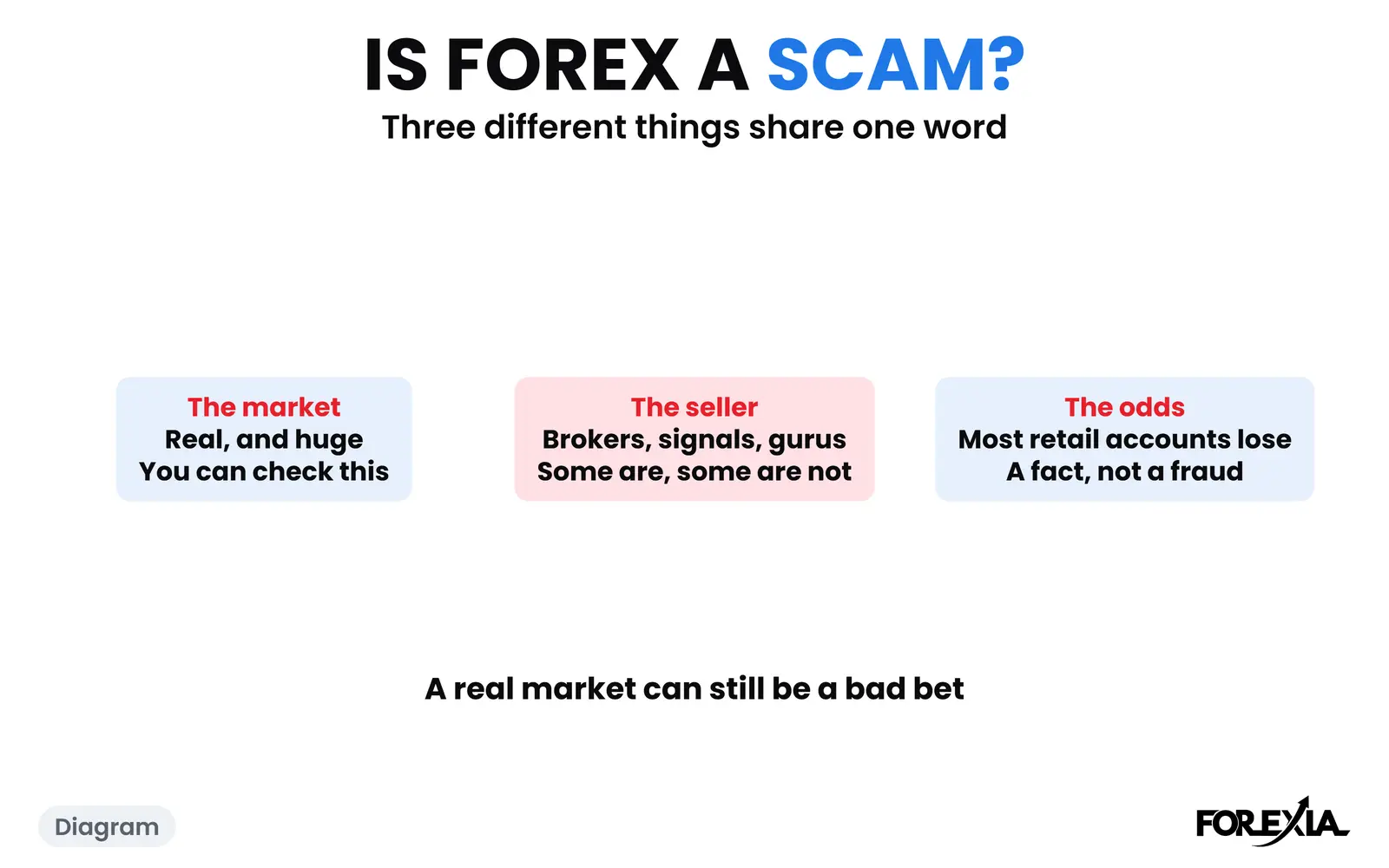
Is forex a scam? The market is not: the Bank for International Settlements measured average daily turnover at $9.6 trillion in April 2025. A lot of what is sold around it is not worth the money, some of it is fraud, and most retail accounts lose. Those are three different problems, and "scam" gets used for all of them.
We sell a course, so you should weigh what we say here accordingly. That is also why we say plainly that our own test of our setup, run as a fixed mechanical rule, did not make money. Nothing below is a signal or a promise.
Is the forex market real?
Yes. Currencies change hands every weekday between banks, funds, companies and individuals, and the BIS survey is the standard count of it. Its April 2025 survey put average daily over-the-counter FX turnover at $9.6 trillion, up 28% from $7.5 trillion in 2022. A company paying a supplier in another currency is part of that number, and so is a tourist's card payment.
What is real about the market is not the same as what is real about your account. Retail traders mostly do not trade on the market itself. They trade through a broker, and that is where the next question starts. A candle on a chart is a price that many people can see, so a price you saw can be checked against another feed. Our charts are Dukascopy's 15-minute candles, and the course case files use OANDA's through TradingView. The two differ by about a pip on the same day, which is what a real market looks like from two windows.
Is forex a scam, or is it the broker?
It can be, and it can also be a real firm that is not on your side. The CFTC's customer advisory, "Eight Things You Should Know Before Trading Forex", is the plainest statement we have read from a regulator. Its first point is that off-exchange, "you are trading against the dealer", whose earnings come from your trading volume, your losses and its fees. Its third is that the dealer controls the trading platform and so the prices you see, which you can compare with a third-party source. Neither is an accusation. Both are how the product works.
The same advisory says that registration, with its background checks and financial requirements, does not guarantee you against fraud, but that most frauds are run by unregistered dealers and individuals. In the US you can look a firm up on the National Futures Association's BASIC register, and in other countries the licensing regulator has its own. A badge on a website proves nothing. A regulator's register is where a real firm can be found and a fake one cannot.
The advisory also names the sellers around the broker: salespeople, influencers and affiliates may be paid for each customer and may not say so, and many frauds begin on social media with a contact that pushes you off-platform, promises promised returns or takes only digital assets. If you want the longer version of whether the broker's prices are fair, is forex rigged covers what regulators have found and a check you can run on your own fills.
Are signals, gurus and courses a scam?
Some are. The trouble is that the same website can hold a fraud and a genuine mistake, and from outside they look alike. Here is what separates the cases in practice.
- Promised or risk-free. No honest seller can promise a result in a market where the price is not theirs to set. Walk away.
- A track record you cannot check. A screenshot is not a record. A record means every trade, with times, on an account you can verify, including the losers.
- A method kept hidden. If you cannot see what the method is until you pay, you cannot test it before you pay.
- Pressure. Timers, "last spots" and private groups that must be joined today.
- A seller who earns from your losing. A broker's affiliate does, whatever they say.
A seller can be honest and still sell something that does not work. That is the second kind of "scam", and nobody has to lie for it to cost you. It is also where we are open about our own case: we teach a way of reading a chart, and the test of the setup as a mechanical rule did not make money. A reversal you see afterwards is not a setup. We think reading the market is still worth learning, and we would rather you heard the limit from us first.
Do most traders lose money?
Yes, on the figures regulators have published, though they measure different things. The CFTC advisory reports that about two-thirds of customers at registered retail forex dealers lost money. In Europe, ESMA's 2018 release said that 74% to 89% of retail CFD accounts typically lose, with average losses per client of 1,600 to 29,000 euros. The FCA's December 2016 sample of CFD firms found 82% of clients lost money. Those figures are for particular products, countries and years, and they count accounts, not people.
None of that is a fraud. It is what trading costs, leverage and a read that is wrong can add up to, without anyone cheating. Why most traders lose goes through the reasons, and is forex trading hard is about sitting through them. "Most people lose" is a reason to be careful and to size small, and it is not by itself evidence that someone took your money.
What can a chart show, and what can it not?
A chart can show what price did. It cannot show why, or who. Here is a day where the difference matters.
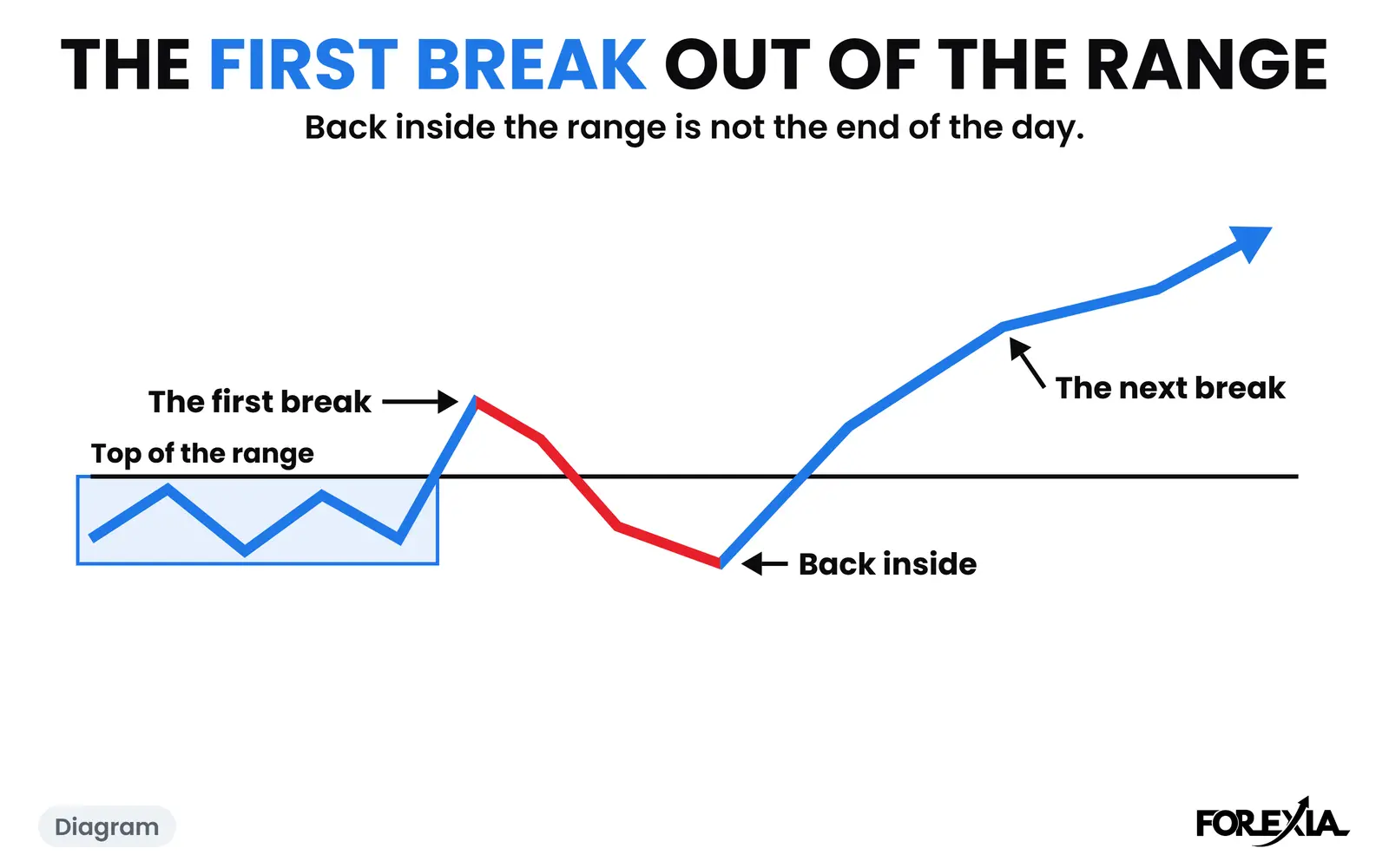
On Monday 8 June 2026, USD/JPY spent the night in a 23-pip range, 160.163 to 160.392. At 04:45 New York a candle took price 31 pips under the low, to 159.849. Our calendar held no medium or high-impact release for the dollar or the yen at that time. Price then climbed to 160.267, back inside the range.
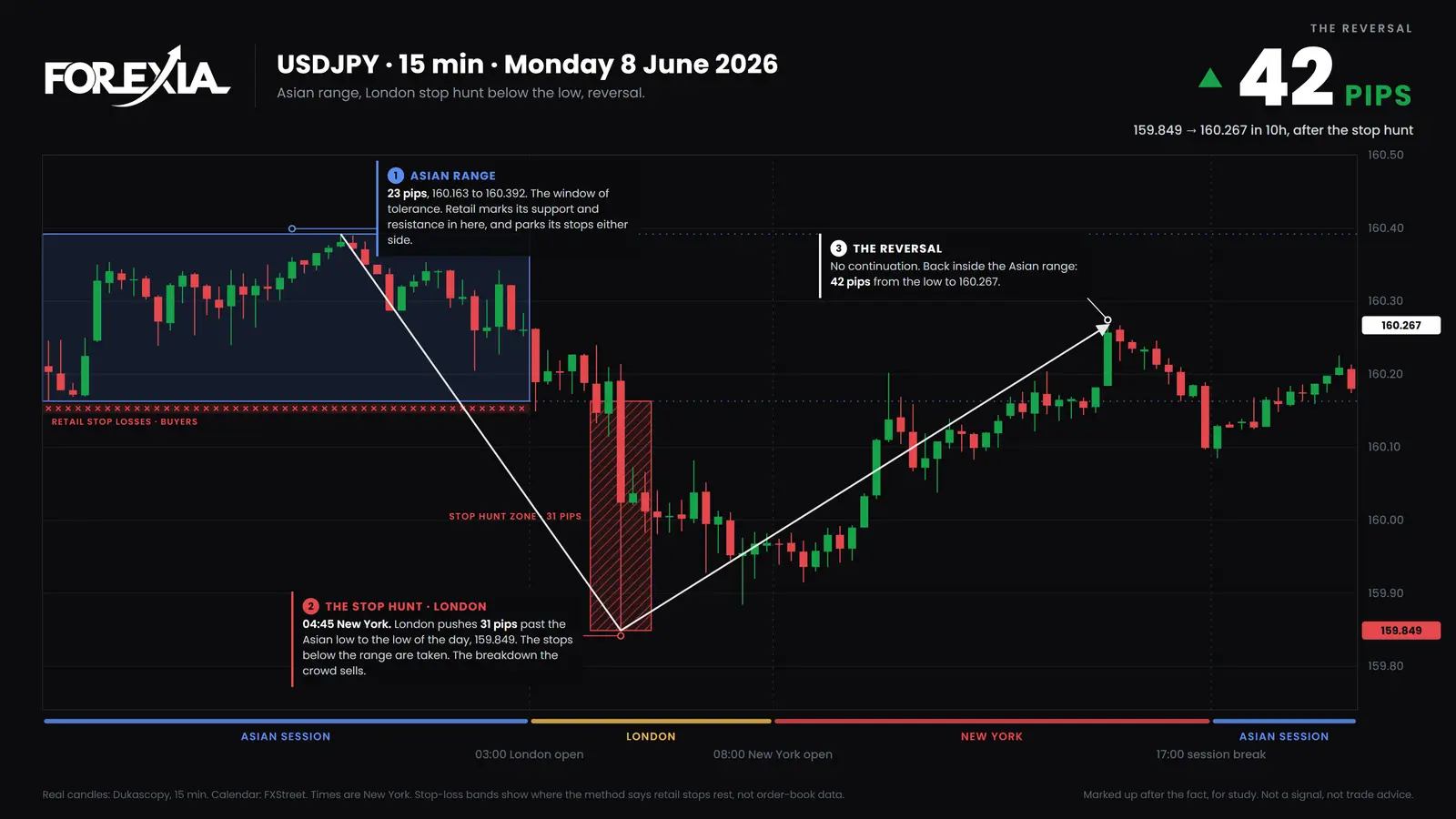
Anyone who had a stop under that range was out at the low. That feels aimed. We read it as a stop hunt, the crowd's sell orders being what a larger buyer needed, and that is our reading. What can be shown is the candle, which you can check on a second feed. What cannot be shown is that anyone chose it, or that the price was made for your trade. A large order that cared about no level at all would print the same candle. The three seats see different things in it: retail sees a breakdown, the market maker's seat is the one we cannot see, and the observer sees a close that came back. The Three Seats explains how we use them.
Being fooled by a candle is not the same as being scammed, and treating them as the same leads to the worst decisions. Blaming the market feels better than checking your own read.
What should you do before putting money in?
Five checks, in this order, cost nothing and catch most of the problems above.
- Look the firm up on its regulator's own register, and confirm the licence number and the firm's name match what the site says.
- Compare your broker's price with a second feed at the minute that bothers you.
- Ask for a seller's full record, not its best month.
- Start by learning to read a chart with nothing at stake. What is trading psychology is a good first page. Dumb Money is our name for the crowd the sellers often depend on.
- Never send money to someone who contacted you first.
If you are already out money to something you think was fraud, report it to the regulator that licenses the firm. In the US the CFTC takes complaints, and the advisory says where. The wider subject is on the trading psychology hub.
Course 1 of ForexiaPRO, Reading the Map, teaches reading a chart from three seats, starting with lesson 1.1.
Frequently asked questions
Is forex trading a scam?
Forex is a real market, with turnover the Bank for International Settlements measured at $9.6 trillion a day in April 2025. It is not a scam. Plenty of what is sold around it is, and most retail accounts lose money, which is a fact about the odds and not a fraud. The question to ask is who is selling you what.
Is forex legit or fake?
The market is legitimate. Whether a given broker, signal group or course is, you check yourself. In the US, the CFTC tells retail traders to confirm that a forex dealer is registered and to read its disciplinary history on the National Futures Association's BASIC system, and says most frauds are run by unregistered dealers.
How do I know if a forex broker or trading group is a scam?
Treat promised returns, risk-free claims, pressure to move to a private chat, and payments in digital assets only as warning signs. Check the regulator's own register for the firm and the licence number, not a badge on its site. A genuine regulator can name the firm, and a scam cannot be found there.
Is forex rigged against traders?
Regulators have fined banks for trying to move benchmark rates and some retail brokers for how they handled prices. None of that shows a given candle was aimed at your trade. Our page on whether forex is rigged separates what can be shown from what cannot.