Is Forex Rigged Against Retail Traders? Proof, Not Opinion
Dylan Forexia10 min read
Is forex rigged? Parts of it have been, on the record: regulators fined banks over benchmark rates, and the UK's said traders attempted to trigger client stop-loss orders. That is not proof that today's market is rigged against you, and no chart can show that anyone targeted your stop. What you can check is your own broker, and your own read.
You probably did not come here for a history lesson. You came because a stop went by a pip or two, then price went where you said, and it has happened too often to feel like chance. We have been there too. That feeling deserves a real answer, and "the market is rigged" and "stop making excuses" are both too easy.
Is forex rigged? Split the word into three questions
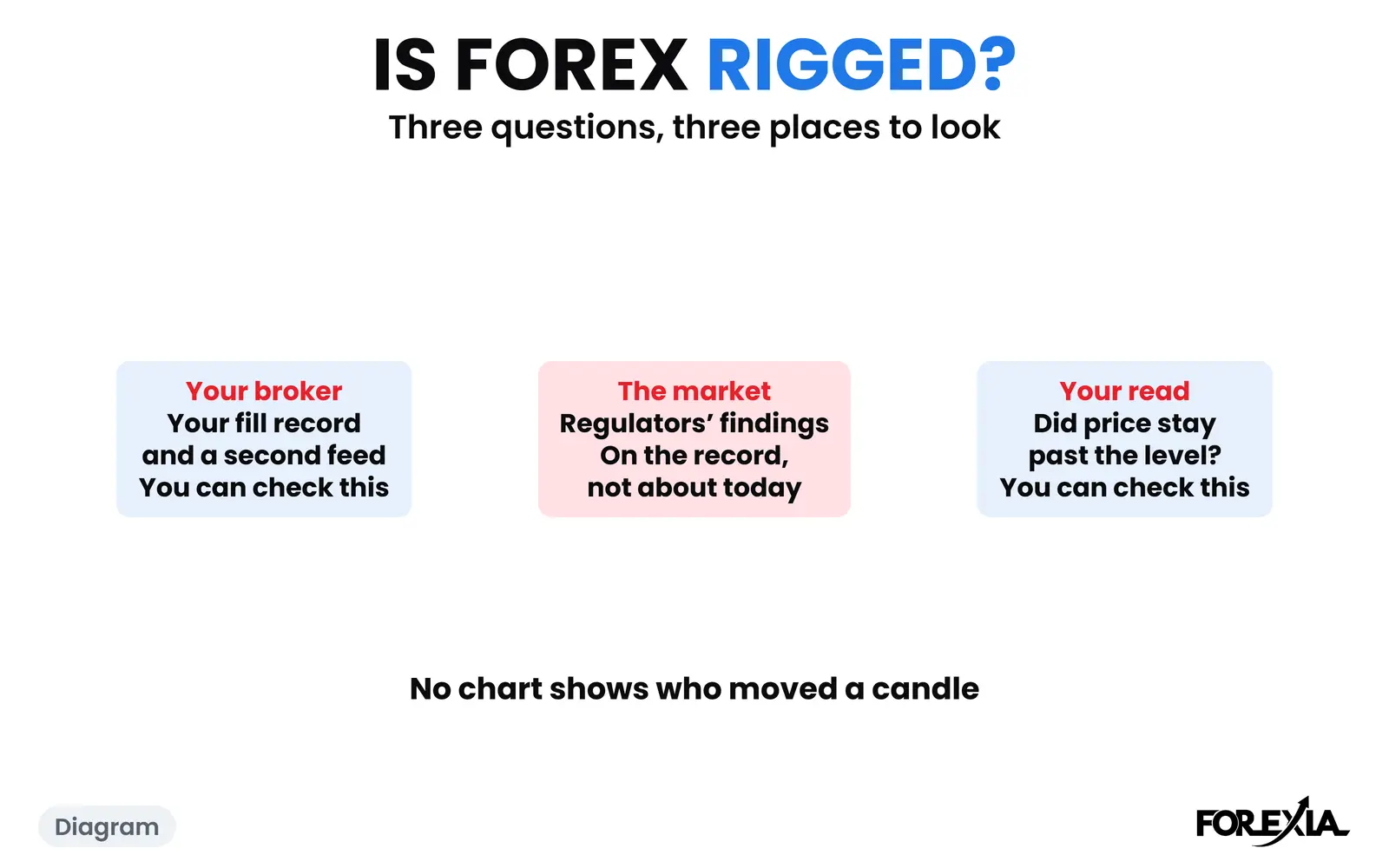
"Rigged" is really three separate questions, and each has a different kind of answer.
- Did your broker treat your order fairly? You can check this, on your own records.
- Have large players moved the market's price on purpose? Regulators have answered this for certain firms and years. Nobody can answer it for a given candle.
- Or was the read simply wrong? You can check this as well, and it is the answer nobody wants.
Most arguments about this mix all three. A broker's rollover spread, a bank trader's chat room and a stop that did its job get called the same thing, which is why the threads never end.
What regulators have put in writing
Here is the record at source, with what each finding leaves out. The first four rows are about banks and their traders, and the last two about a retail broker group. We name no firm here, because the point is the findings.
| When | Who | What it found | What it does not say |
|---|---|---|---|
| Nov 2014 | UK Financial Conduct Authority | Fines of about £1.1 billion on five banks for G10 spot FX failings, 1 January 2008 to 15 October 2013. Traders shared client information and "attempted to manipulate fix rates and trigger client 'stop loss' orders" | Retail traders are not mentioned. These are banks' clients. "Attempted" is its word |
| Nov 2014 | US CFTC | Over $1.4 billion from five banks for attempted manipulation of FX benchmark rates, using private chat rooms, starting in 2009 at some banks and running into 2012 | Stop losses are not mentioned |
| May 2015 | US Justice Department | Four banks agreed to plead guilty to conspiring over euro-dollar spot prices, December 2007 to January 2013, with over $2.5 billion in criminal fines | Stop losses and retail are not mentioned |
| Oct 2018 | A US jury | Acquitted three former traders charged with conspiring to rig euro-dollar prices in the spot market | It decided that case only, and it undoes none of the banks' pleas |
| Feb 2014 | UK Financial Conduct Authority, on a retail broker group | "Asymmetric price slippage", 1 August 2006 to 17 December 2010: if price moved between order and fill, the customer bore a loss and the group kept a gain. Penalty of £4 million plus redress | Nothing about moving the market or hunting stops. The average retained was about $3.70 on the trades where it applied |
| Feb 2017 | US CFTC, on a US retail dealer in that same group | It concealed its link to its most important market maker, while saying its "No Dealing Desk" platform had no conflicts of interest with its customers. A $7 million penalty | Nothing about any candle or any stop |
So traders going after stops is not a forum legend. A regulator has said so in writing, and the industry's own FX Global Code, in its December 2024 version, lists "trading or otherwise acting in a manner designed to move the market to the Stop Loss level" as an unacceptable practice. But those are particular traders in particular years, in the wholesale market. They do not describe today's candle, and they say nothing about your account.
Your broker: execution you can check
Your stop fires on your broker's price, and that price is not the whole market's. Some retail brokers also take the other side of client trades, known as a dealing desk or B-book, and dealing desk, ECN and market maker are not the same thing for your stop. US rules are blunt about this. A retail forex dealer's required risk statement must say "YOUR DEALER IS YOUR TRADING PARTNER WHICH IS A DIRECT CONFLICT OF INTEREST". That is a conflict, and it is not proof of cheating. A broker that makes a market for you is also not the market maker of the three seats, who is our read of the large players moving the whole price.
Here is a wick that shows the difference. At 17:00 New York on Monday 3 August 2026, the daily rollover, USD/CHF's bid dropped from 0.81006 to 0.80729, about 28 pips, with no release on the calendar. We checked the ask on the same feed: in those same five minutes it stayed at 0.81063 or higher. The two lows sat about 33 pips apart, and the 15-minute candle closed at 0.80997. A buyer's stop in those pips fires on the bid, so it could have fired on a price the ask never came near. That is one feed, and your broker's spread may do less or more.
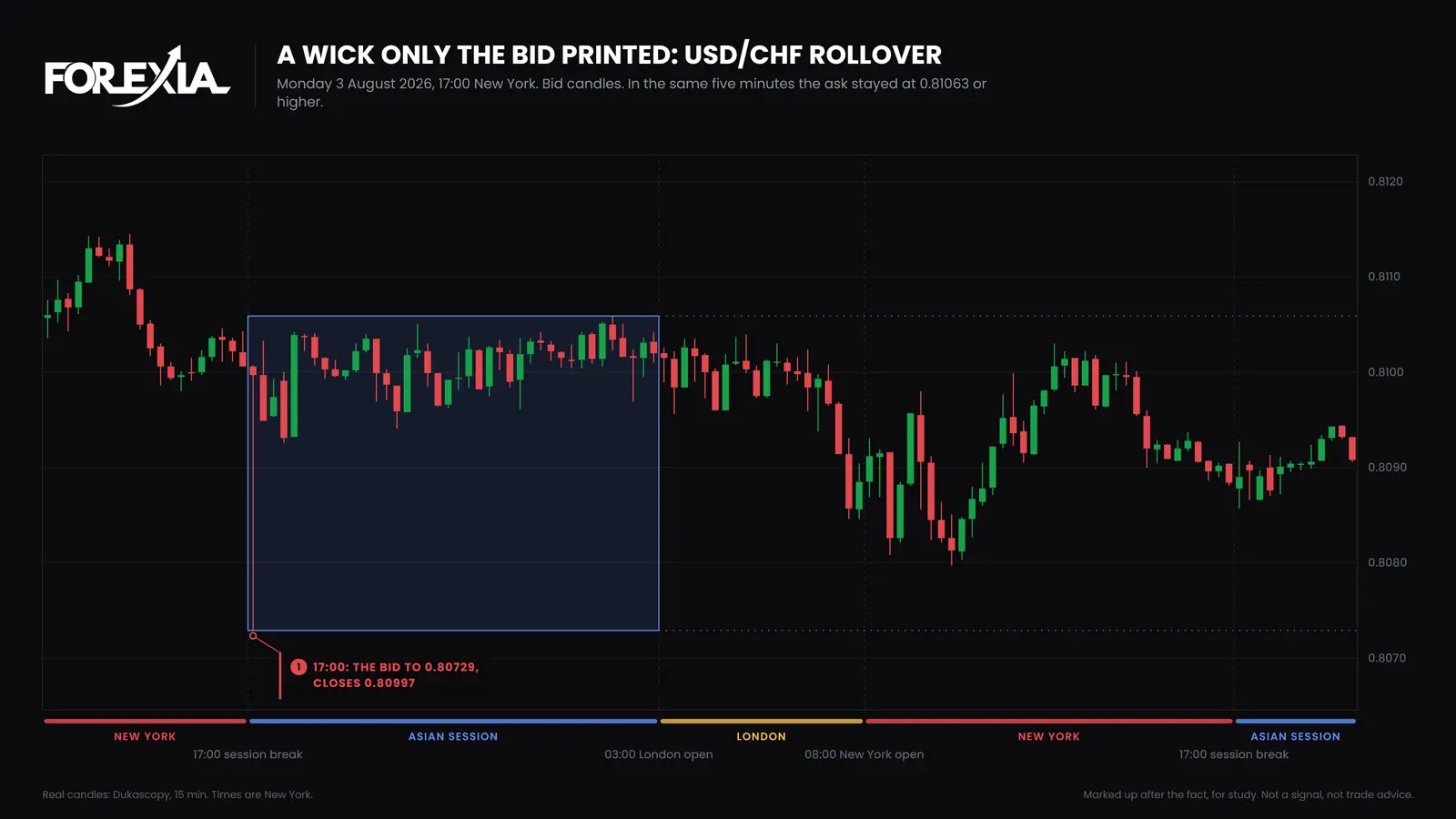
Nobody needs to be cheating for this to happen, and a stop there would still be gone. It is a cost of holding a stop near the market at that minute, and it is a question about your broker and not about the market. Whether brokers hunt stops goes through that test in full.
The market: one candle across seven markets
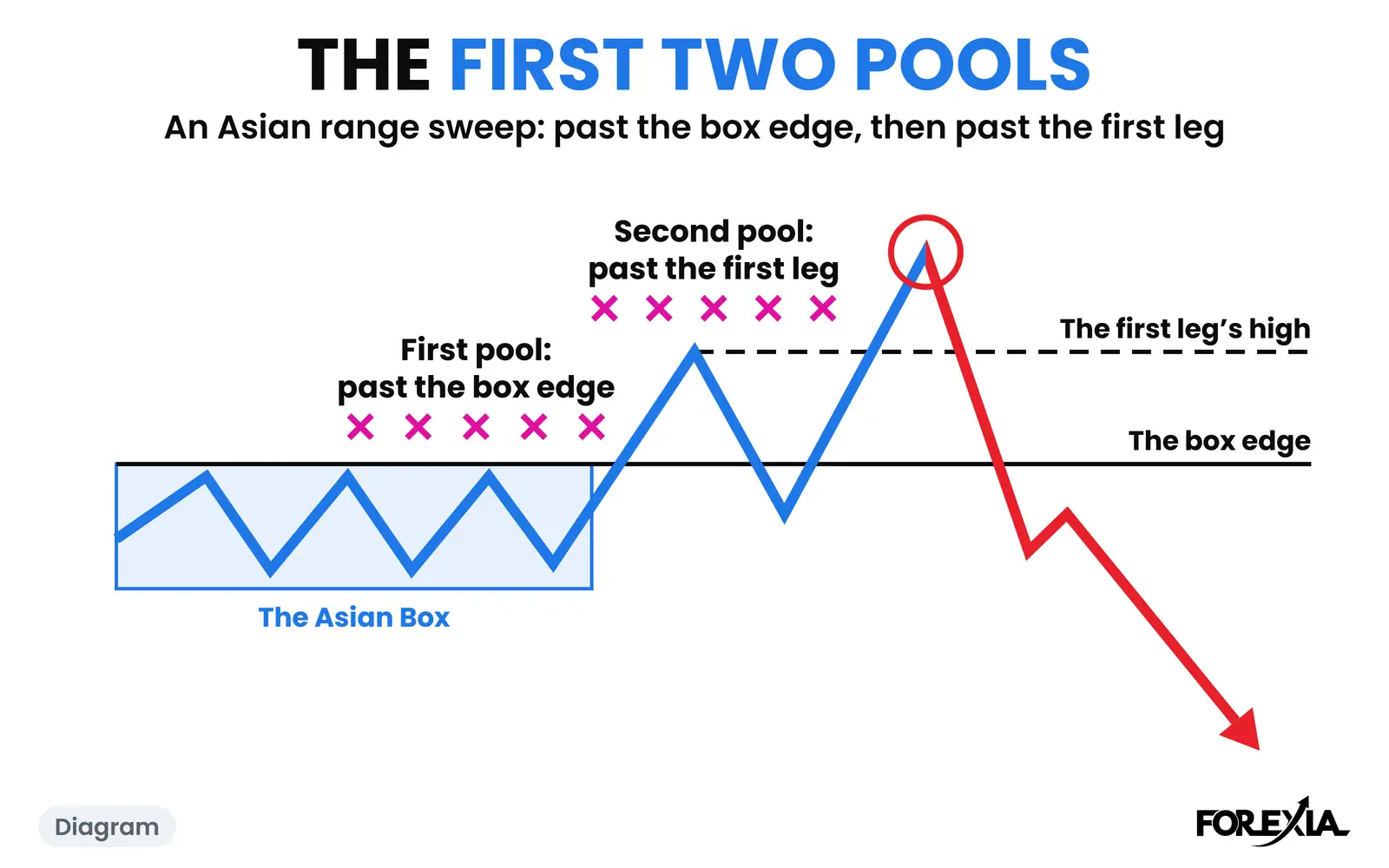
The other kind of move needs no broker at all. On Thursday 11 June 2026, dollar markets moved together in the 13:30 New York candle. AUD/USD went from 0.70030 to 0.70328 and closed at 0.70304, 19 pips over its Asian high of 0.70115, and reached 0.70548 at 15:30. EUR/USD went from 1.15226 to 1.15664 on the same candle, and USD/JPY from 160.397 to 160.030. Seven of our eight markets took a level on that one candle: it was the first that day to trade past an edge of the Asian range, or the previous day's high or low, by at least 3% of the average daily range. Only USD/CAD did not.
Our calendar has no medium or high-impact release for any of those currencies after 08:45 that day. A headline may have done it, and we did not look for one. The point is narrower than that. A stop taken in that candle is hard to put on your broker: seven markets moved on one feed, and a second data source's hourly bars show the same jump in that hour.
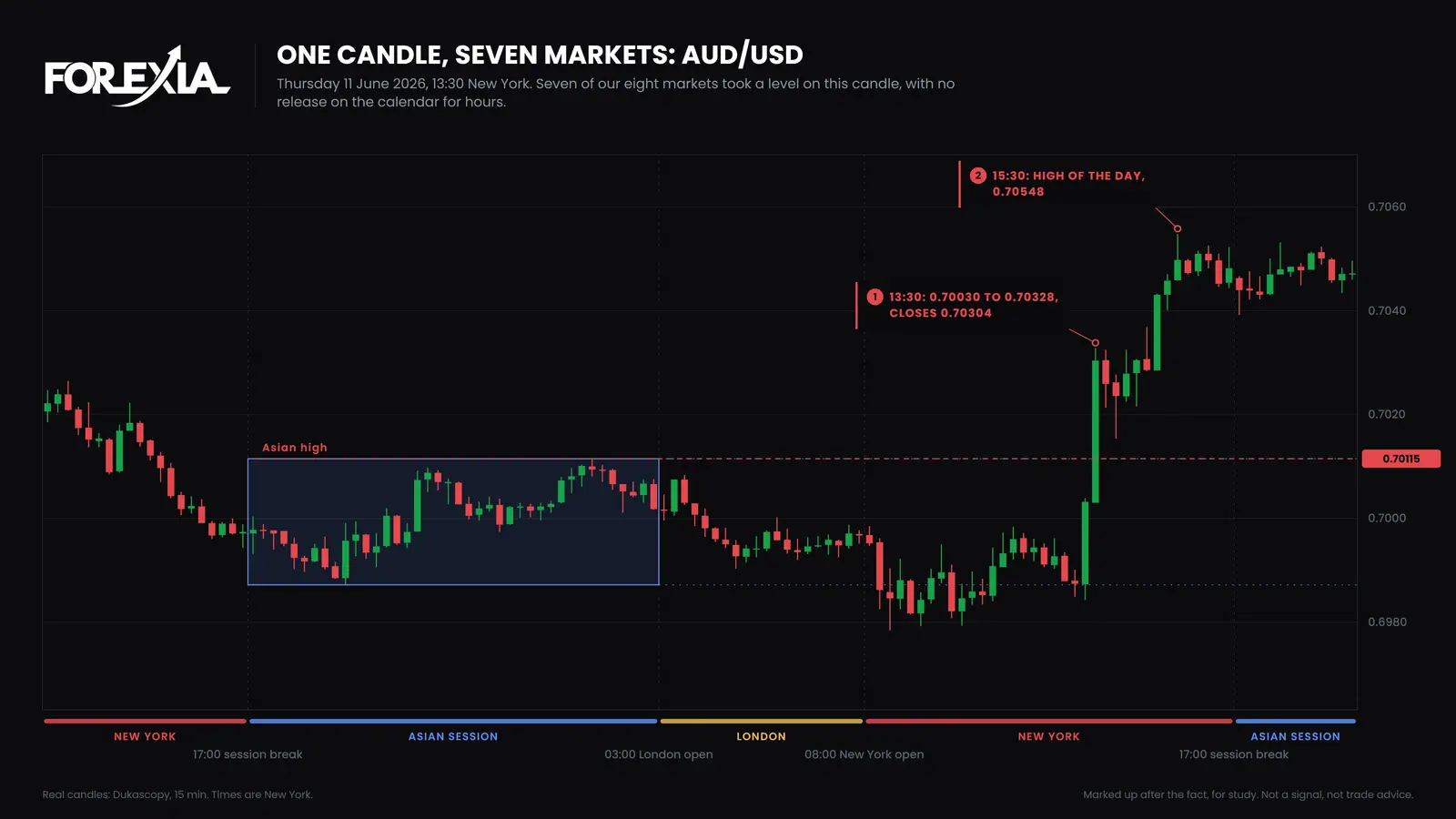
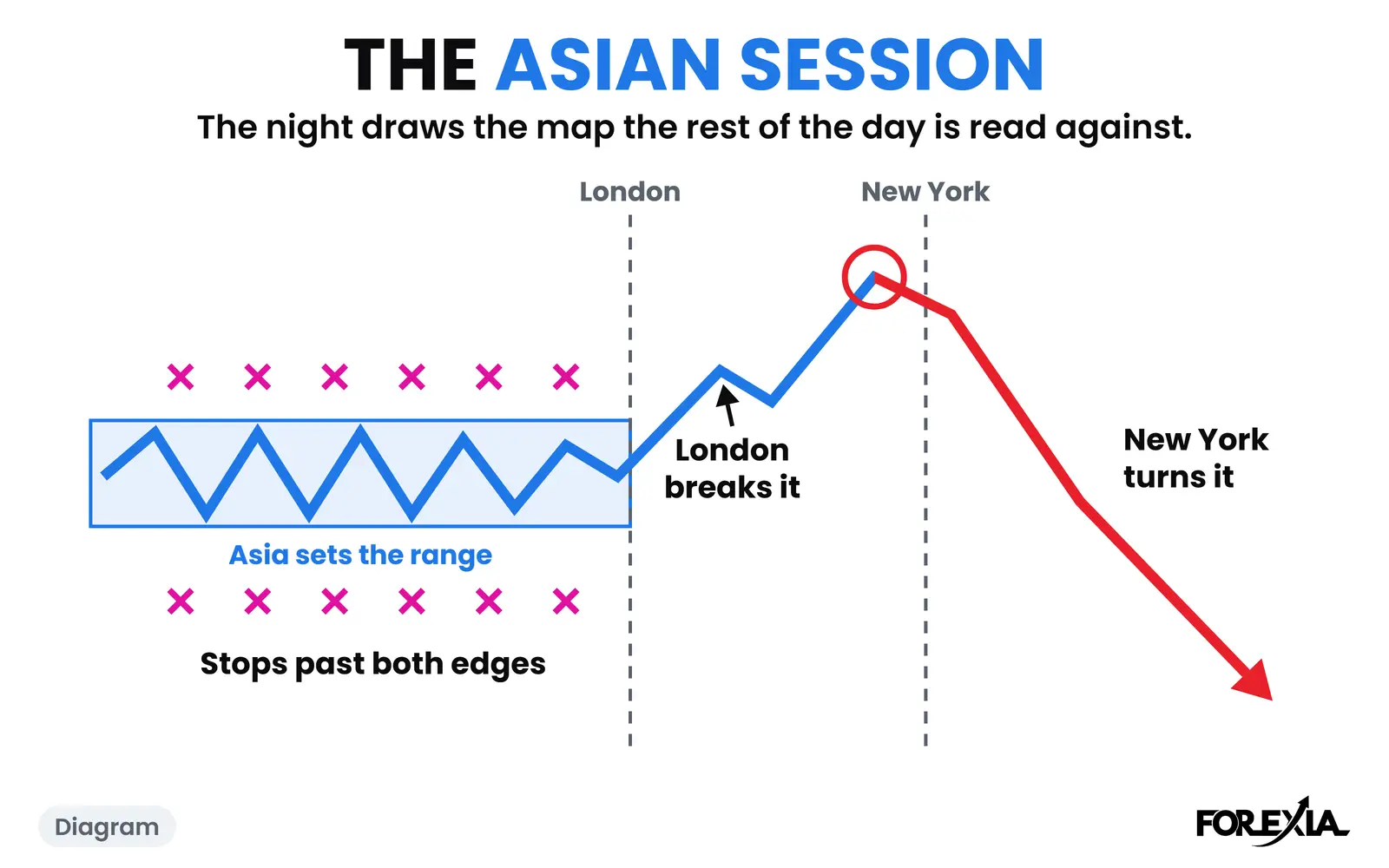
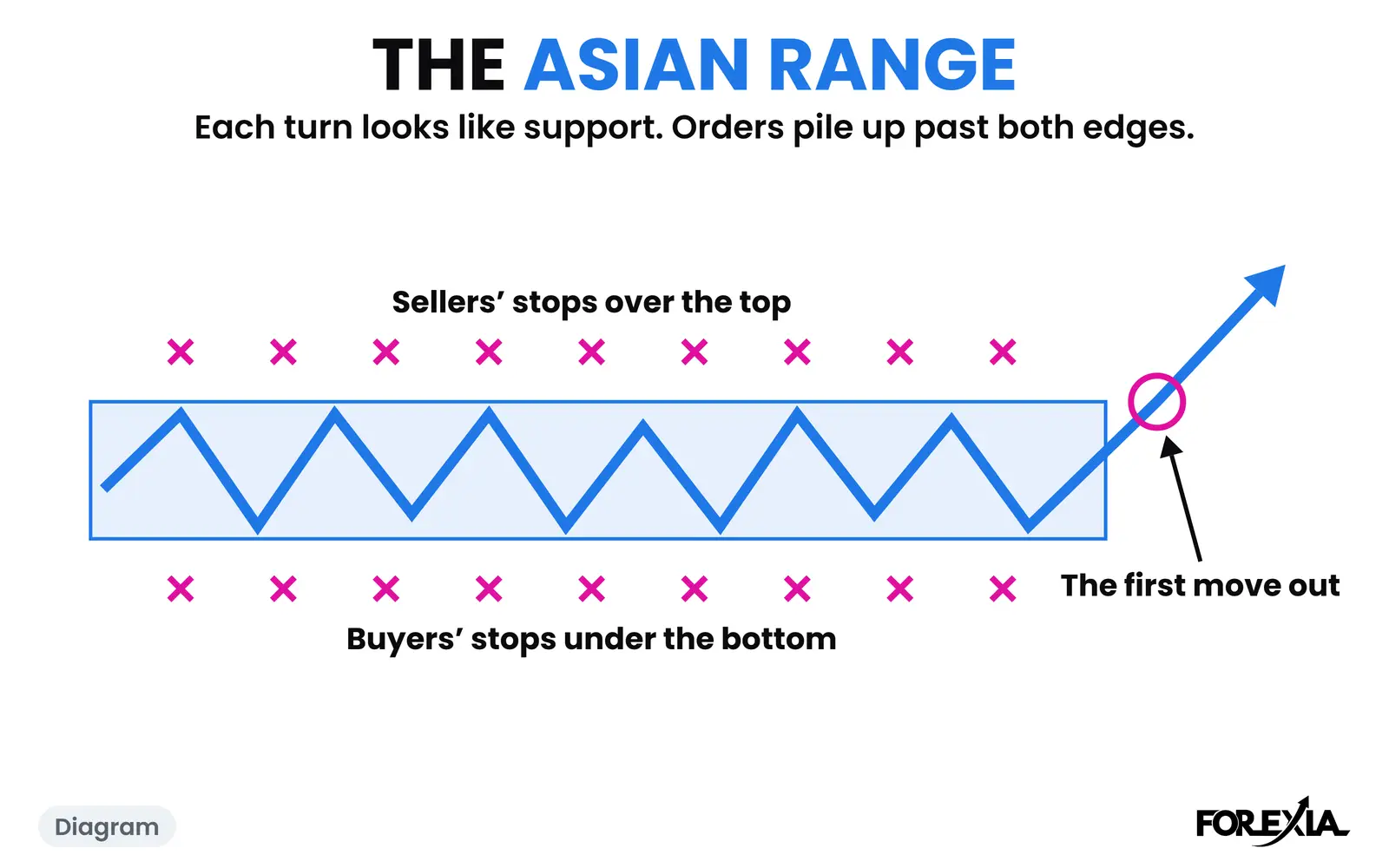
Who moved it? We cannot say, and neither can anyone writing about it from outside. Our read is that market makers build the chart: the quiet hours give the crowd its levels, and the crowd's stops are what large orders need. The crowd is what we call Dumb Money, and that is a read, held openly. A large order with no interest in any level, or stops feeding each other, would print the same candle. A move this wide tells you it was not one broker. It tells you nothing about intent.
Your read: the stop that did its job
The third answer is the plainest. On Wednesday 23 September 2026, GBP/USD left a 38-pip Asian range with a low at 1.33083. A buyer at the bottom had a stop under it. The 03:45 New York candle closed through the low at 1.33016, and no candle closed back over it that day. The low came at 13:00 at 1.32234, 85 pips past the line, and the last candle closed at 1.32381.
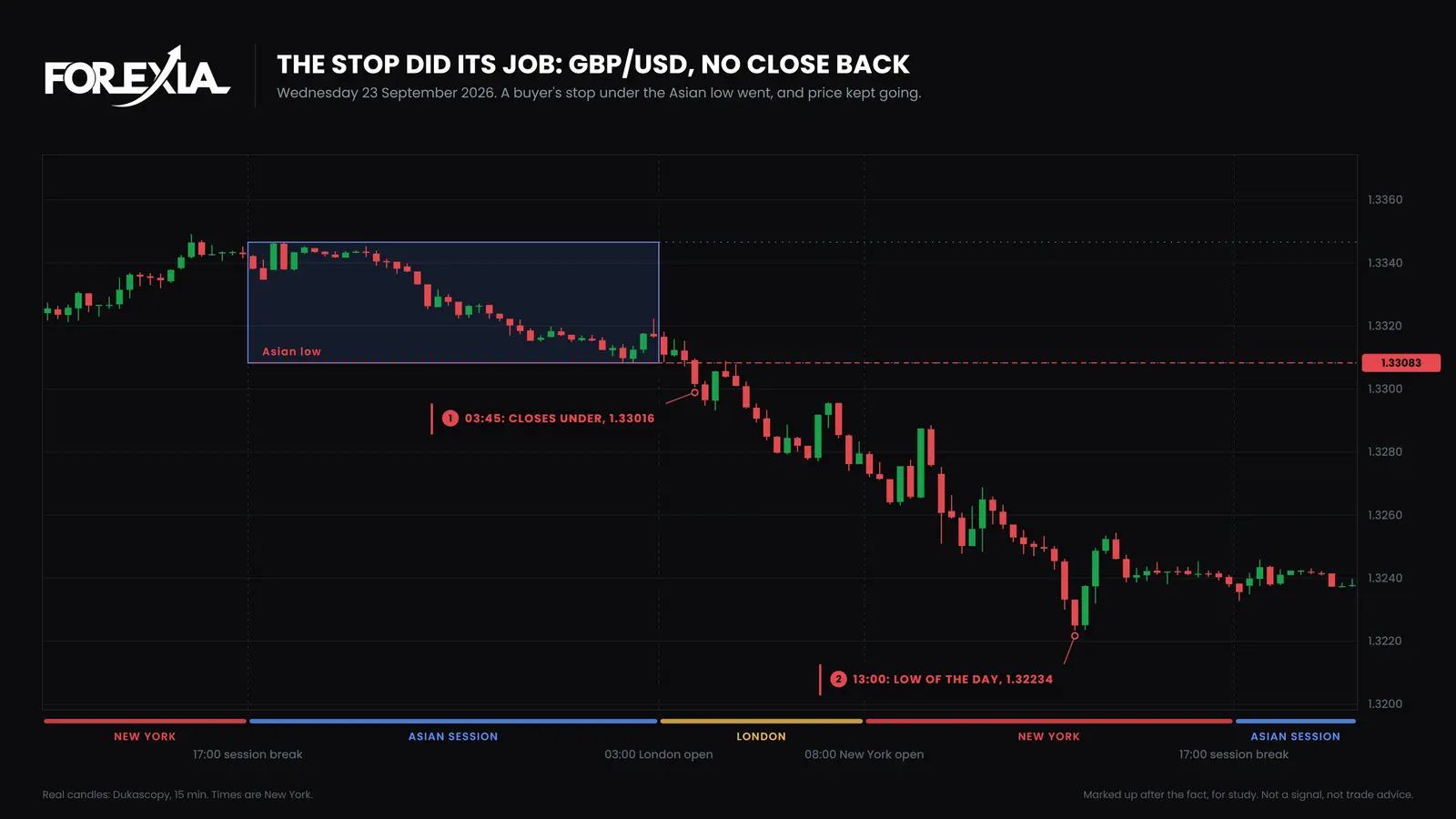
Nobody hunted that buyer, as far as any chart can tell. The stop did its job and saved the rest of an 85-pip fall. If the word for this one is "rigged", the word has stopped meaning anything. Our page on stop hunt vs fakeout shows how to tell these apart, and why price hits a stop and then reverses covers the kind that turned.
Is forex rigged against you? A check on your own trades
You can sort your own losses with these steps, using your broker's history and not your memory.
- Take the time of the fill. Near the 17:00 rollover or a release, look at the spread first.
- Compare a second feed at that minute, allowing for spread. If only your broker printed that price, it is an execution question.
- Tally your slippage. This comes straight from the 2014 finding, and hardly anyone does it. Export as many fills as you can, and for each one note the price asked and the price filled. Slippage in a fair market goes both ways. If yours only ever goes against you, take that to the broker. The US industry body's notice says a dealer must apply slippage settings "uniformly regardless of the direction in which the market has moved".
- Ask what price did next. If it stayed past the level, the stop did its job. If it closed back and went your way, it may have been caught in a sweep, and the full check on your last five losses takes that further.
- Ask for the execution record, then go to the broker's regulator if the numbers do not add up. Keep it to what the records show.
What can be shown and what cannot
The record can show that some traders at banks tried to trigger stops in those years, and that one retail broker group kept price gains it should have passed on. Your own records can show your fills, your slippage and what price did next.
Nothing we have can show that any one candle was aimed, that anyone knew where your stop sat, or that price turns after a hunt more often than chance would produce. On that last point our own test is uncomfortable for both sides. A program flagged 18,884 hunts as they happened, from February 2021 to December 2024, and price then moved -0.2% of the daily range the trade's way after an hour and -0.5% by 17:00. That is no lean at all, which is what chance would look like too. Run as a fixed rule on seven dollar majors and gold, trading against those hunts lost money after costs in every year from 2021 to 2026, between -0.10R and -0.23R a trade, where R is the amount risked on one trade. It is one rule on one data source, and it cannot see order flow. We hold our read and accept that a chart cannot prove it. Our stop hunt page has the method and the limits.
Why so many retail accounts lose is a question for its own page. Losing is not evidence of rigging, and it is not evidence against it either.
Course 1 of ForexiaPRO, Reading the Map, teaches reading a chart from the three seats, starting in lesson 1.1.2.
Frequently asked questions
Is forex manipulated?
It has been, on the record. Regulators in the UK and US fined banks in 2014 over benchmark rates, four banks agreed to plead guilty in the US in 2015, and the UK regulator said traders attempted to trigger client stop-loss orders. Those are findings about particular firms and years. They do not show that today's candle was manipulated, and a US jury acquitted three traders in one such case in 2018.
Is forex rigged against retail traders?
The findings we can point to against the whole market are about banks and their clients, not retail accounts. The ones about retail are about brokers' own execution and disclosure, and those can be checked on your own fills. Nothing we have seen shows the market as a whole aimed at retail traders, and no chart could show it.
Is my broker trading against me?
It may be. Some retail brokers take the other side of client trades, and US rules require a retail forex dealer to say so in its risk statement, in the words 'a direct conflict of interest'. That is a conflict and not proof of cheating. Your fill record and a second feed are how you check any one trade.
Why do so many retail forex traders lose if it is not rigged?
Costs, size and a read that was wrong explain plenty of it without anyone cheating. Our own fixed rule lost money after costs in every year we tested, with no one hunting it at all, and with no costs it still made nothing. That does not prove nobody ever cheats. It does mean losing is not evidence that they did.
How can I report a broker I think has cheated me?
Ask the broker in writing for the execution record of the trade, then take it and your comparison with a second feed to the regulator that licenses the broker. Check first that the broker is licensed where it says it is. Keep it to what your records show, because a fill is checkable and a motive is not.