Best Day to Trade Forex: Average Range by Weekday, Counted
Dylan Forexia7 min read
The forex average range by weekday runs largest on Wednesday and Thursday and smallest on Tuesday. Each weekday's median range, as a share of the market's own average: Monday 86%, Tuesday 83%, Wednesday 97%, Thursday 97%, Friday 89%. That is seven dollar majors and gold over 25 weeks and four days of 2026. Much of the gap follows the US calendar, and a large range does not make a best day to trade.
This page is about the size of a day and nothing else. It says nothing about direction, and nothing about the order of the week.
What is the forex average range by weekday?
Wednesday and Thursday run largest, and the difference is smaller than the usual lists make it sound. Pips cannot be pooled across markets, so each day's range is shown as a percent of that market's own average day across the sample.
| Weekday | Market-days | Median day | Middle half of days | Mean day |
|---|---|---|---|---|
| Monday | 208 | 86% | 64% to 112% | 92% |
| Tuesday | 208 | 83% | 66% to 104% | 88% |
| Wednesday | 208 | 97% | 71% to 144% | 112% |
| Thursday | 208 | 97% | 78% to 128% | 109% |
| Friday | 198 | 89% | 71% to 113% | 99% |
Look at the middle half of days before the median. It is the range that holds the middle 50% of that weekday's days. Most of the middle half of Tuesdays sits inside the middle half of Wednesdays, so a weekday tells you little about the day in front of you. Wednesday's mean sits well above its median because a few very large days pull it up.
A second count agrees on the order. By our ADR Met Tuesday test, a day's range reached the average of the 20 market-days before it on 32% of Mondays (56 of 176), 28% of Tuesdays (49 of 176), 44% of Wednesdays (78 of 176), 44% of Thursdays (77 of 176) and 42% of Fridays (70 of 166). Its average is 20 days and its sample starts later, so it is not the same count.
What rule did we count, on what sample?
The rule is one line: a day's range is its high to its low, from one 17:00 New York session break to the next. So a Monday starts on Sunday at 17:00, and the Sunday open is part of it.
Sample and dates. Dukascopy's 15-minute bid candles on seven dollar majors and gold, from Monday 6 April to Thursday 1 October 2026: 1,030 market-days. Monday to Thursday are tested in 26 weeks. Friday is tested in 25, because the sample stops before Friday 2 October. On gold, $1 counts as 1 pip, and gold has 23 Fridays.
What is left out. The low of each day's first candle is clipped to its body, because it is often only the spread widening. A day with too few candles in our files is not counted. US holidays that still traded are in, such as Memorial Day on Monday 25 May.
Does each market show the same order?
Mostly at the top and not at the bottom. Every one of the eight had its largest median day on Wednesday or Thursday. The smallest was Tuesday on three, Monday on three, Wednesday on USD/JPY and Friday on AUD/USD.
| Median range, pips | Monday | Tuesday | Wednesday | Thursday | Friday |
|---|---|---|---|---|---|
| EUR/USD | 52 | 47 | 59 | 56 | 56 |
| GBP/USD | 69 | 62 | 70 | 74 | 69 |
| USD/JPY | 74 | 69 | 67 | 100 | 78 |
| USD/CHF | 41 | 42 | 48 | 56 | 46 |
| AUD/USD | 45 | 43 | 54 | 49 | 41 |
| USD/CAD | 49 | 46 | 57 | 50 | 55 |
| NZD/USD | 41 | 49 | 56 | 46 | 42 |
| Gold | 86 | 98 | 106 | 92 | 91 |
Each figure rests on 26 days or fewer, so one large week can move it, which is why we show the median here and not the mean. USD/JPY's Thursday is the plainest case, with a mean of 135.5 pips against a median of 99.5.
Why do Wednesday and Thursday run larger?
Much of the gap follows the US calendar, as far as this count can see. We split each weekday by whether a high-impact US item fell inside the trading day. Only US items are counted, on the calendar the markups use.
| Weekday | Market-days with an item | Median day | Market-days without | Median day |
|---|---|---|---|---|
| Monday | 32 | 100.5% | 176 | 84.1% |
| Tuesday | 56 | 103.5% | 152 | 77.0% |
| Wednesday | 168 | 106.0% | 40 | 63.1% |
| Thursday | 112 | 108.3% | 96 | 86.8% |
| Friday | 112 | 87.6% | 86 | 91.0% |
From Monday to Thursday, days with an item sat between 100.5% and 108.3%, and days without one between 63.1% and 86.8%. Wednesday carries an item on 168 of its 208 market-days, which goes a long way to explaining its place in the first table. Its days without one are only five weeks. Friday does not follow the pattern, and we have no count that explains why.
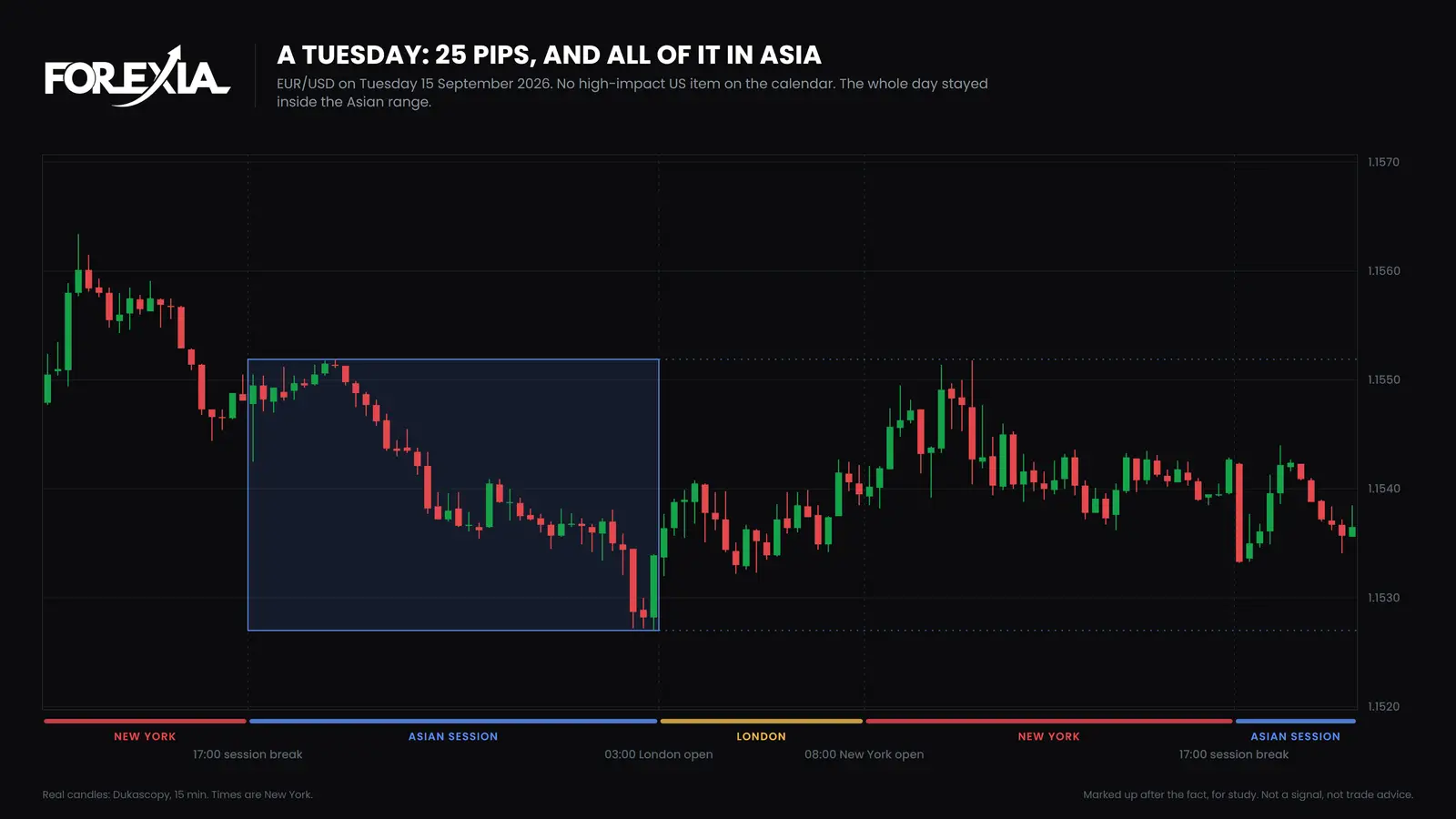
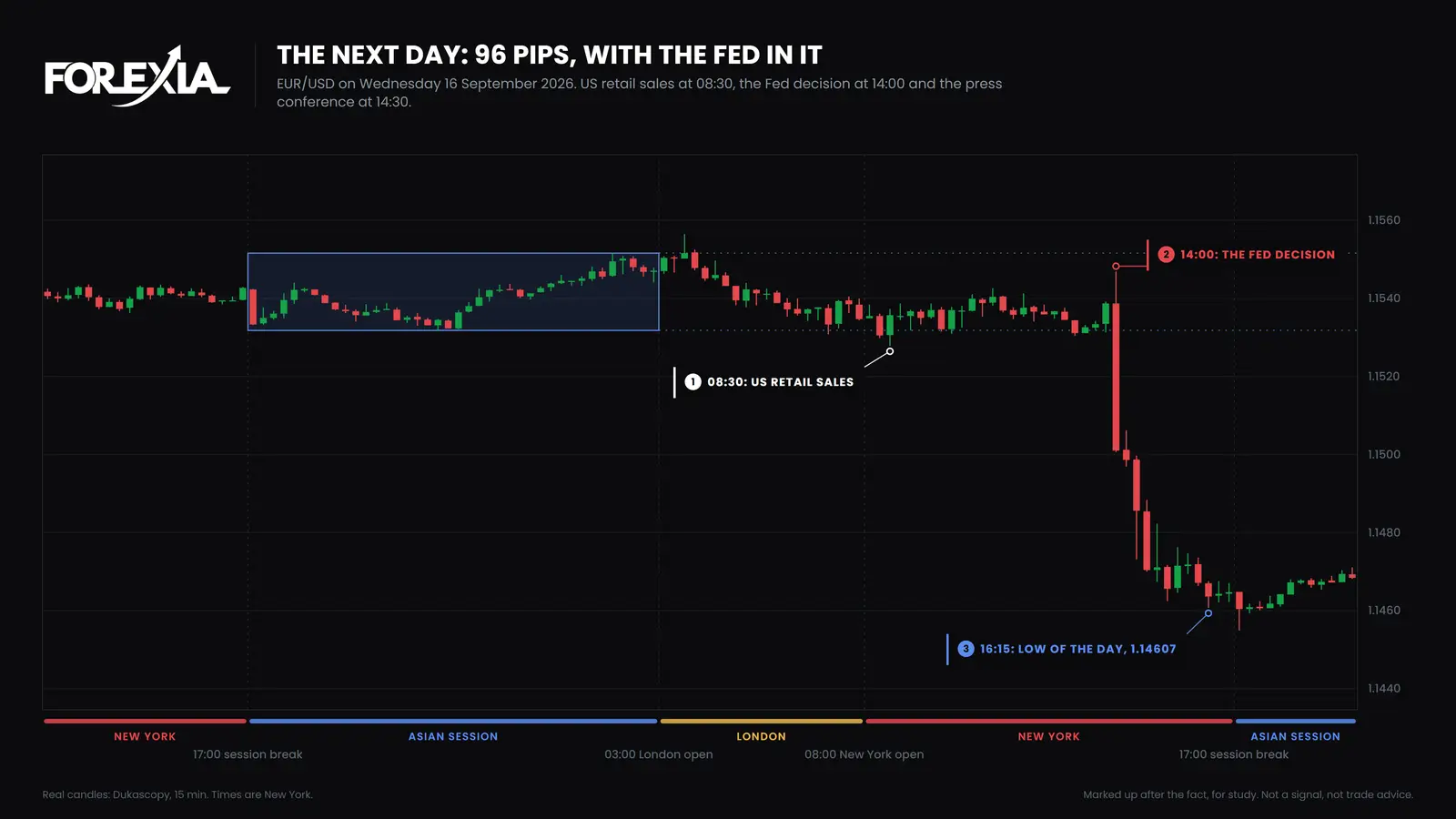
Two days on one market show the size of it. EUR/USD on Tuesday 15 September 2026 ranged 25 pips, 1.15270 to 1.15519, and all of it was set in Asia. The next day had US retail sales at 08:30 and the Federal Reserve's decision at 14:00, with the press conference at 14:30. It ranged 96 pips, from 1.15565 at 03:30 to 1.14607 at 16:15. We picked this pair of days because they are far apart, so they illustrate the split and do not measure it.
So what is the best day to trade forex?
A range count cannot tell you. It measures how far price moved between its high and its low, and nobody trades a whole range. A wide day can be a day when a stop was run both ways. Our own test of the setup as a fixed rule lost money after costs on every weekday, as our liquidity sweep backtest sets out, so no weekday rescued it.
Our guide to the weekly cycle reads the week as having a shape: the Weekly Script, with the Induction Trend among its words. That is a read of the order of a week, and this count does not test it. Monday and Friday each have a post of their own, on why Monday is slow and on whether Friday is a bad day. Why a move that looks strong can still cost you is on losing money trading a trend.
What does this count not prove?
It does not prove that a weekday causes a range, or that one will repeat. The limits are these.
- Candles, not trades. There is no entry, stop, spread, commission, slippage or filter here. A range is not a profit available to anyone.
- Past days only. It covers 25 weeks and four days of one year, inside one setting of the clocks, on one bid feed. A different half-year has a different calendar.
- Averages hide the days. The middle half of each weekday overlaps the others, and a 25-pip Tuesday and a 96-pip Wednesday can sit side by side.
- Not independent. The eight markets move on one dollar, so 1,030 market-days are far fewer separate events.
- Only US items are split out. Central banks and data elsewhere are not separated, so a day counted "without" may have had a large release for another currency.
- Range only. By design this page does not count which way any day went.
Course 4 of ForexiaPRO, The Week, in production, teaches the read of the week step by step.
Frequently asked questions
What day of the week has the largest forex range?
In our count, Wednesday and Thursday, each with a median day of about 97% of the market's own average. Tuesday was smallest at 83%, then Monday at 86% and Friday at 89%. That covers seven dollar majors and gold from 6 April to 1 October 2026.
What is the best day to trade forex?
A range count cannot say. It measures how far price moved, not which way or whether anyone could have made money from it. Our own test of the setup as a fixed rule lost money after costs on every weekday.
Is Monday the slowest day in forex?
It was not the smallest in this count. Monday's median day was 86% of the market's own average and Tuesday's was 83%, and the two are close. The middle half of Mondays and of Tuesdays overlap almost completely.