How to Review a Forex Trading Week: Textbook or Partial
Dylan Forexia7 min read
How to review a forex trading week: wait until Friday's close and do four things, read the new COT report, mark the week's high and low and when each came, run four checks against the textbook weekly cycle, and file the week by how many held. The review grades a finished week and not a trade. Our two filing words are textbook and partial, and Textbook or Partial is the page for them.
Below, the Friday routine in order, then one real week scored on eight markets. It is the second half of a habit that starts with the Sunday map, and both sit inside the weekly cycle.
How do you review a forex trading week on Friday?
You do five small jobs, in this order. Each takes minutes, and none of them needs a view on next week.
- Read the new COT report. The CFTC publishes it on Friday, with positions counted on the Tuesday before. Note where the large speculators now stand, in the three-year range we call the index. How to read the COT report explains the index. This is next week's input, kept apart from this week's grade.
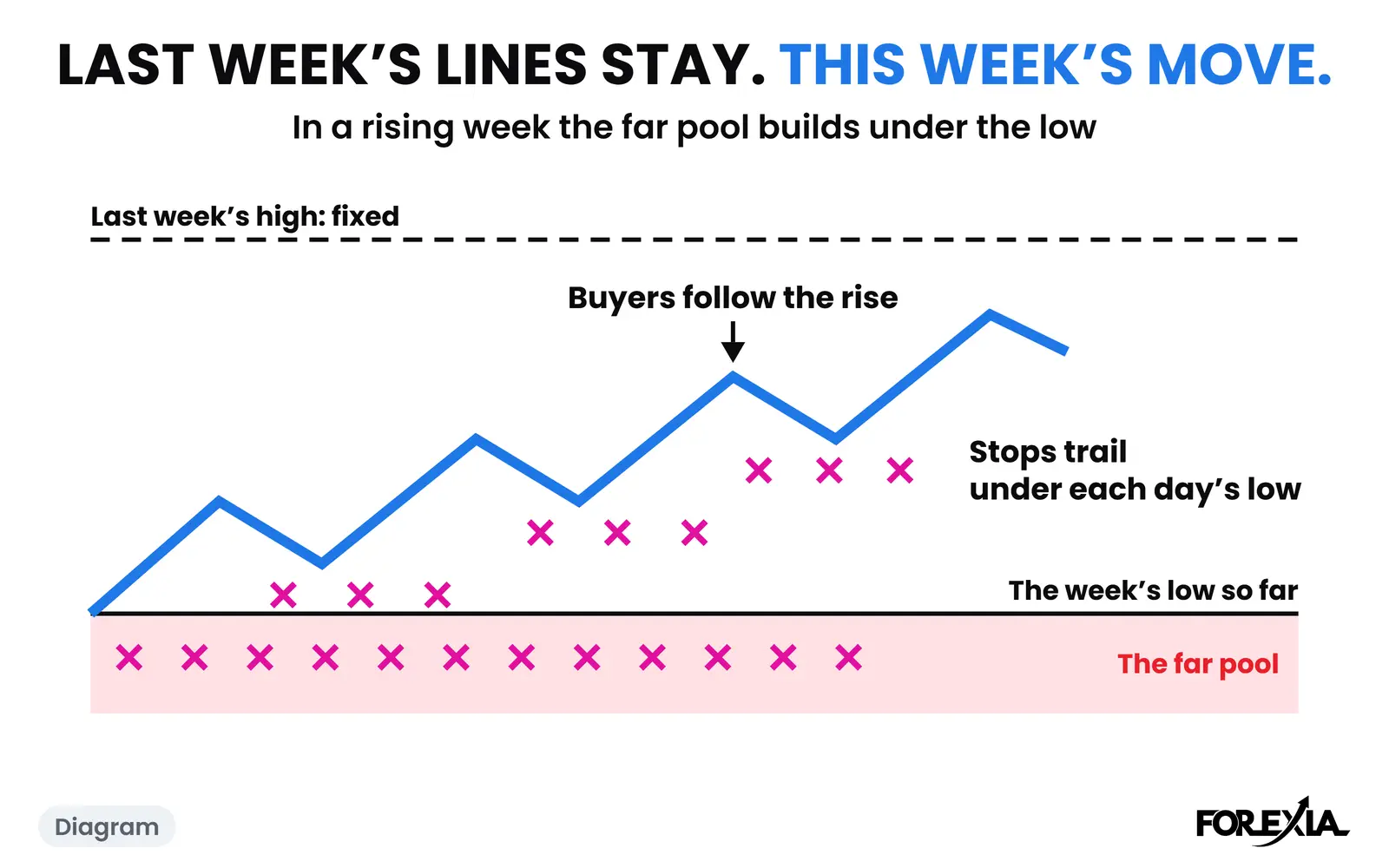
- Mark the week's high and low, with their times. Write the price and the New York time of each, and which session it came in. A week's extreme is only known once the week is over.
- Run the four checks. They are below.
- Note what was released. Check the calendar for the candle of each extreme, and write down whether a release was on it. The calendar can make a hunt, and it can mislead about one.
- File it. Textbook if the checks held, partial if some did not, and one line on why.
Which four checks do you run?
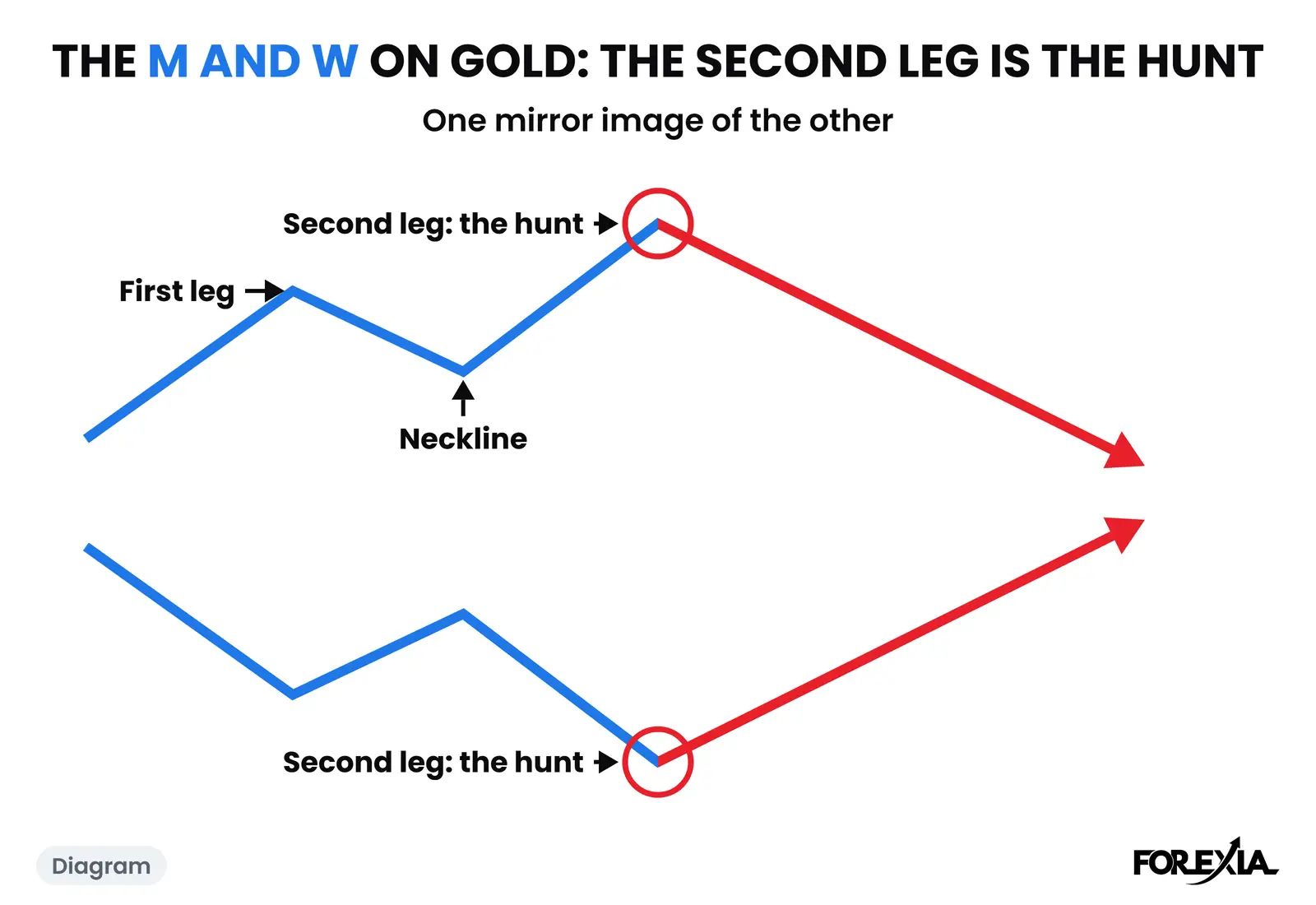
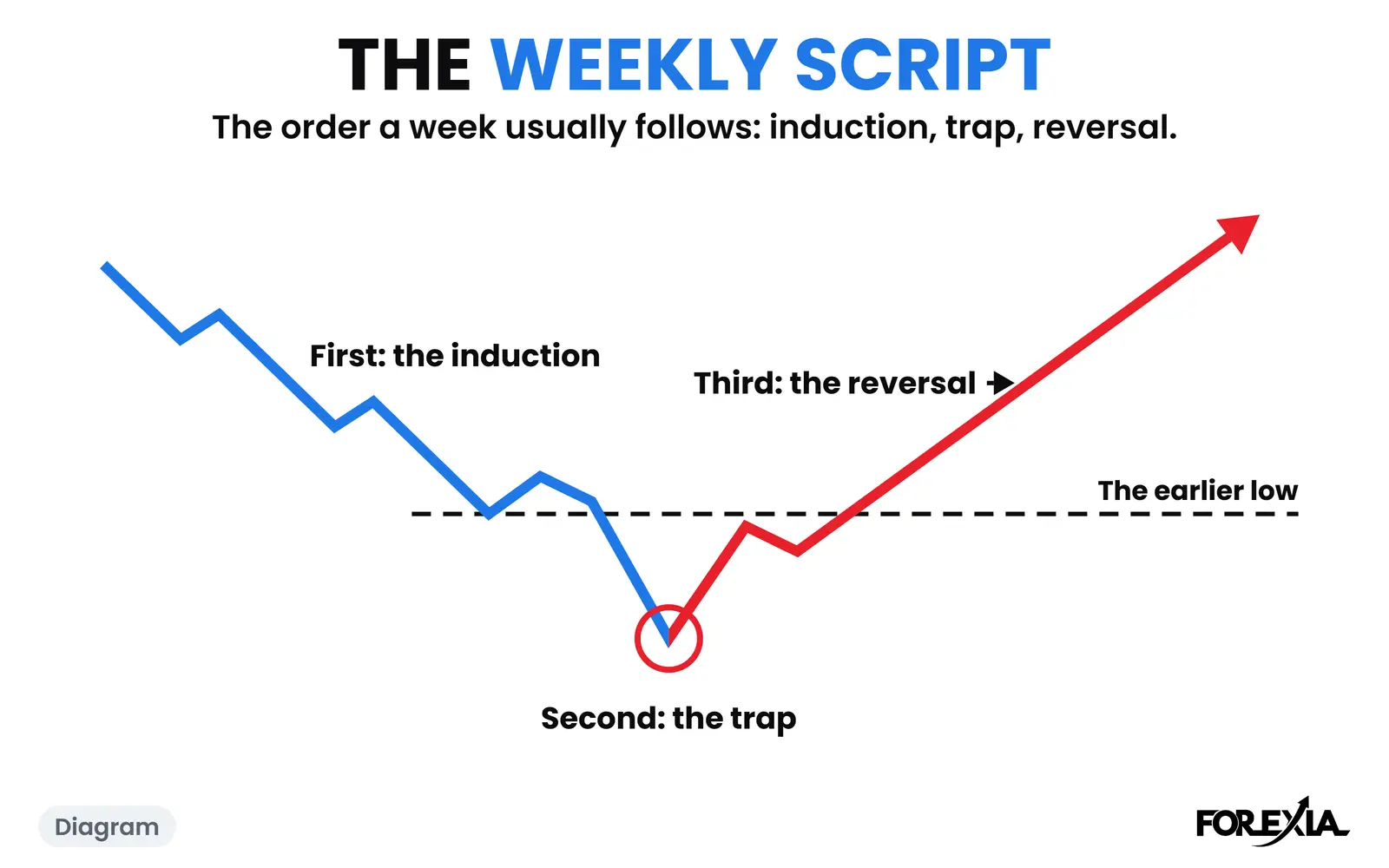
They are the textbook weekly cycle, as our chart markups state it: an induction trend on Sunday, Monday and Tuesday, the high or low of the week on Tuesday or Wednesday, then the reversal through Wednesday, Thursday and Friday. Each check is a plain yes or no that a chart can answer.
- Is the week's extreme on Tuesday or Wednesday? In New York time and by session, since Tuesday evening is already Wednesday's session.
- Was there an induction trend from Sunday to Tuesday? A trend measured from the week's open, and not a range.
- Was there a stop hunt first? A run past an earlier level followed by the turn, and not a run that went much further than a hunt.
- Did the reversal erase the induction? Whether the move back took out what the first half built.
Some weeks fail one and still look good on a chart. That is why the checks are counted and not blended into a feeling.
What did one real week score?
The week of 31 August 2026 scored very differently on eight markets that moved on one dollar. Here are the checks for each, as the weekly cycle write-ups record them.
| Market | Extreme on Tue or Wed | Induction trend | Hunt first | Erased the induction | Checks held |
|---|---|---|---|---|---|
| Gold | Yes | Yes | Yes | Yes | 4 of 4 |
| EUR/USD | Yes | No, ranged | Yes | Yes | 3 of 4 |
| AUD/USD | Yes | No, ranged | Yes | Yes | 3 of 4 |
| USD/JPY | Yes | No, ranged | Yes | Yes | 3 of 4 |
| NZD/USD | Yes | No, ranged | Yes | Yes | 3 of 4 |
| USD/CHF | Yes | Yes | No, ran 32 pips past | Yes | 3 of 4 |
| USD/CAD | Yes | No, ranged | No, ran 30 pips past | Yes | 2 of 4 |
| GBP/USD | Yes | No, ranged | No, ran 31 pips past | No, gave back 82% of it | 1 of 4 |
So gold files as textbook and GBP/USD as partial, on the same week. Two things stand out. Six of the eight ranged from Sunday to Tuesday instead of trending, so the induction check failed there without the week being any less of a turn. And the hunt check failed on USD/CHF, USD/CAD and GBP/USD for the same reason: price ran 30 to 32 pips past an earlier level, which the write-ups call more than a stop hunt.
How is a week different from a day?
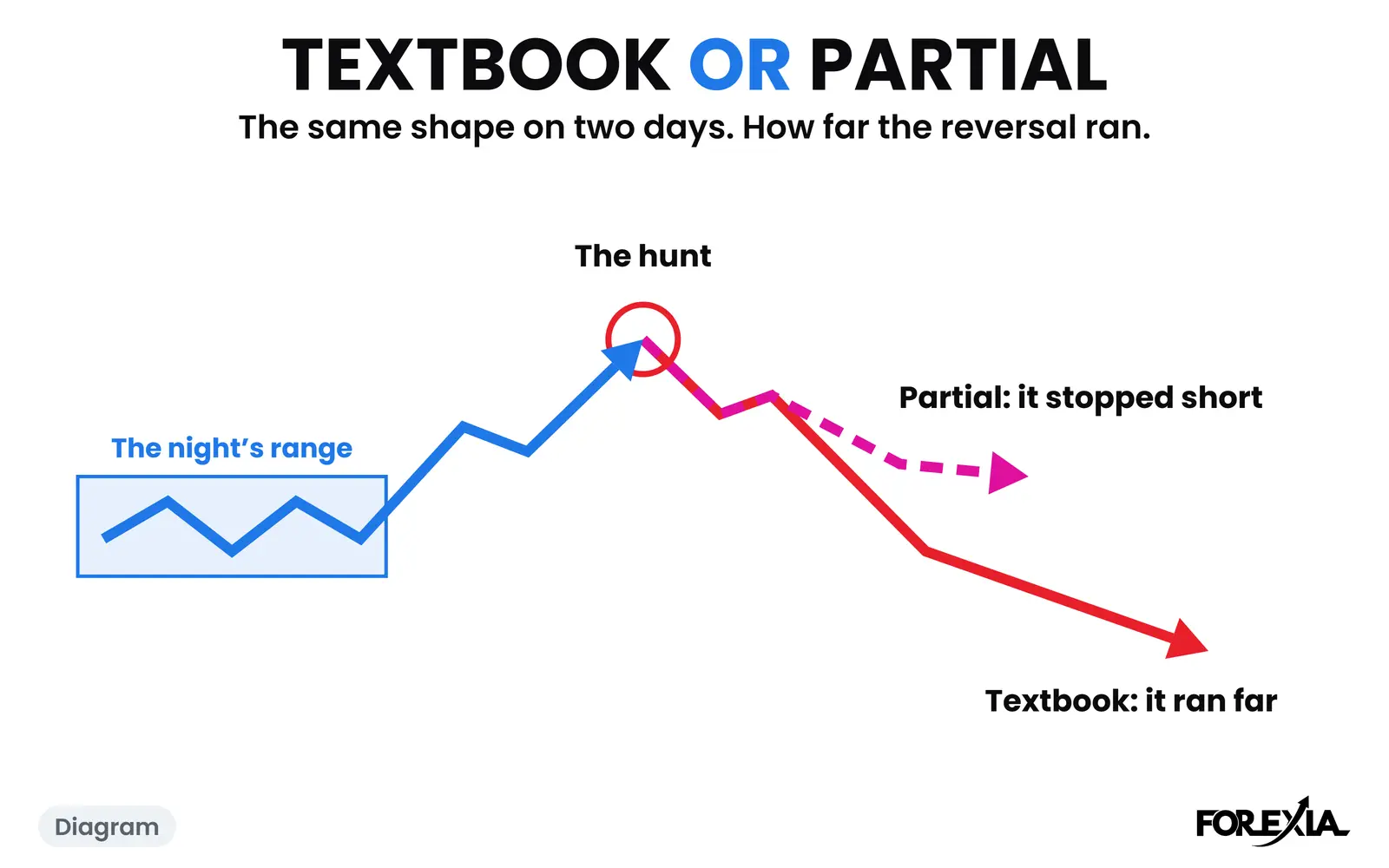
A week is filed once and a day is filed every day. Our day charts are filed Textbook or Partial the same way: of the 332 day charts marked up between 6 April and 1 October 2026, 209 were filed Textbook and 123 Partial. That counts where a chart was filed, nothing more, and our folders hold only days we marked up, which are days that reversed.
Two days on EUR/USD show how alike the two filings can look. On Tuesday 9 June 2026 the reversal ran 50 pips against a 55-pip average day, and it was filed Textbook. On Wednesday 10 June it ran 39 against 54, stopped inside the night's range and was filed Partial.
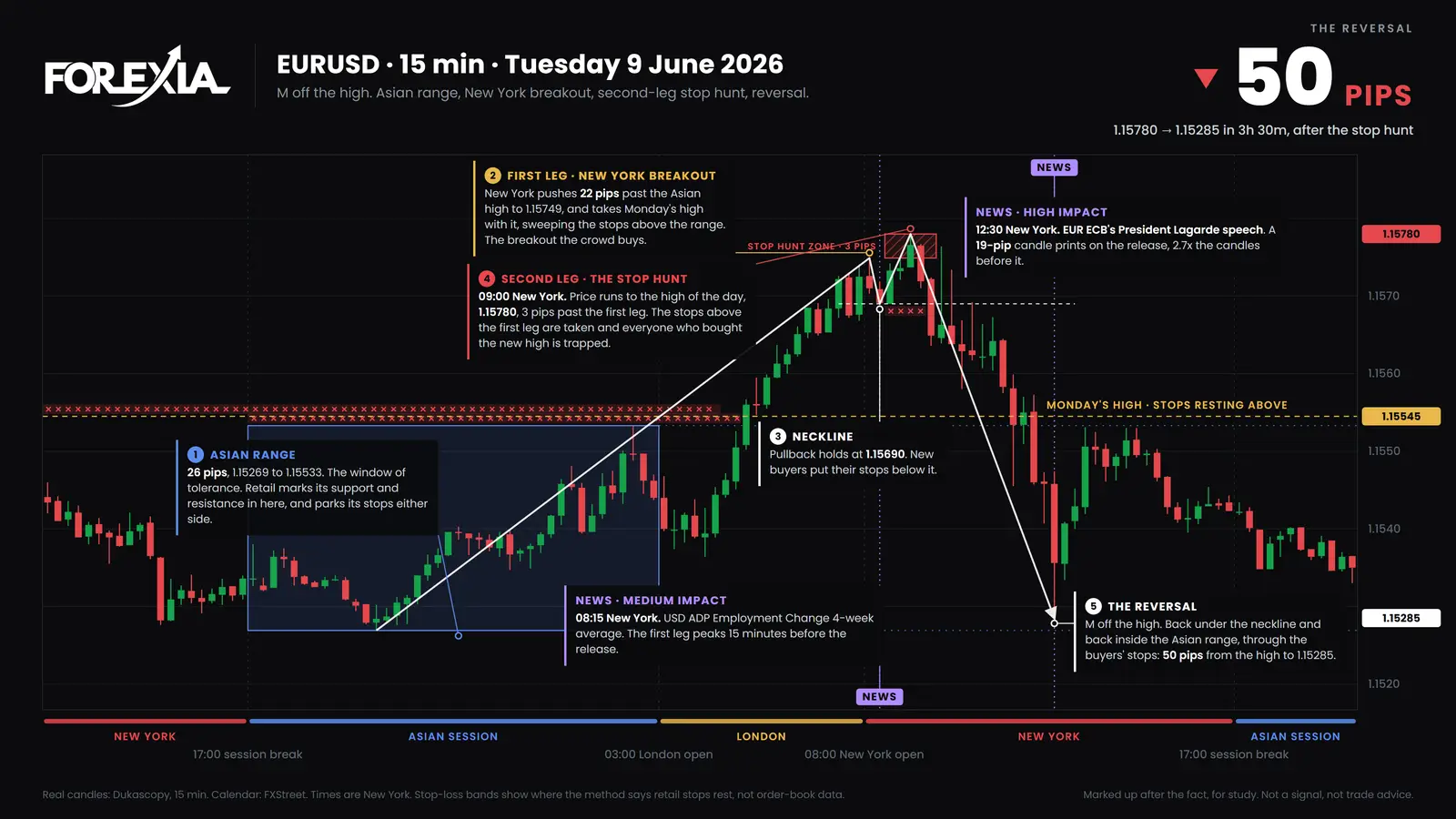
The grade comes from the whole reversal, known after the close, and not from anything you could have known when the first leg was printing. That is the reason to do the review on Friday and keep it apart from the trade.
What does a one-line note look like?
Short, dated and checkable. For the AUD/USD week of 27 July 2026 it could read: "Low Wednesday 12:15 at 0.69219, 40 pips under Tuesday's low, before the Fed at 14:00. Closed back at 14:30. Last week's high taken Thursday by 12:15. High of the week Friday 05:00 at 0.70442." Every figure in that line can be read off the chart, and nothing in it says what the week meant.
Keep the notes in one place and read the last few before the next Sunday's map. A habit like this is what a forex trading journal is for, and the difference between a journal and a review is that the review is written before you know how next week went.
What does the review not tell you?
It does not tell you what to do next week, and it does not turn a count into a result. A week filed textbook is not a trade that worked, and a partial week is not a failed setup. The review grades the shape of a finished week against an order we wrote down, and nothing more. The eight rows are one dollar's week, not eight separate tests, and a table of filings is not a sample of ordinary weeks.
Confirmation Stacking is the count of what lined up on a day before it traded, and it is a separate fact from the grade. A review is also only as good as what you wrote down on Sunday, which is why the weekly outlook and this page are meant to be used together. Compare what the map said with what the week did, and write one line on the difference.
What do traders get wrong about weekly reviews?
Three readings cost the most.
- Grading the week by the profit or loss. A losing week can be a clean textbook week, and the reverse. The grade is about the shape.
- Reading partial as a failed setup. On the same week GBP/USD and gold differ by three checks, and the week was still a turn on both.
- Reading the filing as a signal. A reversal seen afterwards is not a setup, and our own test of the daily setup as a mechanical rule did not make money.
Sources
The four checks and the eight results are read from our week-of-31-August 2026 weekly-cycle chart write-ups, on Dukascopy candles in New York time. The day counts are from the Textbook or Partial glossary page. The COT report is published on the CFTC's Commitments of Traders page.
Course 4 of ForexiaPRO, The Week, in production, teaches the Friday review in lesson 4.4.3.
For study only. This page is not a signal and not trade advice. Charts are Dukascopy candles, marked up after the fact.
Frequently asked questions
How do you review a forex trading week?
On Friday, once the week is over: read the new COT report, mark the week's high and low and when each came, run four checks against the textbook weekly cycle, and file the week by how many held. The review grades a finished week, not a trade.
What does textbook or partial mean for a week?
Textbook means the week played the weekly cycle cleanly. Partial means part of it did not hold. In the week of 31 August 2026, gold held all four checks and GBP/USD held one, on the same dollar move.
Should a weekly review change how I trade?
It should change how you read, and it is not a result. A count of how weeks were filed is not a statement about what a trade would have made. Our own test of the daily setup as a mechanical rule did not make money.