What Moves Gold? Rates, the Dollar, Fear, and the Orders Behind Them
Forexia Academy6 min read
What moves gold in the forex market? Four things get named: interest rates, the dollar, the funds that hold and trade it, and fear. We tested the first two on 223 trading days of real gold candles. The dollar index pointed the same way as gold on 145 days, and the 10-year real yield on 126, so each fits more often than not, and each failed on dozens of days. Below are those counts, a day that fit none of them, and the orders behind the moves.
This page was written on 11 November 2026 and names no live price. On gold we count $1 as 1 pip, all times are New York unless we say London, and chart prices are Dukascopy's bid. The two directions have their own pages: why gold is going up and why gold is falling. For the wider guide, see how to trade gold.
What moves gold prices? The usual drivers
Gold pays no interest and is priced in dollars. Most explanations come back to those two facts.
- Real yields. A real yield is the Treasury yield after expected inflation. A 10-year real yield that rises makes holding a metal that pays nothing more costly, and one that falls makes it less so.
- The dollar. Gold costs more in every other currency when the dollar firms, so buyers abroad may pull back. The Fed's broad dollar index tracks it, and EUR/USD on any chart is a live stand-in.
- Funds. Futures traders show up in the weekly CFTC Commitments of Traders, summarised on our gold COT page. Gold-backed funds publish ETF flows. Both are weekly, so they speak to the month and not the minute.
- Central banks. The World Gold Council's first-quarter 2026 report first put net central bank purchases at 244 tonnes, and its second-quarter report cut that quarter to 57. Figures that late and that revisable cannot explain a day.
- Fear. Some buyers hold gold when they are afraid. There is no clean number for fear, so it is the hardest driver to check and the easiest to claim.
What moves gold the most? Tested on 223 days
We took each trading day from the 17:00 New York break to the next, from 29 December 2025 to 6 November 2026, and set gold's move beside the day's change in three published series from FRED. A day "agrees" if gold rose when the measure fell, or fell when it rose. Gold rose on 114 of the 223 days.
| Measure | Days it agreed with gold | Days it did not | Days unchanged |
|---|---|---|---|
| Fed broad dollar index | 145 | 78 | 0 |
| 10-year Treasury yield | 127 | 82 | 14 |
| 10-year real yield | 126 | 73 | 24 |
Every measure agreed on more days than it disagreed, and the dollar did so most often. None agreed on all days, or on anything like it. The dollar failed on 78 days, a third of them.
Two cautions. These FRED readings are end-of-day figures dated by day, and our gold day runs from 17:00 to 17:00, so the match is approximate. And agreeing on the day does not mean one caused the other. A day on which gold and a yield moved together by chance is counted the same as one where they did not.
What moves gold on a day that fits none of it?
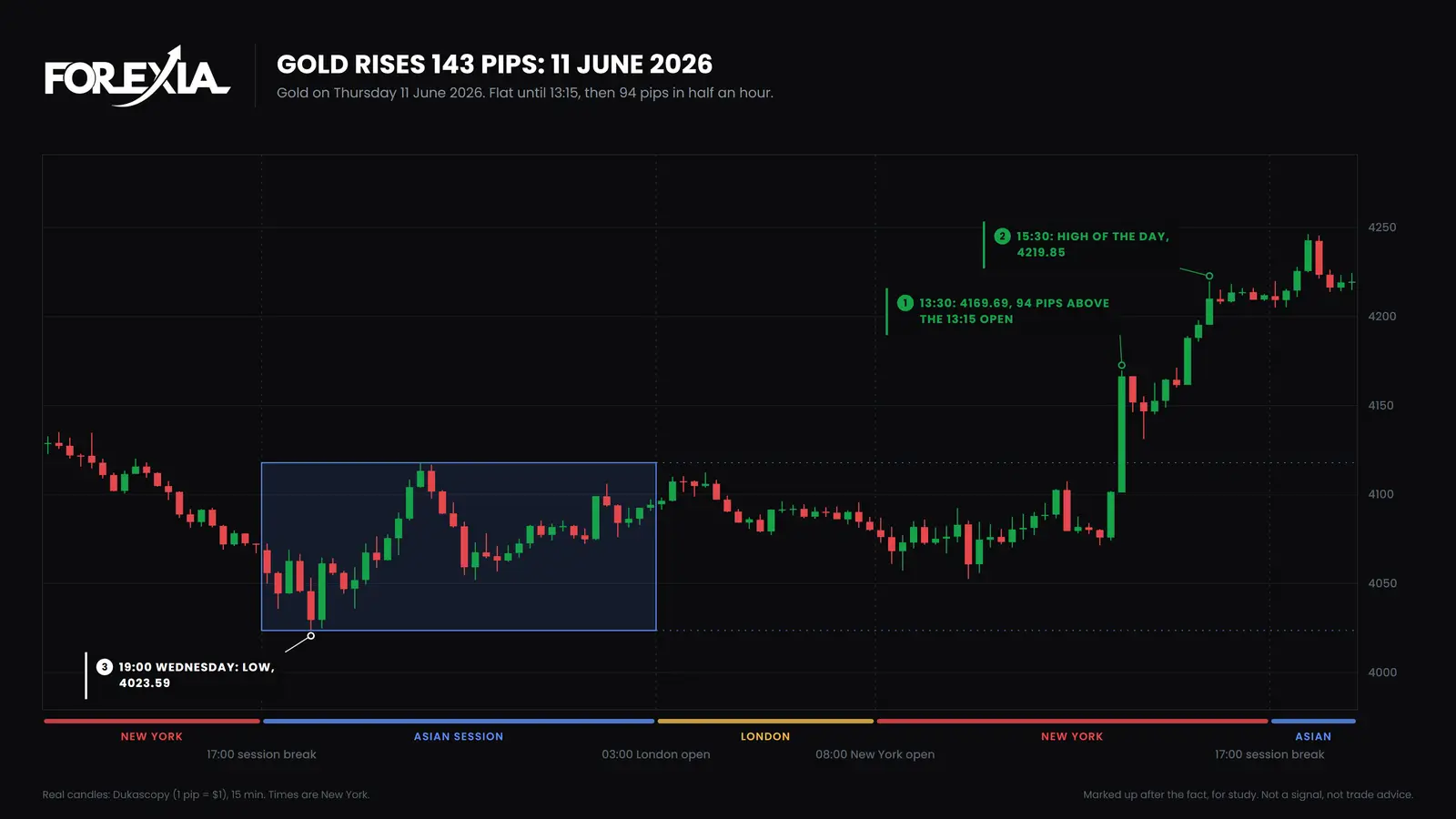
Take Thursday 11 June 2026. Gold opened at 4068.70 and closed at 4212.01, up 143 pips. The 10-year real yield fell from 2.21% to 2.16% and the 10-year Treasury from 4.55% to 4.45%, both on the side that fits. The broad dollar index rose, from 119.91 to 120.12, which does not, though EUR/USD gained 43 pips.
The timing fits less well. The ECB decided at 08:15, and US producer prices came at 08:30, both listed on our calendar. Gold's 08:30 candle opened at 4068.16 and closed at 4073.11, 5 pips higher, and the morning stayed in a narrow band. At 13:15 gold was at 4075.82. The 13:30 candle ran to 4169.69, 94 pips above that open, and the high of 4219.85 came at 15:30. Our stored calendar lists nothing between 13:00 and 14:00.
So the scheduled events fall where gold was quiet, and the move came where none is listed. The yields' direction fits, and a daily yield cannot place a burst in a half hour. We do not name a cause for those 94 pips, because we cannot source one.
What moves gold between the headlines? The orders behind them
A headline says why the crowd traded. It does not say where the orders were. Our method reads a day from three seats: the crowd's, the market maker's and the observer's. The crowd acts on the news. The market maker's seat asks where the crowd's stops and entries rest, because a move that runs through them can be fed by the orders it triggers. News-induced liquidity is the name for the rush of orders a release brings in, and it is the clearest place the two seats meet.
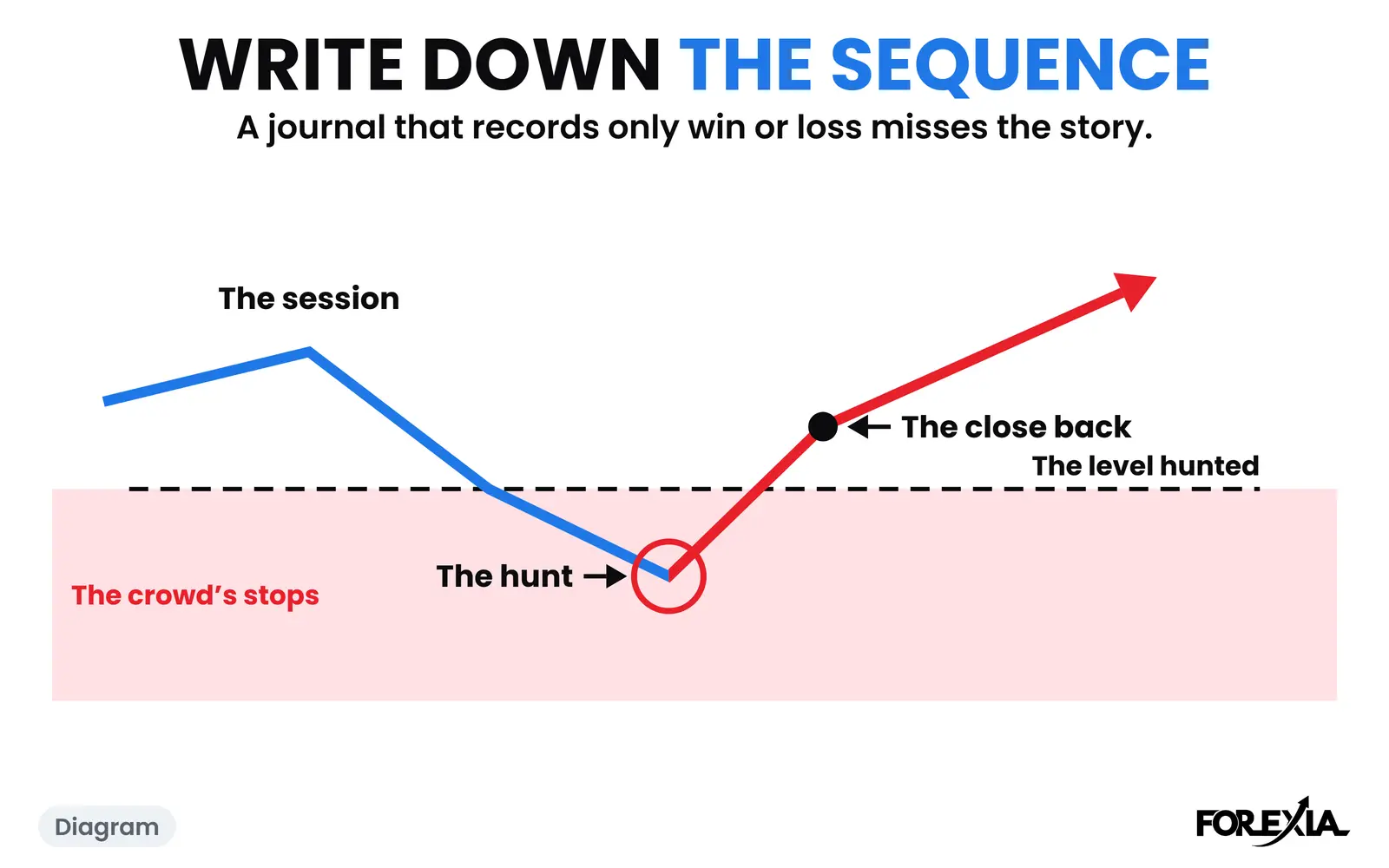
We read two shapes for it. A push through an obvious high or low that closes back is the stop hunt, and the gold M and W patterns are two real days of it. A run that does not close back is just a run. The 11 June move above is a run on our chart: we saw no push and close back, and we say so.
That reading is a way to look at a chart, not a forecast. Our own fixed rule of trading against hunts lost money after costs, as the stop hunt guide sets out.
Who sets the price of gold?
Nobody, in a single place. The LBMA Gold Price is set in auctions at 10:30 and 15:00 London time, administered by ICE Benchmark Administration, and the price comes from each auction's final round. The XAUUSD quote on a chart is a dealer's, and it moves all day on orders in many markets. A day on the Fed calendar adds its own shape, which gold on FOMC day looks at.
How to find what moved gold today
- Look at the dollar. Put EUR/USD beside gold over the same hours. It agreed most often in our test.
- Look at yields. Check the 10-year Treasury on any chart now, then the real yield the next business day.
- Look at the calendar. Find the minute the move began and see whether a release sits there.
- Look at the chart. Did price push through an obvious high or low and close back, or did it run?
- Say if nothing fits. It is a real answer, and it is better than a borrowed headline.
What can this page not tell you?
It tests direction only, on one instrument and 223 days of one year, in which gold made a record in January and then fell. It says nothing about size, and a driver that agrees on direction may still explain few pips. It cannot tell you what moves gold next, and it gives no target.
Course 1 of ForexiaPRO, Reading the Map, teaches The Three Seats starting in lesson 1.1.2.
Tools for this
Frequently asked questions
What moves the price of gold the most?
No single driver wins every day. Over 223 trading days in our candles, the move in the Fed's broad dollar index pointed the same way as gold on 145 days and the opposite way on 78. The 10-year real yield did so on 126 days and not on 73, with 24 unchanged. The dollar agreed most often, and every driver failed on many days.
Does the US dollar move gold?
They tend to move in opposite directions, because gold is priced in dollars. On our days the dollar index and gold moved opposite ways on 145 of 223. On 11 June 2026 they did not: the index closed higher and gold rose 143 pips. The dollar is one pull on gold and not the only one.
Do interest rates move gold?
Through real yields, the Treasury yield after expected inflation. Gold pays nothing, so a higher real yield makes holding it cost more. Over our 223 days a falling real yield came with a rising gold price on 126, and the opposite on 73. The link is loose, and rates do not forecast the next day.
Does inflation move gold?
Not in any fixed way. Inflation matters to gold through the rates markets expect and the real yield that results. The inflation number alone does not give the direction, and we do not read it as a signal.
What moves gold in a day?
Scheduled US releases, the dollar, yields and positioning all contribute, and some of the biggest moves in our candles started at minutes with no release listed. On 11 June 2026 gold rose 94 pips in half an hour from 13:15 New York with nothing on our calendar then.
Who sets the price of gold?
There is no single setter. The LBMA Gold Price is set by auctions at 10:30 and 15:00 London time, administered by ICE Benchmark Administration, and the spot price you see on a chart is a dealer's quote. Orders in many markets move it between those times.