XAUUSD Pip Value: Is a Dollar One Pip on Gold? Three Counts, One Move
Dylan Forexia6 min read
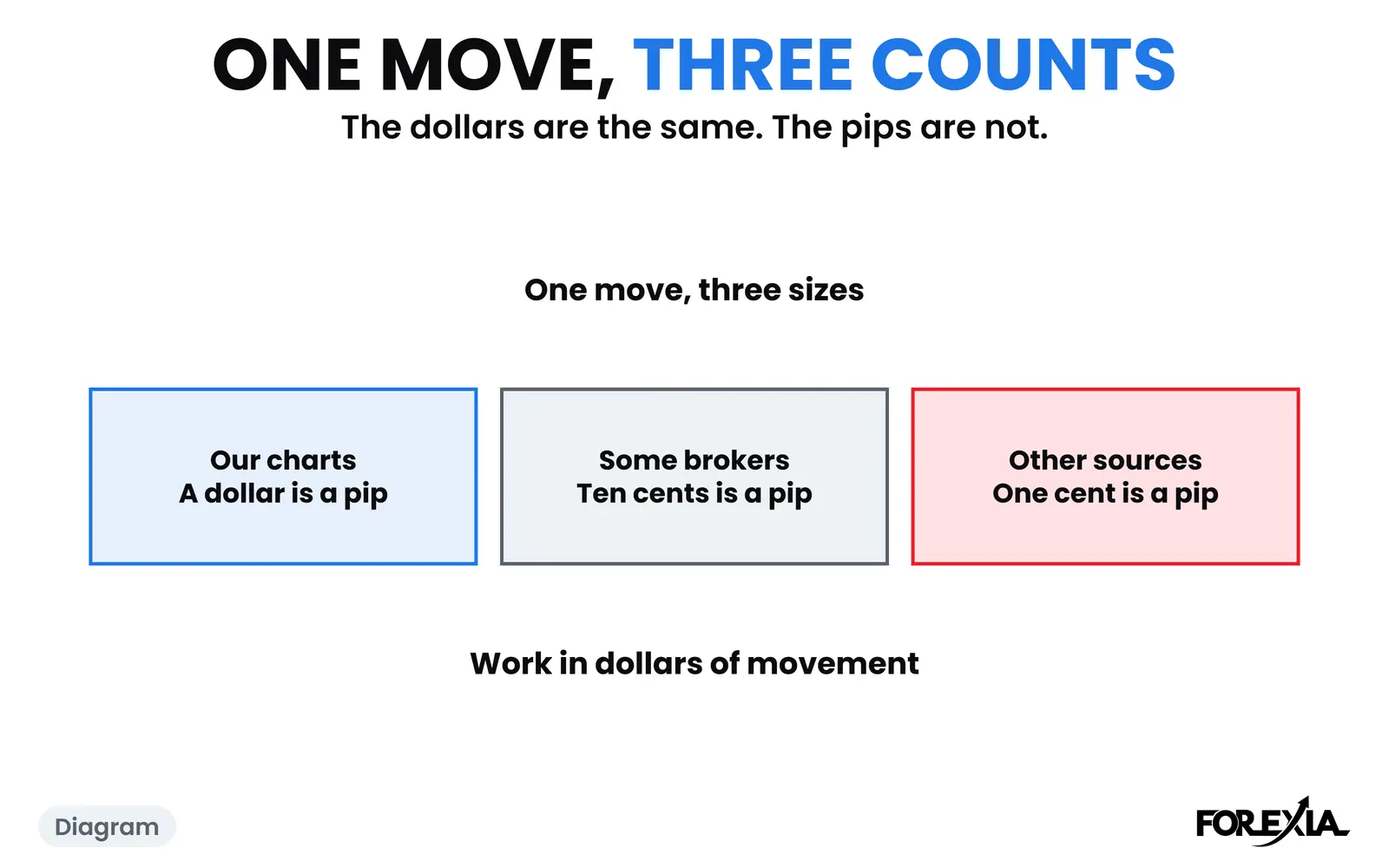
The XAUUSD pip value on our charts is $1 a pip, and on a 100-ounce lot a pip is worth $100. That is a convention and not a standard: some brokers and calculators call $0.10 a pip, others $0.01, and the same $20 move reads as 20, 200 or 2,000 pips. So the first question about any gold pip figure is whose count it is, and the safe habit is to work in dollars of movement.
This page explains the conventions and works them on one real day. To run your own figures, use the pip calculator, the lot size calculator or the gold pip calculator. For gold as a whole, start with how to trade gold.
What is a pip on gold, and why does it differ?
A pip is a unit of price movement that a market agrees on. A currency pair has one: the fourth decimal on EUR/USD, the second on USD/JPY. Gold has no such agreement. Most brokers quote it to two decimals, so one broker's "pip" is $0.10 and a calculator's is $0.01, and we count $1. That is why two gold articles can disagree by a factor of ten and both be right.
We count $1 because dollars are what a gold trader feels, and because our charts show gold in whole-dollar steps. The COMEX gold contract is 100 troy ounces, and we take a lot as that size. That is our convention too, because no exchange sets a lot of spot XAUUSD. Brokers set their own: some use 10 ounces or 1 ounce.
So three things have to be fixed before a pip figure means anything: the size of a pip, the size of a lot, and the account's currency.
What is the XAUUSD pip value for each lot size?
On our count it is the lot's ounces times $1.
| Position | Ounces | Pip value, $1 of movement |
|---|---|---|
| 1.00 lot | 100 | $100 |
| 0.10 lot | 10 | $10 |
| 0.05 lot | 5 | $5 |
| 0.01 lot | 1 | $1 |
There is no price to enter and no conversion, because gold is quoted in dollars. On a dollar account that is the end of it.
A euro account needs one step: work it in dollars, then divide by the dollars one euro buys. At 1.12 dollars to the euro, a 0.10 lot is $10 a pip, which is 10 ÷ 1.12 = 8.93 euros, and a 1.00 lot is 100 ÷ 1.12 = 89.29 euros. The 1.12 is a round figure for the sum, not a quote.
One real move, three counts: Tuesday 9 June 2026
Gold on 9 June ran from 4363.20 at 09:45 New York to 4236.24 at 12:30. That is 4363.20 − 4236.24 = $126.96 of movement. Here is that move in each count, and what it comes to in dollars on a 0.05 lot, which is 5 ounces.
| Count | A pip is | The move reads | On 0.05 lot |
|---|---|---|---|
| Our charts | $1 | 127 pips | $634.80 |
| Some brokers | $0.10 | 1,270 pips | $634.80 |
| Other sources | $0.01 | 12,696 pips | $634.80 |
The right-hand column does not change, and it is the only one that matters. A trader who hears "127 pips", "1,270 pips" or "12,696 pips" is hearing one move.
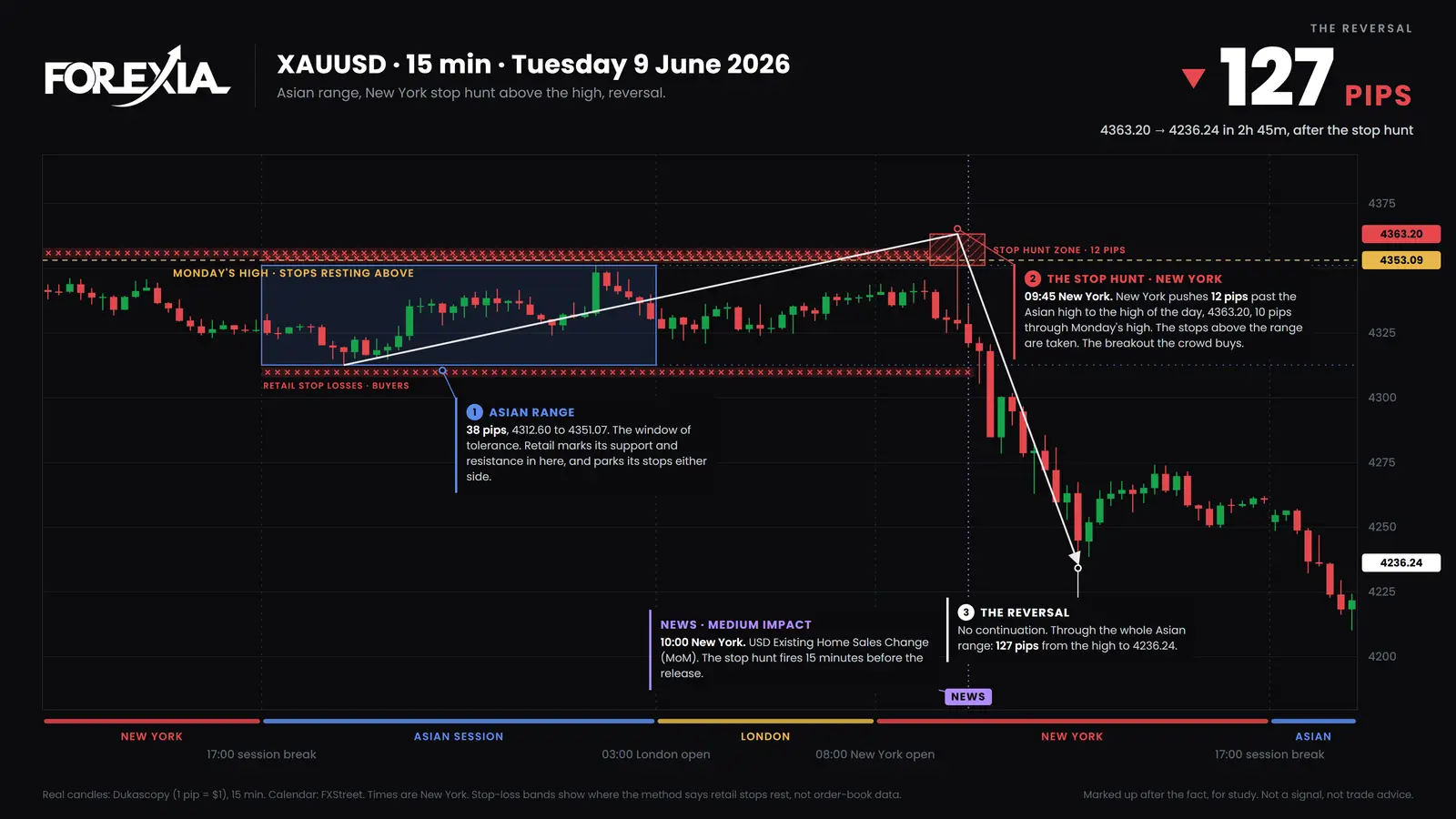
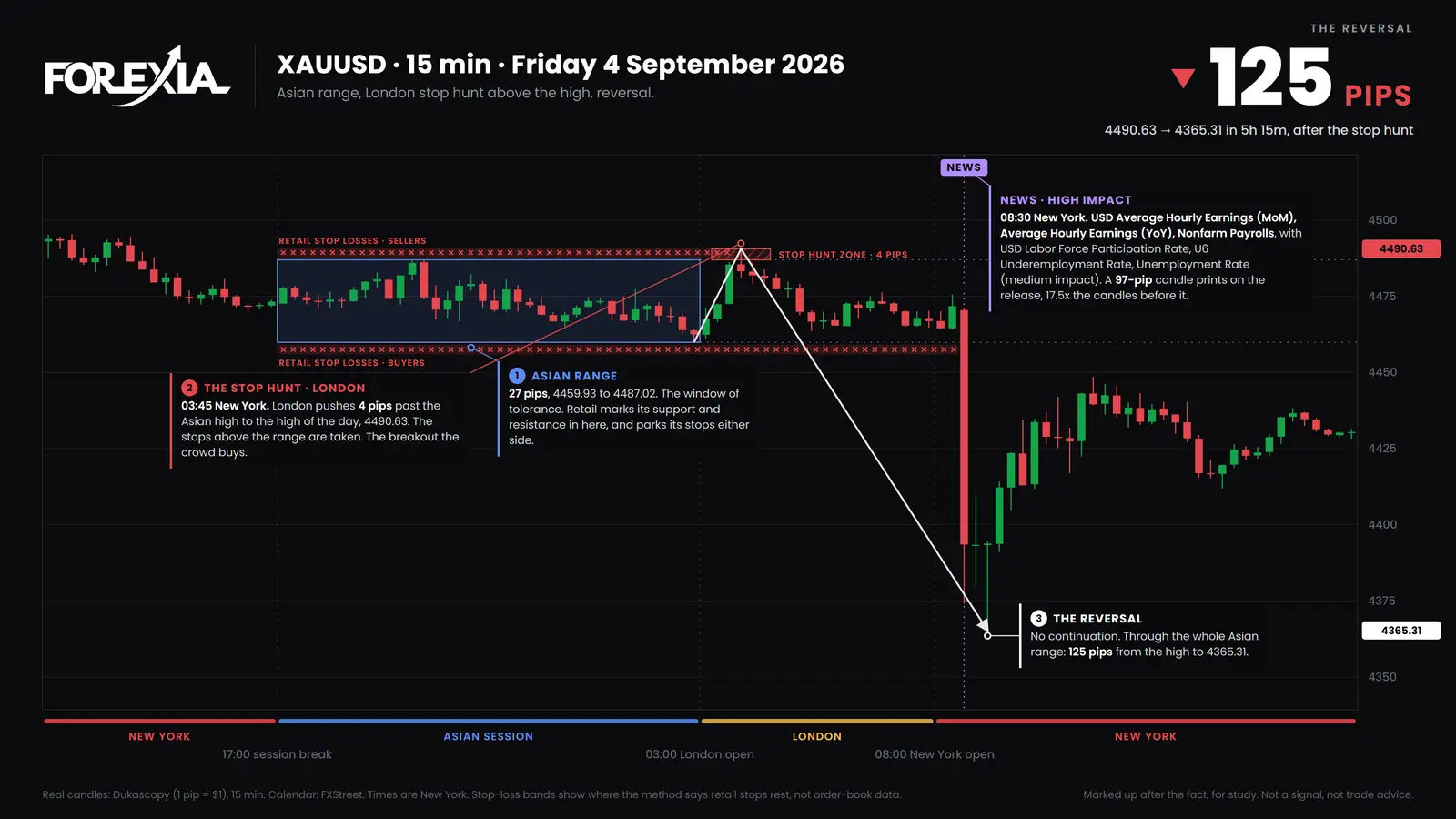
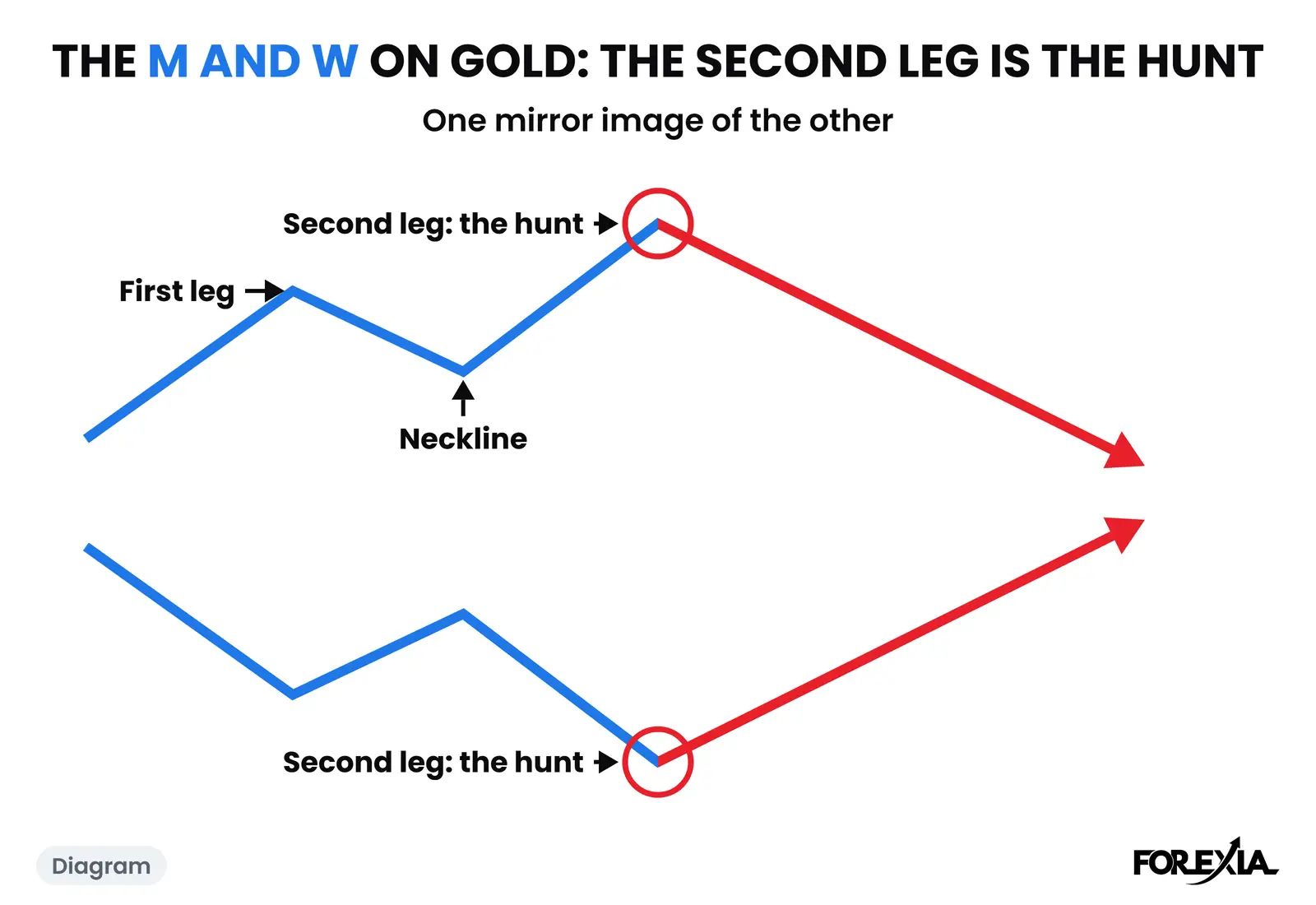
That day was a 127-pip fall by our count after a 12-pip push past the Asian range, which why gold falls draws in full. It is a move seen afterwards, not a setup.
Why does the mix-up cost money?
Because a stop is a number of pips, and the pip is the unit that moves. Take a stop of 50 pips on our count. That is $50 of movement. Type 50 into a calculator that counts $0.10 a pip and it reads $5 of movement, and it sizes ten times too big. At the real $50 stop that size loses ten times what was meant. The other way round, typing a broker's 500 pips into a $1 count answers a size far too small, or none at all.
The arithmetic for a stop is short. Money at risk, divided by the stop in dollars of movement times the ounces per lot. With $100 at risk and a $20 stop on a 100-ounce lot, that is 100 ÷ (20 × 100) = 0.05 lots. We give that as a sum to check against, not as a risk to take. The percentage of an account to risk is your decision, and this page does not set it.
Is it a pip, a point or a tick on gold?
The words are used loosely, so treat each one as a question and not an answer. On a currency pair, many platforms quote a fifth decimal, called a point, and ten points make a pip. A 5-pip move on EUR/USD is 50 points. On gold a platform may use "pip" for $0.10, "point" for $0.01, and neither for a dollar. Our count is the largest of the three, and it is the one that makes a pip equal to the dollar you can see on the chart.
The practical rule does not change. Whatever your platform calls a step, find out how many dollars it is, and multiply by the ounces you hold. That gives the money, and the money is the same on every count.
What else costs money on gold besides the pip?
The spread and the gap. A typical spread on gold from 2021 to 2026 was $0.39, which is 0.39 pips on our count and $39 on a 100-ounce lot, or $1.95 on 0.05 lot. It can widen around a release and at the rollover. And gold gaps: over 25 weekends from April to September 2026 the median gap between Friday's close and Sunday's open was 15 pips, and on 12 April it was 112, from 4746.94 to 4635.00. A stop does not protect you from a gap.
Gold's pip is also a bigger share of a smaller number. A gold day averaged about 101 pips in 2026, which is about $10,100 on one 100-ounce lot, and EUR/USD's averaged 56 pips, about $563 on a standard lot. The same lot size is not the same risk.
How do you check your broker's gold pip?
In three looks, before you size anything.
- The contract size. Is a lot 100 ounces, 10 or 1? It is on the broker's contract specification, not on a calculator.
- The price step. Does the platform quote two decimals, and does it call the second decimal a pip or a point?
- The dollars. Ask what $1 of movement costs on your position, and size from that. It is the same on any count.
What does this page not show?
It does not name a broker, because none was checked for it. It does not say whether $1, $0.10 or $0.01 is the right count, since none is. It does not give a lot size to use or a percentage to risk. And the 100-ounce lot is our convention: if your broker's lot differs, every pip value above scales with it.
From the three seats, the pip count is where retail and the market maker talk past each other: retail counts in the unit its screen shows, and the dollars are what the position actually loses. The stop hunt is a move of a handful of dollars on gold, 3 to 27 pips past a range on the days we have marked.
Tools for this
Frequently asked questions
Is $1 one pip on gold?
On our charts, yes. There is no single standard. Some brokers and calculators call $0.10 a pip, and others call $0.01 a pip or a point. A $20 move reads as 20 pips on our count, 200 on the $0.10 count and 2,000 on the $0.01 count. The dollars are the same under all three.
What is the pip value of XAUUSD on one lot?
$100 on our count, where a lot is 100 ounces and a pip is $1. A 0.10 lot is $10 a pip and a 0.01 lot is $1. Some brokers use a lot of 10 ounces or 1 ounce, so read your contract size before you rely on any figure.
How do I find the pip value on a euro account?
Work it in dollars, then divide by the dollar price of one euro. At 1.12 dollars to the euro, a 0.10 lot is $10 a pip, which is 8.93 euros. A dollar account needs no conversion, and the gold pair is quoted in dollars.
Why do two gold articles give a pip as different sizes?
Because each counts a pip in its own way. One may count $0.10 and another $1. Neither is wrong, but a stop of 50 pips is $50 on one count and $5 on the other, so convert your stop to dollars before you size.