How the BoE Rate Decision Moves Forex, on Real Days
Dylan Forexia6 min read
The BoE rate decision in forex moved GBP/USD 17 to 22 pips in the 07:00 candle on three of the four decisions on our calendar from April to September 2026, and 45 pips on 17 September. An ordinary 07:00 candle ranges about 7. The big one fell through the bottom of the Asian Box, closed back inside it half an hour later, and then went lower still.
All times here are New York and a candle is named by the time it opens. The wider subject is in news trading, and the same read for the ECB and the Bank of Canada is on their own pages.
BoE rate decision forex: what is it, and when does it come?
The Bank of England's Monetary Policy Committee sets Bank Rate, and the Bank publishes its MPC dates in advance. A decision day prints several things in one minute. On our calendar the rate decision, the minutes, the policy summary and the committee's vote counts for a cut, a hike and no change all sit at 07:00 New York, which is noon in London. We do not quote any of them.
Because the vote is part of the minute, a reader cannot tell from a candle whether the pound moved on the rate or on the split. The guides on this search say the split can matter more than the rate. That fits what we cannot see: the candle holds all of it.
BoE rate decision forex: how far did GBP/USD move on four decisions?
The 15-minute candle the decision landed on, 07:00.
| Decision | Range of the 07:00 candle (pips) | Open to furthest point | Open to close |
|---|---|---|---|
| 30 April | 16.8 | 13.7 | 7.6 down |
| 18 June | 21.9 | 16.1 | 13.1 down |
| 30 July | 20.0 | 12.6 | 6.6 down |
| 17 September | 44.6 | 44.2 | 39.1 down |
The median range is 20.9 pips. The median 07:00 candle across all days in our sample is 7.1, so a decision candle ran two to six times an ordinary one. All four closed lower than they opened, which is a fact about four candles and not a rule about the pound. None held the day's high or low. The count is bankDecisions.BoE in scripts/seo-counts.mjs, and it says nothing of what the Bank decided or how it was expected.
On 30 July the morning was crowded: the Governor spoke at 08:00, euro area inflation printed at 08:00 and US core PCE at 08:30, so we have not read that candle as the Bank's alone. The 17 September morning was the clean one.
Why does the BoE decision sometimes sit at 08:00 New York?
The Bank announces at noon London time, and the clocks of Britain and the United States change on different dates. For most of the year noon in London is 07:00 in New York, and it was on all four decisions above. On 19 March 2026, in the weeks when Britain was still on winter time and America on summer time, our calendar has the same decision at 08:00 New York. Take the date and time from the Bank's own page.
It matters for the jobs report and CPI, which stay at 08:30. At 08:00 the Bank's minute is 30 minutes ahead of a US release and at 07:00 it is an hour and a half ahead, so a morning with both can be read as one thing in the first case and two in the second.
What did one real day look like? GBP/USD, 17 September 2026
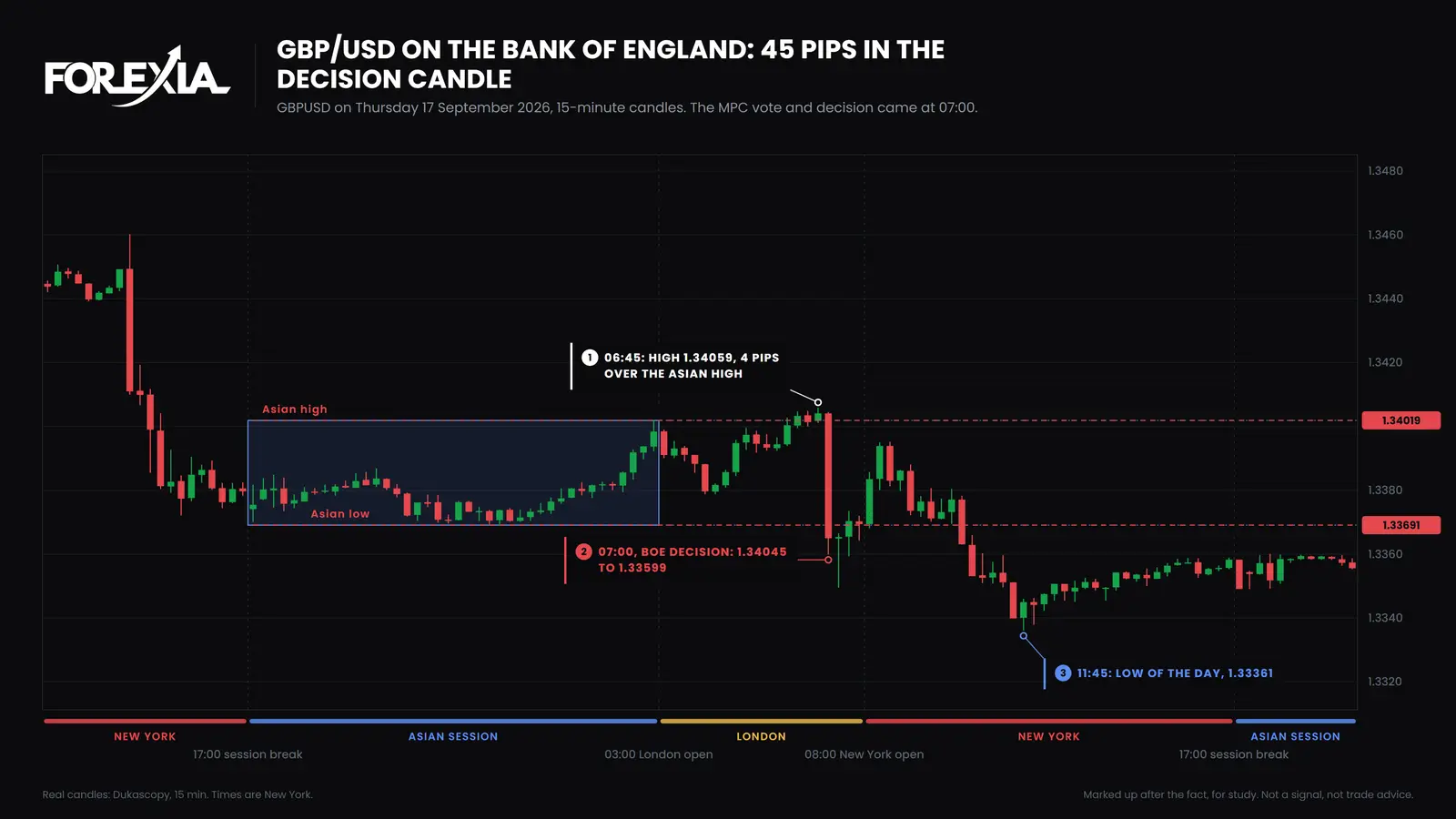
On Thursday 17 September 2026 the only high-impact item on our calendar for the pound or the dollar before noon was the Bank's own minute. The Asian Box was 33 pips, 1.33691 to 1.34019.
- 06:00 to 06:45. Price climbed through the top of the box. The 06:45 candle reached 1.34059, 4 pips over it, and closed at 1.34041. That was the high of the day.
- 07:00, the decision. The candle opened at 1.34041 and traded less than a pip higher. Then it fell to 1.33599, 9 pips under the bottom of the box, and closed at 1.33650. Range 44.6 pips.
- 07:15. The low was 1.33495, 20 pips under the box. The candle closed at 1.33654.
- 07:30. The first close back inside the box: 1.33704, one pip over its bottom. At 08:00 the close was 1.33835.
- After that. The rest of the morning went lower. The 10:30 candle closed at 1.33531, and the low of the day, 1.33361, came at 11:45, 33 pips under the bottom of the box and 70 under the high.
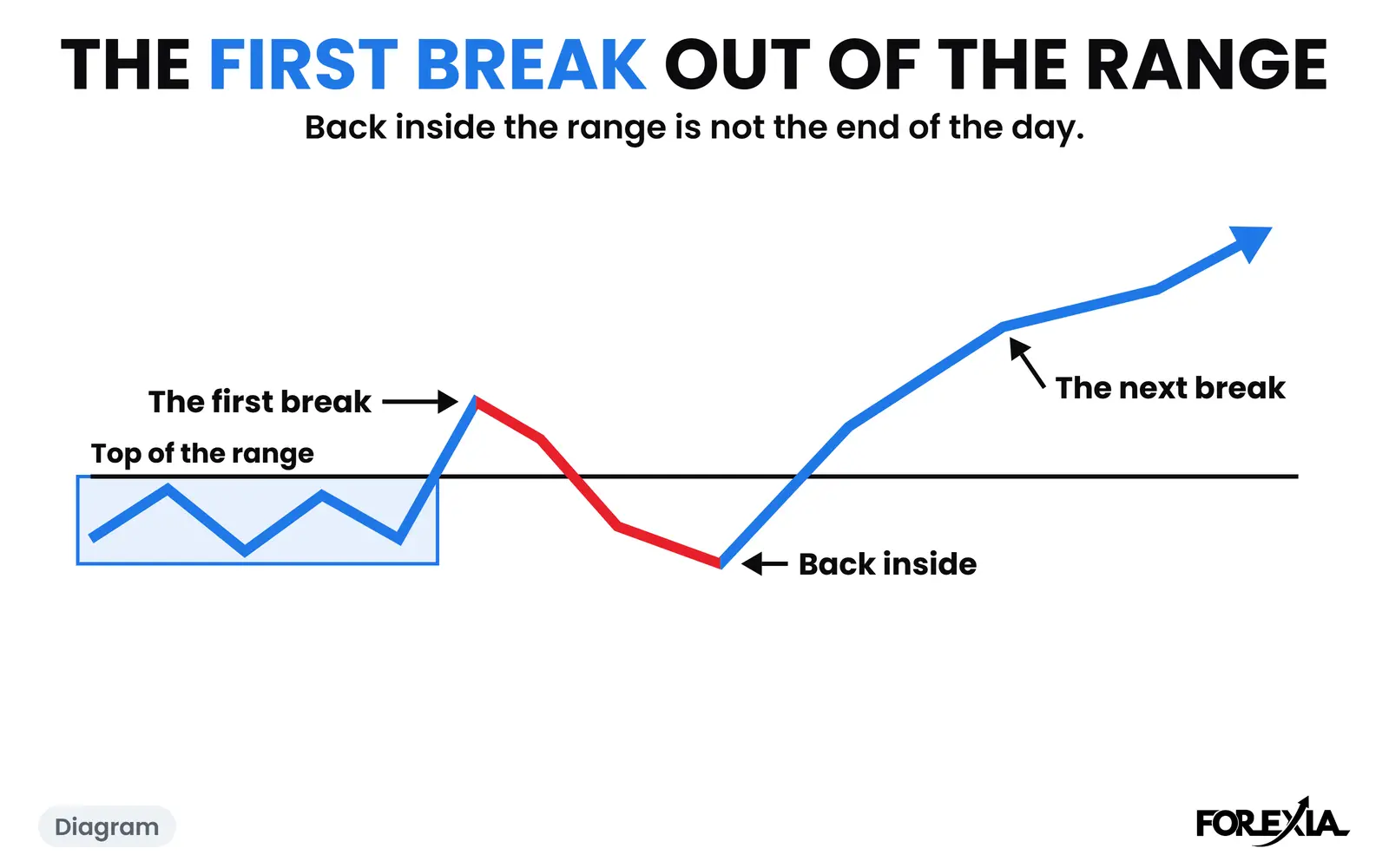
That is the stop hunt of the box's top before the decision and of its bottom in the decision minute, in our words. The 07:30 candle closed back inside the box, which is the Close Back on this timeframe, and it did not mark the end: price made a lower low four hours later. A close back is a fact about one candle. The move to 1.33361 was not a reversal, and a trader who read the close back as the turn was wrong within hours.
Do votes and press conferences move the pound more than the rate?
The guides on this search say so, with examples from earlier years, and they are probably right that a split can move the pound when the rate is as expected. We cannot test it. The candle holds the rate, the vote and the minutes together, and we do not store which way the votes went. All a candle can add is a size and a time.
The size on 17 September was the largest of our four. The time was the first minute. Whether it was the vote, the rate or the words, our data cannot say, and a page that says it can is guessing.
What do the three seats see on a BoE morning?
The Three Seats read 17 September three ways.
- Retail sees a rate decision, a vote and a pound to trade. The candle was 45 pips, and the first sign of a rebound came within half an hour.
- The market maker, as we read it, sees a known minute and a box with stops past both ends. A top that had just been taken and a bottom waiting. That is News-Induced Liquidity. Nobody outside can see those orders.
- The observer sees a size and a sequence. A hunt of the top at 06:45, a run through the bottom at 07:00, a close back at 07:30 and a lower low at 11:45. All can be read from prices, and none says who was behind them.
What does this not tell you?
It does not tell you what the Bank decided or how its committee voted. It is four decisions on one feed, and the 17 September candle was twice the others, so the median is not a typical size. A hunt or a close back seen afterwards is not a setup, and our own fixed-rule test of fading hunts on a release lost money after costs, as the hub sets out. The trap candle looks at the first candle from the wrong side, and the RBA page does the same read on an Asian-session decision.
Course 2 of ForexiaPRO, The Chaos Pattern, teaches this read step by step in lesson 2.3.3, NFP, CPI, FOMC: One Read, Three Calendars.
Frequently asked questions
What time is the Bank of England rate decision in New York?
On the four decisions on our calendar from April to September 2026 it came at 07:00 New York, which is noon in London. The Bank publishes its Monetary Policy Committee dates in advance. The vote, the minutes and the summary print in the same minute as the rate.
How many pips does GBP/USD move on a BoE decision?
On those four days the 07:00 candle ranged 16.8, 21.9, 20.0 and 44.6 pips, a median 20.9, against a median 7.1 for the same candle on ordinary days. All four closed lower than they opened. Four decisions is a small sample, and one of them was twice the others.
Does the BoE decision make the high or low of the day on GBP/USD?
Not on the four we counted. On 17 September 2026 the high of the day came at 06:45, before the decision, and the low at 11:45, nearly five hours after it, and neither came on the decision candle.
Does a close back after the BoE spike mean the move is over?
Not on 17 September 2026. GBP/USD fell 45 pips through the bottom of its Asian Box at 07:00, closed back inside it at 07:30, and went on to a low 33 pips under the box by 11:45. A close back is a fact about one candle.