Pending Orders Before London Open: Stop Chasing Price, and What Rests There
Dylan Forexia7 min read
Pending orders before London open are orders placed in the quiet hours, at a price the market has not reached yet, so you are not chasing the spike when it comes. Forexia's word for them is Pending Limit Orders, and they are the order side of the #SignatureTrade. This page says what such an order meets on a real day, how far price went past the level on three of them, and why a fill is not a signal.
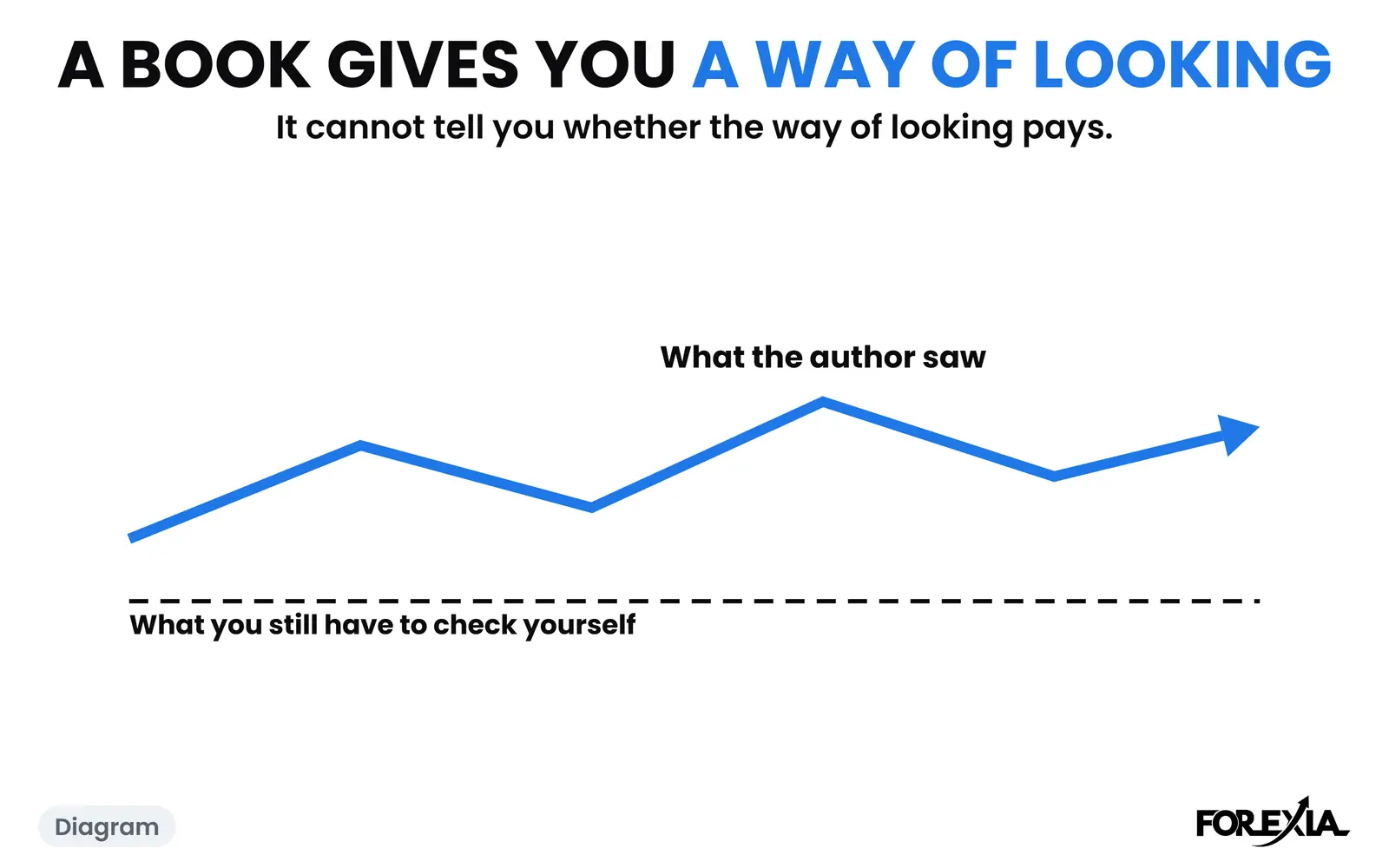
The word is defined in the glossary, Pending Limit Orders. Where to place an order, and how far to let price run, is the lesson, and this page does not give it.
What are pending orders before the London open?
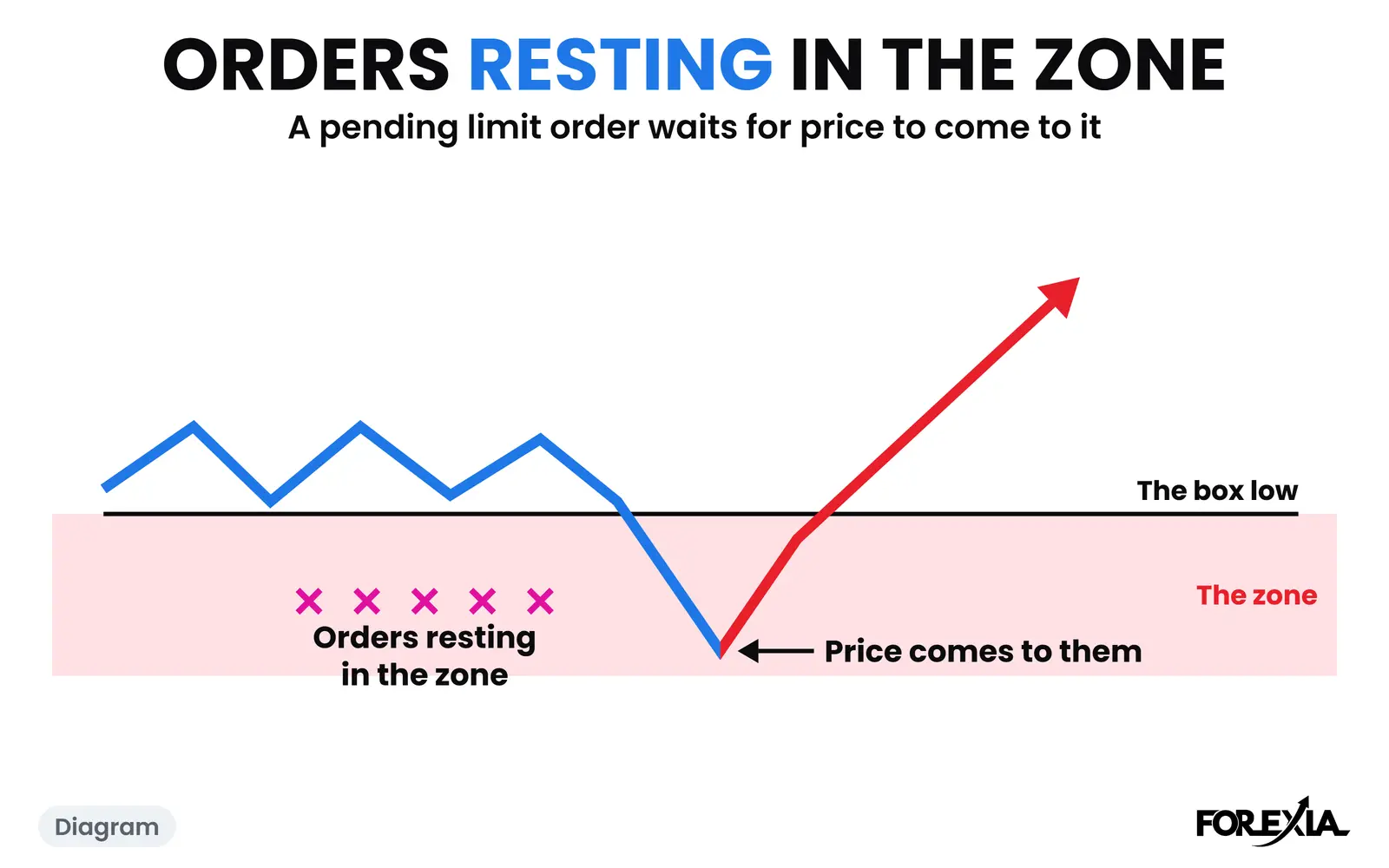
A pending order waits. A buy limit sits below the current price and a sell limit sits above it. Nothing happens until price reaches the level, and if price turns short of it, the order is never filled. A stop order is the opposite kind: it sits beyond the price and fills when the market runs on.
Searched for on its own, the question is about buttons: which order type, which price. Our word adds where and when. The where is a place where we read the crowd's stops resting, such as an edge of the Asian Box or the previous day's high or low. The when is the hours before London, which is the idea behind Liquidity Mapping: mark the pools while the chart is calm.
Why does an order placed ahead beat chasing the spike?
Because by the time you can see the spike, it is gone. The stop hunt that fills a resting order is one fast candle, and what follows is the close back. An order placed at a screen after that candle closes is placed at a price the market has already left.
On GBP/USD on 22 May 2026 the 03:00 candle, London's first, traded to 1.34130, under the Asian box. The candle that opened at 03:15 closed at 1.34251, 12 pips above that low. A trader who waited to see the close back was buying 12 pips higher than the price the hunt printed. That is a fact of the candles, not a claim about a trade, and the price someone else got is no guarantee of the result.
What does a resting order meet on a real day?
The Asian Box on GBP/USD on Friday 22 May 2026 ran from 1.34167 to 1.34336, 17 pips, between the 17:00 session break and the London open at 03:00 New York.
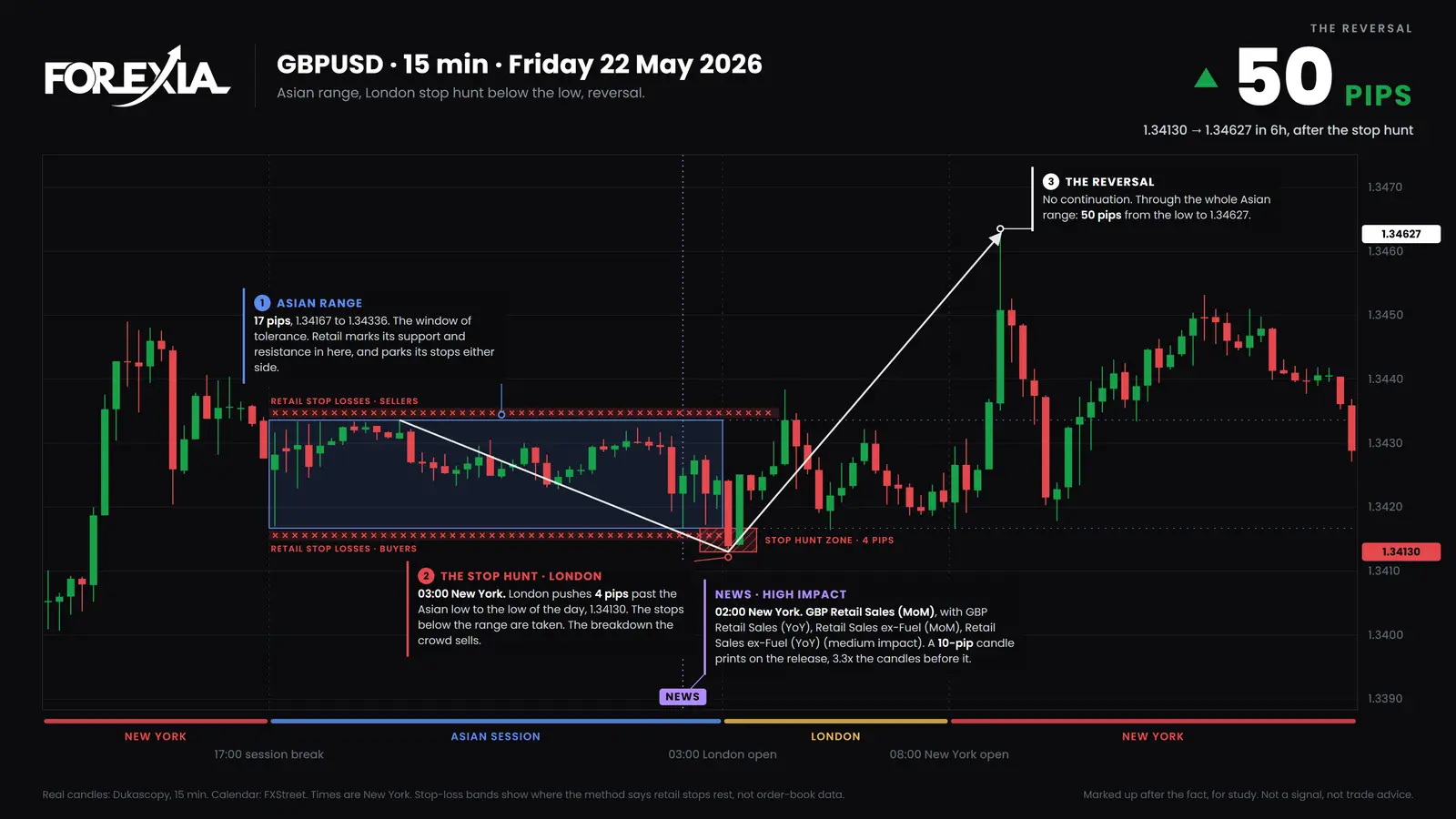
Candles are named by when they open. This is what a resting order at the zone around the low met.
- The line was touched before the hunt. The 02:00 candle, which opened on the release of UK retail sales, set the box low at 1.34167. The 02:30 candle came to 1.34172. An order resting exactly at the line filled on a touch like these, not on the hunt.
- The hunt took it by about 4 pips. The 03:00 candle traded to 1.34130 and closed at 1.34139, still under the box. An order resting in those 4 pips was filled. One resting under 1.34130 was not.
- The close back came a candle later. The 03:15 candle closed at 1.34251, back inside the box.
- Price went on, then gave it back. The 09:00 candle reached 1.34627, 50 pips above the low and past Thursday's high of 1.34546, then closed at 1.34508. At 17:00 the day ended at 1.34288, 16 pips above the low and inside the box.
It was not a day without news. UK retail sales came at 02:00, our calendar marks the monthly figure high impact, and a Fed speaker was due at 04:00. US consumer sentiment came at 10:00, when the candle fell from 1.34375 to 1.34203.
What if the hunt goes further than you expected?
On USD/JPY on Monday 28 September 2026, Friday's low was 156.938. The 04:00 candle closed at 156.697, 24 pips under it, and the 04:15 candle reached 156.506, 43 pips under. That candle and the next two also closed under the line. The 05:00 candle closed at 156.991, back above, and by 11:00 price was at 157.583, 108 pips off the low.
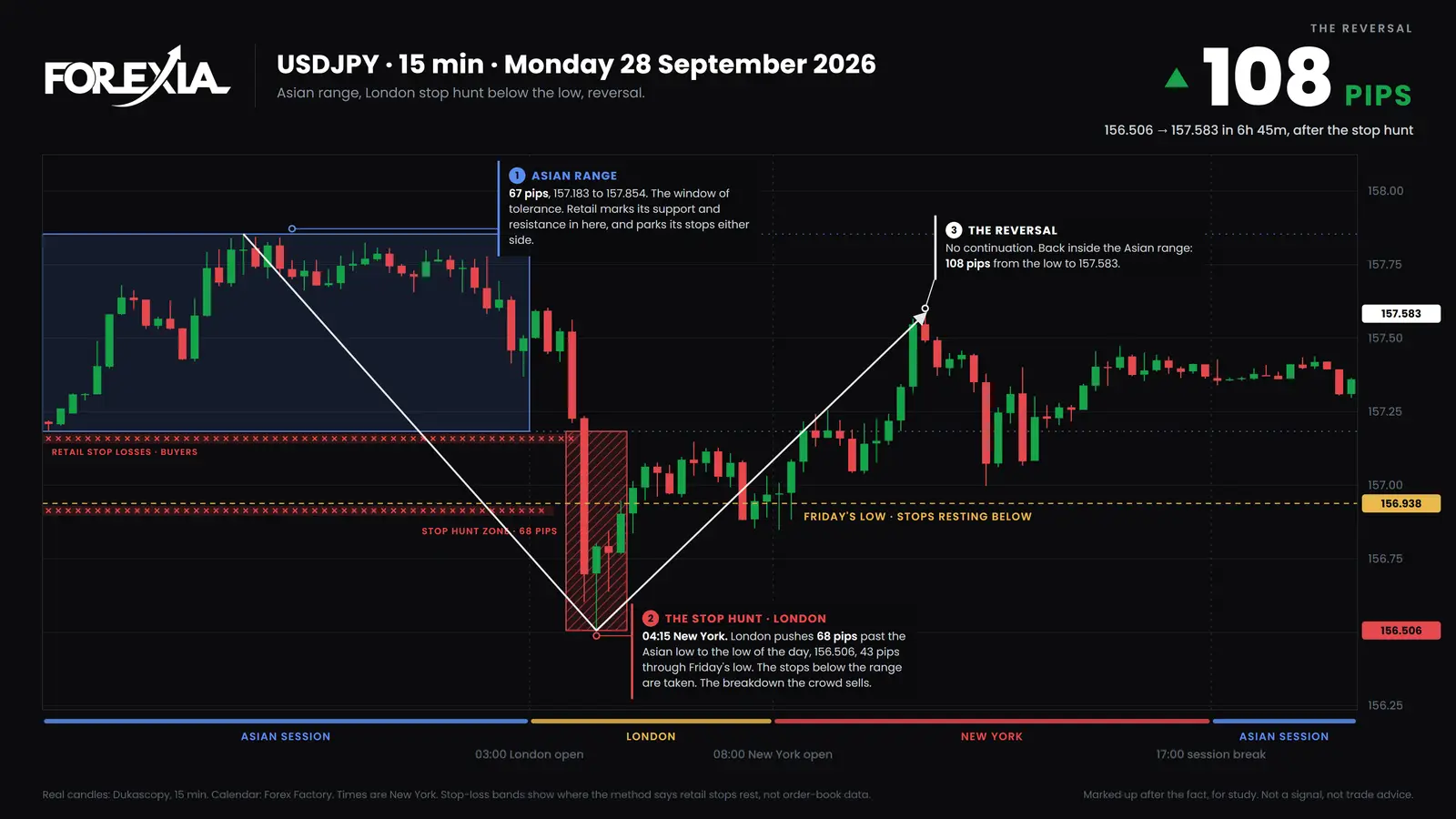
An order resting anywhere between 156.938 and 156.506 was filled. One resting under 156.506 was not, and it would have missed the turn. For an hour a trader would have been watching four closes under the line.
What if the level was a real break?
On AUD/USD on Thursday 10 September, Wednesday's low was 0.72095. The 05:30 candle closed under it, the 05:45 candle closed back at 0.72110, and the 06:00 candle closed under at 0.72064. No candle closed back after that. By 08:30 on Friday price was at 0.71496, 60 pips under the line. An order resting at the low was filled, and the day did not reverse. A resting order does not know which kind of day it is in.
How far does price go past a level, and how often does it stay?
A resting order is filled by a touch, so what matters is how often a level is reached and what it does after. We counted on seven dollar majors and gold, 15-minute candles, from 6 April to 1 October 2026. A level is an edge of the Asian Box, or the previous day's high or low if Asia had not traded past it. Taken means through it after the London open by at least 3% of the average daily range. 1,601 levels were taken.
- 1,310 closed back the same day, by a median of 9% of the average day past the level.
- 291 (18%) had not closed back by 17:00, and ran a median of 65% of the average day past it.
For the levels that closed back, the median trip past the line was 4.1 pips on USD/CHF, 4.3 on NZD/USD, 4.6 on AUD/USD, 5.7 on USD/CAD, 6.5 on EUR/USD, 7.3 on GBP/USD, 7.4 on USD/JPY and 10.1 on gold, where $1 counts as 1 pip. Those are medians of one kind of level, and the 291 that kept going are not in them. This counts candles, not trades: no order, fill, stop or cost.
Who is on the other side of a resting order?
The retail seat has placed its own orders at the same lines: stops past the range, breakout buys over the high. The market maker's seat sees those stops as the orders that will fill whatever comes at them, which is why a fast candle can reach them. The observer's seat, ours, puts an order where the crowd's stops are, so that the crowd's fill is the other side of its own. We call that a read of the chart and not a fact about anyone's orders: the stop bands on our charts show where the method says stops rest, not order-book data.
It also means a limit order here is only as good as the read. If the level is not where the stops are, the order is a limit order like any other, and the setup does not make it better.
What do traders get wrong about resting orders?
Three readings cost the most.
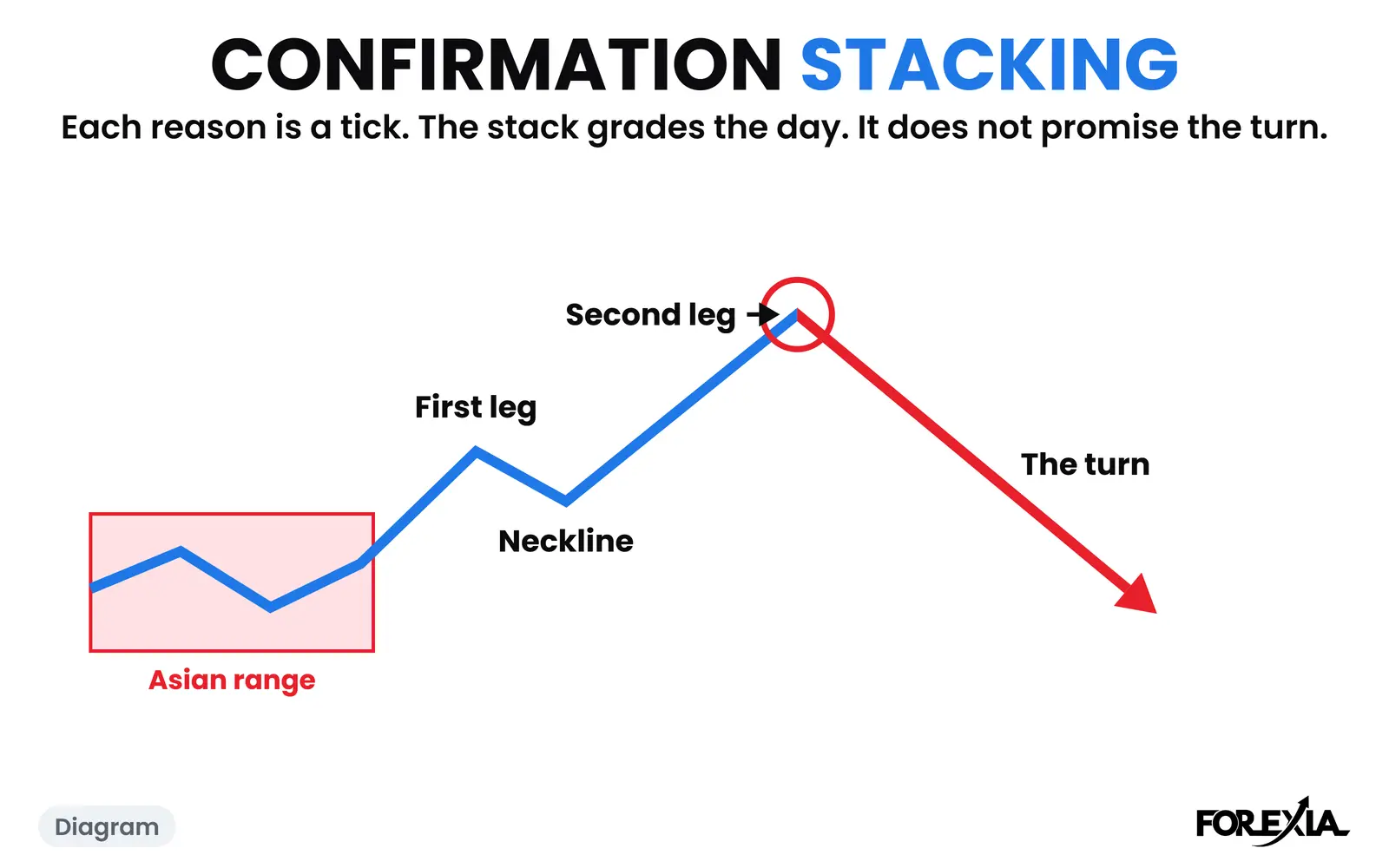
- Reading a fill as a signal. A fill says price arrived. On 22 May the line was touched at 02:00 and 02:30 and held, then gave way at 03:00.
- Taking one good day as the pattern. The 291 levels with no close back look like 28 September until the day ends.
- Treating a zone as a price. A level is a place where stops cluster, and the hunt can stop short of it or run through it.
Our own test of the setup as a mechanical rule did not make money, and a reversal seen afterwards is not a setup. Trade management in forex is the page for what happens after a fill.
Course 5 of ForexiaPRO, The #SignatureTrade, teaches how the orders are placed, in lesson 5.3.1. It is on ForexiaPRO.
Frequently asked questions
What is a pending order in forex?
An order to buy or sell at a price that has not been reached yet. A buy limit sits below the market and a sell limit above it, and nothing happens until price touches the level. If price turns short of it, the order is never filled. A stop order is the other kind: it sits beyond the price and fills when the market runs on.
How far does price usually go past a level before it closes back?
On seven dollar majors and gold from 6 April to 1 October 2026, among the levels that closed back the same day, the median trip past the level was 4.1 pips on USD/CHF, 6.5 on EUR/USD, 7.4 on USD/JPY and 10.1 on gold. It is a median of levels that closed back, so the 291 levels that did not close back are not in it.
Does a limit order at a level fill on a stop hunt?
It fills if the hunt reaches the price. On GBP/USD on 22 May 2026 the hunt ran about 4 pips under the Asian low, so an order resting inside those 4 pips was filled and one resting under 1.34130 was not. The line itself had been touched earlier, at 02:00 and 02:30, so an order exactly on it filled before the hunt.