Forex Trading vs Gambling: Where the Line Really Is
Dylan Forexia7 min read
Forex trading and gambling are different things that can look the same from the chair. The market is real, and a trade can rest on a reason. It becomes closer to a bet when there was no reason before the click, no record afterwards, and no ground to expect a gain after costs. Having a reason does not make a trade win either.
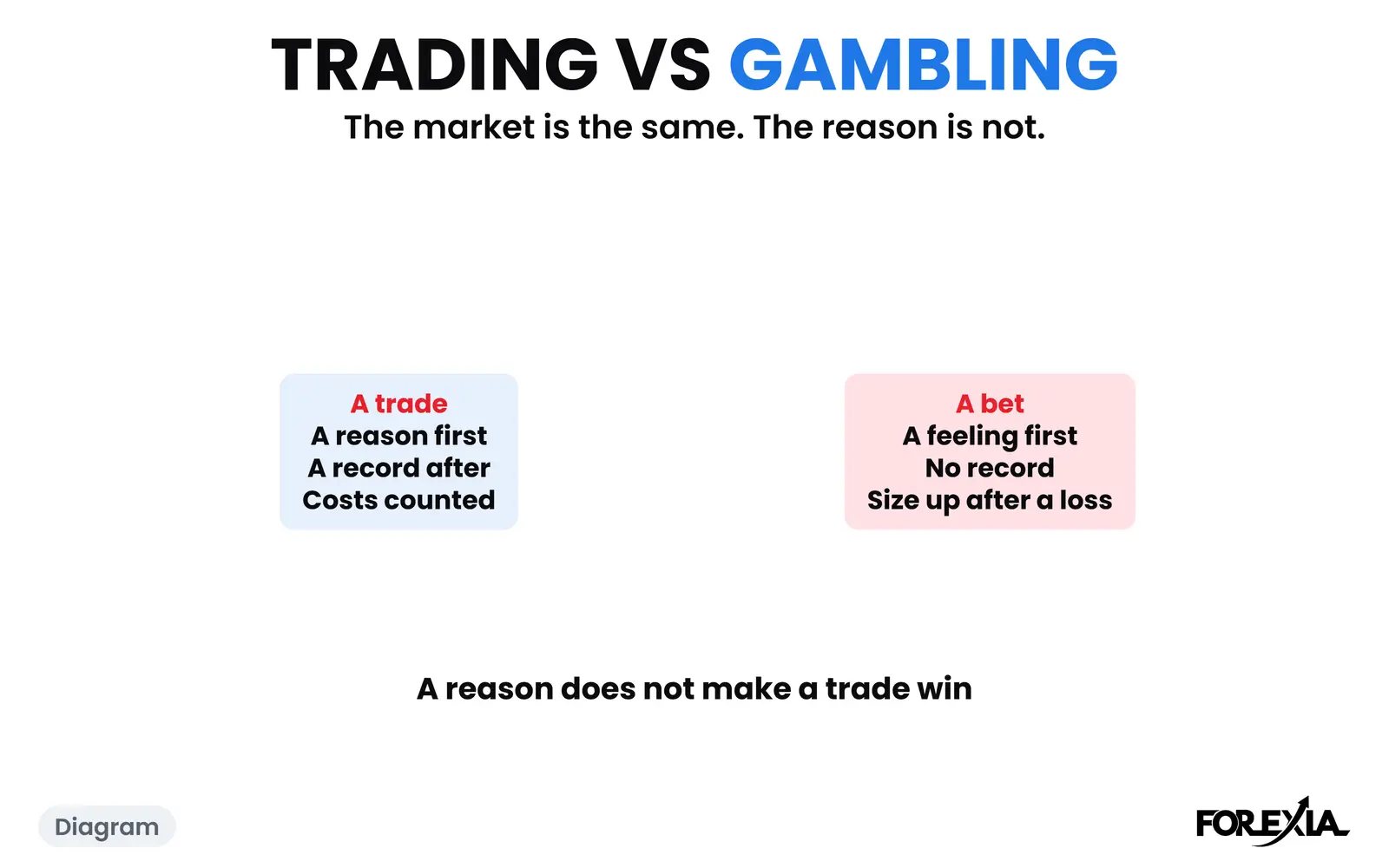
This page does not tell you which one you are. It gives you four questions that can, and two real mornings that show why the answer is not in the outcome.
What makes something gambling?
Gambling is staking money on an outcome you do not control, where the odds are set by someone else and the result is mostly chance. A casino writes its odds into its rules. A roulette wheel does not care what you think of it.
Trading shares the first part. You stake money on a price you do not control, and any single outcome is uncertain. It differs on the second: nobody has written the odds into a currency price. Many buyers and sellers set it, for many reasons. Whether the odds are in your favour on a given trade is a question about your reason, and about the costs you pay.
So the useful question is not whether forex is a casino. It is whether your trade has a reason, and whether the reason is better than the cost of taking it.
Is forex trading gambling or skill?
Both words claim too much, and the honest answer is that nobody can tell from one trade. Skill is a claim a trader can support only with a record: every trade, after spread and commission, over enough trades that luck is a poor explanation. Most do not have one that shows a gain. The CFTC's customer advisory says that about two-thirds of customers at registered retail forex dealers lost money, and it also says that off-exchange you are trading against the dealer, whose earnings come from your trading volume, your losses and its fees.
Two things follow. First, a retail trade is not a fair coin flip: the costs mean you start a little behind. Second, a casino at least says so. Forex does not, and that is part of why the line feels blurry.
Our own result belongs here. We tested our setup as a fixed mechanical rule, a program with no fear and no greed, and it did not make money. A trader following that rule with perfect discipline would have got the same result. A reason can be careful and still lose. That does not make a careful trade gambling, and it does not make it a good one.
What does the research say?
Not much that is specific to forex, so here is the nearest evidence, read as such. Gao and Lin (2015) found that when Taiwan's lottery jackpots passed 500 million Taiwan dollars, trading volume fell between 5.2% and 9.1% in the stocks individuals favour. When the lottery got more exciting, some of the trading went away. That is stocks, and it does not show that any one trader is gambling. It does suggest that for some people the two scratch the same itch.
A 2025 systematic review of 23 papers called problematic trading a "new potential clinical disorder" that still needs defining, and found that psychologists tend to fold it into gambling. It is not a recognised diagnosis of its own.
Two mornings that start the same way
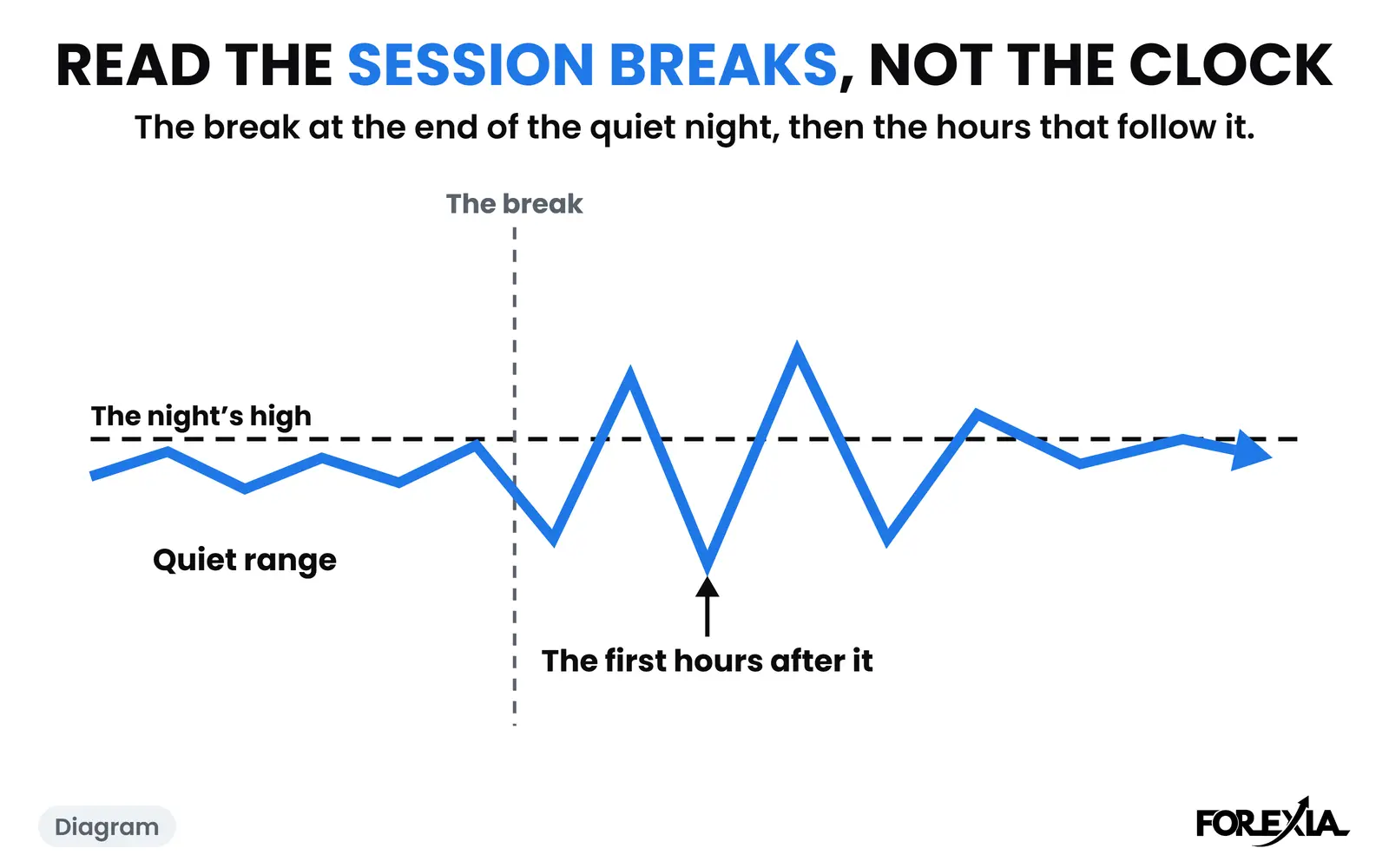
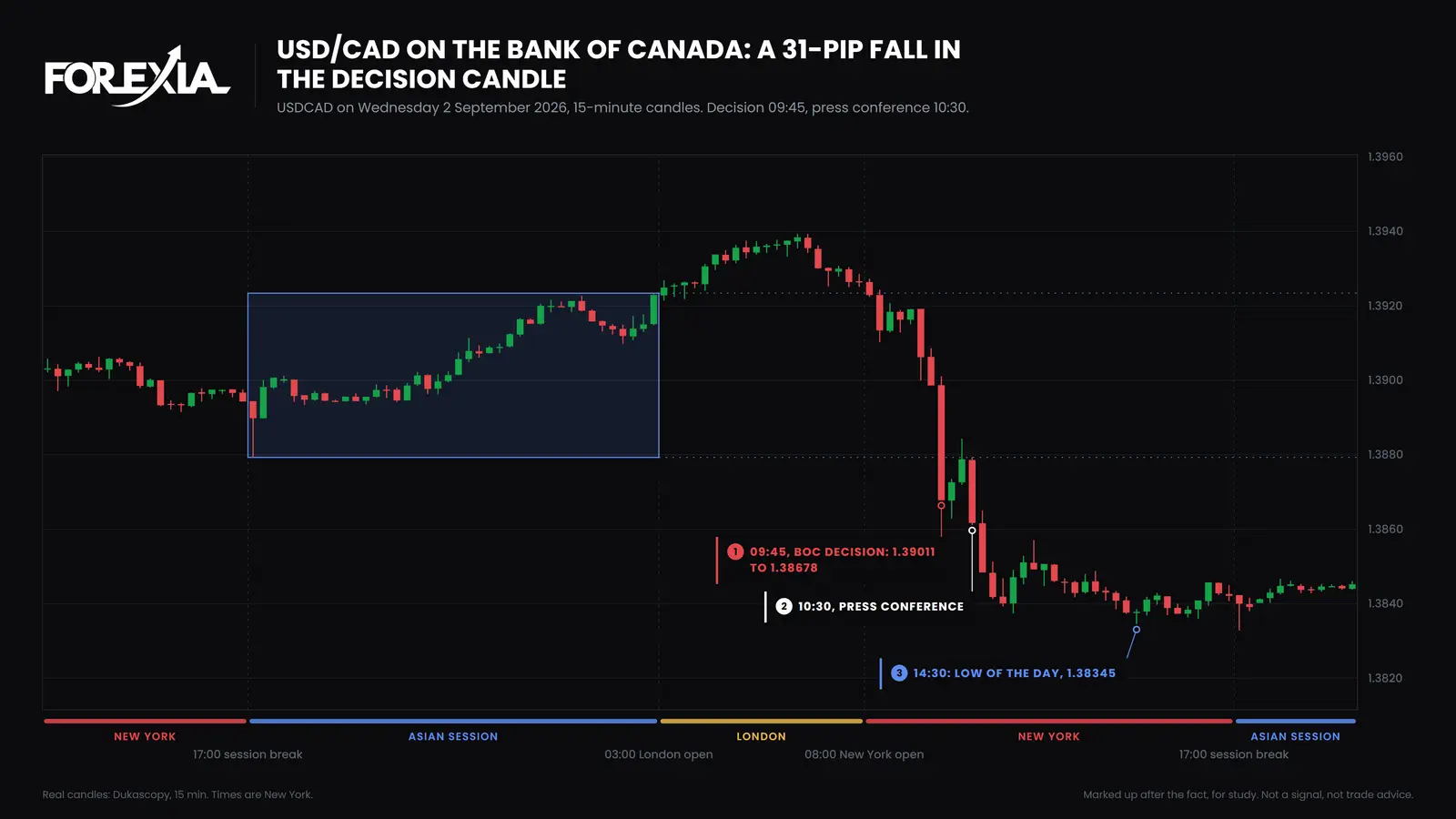
A break of the night's range looks like a trade to some people and a bet to others, and the outcome cannot tell you which. Here are two mornings on GBP/USD that began alike.
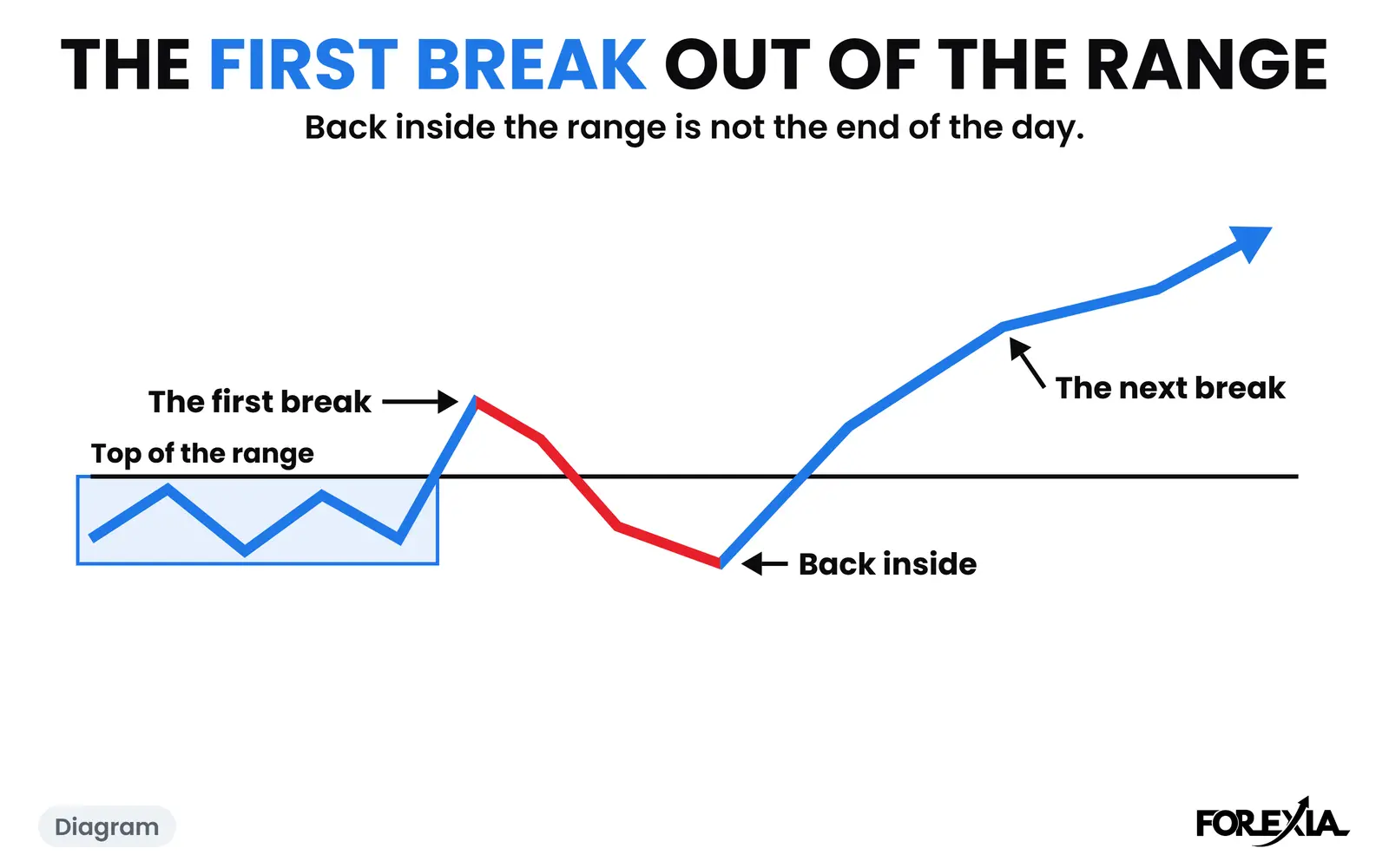
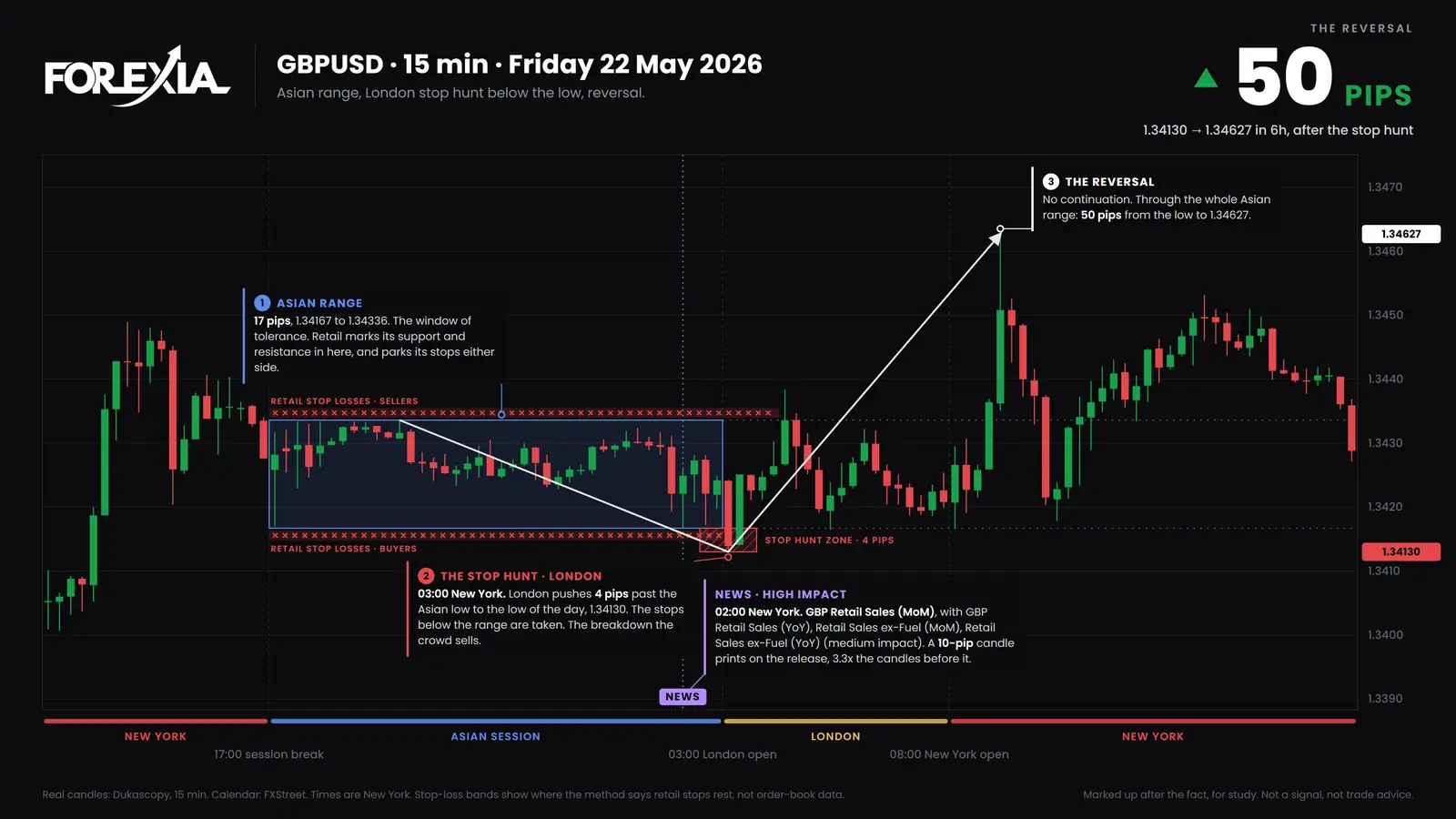
On Friday 22 May 2026 the Asian box ran 17 pips, from 1.34167 to 1.34336. At 03:00 New York a candle took price to 1.34130 and closed at 1.34139, under the box: the first close outside it. The 03:15 candle closed at 1.34251, back inside. The low of the day was that 1.34130 and the high was 1.34627 at 09:00, 50 pips higher. Our calendar had UK retail sales at 02:00.
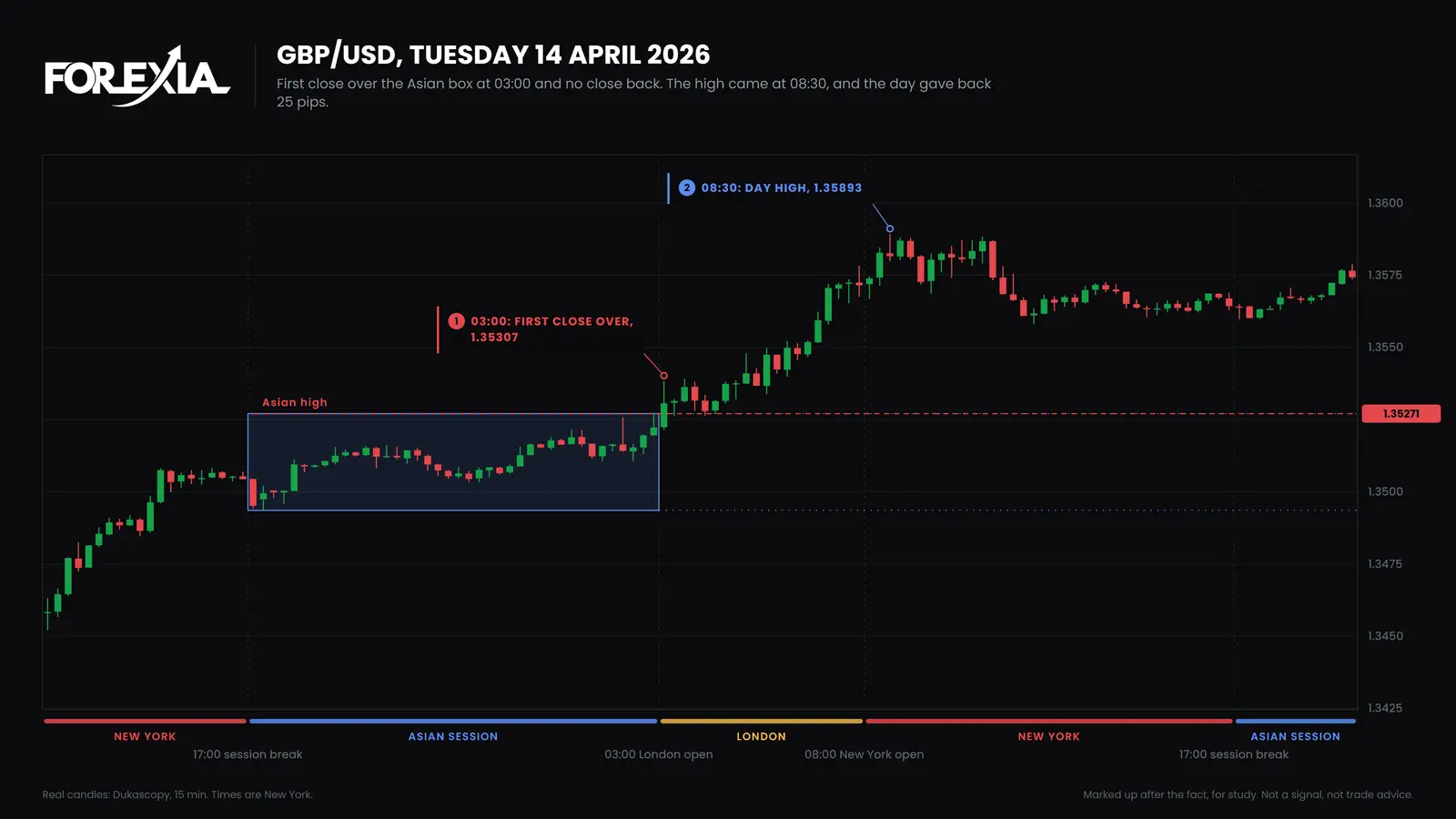
On Tuesday 14 April 2026 the box ran 34 pips, from 1.34936 to 1.35271. The 03:00 candle closed at 1.35307, over the box, and no candle closed back inside that day. The high was 1.35893 at 08:30, when US producer prices came out, and the day's last close was 1.35643, 25 pips under the high.
Two mornings, two first closes outside a range, two opposite endings. Someone who acted on either one at the time had a reason and no way to know which kind of day it was. A trader who took the first on a rule they could write down, and took the second the same way, was trading, even though one of them lost. A trader who took either because the candle looked exciting was betting, even if it paid.
That is the point of the line. It lives in the process, and one result cannot show it. The three seats see the same candle differently: retail sees urgency, the market maker's seat is the one nobody outside can see, and the observer sees a close and what came next. The Three Seats is our name for reading from all of them.
Four questions for your own last ten trades
These tell you more than any definition. Good answers do not make you profitable, and they only tell you that you are running a test and not a slot machine.
- Could you say, before entry, why you expected a gain and what would prove you wrong? If not, it was closer to a bet.
- Do you know your result after spread and commission? If you keep no record, you do not know which you are doing.
- Did your size go up after a loss? That is chasing, and it is the plainest sign it has turned.
- Would you take the trade if it were boring? If the excitement is the point, it is the wrong reason.
If you answered badly to two or more, why you take trades you know you shouldn't looks at what is pulling, and why you lose in forex with a good strategy looks for the leak in a rule that is sound. Whether the people selling around the market can be trusted is on is forex a scam.
When is it a health problem?
If you are hiding losses, borrowing to trade, or cannot stop, it may be. Chasing losses is one of the signs the American Psychiatric Association lists for gambling disorder. We are not clinicians. If these fit, talk to a doctor or a gambling support service. That matters more than anything on this page.
Common mistakes
Most of the confusion comes from three moves that feel reasonable.
- Judging the process by the result. A winning bet is still a bet, and a losing trade with a reason is still a trade.
- Calling a risk plan a reason. A stop tells you what a loss costs. It does not say why you expected a gain.
- Treating "it is a real market" as an answer. It is real. That does not make your trade better than a bet.
The wider subject is on the trading psychology hub, and dumb money is our word for the crowd that bets without knowing it.
Course 1 of ForexiaPRO, Reading the Map, teaches reading a chart from three seats, starting with lesson 1.1.
Frequently asked questions
Is forex trading gambling?
It can be. The market is real and a trade can rest on a reason, but what matters is why you took it and whether you had grounds to expect a gain after costs. A trade with no reason beforehand, no record afterwards and a bigger size after a loss is closer to a bet. A trade with a reason can also lose, and that does not make it gambling.
Is forex gambling or skill?
Both words claim too much. Skill is a claim you can only support with a record of your trades after costs, over enough trades, and most retail accounts do not have one that shows a gain: the CFTC reports that about two-thirds of customers at registered dealers lost money. We cannot say how much of a given result is skill, and our own test of our setup as a fixed rule did not make money.
How is forex different from a casino?
A casino game has its odds written into its rules, and the house takes a stated share. A currency price is set by many buyers and sellers, and there is no stated edge for or against you. You do pay costs on every trade, and if you trade with a retail dealer it is your counterparty, which is a conflict a casino does not pretend away.
How do I know if I have a gambling problem with trading?
Hiding losses, borrowing to trade, chasing a loss with a bigger trade and being unable to stop are the signs to take seriously. Chasing losses is one of the signs the American Psychiatric Association lists for gambling disorder. We are not clinicians. If these fit, talk to a doctor or a gambling support service.