Best Time to Trade EUR/USD: Real Ranges by Hour
Dylan Forexia7 min read
The best time to trade EUR/USD for movement is 08:00 to 11:00 New York time, 13:00 to 16:00 in London. On 129 market-days from 6 April to 1 October 2026, EUR/USD's median range was largest in the 10:00 New York hour, at 14.8 pips, and its quietest hours were 18:00 and 19:00, at 4.9. Movement is not profit, and we did not count spreads.
The rest of this page is the hour-by-hour table behind that answer, two real days that sit far above it, and what the table cannot tell you. The forex sessions page has the clock and the daylight-saving dates for every city.
What is the best time to trade EUR/USD, hour by hour?
Here is each hour of the trading day, from the 17:00 New York break to the next, with its median high-to-low range in pips. An hour is named by the New York time its candles open: the 10:00 row is 10:00 to 10:59. London's time is five hours ahead of New York's in this sample.
| New York hour | London | Median range, pips |
|---|---|---|
| 17:00 | 22:00 | 5.2 |
| 18:00 | 23:00 | 4.9 |
| 19:00 | 00:00 | 4.9 |
| 20:00 | 01:00 | 7.4 |
| 21:00 | 02:00 | 8.0 |
| 22:00 | 03:00 | 6.7 |
| 23:00 | 04:00 | 6.3 |
| 00:00 | 05:00 | 5.4 |
| 01:00 | 06:00 | 6.8 |
| 02:00 | 07:00 | 10.9 |
| 03:00 | 08:00 | 12.3 |
| 04:00 | 09:00 | 11.6 |
| 05:00 | 10:00 | 9.2 |
| 06:00 | 11:00 | 9.5 |
| 07:00 | 12:00 | 11.2 |
| 08:00 | 13:00 | 13.1 |
| 09:00 | 14:00 | 14.1 |
| 10:00 | 15:00 | 14.8 |
| 11:00 | 16:00 | 12.1 |
| 12:00 | 17:00 | 9.6 |
| 13:00 | 18:00 | 8.3 |
| 14:00 | 19:00 | 7.6 |
| 15:00 | 20:00 | 6.6 |
| 16:00 | 21:00 | 5.8 |
Four things stand out.
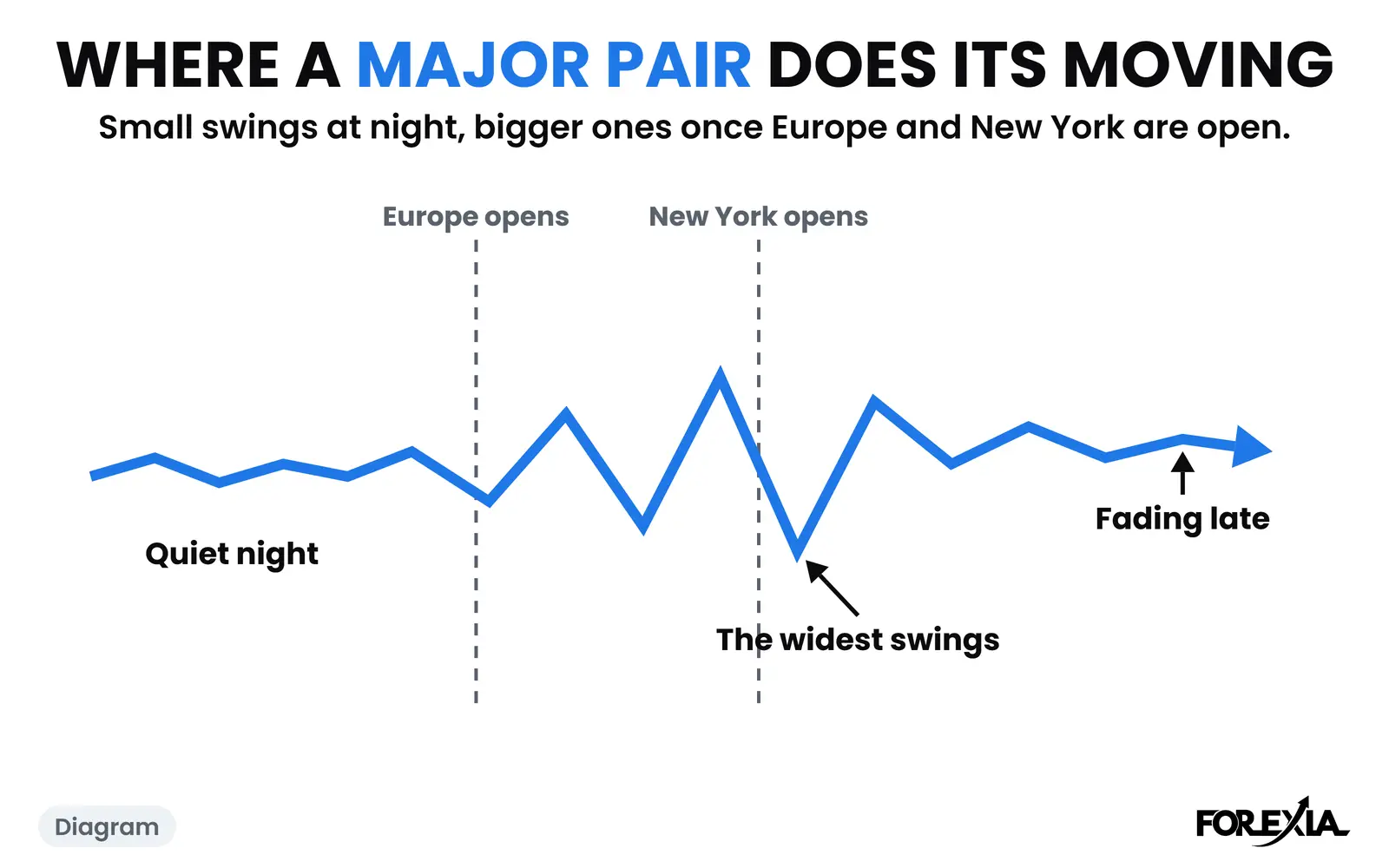
- The busiest block is 08:00 to 11:00 New York, with medians of 13.1, 14.1 and 14.8 pips, and 12.1 at 11:00. That is when the US figures arrive, at 08:30 and 10:00 on New York's own clock.
- London's first hours already move. The 03:00 hour, London's open, had a median of 12.3, and the hour before it 10.9. By then the continent is at its desks and its own releases are out.
- There is a dip in the middle. From 05:00 to 07:00 New York the median sat between 9.2 and 11.2 pips, below both sides of it.
- The evening is quiet. From 13:00 New York the median slid from 8.3 to 5.8 at 16:00, and the 18:00 and 19:00 hours, just after the break, were the quietest of all.
Our hub's table by window says the same thing in blocks: over the four hours of the London and New York overlap EUR/USD's median range was 29.2 pips, against 22.8 over Asia's ten hours, 23.5 over London alone's five and 18.7 over New York's last five. The windows are different lengths, so read that as a ranking and not a rate.
When does EUR/USD print its high and low of the day?
Not always when it moves most. Of the 129 days, the day's high first printed in the 08:00 New York hour on 12 days, in the 10:00 hour on 11 and in the 09:00 hour on 9. By window it was 44 days in Asia, 21 in London alone, 40 in the overlap and 24 in the rest of New York. The low was 44, 16, 32 and 37.
So the busiest hours do not hold the day's extremes by default. Asia held as many of EUR/USD's highs and lows as any other window, because ten hours is a long time, even though it moved least per hour. That is the part of the market the Asian session strategy is about.
A busy London hour: EUR/USD, 21 May 2026
On Thursday 21 May the Asian range was 20 pips, from 1.16155 to 1.16352. London opened at 03:00 and the first candle that mattered was the 03:15. Euro-area purchasing managers' indexes sat on our calendar at 03:15 (medium impact) and at 03:30 and 04:00 (high). The 03:15 candle fell to 1.15938, and the 04:15 candle took price to 1.16353, the day's high. The 03:00 hour ranged 27 pips against a median of 12.3, and the day's low, 1.15763, came at 09:30.
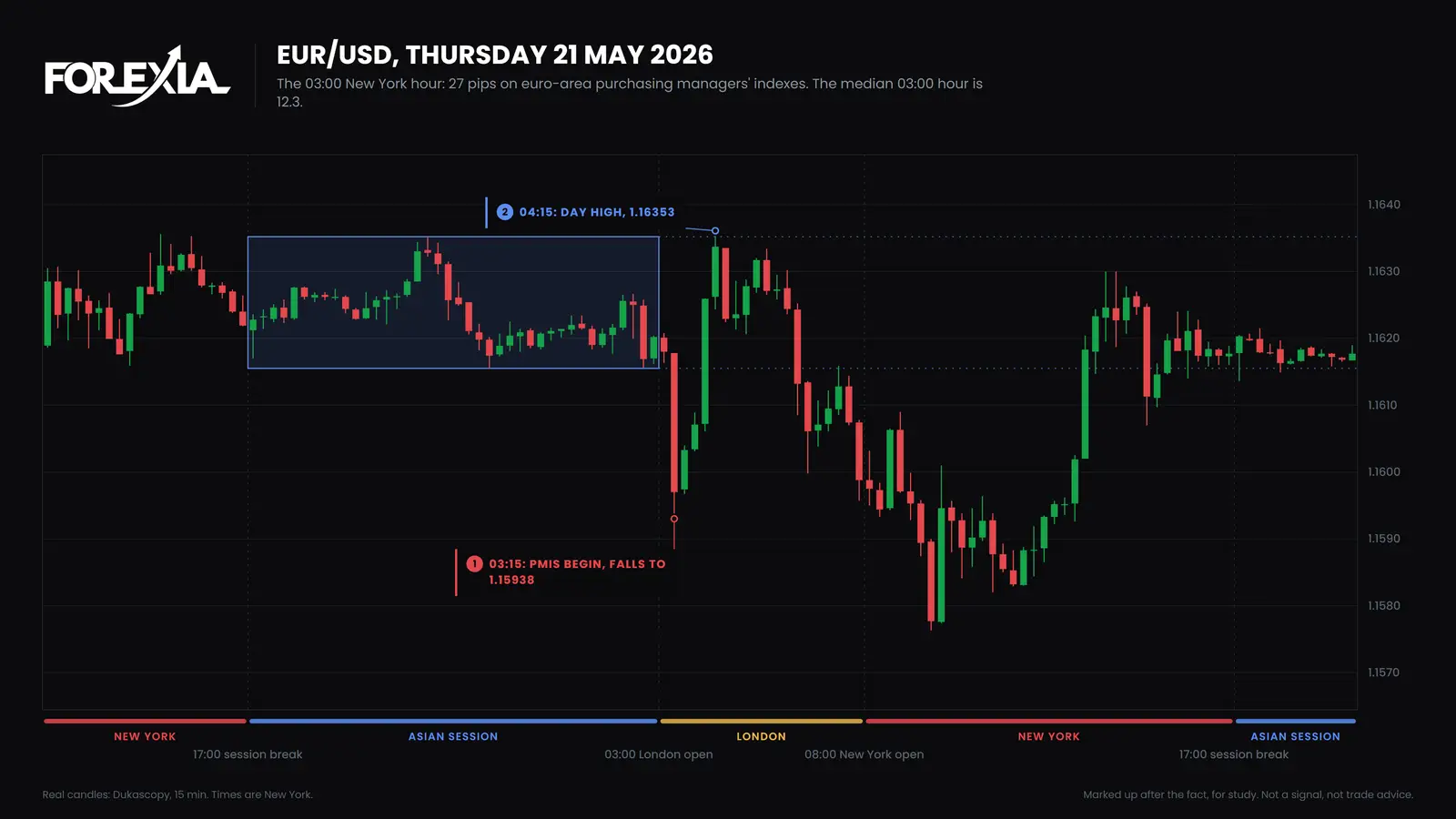
London's first hour is not always like this. It is like this when something is scheduled, and the table's median says that most of the time nothing is.
A busy New York hour: EUR/USD, 28 August 2026
Friday 28 August had a 13-pip Asian range, 1.16424 to 1.16553. The Fed's chair spoke at 10:00 New York, a high-impact item on our calendar, and the 10:00 candle ran from 1.16589 to 1.16102. The hour's range was 64.5 pips, against a median of 14.8. Price reached its day's low, 1.15777, at 14:45.
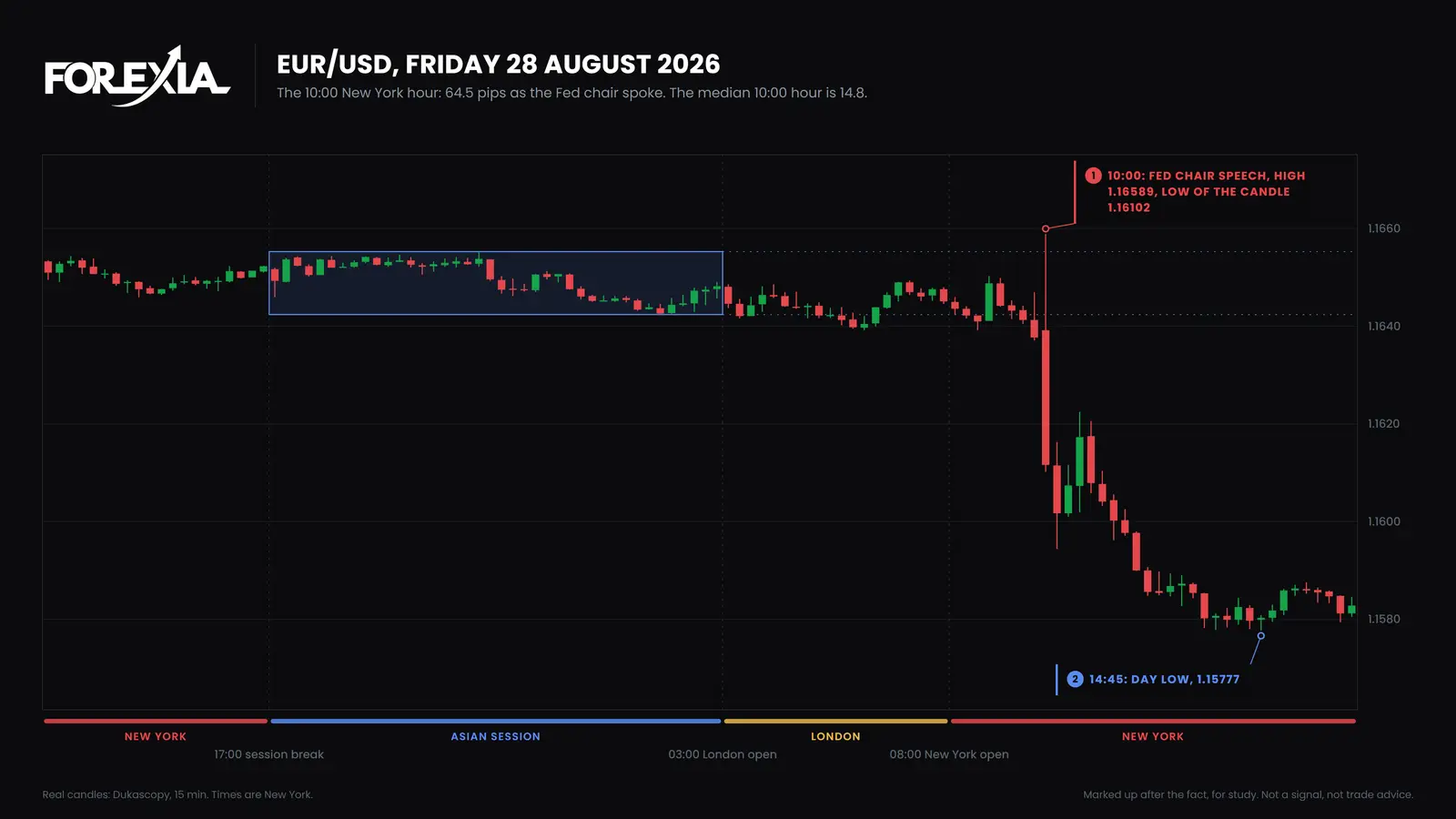
A median is about the usual hour. These two hours are what the tails look like, and the table's busiest hours are busy partly because of days like them. If you trade near a scheduled release, the median is the wrong number to plan with.
What does this not tell you?
It does not tell you what a trade in any of those hours would have made. The counts are of ranges, from candles, with no entry, stop or cost. They do not include spreads, which are usually said to be tightest in the overlap, because our feed is bid prices only. They come from 129 market-days in one setting of the clocks, with New York and London both on summer time. In the weeks the two are out of step, London opens at 04:00 New York.
Range is not profit. Our own test of the setup as a fixed rule lost money in London and in New York alike, and a reversal seen afterwards is not a setup. You may also read that more than half of all forex volume trades in the overlap. We could not find a primary source for it.
Three seats read the same table differently. Retail reads "busiest" as "best". The market maker's seat is the one nobody outside can see, and we do not claim to know what it does at 10:00. The observer reads the table as a ranking of where price travelled. The Three Seats explains how we use them.
Which hours suit which question?
It depends on what you want from the market, and the table gives a different answer for each.
- If you want movement: 08:00 to 11:00 New York.
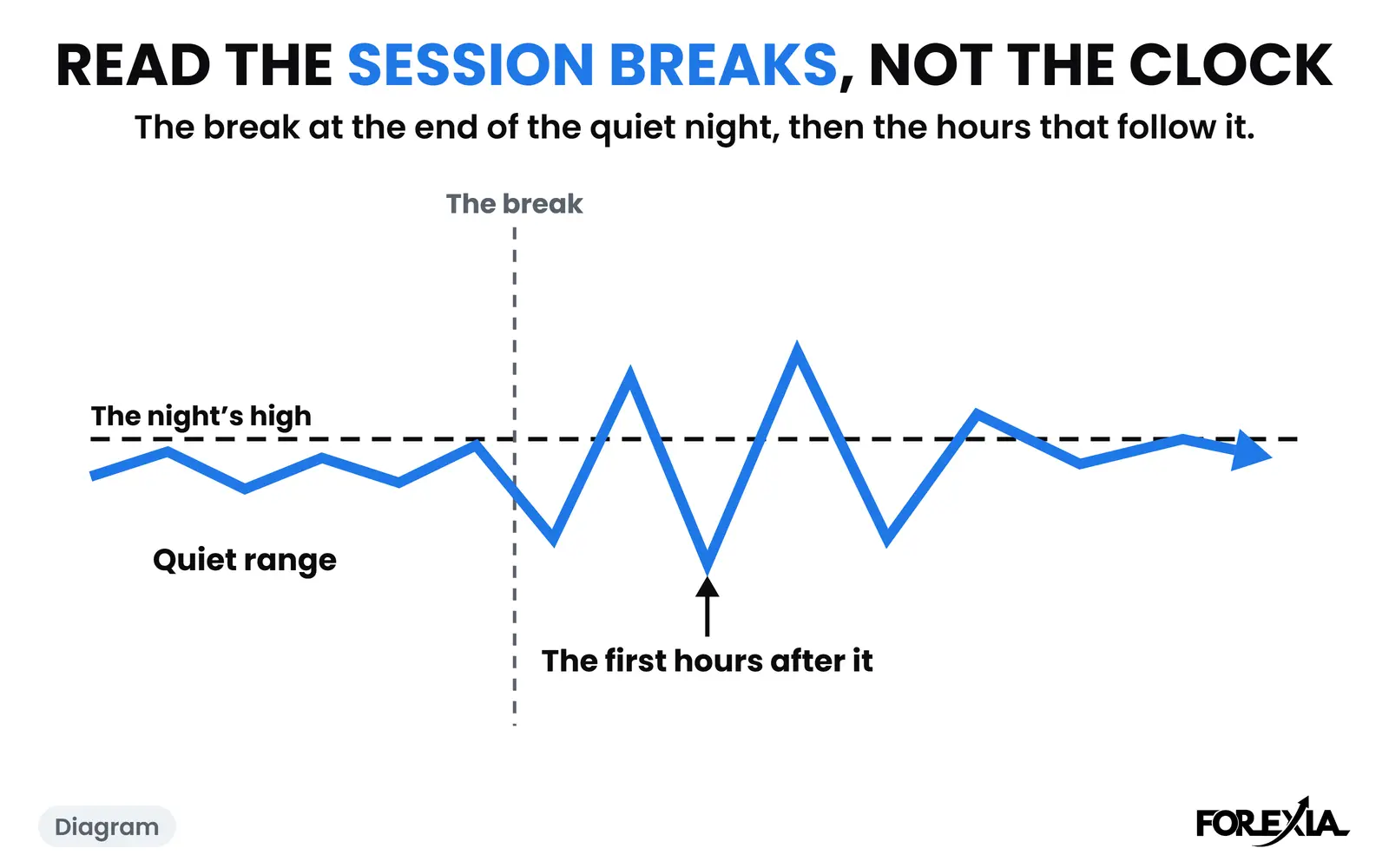
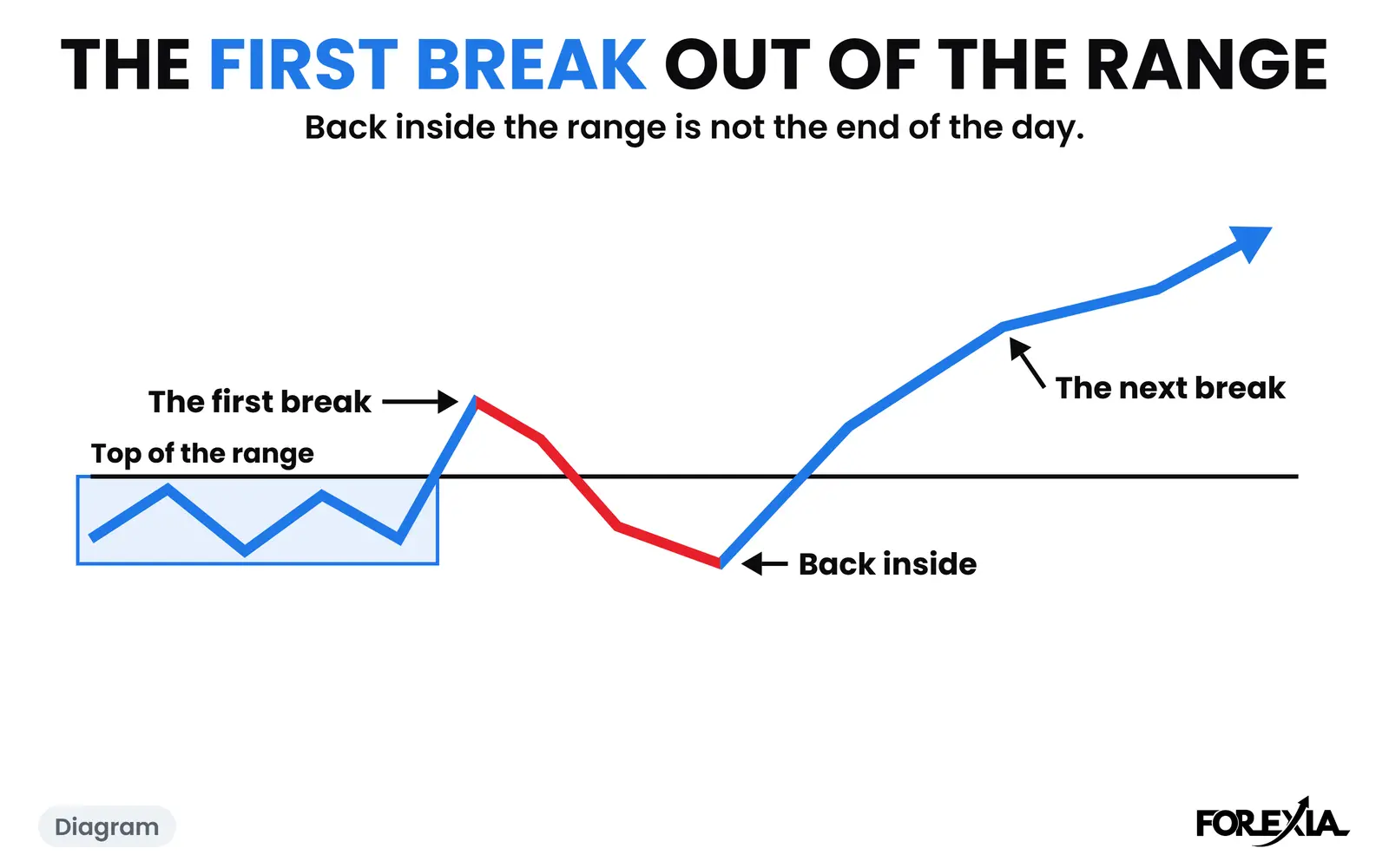
- If you want to see the night's range before the crowd reaches it: the hours before London's open, then the London Breakout, our name for the first close out of that range.
- If you want the New York turn: the 08:00 hour onward, where the New York Reversal is counted.
- If you want quiet: from 16:00 New York to the break, and the first hours of the new day.
For a pair with a second home in Tokyo, see the best time to trade USD/JPY, and for what the week's first hours do, the Sunday open.
Common mistakes
Two mistakes cost the most with this question.
- Using one clock all year. The table is in New York and London time. Your platform's server time may be two or three hours off New York, and the UTC hours move when the clocks do.
- Planning with the median on a release day. The 10:00 median is 14.8 pips and the 28 August hour was 64.5.
Course 2 of ForexiaPRO, The Chaos Pattern, teaches how a day moves from its quiet night to its New York hours, starting with lesson 2.2 and lesson 2.4.1, The New York Reversal.
Frequently asked questions
What is the best time to trade EUR/USD?
For movement, 08:00 to 11:00 New York time, which is 13:00 to 16:00 London. On 129 market-days from 6 April to 1 October 2026 the median range of EUR/USD in the 10:00 New York hour was 14.8 pips, the largest of the 24 hours. The 03:00 hour, London's first, came fourth at 12.3. More movement is not more profit, and spreads were not counted.
What is the best session to trade EUR/USD?
The London and New York overlap moved most. EUR/USD's median range was 29.2 pips over the four hours of the overlap, against 22.8 over Asia's ten, 23.5 over London alone's five and 18.7 over New York's last five. The windows differ in length, so read it as a ranking.
What are the quietest hours for EUR/USD?
The 18:00 and 19:00 New York hours, at a median of 4.9 pips each, the second and third hours after the day's 17:00 break. Midnight and the last hour of New York trading were also quiet, at 5.4 and 5.8.
Do EUR/USD trading hours change in winter?
The hours do not change in New York's or London's own time, but the UTC hours move when the clocks do, and for two to three weeks a year London opens at 04:00 New York instead of 03:00. Our figures come from one setting of the clocks, with New York and London both on summer time.