NFP Spread Widening and Slippage: What One Minute Does on Real Fridays
Dylan Forexia7 min read
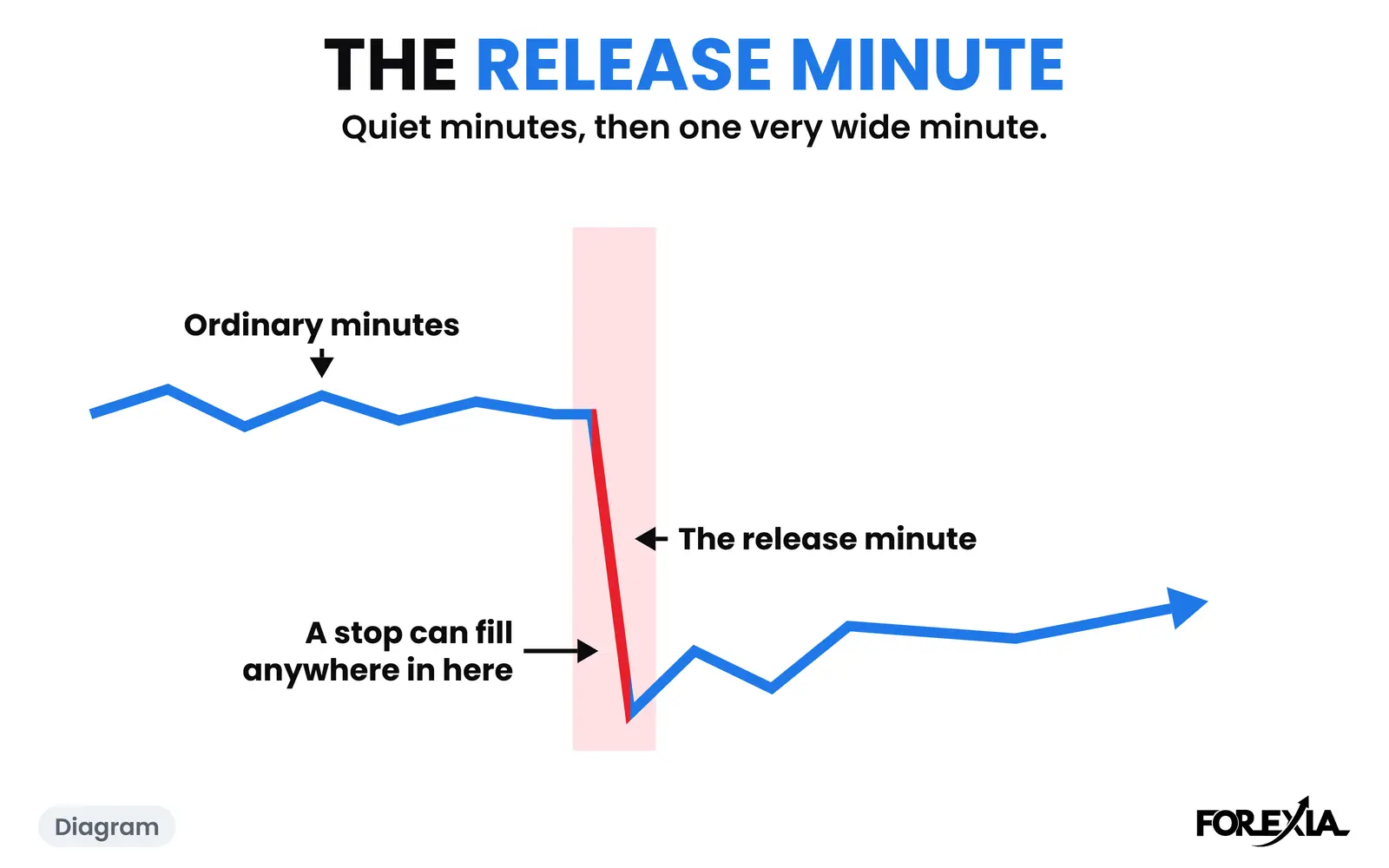
NFP spread widening is real, and a chart cannot show it. Our candles are drawn from the bid alone, so we have no spread to report. What they do show is how far price travels in one minute, and on the jobs report that is 11 to 34 times an ordinary minute on EUR/USD. That is the room a stop or market order has to fill badly in.
NFP is nonfarm payrolls, the headline of the US Employment Situation report, out at 08:30 New York. All times are New York, a candle is named by the time it opens, and on gold we count $1 as 1 pip. The wider picture of the release is in news trading.
Can NFP spread widening be measured? What we can and cannot see
We can measure the range of each one-minute candle, high to low. We cannot measure the spread, the gap between what you pay and what you receive, because the feed is the bid only. A short position's stop is a buy that fills at the ask, so it can fire on a price the chart never drew.
Published figures for the spread itself disagree by a wide margin. Broker pages quote anything from under one pip for under half a minute to tens of pips for a minute or two, nearly always with no date, broker or sample. We quote none of them. Your own broker's history of past releases is the only number that applies to you.
The range of the minute is a different thing and it is ours. It is how far apart the minute's two ends were, so it is the room an order had to be filled away from the price you last saw. It is not a measure of any fill.
How wide was the release minute on five real Fridays?
We took the five jobs reports from 8 May to 4 September 2026 on EUR/USD, and the other markets where we hold the one-minute candles. For each, the 08:30 minute's range against the median range of the 30 minutes from 08:00 to 08:29.
| Friday | Market | Median minute, 08:00 to 08:29 | The 08:30 minute | Times wider |
|---|---|---|---|---|
| 8 May | EUR/USD | 1.2 pips | 13.0 pips | 11 |
| 5 June | EUR/USD | 1.1 pips | 19.3 pips | 18 |
| 2 July (Thursday) | EUR/USD | 1.6 pips | 41.8 pips | 26 |
| 7 August | EUR/USD | 1.2 pips | 41.3 pips | 34 |
| 4 September | EUR/USD | 1.2 pips | 38.8 pips | 32 |
| 5 June | GBP/USD | 1.3 pips | 22.8 pips | 18 |
| 4 September | GBP/USD | 1.8 pips | 50.6 pips | 28 |
| 7 August | USD/JPY | 1.9 pips | 81.3 pips | 43 |
| 4 September | Gold | 2.3 pips | 82.2 pips | 35 |
The jobs report is not always on a Friday: 2 July was a Thursday, so take the date from the official schedule. The multiples are rounded to the nearest whole number.
On eight of the nine market-mornings the 08:30 minute was the widest of the first fifteen. The count is in scripts/seo-counts.mjs as newsMoves.nfpMinute. It is nine market-mornings on one feed, and the markets move together on one dollar, so they are not nine independent tests.
What did that look like on one morning? USD/JPY, 7 August 2026
The widest we hold is the yen on 7 August. Before 08:30 its minutes ranged a median of 1.9 pips. Price stood at 158.340, inside a 36-pip Asian Box. Our calendar also has Canada's employment figures in the same minute, so the dollar was not the only thing printing.
- 08:30. The first minute ran 81.3 pips down, from 158.340 to 157.529.
- 08:31 and 08:32. A pause: 10.3 and 7.9 pips.
- 08:33. 19.9 pips, to 157.538.
- 08:34. The widest minute of the morning, 87.8 pips, from 157.538 to 156.669. That is the low of the day, 89 pips under Thursday's low of 157.558.
- 08:35. 37.2 pips back up.
Four of the first fifteen minutes ranged at least ten times the ordinary minute. The 15-minute candle that held all of this ran 167.3 pips, from 158.340 to 156.669, and closed at 157.259.
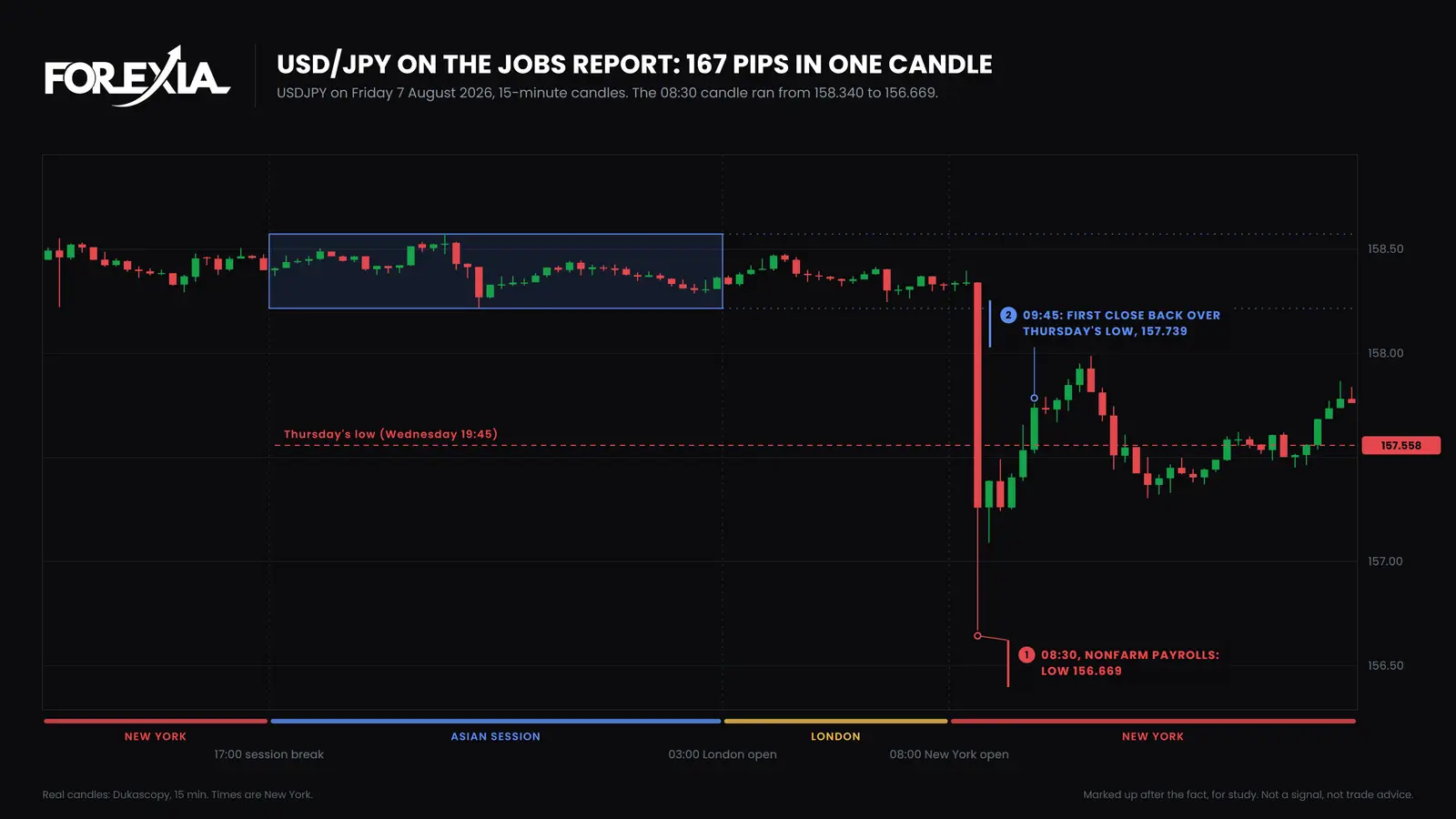
A stop sitting under the market that morning had a hole of 89 pips past Thursday's low to fall into, and the candle's low was printed in the fifth minute, not the first. We cannot know what any real order got. We can say the minute left room for a fill 88 pips from where the minute began.
By 09:45 the candle that closed back over Thursday's low was in. A day like this is a hunt only in hindsight, and it is not a setup. The day ended at 157.761 with the low still the low.
What does the minute do to each kind of order?
Our read, with a limit: an order meets the minute differently by type, and the minute's range is the same for all of them. The stop hunt hub covers how stops rest past levels, and the news trading hub has the order-by-order table. Here is the short version.
- A market order fills at the next quote, which in a minute like 08:34 can be a long way from the last one you saw.
- A stop-loss becomes a market order once it triggers. It is not a promise of its price unless your broker sells it as one.
- A limit order fills at its price or better, or not at all. It fills because price is running through it.
In our own fixed-rule test of fading hunts on a release, fills had the real spread and no extra slippage. Real fills would be worse, and the page on that test says so. How to trade CPI and what price does before the FOMC decision show the same effect on other releases.
What did each seat see?
The Three Seats read the minute three ways.
- Retail sees a price and a stop. The stop was placed for a normal minute, and the minute was 40 times that.
- The market maker, as we read it, sees a thin book and a known time. Quotes widen because holding inventory through the number is risky. That is News-Induced Liquidity, and no chart we hold can show it.
- The observer sees the range. The minute's two ends were 81 and 88 pips apart on the same candle. That is a fact of the prices and says nothing about who was on the other side.
What should a trader take from it?
Read the minute as a size, not a direction. A stop distance chosen for the quiet minutes before the report is a different thing from the same distance inside the release minute. On 7 August any stop sized for the quiet minutes sat inside a candle that travelled 167 pips, and inside a single minute that travelled 88.
Two questions are worth asking before any release, and neither needs a forecast. How far could this position be from its stop's price if the fill came late? And does the broker publish its fills for past releases? Neither this page nor our data answers them for you.
Counting what the minute did on other releases is the next step: the 08:30 candle on CPI mornings is smaller, and what price does before the FOMC decision takes the Fed's two known minutes. The average NFP move by pair gives the 15-minute figures for every market we count.
What this does not tell you
It does not give the spread. It does not give a fill. It covers nine market-mornings on one feed. The EUR/USD figures come from five reports, and the yen, the pound and gold are one or two mornings each. It cannot say whether a given broker's quotes were wider or narrower than the bid we see. On NFP has the 15-minute view of each Friday, and the trap candle looks at the first candle from the wrong side.
Course 2 of ForexiaPRO, The Chaos Pattern, teaches this read step by step in lesson 2.3.3, NFP, CPI, FOMC: One Read, Three Calendars.
Frequently asked questions
How much do spreads widen during NFP?
We cannot say from our data, because our candles are drawn from the bid alone and carry no spread. Published figures disagree by a wide margin: some broker pages quote tens of pips for a minute or two, others under one pip for under half a minute. What we can measure is how far one minute travels. On EUR/USD the 08:30 minute ranged 13 to 42 pips on five jobs Fridays in 2026, against about 1 pip in an ordinary minute before it.
What is slippage on NFP?
Slippage is the gap between the price you asked for and the price you got. A stop becomes a market order once it triggers, so in a minute that ranges 40 or 80 pips it can fill far from its price. We cannot see fills, only the minute's range, which is the room the fill had.
Is the 08:30 minute always the widest?
On 8 of the 9 market-mornings we hold in one-minute candles, yes. The exception was USD/JPY on 7 August 2026, where the 08:34 minute ranged 88 pips against 81 for 08:30. Four of the first fifteen minutes that morning ranged at least ten times the ordinary minute.
Should you hold a trade through NFP?
This page does not advise it either way. It shows that the distance between a stop and the market can be crossed inside one minute, so the loss on a position held through the release can be larger than the stop distance suggests. Your broker's fill record for past releases says more about your own cost than any figure here.