Stop Too Tight or Stop Hunt? A 3-Step Check for Your Last Loss
Dylan Forexia8 min read
Stop too tight or stop hunt? Three checks on your last losing trade answer it. Was the stop just past an obvious high or low? Was it closer than the market's normal swing? Did a candle close back past the level after it fired? Together they tell you whether you were in the pile, in the noise, or simply wrong.
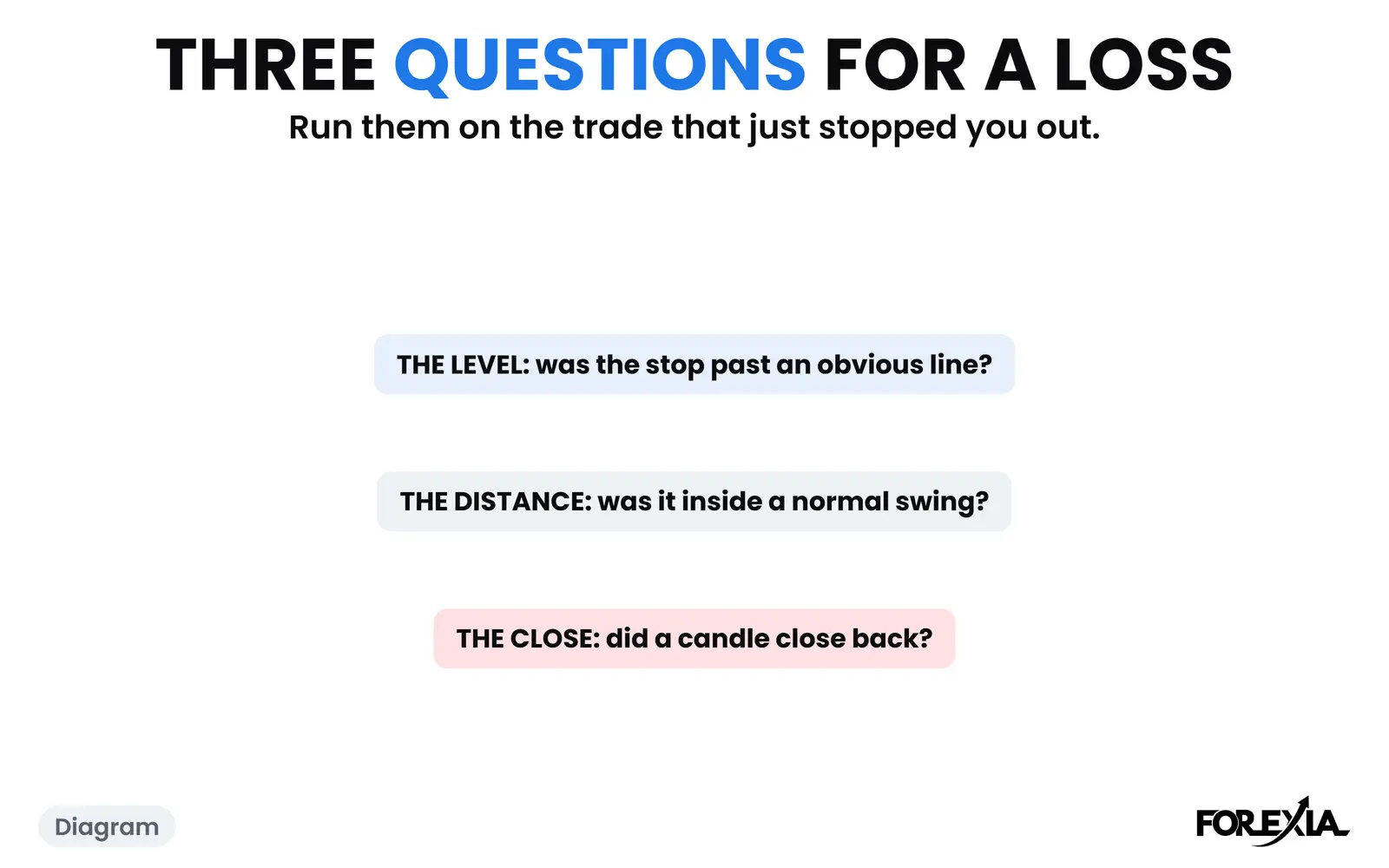
A stop that goes by a few pips, with price then running your way, leaves two stories. One is "I was hunted". The other is "my stop was too tight". Neither is a good answer on its own, and both are comfortable. Here is a way to sort them using the candles, and not the feeling. It can show you a hunt on a chart only as our read, which is why we write "we read this as".
First, was it the market or your broker?
A stop can also fire on a price that only your broker showed. Before the three checks, compare the candle that took you with a second feed at the same minute. If only your broker printed it, it is a question for the broker, and whether brokers hunt stops has the test. If both feeds printed it, the market went there, and the checks below apply.
Check one: was the stop past an obvious level?
If it sat just beyond an obvious high or low, it was in the pile. Those levels are the edge of the Asian range, the previous day's high or low, last week's, and two or more touches at one price. What counts as an obvious high or low goes through which ones qualify.
This is the question that decides whether the word hunt is on the table at all. A stop with no level anywhere near it was not in a pile. It may have been unlucky or too tight, but nobody was going to it. We read a stop in the pile from the market maker's seat: orders past an obvious level are where a large order finds the other side, and The Stop Hunt is the name for the move that collects them.
Check two: was the stop closer than the market's normal swing?
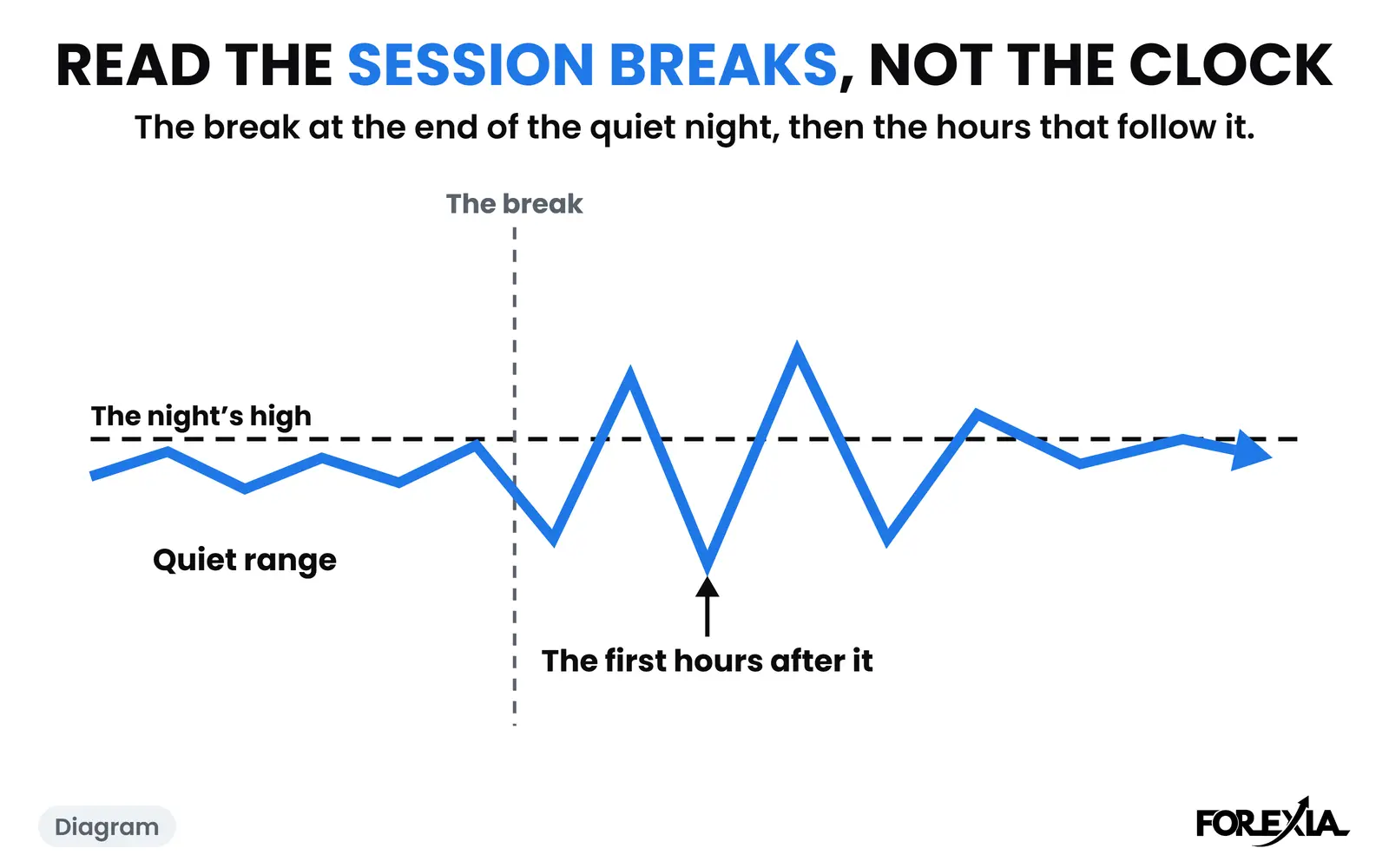
If it was, the market could have reached it without any level being involved. We use the overnight range as a yardstick, because it is the calm part of the day. On our eight markets from 6 April to 1 October 2026 the median Asian range was about 23 pips on EUR/USD, 30 on GBP/USD, 41 on USD/JPY and 54 on gold. The median hunt past a level, on the levels that closed back, ran far less: about 4 to 7 pips on most majors.
| Market | Median overnight range, pips | Median hunt past a level, pips |
|---|---|---|
| EUR/USD | 22.8 | 6.5 |
| GBP/USD | 30.4 | 7.3 |
| USD/JPY | 41.2 | 7.4 |
| USD/CHF | 23.8 | 4.1 |
| AUD/USD | 25 | 4.6 |
| USD/CAD | 23.2 | 5.7 |
| NZD/USD | 26.1 | 4.3 |
| Gold | 53.6 | 10.1 |
The overnight range is the Asian range from the 17:00 New York session break to the 03:00 London open. A hunt counts here when price went past a level by at least 3% of the average daily range after the London open and a candle closed back by 17:00. Pips on gold are dollars.
Look at your own stop against those figures. A stop only a few pips from entry sits inside an ordinary overnight swing, and also inside an ordinary 15-minute candle. On GBP/USD on 28 July 2026 the 11:00 New York candle ran 17 pips from 1.32882 to 1.33050, on a day with no release for either currency near it. We do not tell you where to put a stop, because the data below shows no single distance works. We tell you how to read what happened.
Check three: what did the close do?
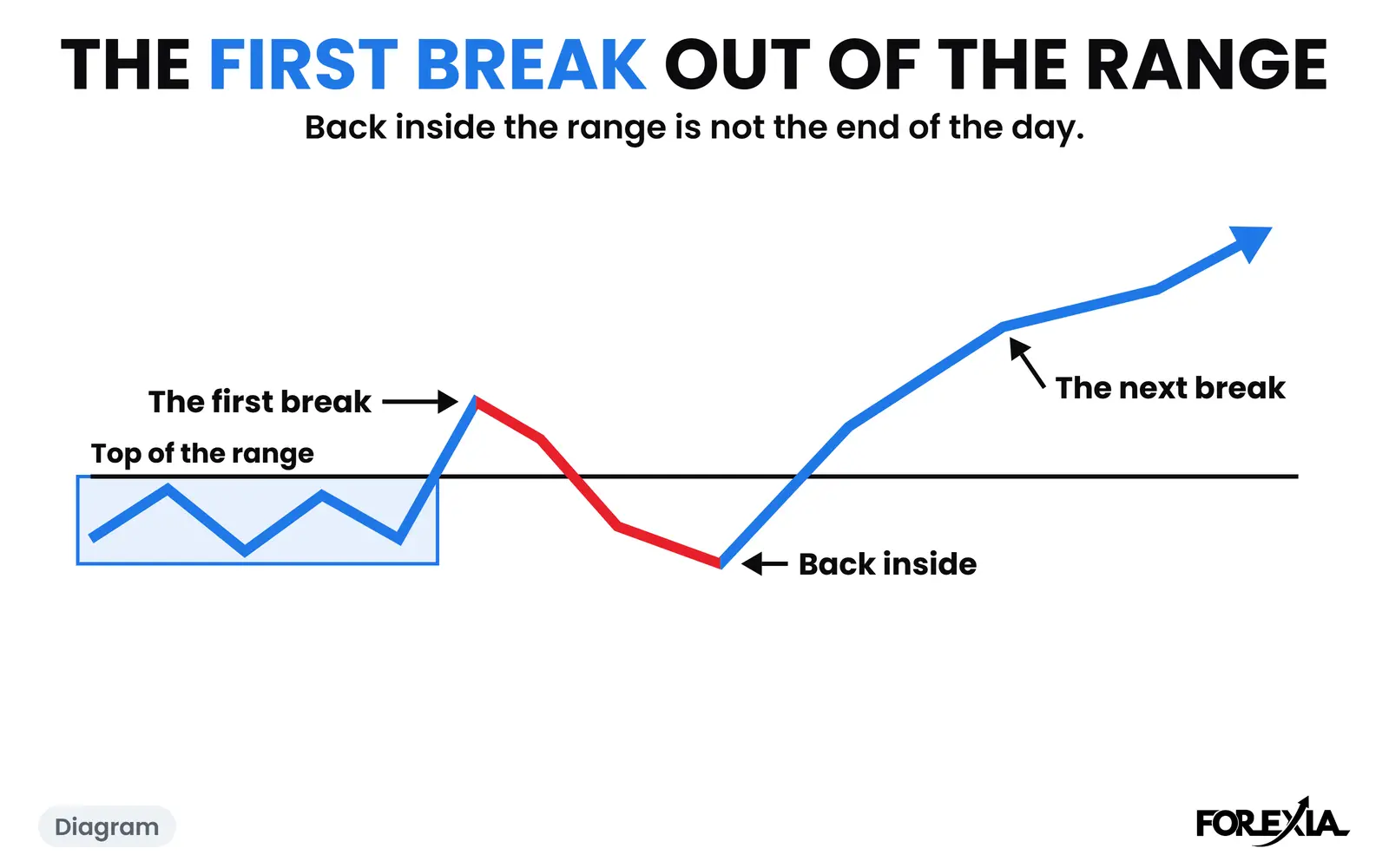
Did a candle close back past the level after your stop fired? The Close Back is the test. If a candle closed back, price went through the level, took what was there and came back, which is what we read as a hunt. If none did, price went through and stayed, and the stop did its job: it saved you the rest of the move. The close back can come late, as the next day shows.
What does a hunted stop look like? GBP/USD, 28 July 2026
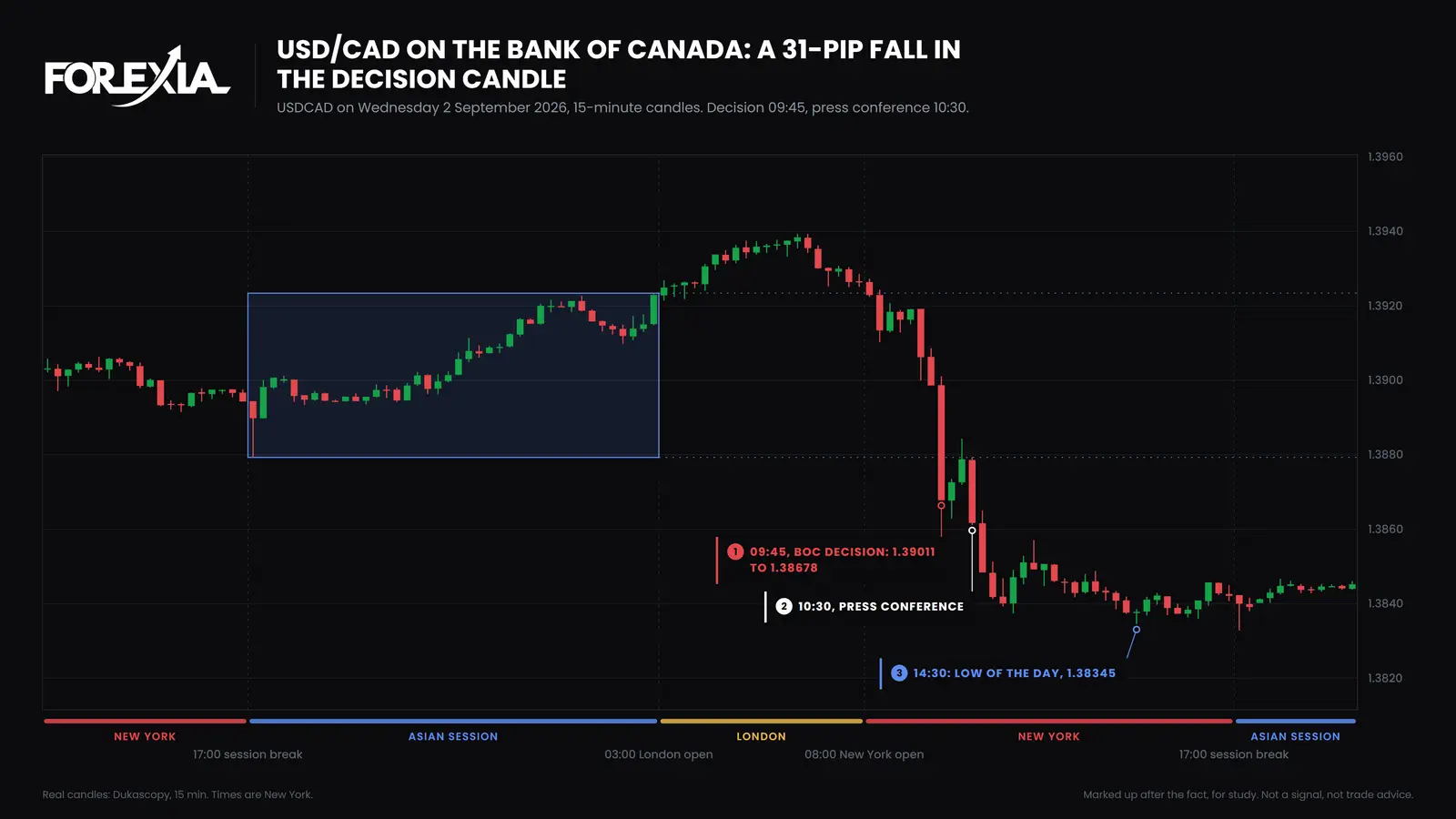
On Tuesday 28 July 2026, GBP/USD left a 19-pip Asian range between 1.32851 and 1.33041. Monday's low sat close by, at 1.32842, so two lines were one pile of buyers' stops. London took the Asian low at 05:45, and the 06:15 candle reached 1.32733, 12 pips past the Asian low and 11 through Monday's low.
A stop just under those lines was inside that candle's reach. The candles then closed under the Asian low for more than two hours. The first close back came at 08:00, at 1.32854, three tenths of a pip over the line. By 11:45 price was at 1.33110, 38 pips off the low. Our calendar shows no sterling or dollar release near it. Times are New York, and the candles are 15-minute Dukascopy, so your broker's chart may differ by a pip or so.
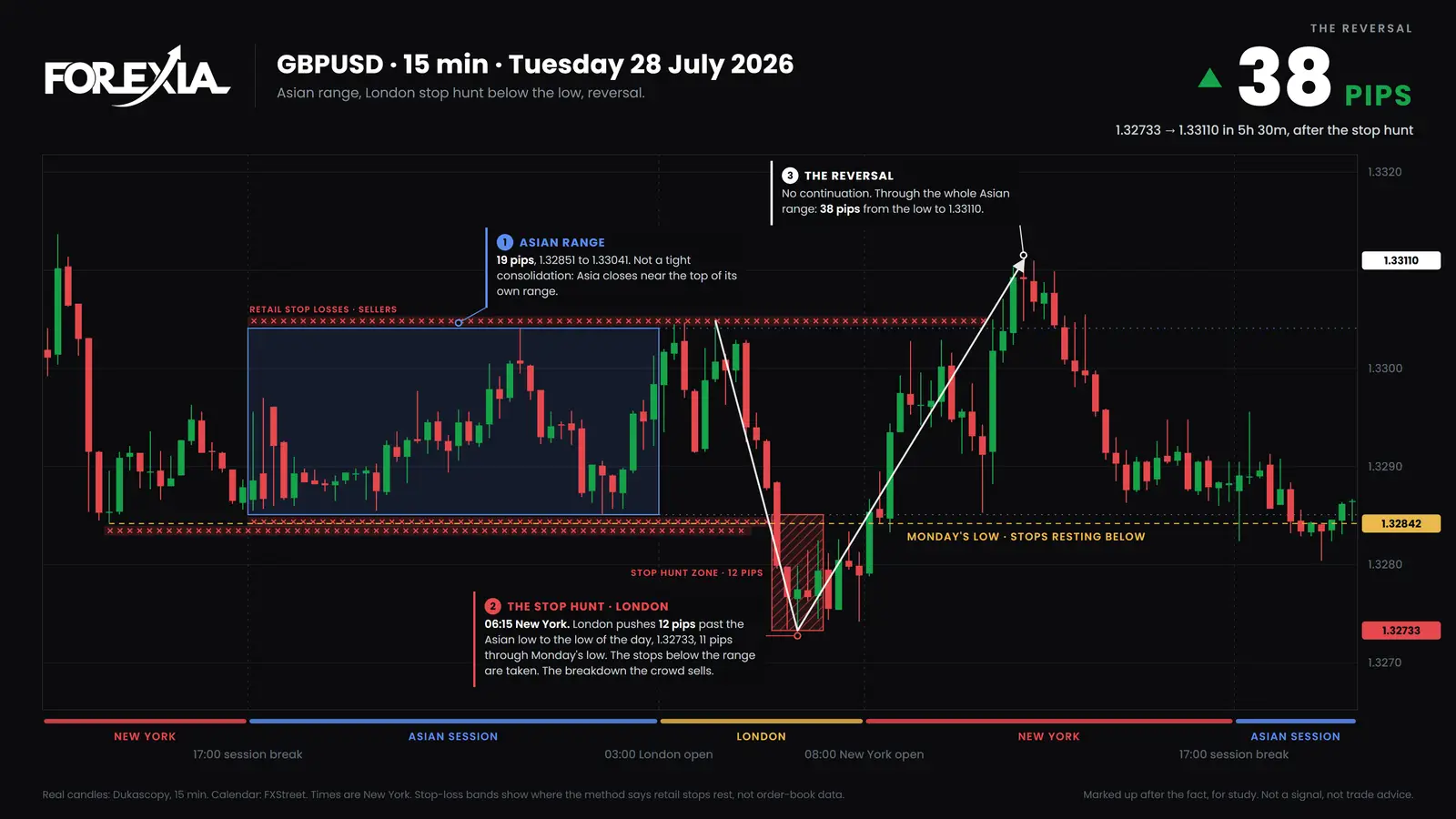
Run the three checks on a stop there. It was in the pile. Whether it was too tight depends on its distance from entry. And a close back did come, an hour and three quarters after the low and by a hair. A trader who read the first close back as the end of the move would have waited two hours for it.
What does a stop that did its job look like? GBP/USD, 16 September 2026
On Wednesday 16 September 2026, GBP/USD had an Asian low of 1.34651. The 07:00 candle ran to 1.34586, 6 pips under, and closed at 1.34618. No candle closed back over 1.34651 for the rest of the day. That day had releases: UK inflation at 02:00, US retail sales at 08:30, and the Fed's rate decision at 14:00. The 14:00 candle ran from 1.34494 down to 1.34100, and the low of the day was 1.33721 at 15:15, 93 pips under the Asian low.
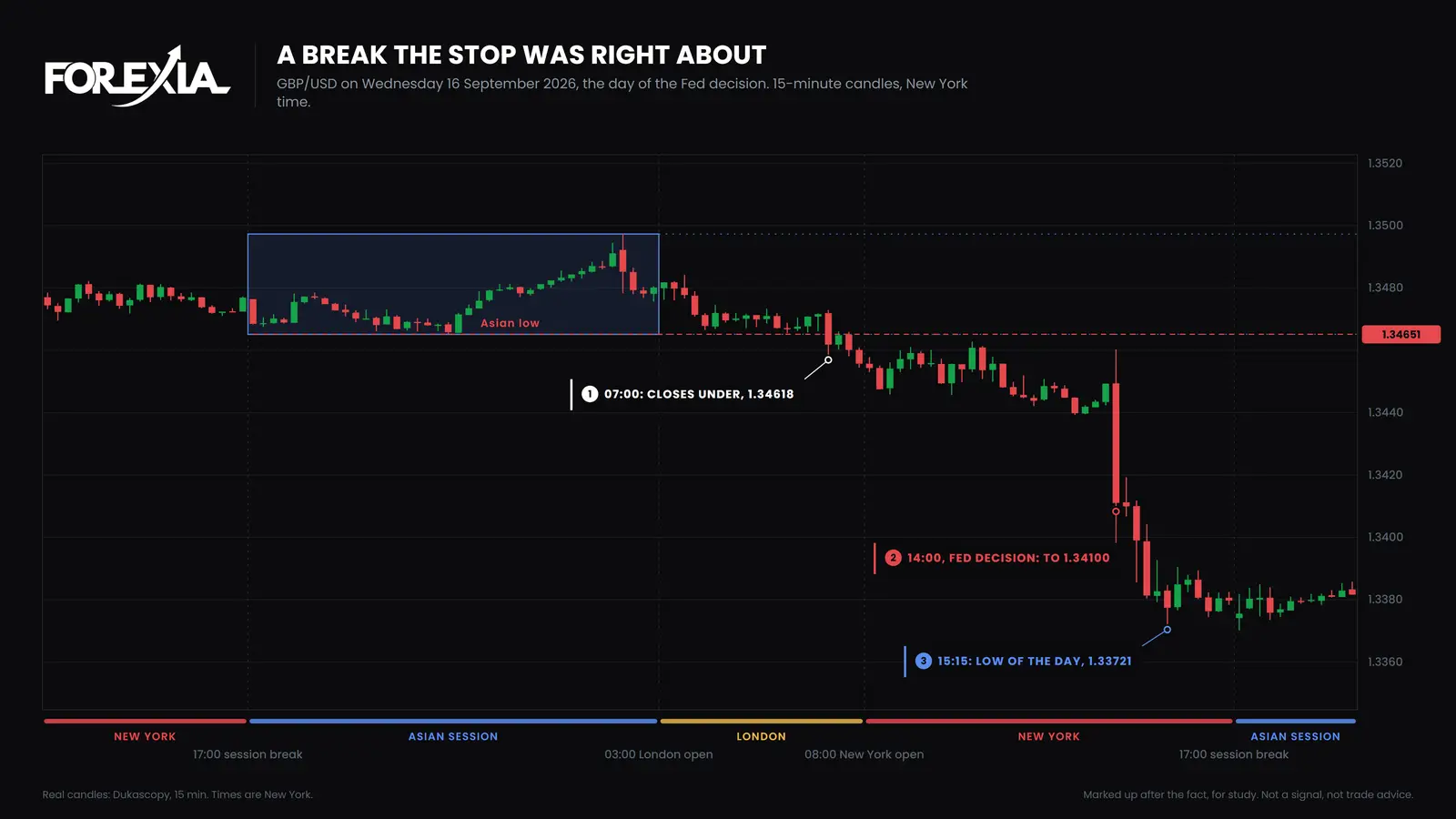
Here a stop under the Asian low was in the pile too, and it fired. But nobody who held a long through that low was hunted. The close back never came. Their stop took them out of a move that ran 93 pips. A stop at a typical hunt's depth would also have been taken, and it would have done what a stop is for.
Stop too tight or stop hunt: which was it? Four outcomes
The three checks give four readings, and you can reach each from the candles.
| In the pile? | A close back? | Read |
|---|---|---|
| Yes | Yes | Hunted, by our read. The level and the close agree |
| Yes | No | The stop did its job. The break stayed |
| No | Yes | Unlucky, or the idea was wrong. There was no pile to hunt |
| No | No | Too tight, or wrong. Price moved through, nobody was going there |
A fifth reading sits across the grid: a stop inside the normal swing can be in the pile and in the noise at once. The checks cannot say which did more, and they do not need to. They tell you what to change next time, which is less the label than the habit. Why price hits your stop and then reverses takes the first row in full, why breakouts fail the break that stayed, and the bull trap and its mirror who gets caught on the other side. For the wider picture, start at the hub on stop hunting in forex.
What this does not tell you
The check works on one trade at a time and it uses hindsight. We picked the two days because they showed the two outcomes, and they are examples and not a sample. The yardsticks are medians over six months on eight markets, and your market on your day may differ.
Nor does a hunted stop mean you were right. Traded against each flagged hunt on seven dollar majors and gold, our own fixed rule lost money after costs in every year from 2021 to 2026, between -0.10R and -0.23R a trade, where R is the amount risked on one trade. That test cannot see order flow, so it says nothing about who moved a candle.
Course 3 of ForexiaPRO, Reverse Price Action, teaches what proves a trade wrong, step by step, from lesson 3.3.
Frequently asked questions
How do I know if my stop was too tight or hunted?
Ask three things in order. Was the stop just past an obvious high or low, where everyone else's sits? Was it closer than the market's normal swing? Did a candle close back past the level after it fired? Past an obvious level and closed back reads as hunted. Inside the normal swing with no level near reads as too tight. No close back means the stop did its job.
What is a stop that is too tight?
One that sits inside the ordinary movement of the market, so a normal candle reaches it. As a yardstick, the median overnight range in our count runs from about 23 pips on EUR/USD to 30 on GBP/USD and 41 on USD/JPY. A stop a few pips from entry sits well inside that, and noise alone will take it.
Can a stop be both too tight and hunted?
Yes. A stop a few pips from entry that also sits just past an obvious level is in the pile and in the noise at once. The check cannot say which did more of the work, and it does not need to. It says what to look at next time: the level, and the room.
How far past a level does a hunt usually go?
On the levels in our count that closed back, the median trip past the line was between about 4 pips on USD/CHF and 10 on gold, and a quarter ran past roughly 7 to 15 pips depending on the market. The levels that never closed back ran a median of about 65% of the daily range. Depth alone does not separate them.
Does a stop that was hunted mean I was right about the trade?
Not necessarily. A stop that sat in the pile and a read that was right can both be true, but so can a stop in the pile and a read that was wrong. The close back is a fact about the candle. Whether your idea was right is a separate question, and the close back does not answer it.